


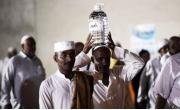
Departing Haj pilgrims face cap on Zam Zam water

October 14, 2014

zamzamJeddah, Oct 14: Pilgrims returning home after completing the Haj pilgrimage are becoming increasingly resentful of the five-liter cap on Zam Zam water imposed by the authorities.

With the demand for the precious water surging as pilgrims return home, the authorities have moved to increase the supplies of Zam Zam in Jeddah and Madinah.While in Makkah, pilgrims have access to plentiful supplies of Zam Zam.

However, the long tradition of carrying Zam Zam water home following the Haj may well be on its way to becoming a memory as now almost all pilgrims are only allowed to carry a five-liter container with them which they are given at the check in counters at the airports. Moreover, this facility is limited to those pilgrims who have performed the Haj under government schemes.

However, individual pilgrims who came through private Haj operators are also allowed to take the same quantity of Zam Zam upon their return home.

Saeed Musfer Al-Wadi, director of the King Abdullah Project for Zam Zam of the National Water Company told Arab News: “Zam Zam water is being packed according to norms set by the civil aviation authorities in view of the carriage space in aircrafts.” He added that, “We are exclusively packing five-liter cans for returning pilgrims as advised by the civil aviation authorities.”

He said that the King Abdullah Project for Zam Zam produced over 78 million water bottles during the current Haj season.

Al-Wadi also said that, “We have prepared well in advance to serve pilgrims by raising our production and both production and packing is being done according to world standards of excellence.” He added that they had established ten selling points at the airports for the sale of five-liter cans of Zam Zam water.

While pilgrims welcomed the change, they were disappointed at the five-liter cap imposed on the volume of Zam Zam water.

“Every pilgrim wishes to take as much as Zam Zam as he can, but since authorities have ruled that they can only take a five-liter can, we have to abide by the ruling,” Indonesian Religious Minister Lukman Hakim Saifuddin told Arab News earlier.

Egyptian pilgrim Rashad Fahmi said: “We thank the authorities for gifting the Zam Zam water upon our return home, but a mere five-liter can is insufficient for my family let alone the numerous visitors and relatives who will come to welcome me after the Haj pilgrimage.” He added that this was the only unique gift he could present back home.

“Zam Zam is a significant part of our journey of a life time,” said Indian pilgrim Abdul Hameed, referring to the pilgrimage, “but a five-liter can is really disappointing,” he concluded.

Comments

Add new comment

  • Coastaldigest.com reserves the right to delete or block any comments.
  • Coastaldigset.com is not responsible for its readers’ comments.
  • Comments that are abusive, incendiary or irrelevant are strictly prohibited.
  • Please use a genuine email ID and provide your name to avoid reject.
News Network
July 20,2020

Abu Dhabi, Jul 20: The United Arab Emirates launched its first-ever interplanetary Hope Probe mission to Mars from Japan's Tanegashima Space Centre at 01:58 a.m. (local time) on Monday.

"United Arab Emirates (UAE) launches its first mission to Mars, the 'Hope Mars Mission' from Japan's Tanegashima Space Center," UAE Space Agency said on its Twitter page.

The spacecraft is expected to reach Mars orbit in about 200 days from now and then begin its mission to study the Red Planet's atmosphere, WAM news agency reported.

Once it enters Mars' orbit in the first quarter of 2021, the Hope probe will mark the UAE's 50th anniversary.

The probe will travel 493 million kilometres into space in a journey that will take seven months, and will orbit the Red Planet for one full Martian year of 687 days to provide the first truly global picture of the Martian atmosphere.

The Hope probe will be the first to study the Martian climate throughout daily and seasonal cycles. It will observe the weather phenomena on Mars such as the massive famous dust storms that have been known to engulf the Red Planet, as compared to the short and localised dust storms on Earth.

It will also examine the interaction between the upper and lower layers of the Martian atmosphere and causes of the Red Planet's surface corrosion, as well as study why Mars is losing its upper atmosphere.

Exploring connections between today's Martian weather and the ancient climate of the Red Planet will give deeper insights into the past and future of Earth as well as the potential of life on Mars and other distant planets.

The Hope Mars Mission is considered as the biggest strategic and scientific national initiative announced by UAE's President His Highness Sheikh Khalifa bin Zayed Al Nahyan and His Highness Sheikh Mohammed bin Rashid Al Maktoum in 2014. The UAE will be the first Arab nation to embark on a space mission to the Red Planet in a journey that contributes to the international science community as a service to human knowledge.

The interplanetary mission is the first by any West Asian, Arab or Muslim majority country.

Comments

Add new comment

  • Coastaldigest.com reserves the right to delete or block any comments.
  • Coastaldigset.com is not responsible for its readers’ comments.
  • Comments that are abusive, incendiary or irrelevant are strictly prohibited.
  • Please use a genuine email ID and provide your name to avoid reject.
Agencies
July 26,2020

Jeddah, Jul 26: The city of Makkah is opening its arms again to welcome pilgrims for the annual Hajj — although only a handful compared with previous years.

Because of the COVID-19 pandemic, this year’s event is limited to about 1,000 pilgrims, all from inside Saudi Arabia, about 700 of whom are expatriates.

Abdullah Al-Kathiri, an Emirati and a recovered COVID-19 patient, postponed his pilgrimage last year because it coincided with his wedding plans. “I’ve heard from many who’ve performed the pilgrimage in past years that it was always a smooth process, even with the massive numbers,” he said. “So you could imagine how it would be with the limited number of pilgrims this year. Surely it will be a great experience.”

Khadija, a Bulgarian expatriate, was overcome with tears when she heard she would be performing Hajj this year. “I didn’t expect they’d accept,” she said. “I’m sure this year’s Hajj will be an exceptional one in all respects.”

Dr. Haifa Yousef Hamdoon, a Tunisian physician in Qassim, is another who did not expect to be accepted because of the low numbers this year. “When I received confirmation of my request, I was overjoyed and couldn’t believe it,” she said.

Mu’taz Mohamed, a Sudanese pilgrim who also lives in Qassim region, praised the preventive and precautionary health measures taken in order to ensure his safety and that of other pilgrims, to enable them to perform the rituals safely.

After completing their arrival procedures, the pilgrims were taken to their accommodation in Makkah, supervised by the Ministry of Hajj and Umrah. They will stay there for four days before beginning their pilgrimage on July 30.

Comments

Add new comment

  • Coastaldigest.com reserves the right to delete or block any comments.
  • Coastaldigset.com is not responsible for its readers’ comments.
  • Comments that are abusive, incendiary or irrelevant are strictly prohibited.
  • Please use a genuine email ID and provide your name to avoid reject.
News Network
April 20,2020

Apr 20: Eight Indians, including two engineers, have died due to the novel coronavirus in Saudi Arabia, according to a media report on Sunday.

Mohammed Aslam Khan, an electrical engineer in Makkah, and Azmatullah Khan, an engineer at the Makkah Haram power station, have died due to the COVID-19, Saudi Gazette reported.

Aslam Khan, aged 51, who hailed from Meerut in Uttar Pradesh, was admitted to King Faisal Hospital, Makkah on April 3, following worsening of his condition after being infected with fever and throat pain.

He had been on ventilator for more than two weeks and breathed his last on Saturday night, the paper said.

Khan is survived by wife and a daughter and a son. His wife and children are under self-imposed home quarantine.

Azmatullah Khan, from Telangana, died of coronavirus on Friday.

Mujeeb Pukkottoor, a prominent Indian social worker and general secretary of Makkah chapter of Kerala Muslim Cultural Center, told the paper that the body of Khan was buried in Makkah on Sunday.

Khan, aged 65, had been working with Saudi Binladin Group for the last 32 years.

Fakre Alam, an employee at the Haram Project of Saudi Binladin Group in Makkah, died on Sunday due to infection, the paper said.

Barkt Ali Abdullatif Fakir, an electrical technician working in Medina, also died of coronavirus, it said.

According to the Saudi Ministry of Health’s daily report published on April 14, the number of coronavirus infected cases among workers of Saudi Binladin Group in various parts of the Kingdom stood at 117, and these included 70 cases in Makkah.

The first two Indian fatalities were reported from Medina and Riyadh earlier this month with the death of Shebnaz Pala Kandiyil (29) and Safvan Nadamal (41), both from Kerala.

Mohammed Sadiq, from Hyderabad, working in Jeddah and Suleman Sayyid Junaid (Maharashtra) are other Indians who died due to COVID-19 in the Gulf kingdom, the paper said.

Shebnaz from Panoor in Kannoor district died on April 3 and his body was buried in Medina on April 7. He came back to the Kingdom March 3 after his marriage in January.

Safvan, a taxi driver from Chemmad in Malappuram district, died on April 2 and was buried in Riyadh on April 8.

Comments

Add new comment

  • Coastaldigest.com reserves the right to delete or block any comments.
  • Coastaldigset.com is not responsible for its readers’ comments.
  • Comments that are abusive, incendiary or irrelevant are strictly prohibited.
  • Please use a genuine email ID and provide your name to avoid reject.