


Deputy crown prince: ‘Sky is the limit’ for Saudi society amid reforms

April 22, 2017

Jeddah, Apr 22: The “sky is the limit” for Saudi Arabian society if people are willing to embrace the change, the Kingdom’s Deputy Crown Prince Mohammed bin Salman has said.
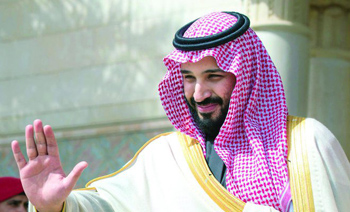
princeIn a wide-ranging interview with American columnist David Ignatius, the deputy crown prince reflected on the ground-breaking changes presently taking place in the Kingdom under the Vision 2030 plan.

He told Ignatius that the crucial requirement for reform is public willingness to change a traditional society, saying the era of extreme religious conservatism is over.

“If the Saudi people are convinced, the sky is the limit,” he was quoted as saying.

David Ignatius, who was in the Kingdom this week as part of the press corps accompanying US Defense Secretary James Mattis, wrote about Saudi Arabia in an in-depth opinion article for The Washington Post.

The article drew heavily on his 90-minute conversation with Deputy Crown Prince Mohammed bin Salman.

“Two years into his campaign as change agent,” the deputy crown prince “appears to be gaining the confidence to push his agenda of economic and social reform,” Ignatius wrote.

“Change seems increasingly desired in this young, restless country,” he wrote. He quoted a recent poll which indicated that 85 percent of the public, if forced to choose, would support the government rather than religious authorities on policy matters.

The article also reveals that 77 percent of those surveyed supported the government’s Vision 2030 reform plan, and that 82 percent favored public music performances attended by men and women.

During the conversation with Ignatius, the deputy crown prince was optimistic about President Donald Trump; the prince described him as a president who will bring America back to the right track.

“Trump has not yet completed 100 days, and he has restored all the alliances of the US with its conventional allies,” Ignatius quotes the deputy crown prince as saying.

The article talks about the growing ties between Saudi Arabia and the US as evidenced in the discussions with Mattis during which the possibility of additional US support was discussed “if the Houthi insurgents in Yemen don’t agree to a UN-brokered settlement.”

The deputy crown prince favored a relationship of equals between Saudi Arabia and the US. “We have been influenced by you in the US a lot,” he told Ignatius. “Not because anybody exerted pressure on us — if anyone puts pressure on us, we go the other way. But if you put a movie in the cinema and I watch it, I will be influenced.” Without this cultural nudge, he said, “We would have ended up like North Korea.”

Explaining to Ignatius about why Saudi Arabia has been wooing Russia, the deputy crown prince said: “The main objective is not to have Russia place all its cards in the region behind Iran. (We have been) coordinating our oil policies (recently with Moscow) in what could be the most important economic deal for Russia in modern times.”

The deputy crown prince also talked about the pace of economic reforms, which he says “appear to be moving ahead slowly but steadily.”

The prince said that the budget deficit had been reduced; non-oil revenue increased 46 percent from 2014 to 2016 and is forecast to grow another 12 percent this year. Unemployment and housing remain problems, he said, and improvement in those areas is not likely until between 2019 and 2021.

Ignatius describes the deputy crown prince as “the instigator of (the) attempt to reimagine the Kingdom,” and observes that “unlike so many Saudi princes, he wasn’t educated in the West, which may have preserved the raw combative energy that is part of his appeal to young Saudis.”

According to the deputy crown prince, “extreme religious conservatism in Saudi Arabia is a relatively recent phenomenon, born in reaction to the 1979 Iranian revolution and the seizure of the Grand Mosque in Makkah by Sunni radicals later that year.”

“I’m young. Seventy percent of our citizens are young,” he told Ignatius. “We don’t want to waste our lives in this whirlpool that we were in for the past 30 years. We want to end this epoch now. We want, as the Saudi people, to enjoy the coming days, and concentrate on developing our society and developing ourselves as individuals and families while retaining our religion and customs. We will not continue to be in the post-’79 era,” he said. “That age is over.”

Comments

Add new comment

  • Coastaldigest.com reserves the right to delete or block any comments.
  • Coastaldigset.com is not responsible for its readers’ comments.
  • Comments that are abusive, incendiary or irrelevant are strictly prohibited.
  • Please use a genuine email ID and provide your name to avoid reject.
News Network
June 12,2020

Beirut, Jun 12: Angry Lebanese protesters blocked roads across the country with burning tyres, debris and their vehicles, incensed over the local currency's depreciation by more than 25 percent in just two days.

The demonstrations from northern Akkar and Tripoli to central Zouk, the eastern Bekaa Valley, Beirut and southern Tyre and Nabatieh on Thursday were some of the most widespread in months of upheaval over a calamitous economic and financial crisis.

Protesters set ablaze a branch of the Central Bank, vandalised several private banks and clashed with security forces in several areas. At least 41 people were injured in Tripoli alone, according to the Lebanese Red Cross.

"I'm really pissed off, that's all. If politicians think they can burn our hearts like this the fire is going to reach them too," unemployed computer engineer Ali Qassem, 26, told Al Jazeera after pouring fuel onto smouldering tyres on a main Beirut thoroughfare.

Tens of thousands of Lebanese have lost jobs in the past six months and hundreds of businesses have shuttered as a dollar shortage led the Lebanese pound to slide from 1,500 to $1 last summer - where it was pegged for 23 years - to roughly 4,000 for each US dollar last month.

But the slide turned into a freefall between Wednesday and Thursday when the pound plummeted to roughly 5,000 to $1 on black markets, which have become a main source of hard currency. There was widespread speculation the rate hit 6,000 or even 7,000 pounds to the dollar, though most markets stopped trading.

Protesters began amassing on streets across the country before sunset and increased into the thousands across the country as the night fell.

Prime Minister Hassan Diab cancelled all meetings scheduled for Friday to hold an emergency cabinet session at 9:30am and another at 3pm at the presidential palace to be headed by President Michel Aoun.

The pound's collapse is the perhaps the biggest challenge yet for Diab's young cabinet, which gained confidence in February after former prime minister Saad Hariri's government was toppled by an unprecedented October uprising that had the country's economic crisis at its core.

Economy Minister Raoul Nehme told Al Jazeera that there was "disinformation" being circulated about the exchange rate on social media and said he was investigating possible currency manipulation.

"I don't understand how the exchange rate increased by so much in two days," he said.

Many protesters have pitted blame on Central Bank governor Riad Salameh, nominally in charge of  keeping the currency stable. But they have also called on the government to resign.

"If people want reform between dawn and dusk, that's not going to work, and if someone thinks they can do a better job then please come forward," Nehme said.

"But what we can't have is a power vacuum - then the exchange rate won't be 5000, it'll be a catastrophe."

'Everyone paying the price'

When protesters set a large fire in Beirut's Riad al-Solh Square, which lies at the foot of a grand Ottoman-era building that serves as the seat of government, firefighters did not intervene to extinguish it.

It later became clear why: Civil Defence told local news channel LBCI they had run out of diesel to fuel their firetrucks.

Basic imports such as fuel have been hit hard by the currency crisis, making already-weak state services increasingly feeble.

A half-dozen or so police officers with Lebanon's Internal Security Forces observed the scene unfolding in front of them in the square.

"Why do you destroy shops and things and attack us security forces - do you think we're happy? Go and f****** break that wall or go to the politicians' houses," one police officer told Al Jazeera, referring to a large concrete barrier separating protesters from the seat of government.

"In the end we are with you and we want the country to change. Don't you dare think we're happy. My salary is now worth $130," the officer said.

The currency's spectacular fall seems to have pushed many Lebanese to put common interests above their differences.

Large convoys of men on motorbikes from Shia-majority areas of southern Beirut joined the demonstrations on Thursday, though they have clashed with protesters many times before - including at a protest on Saturday.

Some chanted sectarian insults, leading to brief clashes in areas that were formerly front lines during the country's devastating 15-year civil war.

Instead, the motorbike-riding demonstrators on Thursday chanted: "Shia, Sunni, F*ck sectarianism."

"We are Shia, and Sunnis and Christian are our brothers," Hisham Houri, 39, told Al Jazeera, perched on a moped with his fiancee behind him just a few metres from a pile of burning tyres.

The blaze sent thick black smoke into the sky towards an iconic blue-domed mosque and church in downtown Beirut.

"Politicians play on these sectarian issues and sometimes succeed, but in the end, they'll fail because all the people have been hurt," he said. "The dollar isn't just worth 6,000 for Shias or for Sunnis, everyone is paying that price."

Comments

Add new comment

  • Coastaldigest.com reserves the right to delete or block any comments.
  • Coastaldigset.com is not responsible for its readers’ comments.
  • Comments that are abusive, incendiary or irrelevant are strictly prohibited.
  • Please use a genuine email ID and provide your name to avoid reject.
News Network
February 5,2020

The Organisation of Islamic Cooperation (OIC) has said it rejects US President  Donald Trump 's recently unveiled Middle East plan.

The 57-member body, which held a summit on Monday  to discuss the plan in Saudi Arabia's Jeddah, said in a statement that it "calls on all member states not to engage with this plan or to cooperate with the US administration in implementing it in any form".

Requested by the Palestinian leadership, the meeting of the body came two days after the Arab League rejected Trump's so-called "deal of the century", saying: "It does not meet the minimum rights and aspirations of Palestinian people."

Addressing a pro-Israel audience at the White House with Israeli Prime Minister Benjamin Netanyahu by his side, Trump on Tuesday described his long-delayed plan for resolving the Israeli-Palestinian conflict as a "win-win solution" for both sides.

The US president said his proposed deal would ensure the establishment of a two-state solution, promising Palestinians a state of their own with a new capital in Abu Dis, a suburb just outside Jerusalem. Trump also said Jerusalem would be the "undivided capital" of Israel. The Palestinians want both occupied East Jerusalem and the West Bank to be part of a future state.

Palestinian leaders, who were absent during the announcement and had rejected the proposal even before its release, denounced the plan as "a new Balfour Declaration" that heavily favoured Israel and would deny them a viable independent state.

The OIC said in a statement on Twitter on Sunday that its "open-ended executive committee meeting" at the level of foreign ministers would "discuss the organisation's position after the US administration announced its peace plan".

With member states from four continents, the OIC is the second-largest intergovernmental organisation in the world after the United Nations, with a collective population reaching more than 1.8 billion.

The majority of its member states are Muslim-majority countries, while others have significant Muslim populations, including several African and South American countries. While the 22 members of the Arab League are also part of the OIC, the organisation has several significant non-Arab member states, including Turkey, Iran and Pakistan. It also has five observer members, including Russia and Thailand.

Iran 'barred'

Meanwhile, Iran on Monday accused its regional rival Saudi Arabia of blocking its officials from attending the OIC meeting.

"The government of Saudi Arabia has prevented the participation of the Iranian delegation in the meeting to examine the 'deal of the century' plan at the headquarters of the Organization of Islamic Cooperation," Fars news agency quoted Abbas Mousavi, spokesman for Iran's foreign ministry, as saying.

Mousavi said Iran - one of the countries to strongly condemn Trump's plan - had filed a complaint with the OIC and accused its regional rival of misusing its position as the host for the organisation's headquarters.

There was no immediate comment from Saudi officials.

Following the unveiling of Trump's plan, the Saudi foreign ministry expressed appreciation for Trump's efforts and support for direct peace negotiations under Washington's auspices, while state media reported that King Salman had called Palestinian President Mahmoud Abbas to reassure him of Riyadh's unwavering commitment to the Palestinian cause.

The announcement of Trump's plan drew mixed responses from Arab states.

Observers said the reaction was indicative of the division among Arab countries and their inability to prioritise the Palestinian people's plight over domestic economic agendas and political calculations in relation to the Trump administration.

Comments

Add new comment

  • Coastaldigest.com reserves the right to delete or block any comments.
  • Coastaldigset.com is not responsible for its readers’ comments.
  • Comments that are abusive, incendiary or irrelevant are strictly prohibited.
  • Please use a genuine email ID and provide your name to avoid reject.
News Network
April 28,2020

Dubai, Apr 28: Riyadh municipality has announced 13 requirements to restore commercial activity in malls starting Wednesday (April 29), in accordance with the government’s coronavirus precautionary measures.

The requirements include: the continued closure of all entertainment and playing areas inside malls, and not allowing the entry of children under the age of 15.

The municipality requires all malls to ensure the availability of medical examination and sterilization teams to measure the temperature of all individuals entering the mall at all entrances throughout opening hours, prevent any person with a temperature exceeding 38 degrees Celsius from entering, remove all chairs and benches in the corridors, and provide masks and gloves for visitors at the entrances.

All malls are to have security personnel stationed at all entrances to ensure that visitors are wearing masks.

The municipality also requires all malls to sterilize the entire facility every 24 hours, allocate rooms for medical isolation when there is any suspicion of an individual being infected with COVID-19, ensure the presence of a sufficient number of security personnel, and carry out regular rounds to verify full compliance, and suspend the valet service.

It also called for malls to put up explanatory signs of the guidelines to ensure that everyone understands the precautionary measures.

Malls should rely on the use of escalators and stairs for movement between floors, and in the event they are not available, only two people are allowed to ride the elevator at a time.

Revised curfew

Saudi Arabia had revised on April 21 its coronavirus curfew timings for the holy month of Ramadan, allowing residents in all areas and cities not currently under a 24-horu lockdown to go out between 9 a.m. and 5 p.m.

However, areas under a complete lockdown will only be allowed to go out for essential needs, such as grocery shopping or medical visits, between the hours of 9 a.m. and 5 p.m. Residents in these areas must stay within their neighborhoods

A 24-hour lockdown was previously imposed on the cities of Riyadh, Tabuk, Dammam, Dhahran, and Hofuf and throughout the governorates of Jeddah, Taif, Qatif, and Khobar.

The government had imposed a full lockdown on the holy cities of Makkah and Madinah as well. Other cities and governorates had a curfew implemented from 3 p.m. to 6 a.m. daily.

Comments

Add new comment

  • Coastaldigest.com reserves the right to delete or block any comments.
  • Coastaldigset.com is not responsible for its readers’ comments.
  • Comments that are abusive, incendiary or irrelevant are strictly prohibited.
  • Please use a genuine email ID and provide your name to avoid reject.