


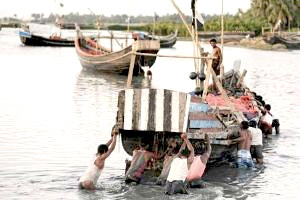
Sittwe/Myanmar. Apr 27: The two children stood on the beach, at the end of the only world they knew, torn between land and sea.
They couldn't go back to their tiny Muslim village in Myanmar's northwest Rakhine because it had been devoured in a fire set by an angry Buddhist mob. In the smoke and chaos, the siblings became separated from their family. And after seven months of searching, they had lost hope of finding anyone alive.
The only way was forward.
Hungry and scared, they eyed a rickety wooden fishing boat in the darkness. Mohamad Husein, just 15, dug into his pocket and pulled out a little wad of money for the captain. He and his 9-year-old sister, Senwara Begum, climbed on board, cramming themselves tightly between the other ethnic Rohingya in the small hull.
As the ship pushed off, they didn't realize they were among hundreds, if not thousands of children joining one of the world's biggest boat exoduses since the Vietnam War. They only understood it wasn't safe to stay in a country that didn't want them.
Mohamad had no idea where they were headed. And as Senwara looked back in tears, she wondered if she would ever see her parents again.
Neither could imagine the horrors that lay ahead.
From Malaysia to Australia, countries easily reachable by boat have been implementing policies and practices to ensure that Rohingya Muslims don't wash up on their shores — from shoving them back to sea, where they risk being sold as slaves, to flat out barring the refugees from stepping onto their soil.
Despite pleas from the United Nations, which considers the Rohingya to be among the most persecuted groups on earth, many governments in the region have refused to sign refugee conventions and
protocols, meaning they are not obligated to help. The countries said they fear adopting the international agreements could attract a flood of immigrants they cannot support.
However, rights groups said they are failing members of the religious minority at their most vulnerable hour, even as more women and children join the increasing mass departure.
"The sense of desperation and hopelessness is growing," warned Vivian Tan of the UN Refugee Agency.
About 1.3 million Rohingya live in the predominantly Buddhist country of 60 million, almost all of them in Rakhine state. Myanmar considers them illegal immigrants from neighbouring Bangladesh, though some families have lived here for generations.
When the country was under military rule, young men took to the seas on small, dilapidated boats every year in search of a better life. But since the bumpy transition to democracy in 2011, sectarian violence has killed up to 280 Rohingya and forced more than 140,000 others from their homes. Now, people of all ages are fleeing, many on massive cargo ships.
Women and children made up 5 per cent to 15 per cent of the estimated 75,000 passengers who have left since the riots began in mid-June 2012, said Chris Lewa of the nonprofit Arakan Project, a group that has tracked the boat journeys for a decade. The year before, around 9,000 people fled, most of them men.
It's a dangerous voyage: Nearly 2,000 Rohingya have died or gone missing in the past two years, Lewa said. Unaccompanied children like Senwara and her brother are among the most at risk.
The Associated Press reported from Myanmar, Indonesia, Malaysia and Thailand on their plight, interviewing family members, witnesses and aid groups. Data were collected from the UN, government agencies, nonprofit organizations and news reports at the time.
The relief the two children felt after making it safely away from land quickly faded. Their small boat was packed with 63 people, including 14 children and 10 women, one seven months pregnant. There were no life jackets, and neither sibling could swim. The sun baked their skin.
Senwara took small sips of water from a shared tin can inside the hull piled with aching, crumpled arms and legs. With each roiling set of waves came the stench of vomit.
Nearly two weeks passed. Then suddenly a boat approached with at least a dozen Myanmar soldiers on board.
They ordered the Rohingya men to remove their shirts and lie down, one by one. Their hands were bound. Then they were punched, kicked and bludgeoned with wooden planks and iron rods, passengers on the boat said.
They howled and begged God for mercy.
"Tell us, do you have your Allah?" one Rohingya survivor quoted the soldiers as saying. "There is no Allah!"
The police began flogging Mohamad before he even stood up, striking his little sister in the process. They tied his hands, lit a match and laughed as the smell of burnt flesh wafted from his blistering arm. Senwara watched helplessly.
As they stomped him with boots and lashed him with clubs, his mind kept flashing back to home: What had he done? Why had he left? Would he die here?
After what seemed like hours, the beating stopped. Mohamad suspected an exchange of money finally prompted the soldiers to order the Rohingya to leave.
"Go straight out of Myanmar territory to the sea!" a witness recalled the commander saying. "If we see you again, we will kill you all!"
The Myanmar government denied that the Navy seized any ships during that period.
The refugees plodded on, but the boat was falling apart. A sarong stuffed in a hole could not stop water from bubbling through. The sticky rice and bits of bread Mohamad had brought for his sister were gone.
When they finally floated ashore, someone said they were in Thailand. Senwara didn't even know where that was.
Thailand is the first stop for almost all Rohingya fleeing by sea, but it does not offer them asylum. Up until a few years ago, the country had a "push back" policy of towing migrants out to sea and leaving them, often with little or no food, water or fuel. But after photos leaked of the military dragging one such boat in 2009, the government changed course.
Under its new "help on" policy, Thai authorities give basic supplies to migrants in its waters before sending them on. Other times, however, they direct the boat to traffickers who hold the asylum seekers for ransom, according to human rights groups that have interviewed scores of escapees.
Those who cannot get money are sometimes sold as slaves to work on fishing boats or in other industries without pay. Others flee, usually back into the hands of agents, where the cycle continues.
Royal Thai navy spokesman Rear Admiral Karn Dee-ubon denied cooperation with traffickers and allegations of boats being towed out to sea. He insisted the navy always follows humanitarian principles, but added that other Thai agencies could be involved in such activities.
After the children's boat entered Thai waters, all of its passengers were marched into the jungle where their hands were tied and they were told not to leave, survivors said. They were given rice and dry fish crawling with bugs.
Days later, they were put on another small boat without an engine. Then, survivors said, Thai troops pulled them far out to sea, cut the rope and left them to drift without food or water.
The boat rolled with the wind and currents. Senwara drank sea water and ate a paste of ground-up wood. She vomited, and diarrhoea poured out of her.
The next day, someone spotted what looked like a shadowy tree in the distance. The men used a little boy's mirror to flash signals in its direction.
When the boat came near, Indonesian fishermen smiled and spoke a language no one understood. The Rohingya could only make out that the crew was Muslim.
Indonesia has been sympathetic to the Rohingya, and its president has sent a letter to his Myanmar counterpart calling for an end to the crisis. Protesters in cities across the world's most populous Muslim nation have condemned the violence.
Yet Indonesia has not opened its doors to the Rohingya. It only allows them to stay until they can be resettled elsewhere, which can take years. In the meantime, they are kept in overcrowded detention centres and shelters, and no one can legally work.
The Indonesian and Malaysian governments fear that letting the Rohingya stay could lead to a greater influx of illegal migrants.
"At stake is national interest," said Yan Welly, an Indonesian immigration official. "Let alone a flood of immigrants could affect efforts in coping with problems of our own people."
The number of Rohingya housed in Indonesia jumped from 439 in 2012 to 795 last year. About 20 percent of the children who arrived were traveling alone, according to U.N. data.
Some go the official route: They register with the U.N. Refugee Agency when they arrive and wait to be resettled in another country. However, no Rohingya in Indonesia were referred for placement last year.
Ultimately, it is up to accepting nations, with their own policies and criteria, to decide whom to accept. To avoid the long delay, many asylum seekers run away and never get recorded.
In the past, thousands paid smugglers to take them by boat across a deadly stretch of ocean to Australia's Christmas Island. But that country recently took a hard line, transferring everyone arriving by sea to impoverished Papua New Guinea or the tiny Pacific island of Nauru. Australia's new policies also include towing vessels back into Indonesian waters, which has left the two governments sparring.
The boat carrying Mohamad and Senwara only made it as far as Indonesia.
After nearly a month and hundreds of miles at sea, they were rescued off Aceh's coast in the west. UN and news reports confirm the rickety ship arrived in late February 2013 and was towed because it had no engine.
The asylum seekers were transferred to a filthy detention centre with about 300 people — double its capacity — including more than 100 Rohingya. They soon clashed with 11 Buddhists from Myanmar picked up for fishing illegally in Indonesian waters, according to a police report obtained by The AP. The Rohingya complained the Buddhists were harassing their women.
A riot broke out in April 2013, and the nightmare the children thought they had escaped began replaying itself. Men threw splintered chairs and spewed rage into a darkness so black, it was impossible to see who was fighting whom. Eight Buddhist fishermen were beaten to death.
Senwara slept through the brawl in a separate quarter for women. But when she awoke the next morning, her brother was gone.
She was now all alone.
After a few months in jail with other Rohingya arrested for the fight, Mohamad was released due to his age. He soon left for neighbouring Malaysia on a small boat to find work and avoid further trouble.
For many fleeing Rohingya, Malaysia, is the preferred destination. Around 33,000 are registered there and an equal number are undocumented, according to the Rohingya Society of Malaysia. Those numbers have swelled with the violence in Myanmar.
But increasingly, migrants risk getting caught up in group arrests and sent to detention centers. Up to 1,000 have been detained in a nationwide crackdown, the Society said.
Those who arrive in the Muslim-majority country are not eligible for free health care or education, relying mainly on help from the U.N. and aid groups. But it usually doesn't take long to get illegal work on construction sites or in factories.
Mohamad found a job as a street sweeper in the city of Alor Setar, earning about $70 a month. He now lives in a tiny hovel with about 17 other Rohingya men sleeping on every inch of floor.
For the first time, he is earning a living on his own. But he remains tortured with guilt for leaving his little sister behind.
Soon after the detention centre riot, Senwara was registered as an asylum seeker. She was moved to temporary UN housing in Medan that's made of small concrete dorm-style rooms with a large play area in front. A Rohingya woman who knew Senwara's parents from childhood took the girl in.
Although Senwara smiles around her new foster parents, she remains hurt and angry that her brother left.
Mostly, her heart aches for home.
Senwara's parents didn't learn the children were safe until more than eight months after their village was burned.
On that awful night, rioters lit bottles and lobbed them into the mosque. Panicked Rohingya raced outside, slicing their bare feet on shards of broken glass left to make them bleed.
Senwara's mother, Anowar Begum, and father, Mohamad Idris, fled with two babies into a lake. They used bamboo stalks to guide them through the muddy chest-high water in the darkness.
Later, they searched frantically and found five more of their nine children. But Senwara and Mohamad had vanished. Everyone feared they were dead.
After moving from place to place, the family ended up in a squalid camp with tens of thousands of other homeless Rohingya on the outskirts of Rakhine state's capital, Sittwe.
They had given up hope for Senwara and Mohamad by the time an unknown Rohingya called from Indonesia to say they were safe. Today, 22 months after their separation, it's only through technology that the family, now scattered across three countries, can remain in touch.
Mohamad, in Malaysia, watches a video clip of his sister playing soccer in Indonesia. While the other young men in his simple, two-room flat sit on the floor chatting and scraping curry from their plates, the teenager retreats into silence. Even as he breaks down, he cannot look away from the little girl on the screen.
Back in Myanmar, a Skype video call pops up on a laptop. From inside the camp, Anowar stares at her daughter and sobs quietly into her headscarf. In Indonesia, Senwara quickly wipes away her own tears.
Two birthdays have passed since she left home. As her father asks how she's been, his weathered face trembles.
They then go through the questions every parent wants to know: Is she well? How is she doing in school? Is she getting enough to eat?
"It's really good to see you here and healthy," her father says, balancing a baby on his knee.
Soon her favourite sister, who looks just like her, starts making jokes. The whole family laughs, breaking the sadness for a few minutes.
"I'm fine," Senwara says, trying to sound upbeat. "I'm with a family that is taking good care of me. They love me. I'm learning things, English and religion."
Her father reminds her to be a good girl. He is desperate to see his children again, but believes they are better off far away. The family often goes hungry, and there's no money for medicine.
When it's time to say goodbye, Senwara keeps staring at the screen even after the faces disappear. She still doesn't understand why her village was burned or what forced her to leave home. She only knows one thing.
"I don't think I will ever be able to see my parents," she says, softly. "For the rest of my life."

Comments
What are the laws with regard to cannabis in India?
Here is my blog; seattle
marijuana buy: http://100percenth20.com/__media__/js/netsoltrademark.php?d=recreationa…
Add new comment