



Dhoni felt he wouldn’t be doing justice to the team if he kept playing: Shastri

January 5, 2015

New Delhi, Jan 5: Team Director Ravi Shastri said Mahendra Singh Dhoni’s "selfless act" of retiring from Test cricket format at the right time should be given its due respect.
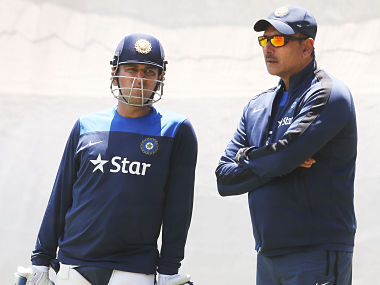
dhoni shastri

Shastri said that there was nothing wrong with Virat Kohli’s aggression but it should be used to help build a young team into a dangerous outfit in the near future. He said Kohli was a young captain and will gradually mature into a better cricketer and leader.

He also strongly rebutted reports that the growing closeness between him and Kohli resulted in Dhoni quitting the format with immediate effect. But Shastri did admit that Dhoni’s sudden decision to retire in the middle of the Test series against Australia was a bolt from the blue for him and the rest of the team.

However, he also acknowledged that Dhoni did deliberate quite a bit before making the decision and defended its timing by saying that those who question the wicketkeeper-batsman’s motives have no idea what he gave to Indian cricket.

The former player also hinted at taking a full-time role with the Indian team after next month’s ODI World Cup.

Excerpts from the interview:

Virat Kohli is the next captain. Do you think he needs to curb his aggressive mood a little bit?

What is wrong with that aggressive attitude? If he was only talking on the field and had scored only 5 runs in three Tests, I would have had a word with him. But he is 1 run short of 500 runs in this series. So obviously he is doing something right and it is working wonders for him and the team of course. He is an aggressive cricketer and he loves this attitude on the field and it brings out the best in him.

Sir Vivian Richards is in Melbourne and has praised his attitude. The whole of Australia is admiring him the way he is playing here, because for a long time they haven’t seen anyone who plays such brand of cricket, against them, in their own country.

Of course, Virat is only a young man, a young captain now, he will learn gradually with time as well. He will mature into an even better cricketer and that is only good for the team as a whole.

Can you talk about the moment when M.S. Dhoni announced his retirement to the team? What was the reaction in the dressing room? How has the team reacted to it?

He took everyone by surprise. The match was over and he had finished his post-match commitments. And he came to the dressing room and said that his time in Test cricket was up.

It was just a shock to us all. And the way he said it, it was obvious that it was a well thought-out decision. He didn’t even inform his family but told his team-mates first. He was honest with us and honest with himself. His esteem in my eyes has just shot up by 20-25 notches.

This news was a bolt from the blue for us. He knew what words to say and he was honest about it. Dhoni is an all-time Indian legend, a cricket great. And this team sees him like one and not only for what he has done. He hasn’t chased statistics or numbers or fanfare farewell. He was honest with himself and they respect him for it. This is a young team and an example has been set in front of them and it’s a great learning for them.

You have seen Dhoni from the commentary box. You have seen him as team-director. How do you rate him as a Test captain, after 8-0 in 2011-12 and this calendar year of overseas Test cricket?

It has been a hard job for him. In overseas Test cricket it’s all about taking those 20 wickets. Recently they have been coming close but were unable to win. They should have won in South Africa and also in New Zealand. Here in Australia too they have competed well in all three matches and could have won any of them. It’s a young side which is still learning.

But knowing Dhoni, he would have loved to win those matches but unfortunately at this juncture he felt his time in Test cricket had come to an end. He felt he wouldn’t be doing justice to the team if he kept playing. He saw that the team had Virat Kohli fit and ready to lead and he saw there was Wriddhiman Saha to take over from him behind the stumps. He saw the future was in safe hands.

Dhoni gave his everything for Indian cricket, irrespective of the format. I am sure he will keep playing limited-overs formats for a couple more years like a king and some opposition team will get hurt.

In December 2012, in Nagpur, after losing the Test series (2-1) to England at home, Dhoni had hinted about retiring from one format in late 2013. But he has waited a whole year to do so. What do you think is the reason behind that?

I believe it is a well thought-out move. A lot of hard work has been put into this team over the last one year and he felt that it was time to hand over the charge to a fresh young leader. He has made sure that there will be no speculation over who will be captain afterwards or who will be wicket keeper after he is gone. All these questions are answered.

Dhoni isn’t leaving without reason, it’s not ill-timed. It’s a long process and everything about it has been a selfless motive from Dhoni.

For playing 25 years for the country, Sachin Tendulkar was an exception and rightly so. But in the past there have been so many players who play for stats or want fanfare farewells, they just keep on playing. But there are very few who don’t need that. Dhoni belongs to the ‘I don’t need it’ club. And there are people speculating about his motives and judging him that he abandoned a sinking ship and all that nonsense. Forget playing, have these people even watched 5 percent of the cricket Dhoni has played?

Moving on, you have been with the team for six months now. What exactly is your role as Team Director?

My role is to oversee everything that goes on with the Indian team. I make sure that everyone and everything is functioning to the best of their abilities for the betterment of the players, so that the Indian team can deliver results in all formats of the game. As and when it is necessary, I also give my two cents in the dressing room.

Will you be willing to take on a full-time role with the team after Duncan Fletcher’s time ends post the 2015 ODI World Cup?

As the Director of the Indian team, my job is to put forward to the BCCI, what I think serves best for this team. I have to make them aware of all the functionalities available to the players, and what they need more to be able to keep on performing consistently at this level and to give Indian cricket the desired results.

After that whatever the Board deems is in the best interest of the Indian team, they will take the final decision and it will be acceptable to me as well. But at this stage I don’t even want to think about all those things because it is a long way off. We have a very important three months of international cricket ahead of us, then we have the IPL and only then some international assignment will come up. So there is plenty of time to mull over all of this.

In the last six months, different Indian players have praised your inputs in the dressing room/practice sessions. What have you said to them?

My only job has been to give a favourable environment to the Indian players in the dressing room. This is what we are all striving to do, whether it is Duncan Fletcher or R. Sridhar or B. Arun or Sanjay Bangar. Our effort is to give them a proper atmosphere where they can grow as players. And we are speaking the language of cricket to them.

Experience in cricket is something that can neither be bought nor sold, it is not a commodity. You can only gain experience by playing cricket. So we want them to forget everything and compete, play to win. Go out there and take the opposition head on. When I first joined I felt the enjoyment aspect had gone out of their game, so my personal aim has been to bring back that element into their game whether they are playing at home or at the MCG or at the SCG.

What went wrong that the players weren’t enjoying their game?

I can’t really point it out and I don’t have the pulse of that exact moment. But I felt it. I told the players that it is not a 9-to-6 job that they are doing on the field, sitting in front of computers. They are on the field to play cricket, to represent their country. They should take pride in the way they are playing and get on with the game.

These guys can play bloody good cricket and they just needed the smallest of change in outlook to be able to do that. They are playing for one of the best countries in world cricket, millions of fans watch them, adore them when they play well and criticise when they play badly. That passion has to reflect in their cricket as well, and I must say here that it has. This has been a very competitive series.

What has impressed you most in this series? India is still trailing 2-0 and have conceded the Border-Gavaskar Trophy.

People back home do not realise how well this young side has played in Australia, giving it back to the opposition on the field, and the Australian public is appreciating that.

I am not one to make excuses and will not do so for the team either. The scoreline is against us but they have played good aggressive cricket. This is what I like about this team, grabbing every opportunity to play for India. They have a mindset to not just turn up overseas and mark attendance in Test cricket but they want to compete and win Test matches. They have shown that with both batting and bowling. We have primarily used only four pacers on this tour and they have looked to attack. The batsmen have been wonderful.

Look at Murali Vijay and his solidity at the top order, or look at that partnership between Ajinkya Rahane and Virat Kohli. And the biggest point for me is that this is a very young team, still learning, and they all have at least 5-6 years of cricket left in them together as a group. They will develop into one of the most dangerous team in world cricket if they carry on playing with this attitude.

And I want to add here about some of the stuff that is written about the dressing room. Let me just say this Indian team doesn’t care about such stories. And some of them are complete garbage, trash is the word. Shikhar Dhawan and Virat Kohli didn’t even have an argument let alone what was speculated and said. We don’t care about such things being written or said about the dressing room.

Comments

Add new comment

  • Coastaldigest.com reserves the right to delete or block any comments.
  • Coastaldigset.com is not responsible for its readers’ comments.
  • Comments that are abusive, incendiary or irrelevant are strictly prohibited.
  • Please use a genuine email ID and provide your name to avoid reject.
News Network
January 20,2020

Jan 20: Both Steve Smith and Rohit Sharma made sparkling centuries in Bengaluru, but it was the Indian who finished on the winning side, leading his team to a 2-1 series win.

Smith, having run out his captain Aaron Finch early on, dug in to bring up his ninth ODI century, his 131 off 132 balls setting India a target of 287 on Sunday, 19 January. Continuing the dazzling display of batting at the M Chinnaswamy stadium, Rohit struck 119 in 128 balls, and skipper Virat Kohli chipped in with 89, as the hosts chased down the target with seven wickets to spare in 47.3 overs.

With Shikhar Dhawan hurting his shoulder in the fifth over of the day and sidelined for the rest of the match, Rohit was reunited with KL Rahul – who had a chance to open the innings after coming in at No.3 and No.5 in the first two matches, while also standing in as wicket-keeper. The vice-captain was on the ball right away, dominating the scoring as India raced to 61/0 in the first 10 overs.

The introduction of spin gave Australia a vital breakthrough: Ashton Agar trapped Rahul in front on review, and although the new pair of Rohit and Kohli weren't unduly troubled, the run-rate slowed down. Josh Hazlewood, playing his first ODI in India and his first match in the format in 14 months, was especially miserly, conceding just 10 runs in his first five overs.

But, having settled in, the duo built a useful partnership of 137 and gave themselves the chance to hit out with wickets in hand. The part-time bowling of Finch and Marnus Labuschagne was punished, Rohit lapping up the short balls and sending them soaring into the stands. His century, his eighth against Australia, came with a single to third man.

Zampa finally got the breakthrough, having him caught in the deep going for another big one. But with Kohli having loosened his arms with a couple of beautiful fours off Pat Cummins to go past his half-century, India remained on course.

The skipper missed out on a hundred, but with Shreyas Iyer too clearing the ropes, there were no hurdles as India wrapped up an entertaining series win.

Earlier, the Indian bowlers struggled to find their lines after Australia chose to bat, but Australia weren't able to fully capitalise. David Warner was thrown by the movement to nick Mohammed Shami to the wicket-keeper, while Finch was caught short after Smith pulled out of a run, to leave the hosts at 46/2.

Labuschagne and Smith, though, combined for another special partnership, going at a brisk rate and showing delectable timing against spin. They had guided their side to 173 in the 32nd over when the a sharp piece of fielding from the home captain and strong bowling pulled things back.

Kohli, at cover, plucked a drive from Labuschagne soon after the batsman had reached his maiden fifty. Ravindra Jadeja had his second of the over when the experiment to send Mitchell Starc at No.5 lasted just three balls.

Alex Carey gave Smith company as he brought up a well-earned century, having fallen just short the previous game. The former skipper stepped up the scoring once he crossed three figures, a wristy helicopter six over deep square leg the highlight of his innings. But, excellent death bowling by Shami, who finished with four wickets, ensured the tourists were kept to under 300 – a total that proved below par.

Comments

Add new comment

  • Coastaldigest.com reserves the right to delete or block any comments.
  • Coastaldigset.com is not responsible for its readers’ comments.
  • Comments that are abusive, incendiary or irrelevant are strictly prohibited.
  • Please use a genuine email ID and provide your name to avoid reject.
News Network
June 3,2020

New Delhi, Jun 3: Shuttler HS Prannoy has hit out at the Badminton Association of India (BAI) and has questioned the selection criteria for the Arjuna Award.

The shuttler has said that the players who have won nothing have been recommended, while the players who have medals to their credit have been snubbed.

His remarks come as BAI recommended doubles pair of Satwiksairaj Rankireddy and Chirag Shetty and men's singles player Sameer Verma for the Arjuna Award on Tuesday.

"Same old story. Guy who has Medals in CWG and Asian Championships not even recommended by Association. And guy who was not there on any of these major events recommended #waah #thiscountryisajoke," Prannoy tweeted.

Prannoy had been left out from the list last year as well and the shuttler had slammed the criteria then as well.

"If you ever want your name in the awards list, make sure you have people who will get your name to the list. Performance is least considered in our country. Sad state of our county but can't help it. Let go and just play until you can," Prannoy had tweeted last year.

Prannoy had won the mixed team gold at the 2018 Commonwealth Games in Gold Coast and he also has a men's singles bronze medal at the 2018 Asian Championships.

On Tuesday, the BAI has also recommended the renowned National Institute of Sports (NIS)-certified coaches, S. Murlidharan and Bhaskar Babu for the Dronacharya Award.

Murlidharan has been working relentlessly for the growth and development of the sport in Kerala, besides being an able administrator.

He has coached the likes of Vimal Kumar, Rupesh Kumar and Sanave Thomas amongst many other renowned former players.

He has also been a recipient of the Meritorious Service Award given by the Badminton World Federation (BWF) in 1996.

For the Dhyanchand Award, BAI has recommended the names of Pradeep Gandhe and Manjusha Kanwar.

Gandhe is a two-time Asian Games bronze medallist while Manjusha is a South Asian Games silver medallist.

Comments

Add new comment

  • Coastaldigest.com reserves the right to delete or block any comments.
  • Coastaldigset.com is not responsible for its readers’ comments.
  • Comments that are abusive, incendiary or irrelevant are strictly prohibited.
  • Please use a genuine email ID and provide your name to avoid reject.
Agencies
April 2,2020

Lausanne, Apr 2: The postponement of the Tokyo Olympics and the shutdown of the sporting calendar because of the coronavirus pandemic are going to hit international sports federations hard financially.

Many sports that are part of the Games depend heavily on the payouts every four years from the International Olympic Committee (IOC).

"The situation is tense and very gloomy. An assessment will be made, but clearly some posts are under threat," said an official of a major international federation.

The 28 international federations (IF) of the sports that were due to be present at the Tokyo Olympics, would have received substantial sums from the IOC.

However, the postponement of the Games until 2021 could lead to a freeze of their payment.

"We have a lot of IF with substantial reserves, but others work on a different business model, they have income from major events which are suspended, which can be a problem for the cashflow if they don't have enough reserves," said Andrew Ryan, director general of the Association of International Olympic Summer Sports Federations (ASOIF), which is responsible for distributing this money.

The five additions to the Tokyo Games programme - karate, surfing, skateboarding, climbing and baseball/softball - are not eligible.

The Olympic payout totalled 520 million after the Rio Games, four years ago.

"The Olympic money could be less than for Rio 2016," Ryan warned before adding: "My advice is to budget the same as in Rio".

The federations receive money on a sliding scale determined by their audience and size.

The three largest (athletics, swimming and gymnastics) can expect approximately 40 million.

For the second tier, made up of cycling, basketball, volleyball, football and tennis, the sum is 25 million.

For group three, which contains eight sports, including boxing, rowing, judo and table tennis, it is 17 million.

The nine sports in the next level (including sailing, canoing and fencing) receive 12 million.

For the three in the last category (rugby, golf, modern pentathlon) the payout is 7 million.

For the largest associations, such as football's FIFA which has a 1.5 billion nest egg, or basketball body FIBA which has CHF 44.4 million (42 million euros) in reserves, IOC aid represents a small proportion of their income.

For others, it is vital.

"Some IF probably don't have the cashflow to survive one year," said Ryan.

For most federations, the postponement of the Olympic Games has a domino effect, forcing them to reschedule their own money-earning competitions.

"The revenues from these events will eventually come in," said Ryan. "But this impacts the cashflow." World Athletics has already postponed the 2021 World Championships in Eugene, Oregon to 2022.

The International Swimming Federation (FINA) will have to do the same for its World Championships scheduled for next summer in Fukuoka, Japan, when they would probably clash with the Tokyo Games.

"One edition of the World Championships means for us 10 million in revenues," said one sports federation official, speaking on condition of anonymity.

"If this income is postponed, totally or partially, for a year, we will face major problems, especially if the IOC money, originally expected in September, is not paid out."

The Singapore-based International Table Tennis Federation has already taken steps, with "the Executive Committee agreeing to reduce their expenses and senior staff offering to take a salary reduction," said marketing director Matt Pound, but, he added,"further cuts will take place if needed."

- 'Significant loss of revenue' -

The ITTF has suspended all its competitions until June and that is costly.

Kim Andersen, the Danish president of London-based World Sailing, said commercial revenues are not immune.

"The IOC will eventually pay out its aid, but what weighs most heavily is the uncertainty about whether our competitions will be held and whether our sponsors will be maintained," he said.

The IOC is not prepared to go into details of what it plans.

"It is not possible at this stage to assess the overall impact" of the postponement of the Tokyo Olympics, an official told AFP.

"It depends on a number of variables that are currently being studied." According to an official of one federation: "the IOC will discuss on a case-by-case basis, sport by sport".

Another option is for the federations to ask for a share of the public aid set up to deal with the coronavirus crisis, in Switzerland, where 22 ASOIF members are based and also in the United Kingdom, home of World Sailing.

"Can sports federations benefit from federal aid? The answer is yes, in principle," Philippe Leuba, State Councillor of the canton of Vaud, in charge of the economy and sport, told.

Comments

Add new comment

  • Coastaldigest.com reserves the right to delete or block any comments.
  • Coastaldigset.com is not responsible for its readers’ comments.
  • Comments that are abusive, incendiary or irrelevant are strictly prohibited.
  • Please use a genuine email ID and provide your name to avoid reject.