



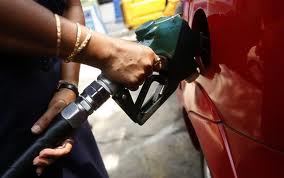
Diesel price rise may be imminent

April 25, 2012
Diesel

New Delhi, April 25: The price of diesel may go up as the government has agreed to make the prices “market determined.”

The announcement came on Tuesday in the Rajya Sabha in the form of a written reply by Minister of State Namo Narain Meena. The minister, however, said the government did not propose to deregulate prices of cooking gas.

“(The) government has, in principle, agreed to make prices of diesel market-determined. There is no proposal at present to fully de-regulate cooking gas prices,” Meena stated, sparking protests from BJP members. The members of the main Opposition party said the move would have a cascading effect on overall prices of commodities since diesel “is the basic transport fuel”. “The government wants to help the oil mafia by taking the in-principle decision on diesel price deregulation,” BJP vice-president Mukhtar Abbas Naqvi said.

Finance Minister Pranab Mukherjee said that thein-principle decision to deregulate diesel prices was taken as early as last June.

Mukherjee, while presenting the 2012-13 budget on March 16, vowed to reduce subsidies to less than 2 per cent in the current financial year (2012-13). High oil prices have swelled India’s subsidy burden to roughly 2.5 per cent of GDP.

While petrol prices have been linked to the market, the government’s control on pricing of diesel, LPG and kerosene has resulted in large public expenditure on subsidies.

The government control of diesel prices has been criticised by many in the past with the Reserve Bank of India (RBI) being the most vociferous. The prices should be decontrolled fully to contain the trade deficit, which was expected to widen to $185 billion during the current fiscal, RBI has said.

A couple of days ago, the government’s chief economic adviser Kaushik Basu suggested partial decontrol of diesel in order to mirror the rise and fall of the global oil prices.

“A phased deregulation of diesel prices is required in order to rein in runaway fiscal deficit, reduce growing under-recoveries of oil marketing companies and save the common man from a rather bigger pressure of inflation, which is only being momentarily suppressed due to the government’s current policies,” Crisil chief economist Deepak Joshi told Deccan Herald.

Tough pill

* Cooking gas exempt from proposal

* Decision to deregulate diesel prices was taken as early as last June, says finance minister

* Government control of diesel prices has been criticised by many in the past with the RBI being the most vociferous

* High oil prices have caused subsidy burden to swell up to 2.5 per cent of GDP

*Diesel basic transport fuel; move will have cascading effect on overall prices of commodities, cries Opposition BJP

Comments

Add new comment

  • Coastaldigest.com reserves the right to delete or block any comments.
  • Coastaldigset.com is not responsible for its readers’ comments.
  • Comments that are abusive, incendiary or irrelevant are strictly prohibited.
  • Please use a genuine email ID and provide your name to avoid reject.
News Network
March 5,2020

Mar 5: The Kerala government has given its nod to a proposal aimed at encouraging students aged between 18 and 25 years to take up part-time jobs while pursuing education so as to help them gain work experience and hone their skills.

The government has decided to accept the proposal as a policy decision at the Cabinet meeting held on Wednesday, an official press release said.

The aim is to ensure that in a fiscal, 90 days of work is assured for students in government departments, local body organisations, PSUs and private companies.

This will help in developing a work culture among students.

Honorariums will be given to students by the organisations employing them part-time, the release said.

Students aged between 18 and 25 years will be permitted to become part of the scheme which will help them to gain work experience and hone their skills, the release added.

In another decision, the government decided to release Rs 26 crore from the Chief Minister's disaster relief fund for providing compensation to farmers who suffered crop loss during the 2018 floods.

Comments

Add new comment

  • Coastaldigest.com reserves the right to delete or block any comments.
  • Coastaldigset.com is not responsible for its readers’ comments.
  • Comments that are abusive, incendiary or irrelevant are strictly prohibited.
  • Please use a genuine email ID and provide your name to avoid reject.
News Network
May 20,2020

New Delhi, May 20: With 5,611 new cases reported in the last 24 hours, India's COVID-19 tally reached 1,06,750 on Wednesday, according to the Union Ministry of Health and Family Welfare.

As many as 140 deaths have been reported in the last 24 hours, taking the total number of deaths to 3,303.

Out of the total cases, 61,149 are actives cases and 42,298 patients have been cured/discharged/migrated.

Maharashtra continues to remain the worst-affected state with 37,136 cases, followed by Tamil Nadu (12,448 cases), Gujarat (12,140 cases), and Delhi (10,554 cases).

The nationwide lockdown imposed as a precautionary measure to contain the spread of coronavirus has been extended till May 31.

Comments

Add new comment

  • Coastaldigest.com reserves the right to delete or block any comments.
  • Coastaldigset.com is not responsible for its readers’ comments.
  • Comments that are abusive, incendiary or irrelevant are strictly prohibited.
  • Please use a genuine email ID and provide your name to avoid reject.
News Network
January 22,2020

Jan 22: India's ranking in the latest global Democracy Index has dropped 10 places to the 51st spot out of 167 owing to violent protests and threats to civil liberties challenging freedoms across the country.

Prime Minister Narendra Modi's government has been criticized by rights groups and western governments after shutting off the internet and mobile phone networks and detaining opposition politicians in Kashmir.

Modi’s government has also responded harshly to ongoing protests against a controversial, religion-based citizenship law. Muslims have said their neighborhoods have been targeted, while the central government has attempted to ban protests and urged TV news channels not to broadcast “anti-national” content. Some leaders in Modi’s ruling party called for “revenge” against protesters. India’s score in 2019 was its worst ranking since the EIU’s records began in 2006, and has fallen gradually since Modi was elected in 2014.

The Economist Intelligence Unit’s 2019 Democracy Index, which provides an annual comparative analysis of political systems across 165 countries and two territories, said the past year was the bleakest for democracies since the research firm began compiling the list in 2006.

“The 2019 result is even worse than that recorded in 2010, in the wake of the global economic and financial crisis,” the research group said in releasing the report on Wednesday.

The average global score slipped to 5.44 out of a possible 10 -- from 5.48 in 2018 -- driven mainly by “sharp regressions” in Latin America, Sub-Saharan Africa, the Middle East and North Africa. Apart from coup-prone Thailand, which improved its score after holding an election last year, there were also notable declines in Asia after a tumultuous period of protests and new measures restricting freedom across the region’s democracies.

Asia Declines

Hong Kong, meanwhile, fell three places to rank 75th out of 167 as more than seven months of violent and disruptive protests rocked the Asian financial hub. An aggressive police response early in the unrest, when protests were mostly peaceful, led to a “marked decline in confidence in government -- the main factor behind the decline in the territory’s score in our 2019 index,” the group said.

In Singapore, which ranked alongside Hong Kong at 75th, a new “fake news” law led to a deteriorating score on civil liberties.

“The government claims that the law was enacted simply to prevent the dissemination of false news, but it threatens freedom of expression in Singapore, as it can be used to curtail political debate and silence critics of the government,” EIU analysts said.

China’s score fell to just 2.26 in the EIU’s ranking, placing it near the bottom of the list at 153, as discrimination against minorities, repression and surveillance of the population intensified. Still, in China “the majority of the population is unconvinced that democracy would benefit the economy, and support for democratic ideals is absent,” the EIU said.

Comments

Add new comment

  • Coastaldigest.com reserves the right to delete or block any comments.
  • Coastaldigset.com is not responsible for its readers’ comments.
  • Comments that are abusive, incendiary or irrelevant are strictly prohibited.
  • Please use a genuine email ID and provide your name to avoid reject.