


Dipa Karmakar is first Indian gymnast to enter vault finals

August 8, 2016

Rio de Janeiro, Aug 8: Indian gymnast Dipa Karmakar scripted history as she became the first Indian to make the cut for the individual vault finals in her debut Olympic Games after finishing 8th in the qualifying round here.
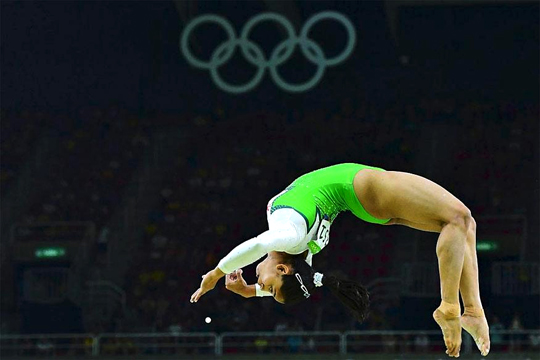
Dipa

The Tripura-girl, who is the country's first woman gymnast to qualify for the Olympics, managed to perform her much-appreciated 'Produnova' vault cleanly to secure 14.850 points after two attempts.

It was a nervous wait for the Indian after that. She had ended sixth after the third of five sub-divisions.

She dropped to 8th eventually when Canadian Shallon Olsen's terrific effort of 14.950 rejigged the overall standings.

But that was just about enough to secure her a place in the finals scheduled for August 14 as the top-8 made the cut for the medal round.

Dipa secured 7.000 on difficulty and 8.1 on execution in her first attempt. Her score for difficulty was a tad lower at 6.000 in the second attempt.

She landed low on her Produnova vault in the first attempt, while her second vault was a 'Tsuk double full twist' with step to the side.

Three-time world all-round champion Simone Biles topped the charts with a sensational score of 16.050. The American scored a brilliant 9.700 on execution in both her attempts.

North Korea's Jong Un Hong was a distant second after securing 15.683 followed by Switzerland's Giulia Steingruber (15.266).

In the other routines, Dipa secured 11.666 for her effort on the uneven bars, scoring low on difficulty but decent on execution. Later, Dipa scored 12.866 for her performance on the balance beam.

The floor exercise fetched Dipa a score of 12.033, which also included a 0.300 penalty.

Dipa, the first Indian woman gymnast to win a Commonwealth Games medal, stood a poor 47th in the all-round standings with a combined score of 51.665.

The eight gymnasts with the highest individual scores in each apparatus move on to compete for an individual event title in that apparatus.

The 24 men and 24 women with the highest combined individual totals move on to the all-around finals.

Comments

Add new comment

  • Coastaldigest.com reserves the right to delete or block any comments.
  • Coastaldigset.com is not responsible for its readers’ comments.
  • Comments that are abusive, incendiary or irrelevant are strictly prohibited.
  • Please use a genuine email ID and provide your name to avoid reject.
News Network
July 12,2020

New Delhi, Jul 12: Former India batsman Sachin Tendulkar has urged the International Cricket Council (ICC) to do away with 'umpire's call' whenever a team opts for a review regarding a leg-before wicket (LBW) decision.

The Master Blaster has also said that a batsman should be given out if the ball is hitting the stumps.

Whether more than 50 per cent of the ball is hitting the stumps or not should not be matter, he further stated.

"What per cent of the ball hits the stumps doesn't matter, if DRS shows us that the ball is hitting the stumps, it should be given out, regardless of the on-field call," Tendulkar tweeted.

With this tweet, the former India batsman also shared a video, in which he has a discussion with Brian Lara regarding the working of DRS.
"One thing I don't agree with, with the ICC, is the DRS they have been using for quite some time. It is the LBW decision where more than 50 per cent of the ball must be hitting the stumps for the on-field decision to be overturned," Tendulkar said in the video.

"The only reason they (the batsman or the bowler) have gone upstairs is that they are unhappy with the on-field decision, so when the decision goes to the third umpire, let the technology take over, just like in tennis, it's either in or out, there's nothing in between," he added.

This call for doing away with umpire's call has been recommended by many former players.
Whenever a verdict pops up as 'umpire's call, the decision of the on-field umpire is not changed, but the teams do not lose their review as well.

ICC recently introduced some changes to the game of cricket, and they gave all teams liberty of extra review as non-neutral umpires will be employed in Test matches due to the coronavirus pandemic.

As a result, all teams will now have three reviews in every innings of a Test match. 

Comments

Add new comment

  • Coastaldigest.com reserves the right to delete or block any comments.
  • Coastaldigset.com is not responsible for its readers’ comments.
  • Comments that are abusive, incendiary or irrelevant are strictly prohibited.
  • Please use a genuine email ID and provide your name to avoid reject.
News Network
May 15,2020

New Delhi, May 15: Former England skipper David Gower feels Sourav Ganguly has the right "political skills" to lead the ICC one day and he has already displayed that as BCCI president, which is a "far tougher job".

The elegant left-hander is very impressed with Ganguly's leadership abilities and believes that he has what it takes to head the global body in the future.

"One thing I have learnt over the years is that if you are going to run BCCI, you need to be many, many things. Having a reputation like he (Ganguly) has is a very good start, but you need to be a very deft politician.

"You need to have control of a million different things," Gower said ahead of "Q20", a unique chat show for the fans presented by 'GloFans'.

Gower reckons being president of the BCCI is the toughest job imaginable in world cricket.

"And of course, you need to be responsible for a game that is followed by, I mean, should we say a billion people here in India," he said.

"We all know about the immense following for cricket in India. So it is indeed a wonderful thing to behold. Sourav has the toughest task imaginable in charge of BCCI, but so far I would say the signs are very good.

"He has listened, given his own opinion and has pulled strings gently," he said.

Political skills are a must in administration and that's where Gower finds his fellow left-hander ticking all the boxes.

"He is a very, very good man and has those political skills. He has the right attitude and can keep things together and will do good job. And if you do a good job as BCCI chief in the future, who knows?

"But I would actually say the more important job, to be honest, is running BCCI. Being head of ICC is an honour, there is a lot that can be done by ICC, but actually look at the rankings, look at where the power is heading up. BCCI is definitely the bigger job," he said.

On the cricketing front, Gower believes World Test Championship has given the format much-needed context.

"The idea of this World Test Championship has come about for one very simple reason that people are worried about the survival of Tests. Back in the seventies, eighties, I don't think we needed context to be fair.

"Test cricket was very much more obviously the most important format and if there was anything to be judged by, it was the performances in Test matches both as an individual and as a team.

Comments

Add new comment

  • Coastaldigest.com reserves the right to delete or block any comments.
  • Coastaldigset.com is not responsible for its readers’ comments.
  • Comments that are abusive, incendiary or irrelevant are strictly prohibited.
  • Please use a genuine email ID and provide your name to avoid reject.
News Network
February 11,2020

Dubai, Feb 11: Two Indian players-- Akash Singh and Ravi Bishnoi -- and three Bangladeshis have been charged by the International Cricket Council (ICC) for involvement in the quarrel just after the U-19 cricket World Cup summit clash in Potchefstroom, South Africa on Sunday.

Akash and Bishnoi and three Bangladeshi players -- Md. Towhid Hridoy, Shamim Hossain and Rakibul Hasan -- were found guilty of breaching the ICC Code of Conduct after a few players from both sides nearly came to blows after Bangladesh beat India by three wickets to win their maiden U-19 World Cup title.

"Five players have been found guilty of a Level 3 breach of the ICC Code of Conduct for Players and Support Personnel ... (they) were charged with violating Article 2.21 of the code, whilst Bishnoi received a further charge of breaching Article 2.5," the ICC said in a statement.

"All five players have accepted the sanctions proposed by ICC U-19 Cricket World Cup Match Referee Graeme Labrooy," it added.

A near brawl broke out after Bangladesh’s historic win over India in the final. The Bangladesh players were aggressive during the Indian innings with lead pacer Shoriful Islam frequently sledging the Indian batsmen.

As soon as the match ended, Bangladeshi players rushed into the playing area.

"India's Akash accepted the charge of breaching Article 2.21 and has received a sanction of eight suspension points, which equates to six demerit points, which will remain on his record for two years," the ICC said.

Compatriot Bishnoi accepted the charge of breaching Article 2.21 and has received a sanction of five suspension points, which equates to five demerit points.

"Bishnoi also accepted a level 1 charge of breaching Article 2.5 for a separate incident during the match, where he used language, actions or gestures which disparage or which could provoke an aggressive reaction from a batter following the dismissal of Avishek Das in the 23rd over," said the ICC.

"For this he received a further two demerit points meaning seven demerit points will remain on his record for the next two years."

Bangladesh's Towhid Hridoy accepted the charge of breaching Article 2.21 and has received a sanction of ten suspension points, which equates to six demerit points, which will remain on his record for two years.

Shamim Hossain accepted the charge of breaching Article 2.21 and has received a sanction of eight suspension points, which equates to six demerit points, which will remain on his record for two years.

Rakibul Hasan accepted the charge of breaching Article 2.21 and has received a sanction of four suspension points, which equates to five demerit points, which will remain on his record for two years.

All charges were levelled by on-field umpires Sam Nogajski and Adrian Holdstock, third umpire Ravindra Wimalasiri as well as fourth umpire Patrick Bongni Jele. Level 3 breaches carry a minimum penalty of four suspension points and a maximum penalty of 12 suspension points.

The suspension points will be applied to the forthcoming international matches the players are most likely to participate in at either senior or U-19 level. One suspension point equals a player being ineligible for one ODI or T20I, U-19 or A team international match.

Comments

Add new comment

  • Coastaldigest.com reserves the right to delete or block any comments.
  • Coastaldigset.com is not responsible for its readers’ comments.
  • Comments that are abusive, incendiary or irrelevant are strictly prohibited.
  • Please use a genuine email ID and provide your name to avoid reject.