



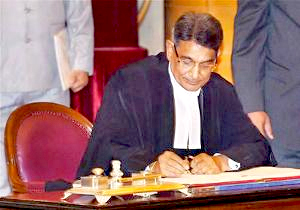
‘Do item number’: Gwalior additional judge resigns, alleging sexual harassment by HC judge

August 4, 2014

Sexual harassmentMumbai, Aug 4: In a shocking revelation of sexual harassment in the higher ranks of judiciary, an additional district and sessions judge in Gwalior resigned after alleging that she was sexually harassed by a High Court judge in the Madhya Pradesh high court.

Reportedly, the woman judge, who resigned on July 15, had alleged sexual harassment by a High Court judge in her complaint, saying that after she refused to yield to his advances, she was transferred from Gwalior to a remote place in Madhya Pradesh in the middle of her daughter’s academic session. She said, “I resigned in compelling and humiliating circumstances to save my dignity, womanhood, self-esteem and career of my daughter.”

The female judge was heading the Vishaka committee against sexual harassment in her district.

According to a report, the HC judge asked her to visit his bungalow alone and perform an 'item number' at a function in his residence. When she didn't turn up, he told her that he had "missed the opportunity of viewing a sexy and beautiful figure dancing on the floor and that he is desperate to see the same.

The story came to light after the female judge wrote a complaint to the Chief Justice of India RM Lodha, Supreme Court judges Justices H L Dattu, T S Thakur, Anil R Dave, Dipak Misra and Arun Misra, as well as the MP HC chief justice.

Lodha has sought report and will initiate action against the sitting judge of the Madhya Pradesh High Court.

Comments

Add new comment

  • Coastaldigest.com reserves the right to delete or block any comments.
  • Coastaldigset.com is not responsible for its readers’ comments.
  • Comments that are abusive, incendiary or irrelevant are strictly prohibited.
  • Please use a genuine email ID and provide your name to avoid reject.
News Network
June 24,2020

New Delhi, Jun 24: Union Civil Aviation Minister Hardeep Singh Puri on Tuesday said that nearly 1,25,000 Indians have returned from different countries under the Vande Bharat Mission.

He informed that 6,037 people returned to India from overseas on June 23.

"Vande Bharat continues to be a mission of hope and happiness for stranded and distressed Indians around the world. So far, nearly 125K Indians have come back on these evacuation flights and nearly 43K have flown out of India. Today (on Tuesday) 6,037 people returned from different countries," Puri said in a tweet.

As many as 2,50,087 Indian nationals stranded abroad have been repatriated since the beginning of Vande Bharat Mission last month, the Ministry of External Affairs (MEA) said last week.

The Vande Bharat Mission, which started from May 7 to evacuate Indians stranded abroad due to coronavirus pandemic, is in its third phase.
The recent phase commenced on June 11.

Under the third phase, India would have 550 flights including 191 feeder flights.

Comments

Add new comment

  • Coastaldigest.com reserves the right to delete or block any comments.
  • Coastaldigset.com is not responsible for its readers’ comments.
  • Comments that are abusive, incendiary or irrelevant are strictly prohibited.
  • Please use a genuine email ID and provide your name to avoid reject.
News Network
January 7,2020

Mumbai, Jan 7: People protesting against the JNU violence were evicted from Gateway of India here on Tuesday morning as roads were getting blocked and tourists and common people were facing problems, a police official said.

Police had appealed to the protesters to shift but they didn't listen, so they were "relocated" to Azad Maidan, the official said.

Hundreds of people, including students, women and senior citizens - who assembled at the iconic Gateway of India since Sunday midnight - demanded action against the culprits and called for Union Home Minister Amit Shah's resignation.

Violence broke out in the Jawaharlal Nehru University (JNU) in Delhi on Sunday night as masked men armed with sticks and rods attacked students and teachers and damaged property on the campus.

Comments

Add new comment

  • Coastaldigest.com reserves the right to delete or block any comments.
  • Coastaldigset.com is not responsible for its readers’ comments.
  • Comments that are abusive, incendiary or irrelevant are strictly prohibited.
  • Please use a genuine email ID and provide your name to avoid reject.
News Network
January 10,2020

New Delhi, Jan 10: One woman reported a rape every 15 minutes on average in India in 2018, according to government data released on Thursday, underlining its dismal reputation as one of the worst places in the world to be female.

The highly publicised gang rape and murder of a woman in a bus in New Delhi in 2012 brought tens of thousands onto the streets across India and spurred demands for action from film stars and politicians, leading to harsher punishments and new fast-track courts. But the violence has continued unabated.

Women reported almost 34,000 rapes in 2018, barely changed from the year before. Just over 85% led to charges, and 27% to convictions, according to the annual crime report released by the Ministry of Home Affairs.

Women's rights groups say crimes against women are often taken less seriously, and investigated by police lacking insensitivity.

"The country is still run by men, one (female prime minister) Indira Gandhi is not going to change things. Most judges are still men," said Lalitha Kumaramangalam, former chief of the National Commission for Women.

"There are very few forensic labs in the country, and fast-track courts have very few judges," said Kumaramangalam, a member of Prime Minister Narendra Modi's Bharatiya Janata Party (BJP).

The rape of a teenager in 2017 by former BJP state legislator Kuldeep Singh Sengar gained national attention when the accuser tried to kill herself the following year, accusing the police of inaction.

Five months before Sengar was convicted last December, the accuser's family had to be provided with security after a truck crashed into the car she was in, injuring her and killing two of her relatives.

A 2015 study by the Centre for Law & Policy Research in Bengaluru found that fast-track courts were indeed quicker, but did not handle a high volume of cases.

And a study in 2016 by Partners for Law in Development in New Delhi found that they still took an average of 8.5 months per case - more than four times the recommended period.

The government statistics understate the number of rapes as it is still considered a taboo to report rape in some parts of India and because rapes that end in the murder are counted purely as murders.

Comments

Add new comment

  • Coastaldigest.com reserves the right to delete or block any comments.
  • Coastaldigset.com is not responsible for its readers’ comments.
  • Comments that are abusive, incendiary or irrelevant are strictly prohibited.
  • Please use a genuine email ID and provide your name to avoid reject.