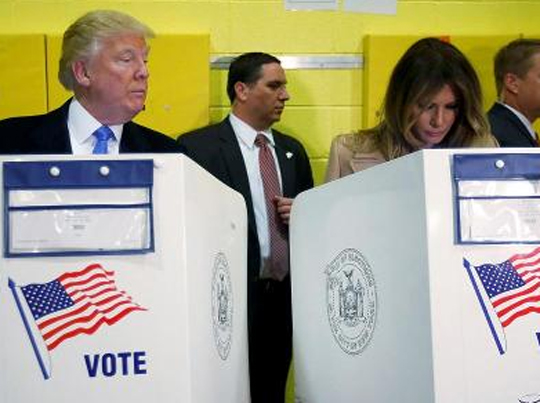
Donald Trump peeks at Melania's ballot

November 9, 2016

New York, Nov 9: Donald Trump cast his ballot under a hail of boos on Tuesday near his home in the Democratic stronghold of New York, in a historic presidential election pitting the billionaire Republican against Democrat Hillary Clinton.

peep

Hundreds of onlookers watched as Trump, his wife Melania, daughter Ivanka, and son-in-law Jared arrived Tuesday morning at their polling place at a public school on Manhattan's East Side.

Trump said: "it's a great honor, a tremendous honor" to be casting his ballot.

He said he's feeling confident about the outcome, citing "tremendous enthusiasm."

However, Donald Trump's day did not start as well as he might have planned.

As he went to cast his ballot, The Donald's fellow New Yorkers were characteristically warmhearted, greeting him with shouts of "New York hates you!"

When Trump was caught on camera seemingly taking a peek over the voting machine's blinder at his wife Melania's ballot, it would invite more mocking and launch the umpteenth social media election meme of 2016.

"Donald Trump doesn't even trust Melania to vote for him" joked @cafedotcom.

When a similar image emerged of Eric Trump stealing a glance toward his own wife Lara Yunaska @JuddLegum tweeted "Like father, like son."

Comments

Add new comment

  • Coastaldigest.com reserves the right to delete or block any comments.
  • Coastaldigset.com is not responsible for its readers’ comments.
  • Comments that are abusive, incendiary or irrelevant are strictly prohibited.
  • Please use a genuine email ID and provide your name to avoid reject.
News Network
April 21,2020

New York, Apr 21: Oil prices plunged below zero on Monday as demand for energy collapses amid the coronavirus pandemic and traders don't want to get stuck owning crude with nowhere to store it.

Stocks were also slipping on Wall Street in afternoon trading, with the S&P 500 down 0.9%, but the market's most dramatic action was by far in oil, where benchmark U.S. crude for May delivery plummeted to negative $3.70 per barrel, as of 2:15 pm. Eastern time.

Much of the drop into negative territory was chalked up to technical reasons — the May delivery contract is close to expiring so it was seeing less trading volume, which can exacerbate swings. But prices for deliveries even further into the future, which were seeing larger trading volumes, also plunged.

Demand for oil has collapsed so much due to the coronavirus pandemic that facilities for storing crude are nearly full.

Tanks could hit their limits within three weeks, according to Chris Midgley, head of analytics at S&P Global Platts.

Benchmark U.S. crude oil for June delivery, which shows a more ”normal” price, fell 14.8% to $21.32 per barrel, as factories and automobiles around the world remain idled. Big oil producers have announced cutbacks in production in hopes of better balancing supplies with demand, but many analysts say it's not enough.

“Basically, bears are out for blood,” analyst Naeem Aslam of Avatrade said in a report. “The steep fall in the price is because of the lack of sufficient demand and lack of storage place given the fact that the production cut has failed to address the supply glut.”

Halliburton swung between gains and sharp losses, even though it reported stronger results for the first three months of 2020 than analysts expected. The oilfield engineering company said that the pandemic has created so much turmoil in the industry that it “cannot reasonably estimate” how long the hit will last. It expects a further decline in revenue and profitability for the rest of 2020, particularly in North America.

Brent crude, the international standard, was down $1.78 to $26.30 per barrel. .

In the stock market, the mild drops ate into some of the big gains made since late March, driven lately by investors looking ahead to parts of the economy possibly reopening as infections level off in hard-hit areas.

Pessimists have called the rally overdone, pointing to the severe economic pain sweeping the world and continued uncertainty about how long it will last.

The Dow Jones Industrial Average was down 364 points, or 1.5%, to 23,887. The Nasdaq was down 0.1%..

More gains from companies that are winners in the new stay-at-home economy helped limit the market's losses Amazon rose 1.4%, and Netflix jumped 3.8% as people shut in at home buy staples and look to fill their time. Clorox likewise rose toward a new record and was up 1% as households and businesses that remain open look to stay clean.

In Tokyo the Nikkei 225 fell 1.1% after Japan reported that its exports fell nearly 12% in March from a year earlier as the pandemic hammered demand in its two biggest markets, the U.S. and China.

The Hang Seng index in Hong Kong lost 0.2%, and South Korea's Kospi fell 0.8%.

European markets were modestly higher The German DAX was up 0.5%, the French CAC 40 was up 0.7% and the FTSE 100 in London gained 0.7%.

In a sign of continued caution in the market, Treasury yields remained extremely low. The yield on the 10-year Treasury slipped to 0.64% from 0.65% late Friday. It started the year near 1.90%. Bond yields drop when their prices rise, and investors tend to buy Treasurys when they're worried about the economy.

Stocks have been on a generally upward swing recently, and the S&P 500 just closed out its first back-to-back weekly gain since the market began selling off in February. Promises of massive aid for the economy and markets by the Federal Reserve and U.S. government ignited the rally, which sent the S&P 500 up as much as 28.5% since a low on March 23.

More recently, countries around the world have tentatively eased up on business-shutdown restrictions put in place to slow the spread of the virus.

But health experts warn the pandemic is far from over and new flareups could ignite if governments rush to allow ”normal” life to return prematurely.

The S&P 500 remains about 15% below its record high in February as millions more U.S. workers file for unemployment every week amid the shutdowns.

Many analysts also warn that a significant part of the recent recovery in stocks is due to the expectation among some investors that the economy will rebound sharply once economic quarantines are lifted. They're essentially predicting that a line chart of the economy will ultimately resemble the letter “V,” with a wild ride down but then a quick pivot to a vigorous recovery.

That may be to optimistic. “We caution that a U-shaped recovery is also quite likely,” where the economy bottoms out and stays at that low level for a while before recovering, strategists at Barclays warned in a recent report.

Without strong testing programs for COVID-19, businesses likely won't feel comfortable bringing back their full workforces for a while.

”With risk assets now overbought, the chance for a correction has increased,” Morgan Stanley strategists wrote in a report.

Comments

Add new comment

  • Coastaldigest.com reserves the right to delete or block any comments.
  • Coastaldigset.com is not responsible for its readers’ comments.
  • Comments that are abusive, incendiary or irrelevant are strictly prohibited.
  • Please use a genuine email ID and provide your name to avoid reject.
News Network
May 20,2020

Kensington (United States), May 20: The world cut its daily carbon dioxide emissions by 17% at the peak of the pandemic shutdown last month, a new study found.

But with life and heat-trapping gas levels inching back toward normal, the brief pollution break will likely be “a drop in the ocean" when it comes to climate change, scientists said.

In their study of carbon dioxide emissions during the coronavirus pandemic, an international team of scientists calculated that pollution levels are heading back up — and for the year will end up between 4% and 7% lower than 2019 levels.

That's still the biggest annual drop in carbon emissions since World War II.

It'll be 7% if the strictest lockdown rules remain all year long across much of the globe, 4% if they are lifted soon.

For a week in April, the United States cut its carbon dioxide levels by about one-third.

China, the world's biggest emitter of heat-trapping gases, sliced its carbon pollution by nearly a quarter in February, according to a study Tuesday in the journal Nature Climate Change. India and Europe cut emissions by 26% and 27% respectively.

The biggest global drop was from April 4 through 9 when the world was spewing 18.7 million tons (17 million metric tons) of carbon pollution a day less than it was doing on New Year's Day.

Such low global emission levels haven't been recorded since 2006. But if the world returns to its slowly increasing pollution levels next year, the temporary reduction amounts to ''a drop in the ocean," said study lead author Corinne LeQuere, a climate scientist at the University of East Anglia.

“It's like you have a bath filled with water and you're turning off the tap for 10 seconds," she said.

By April 30, the world carbon pollution levels had grown by 3.3 million tons (3 million metric tons) a day from its low point earlier in the month. Carbon dioxide stays in the air for about a century.

Outside experts praised the study as the most comprehensive yet, saying it shows how much effort is needed to prevent dangerous levels of further global warming.

“That underscores a simple truth: Individual behavior alone ... won't get us there,” Pennsylvania State University climate scientist Michael Mann, who wasn't part of the study, said in an email.

“We need fundamental structural change.”

If the world could keep up annual emission cuts like this without a pandemic for a couple decades, there's a decent chance Earth can avoid warming another 1.8 degrees (1 degree Celsius) of warming from now, study authors said. But getting the type of yearly cuts to reach that international goal is unlikely, they said.

If next year returns to 2019 pollution levels, it means the world has only bought about a year's delay in hitting the extra 1.8 degrees (1 degree Celsius) of warming that leaders are trying to avoid, LeQuere said. That level could still occur anywhere from 2050 to 2070, the authors said.

The study was carried out by Global Carbon Project, a consortium of international scientists that produces the authoritative annual estimate of carbon dioxide emissions. They looked at 450 databases showing daily energy use and introduced a measurement scale for pandemic-related societal “confinement” in its estimates.

Nearly half the emission reductions came from less transportation pollution, mostly involving cars and trucks, the authors said. By contrast, the study found that drastic reductions in air travel only accounted for 10% of the overall pollution drop.

In the US, the biggest pollution declines were seen in California and Washington with plunges of more than 40%.

Comments

Add new comment

  • Coastaldigest.com reserves the right to delete or block any comments.
  • Coastaldigset.com is not responsible for its readers’ comments.
  • Comments that are abusive, incendiary or irrelevant are strictly prohibited.
  • Please use a genuine email ID and provide your name to avoid reject.
News Network
February 24,2020

Beijing, Feb 24: The lockdown of Guo Jing's neighbourhood in Wuhan -- the city at the heart of China's new coronavirus epidemic -- came suddenly and without warning.

Unable to go out, the 29-year-old is now sealed inside her compound where she has to depend on online group-buying services to get food.

"Living for at least another month isn't an issue," Guo told news agency, explaining that she had her own stash of pickled vegetables and salted eggs.

But what scares her most is the lack of control -- first, the entire city was sealed off, and then residents were limited to exiting their compound once every three days.

Now even that has been taken away.

Guo is among some 11 million residents in Wuhan, a city in central Hubei province that has been under effective quarantine since January 23 as Chinese authorities race to contain the epidemic.

Since then, its people have faced a number of tightening controls over daily life as the death toll from the virus swelled to over 2,500 in China alone.

But the new rules this month barring residents from leaving their neighbourhoods are the most restrictive yet -- and for some, threaten their livelihoods.

"I still don't know where to buy things once we've finished eating what we have at home," said Pan Hongsheng, who lives with his wife and two children.

Some neighbourhoods have organised group-buying services, where supermarkets deliver orders in bulk.

But in Pan's community, "no one cares".

"The three-year-old doesn't even have any milk powder left," Pan told news agency, adding that he has been unable to send medicine to his in-laws -- both in their eighties -- as they live in a different area.

"I feel like a refugee."

The "closed management of neighbourhoods is bound to bring some inconvenience to the lives of the people", Qian Yuankun, vice secretary of Hubei's Communist Party committee, said at a press briefing last week.

Authorities on Monday allowed healthy non-residents of the city to leave if they never had contact with patients, but restrictions remained on those who live in Wuhan.

Demand for group-buying food delivery services has rocketed with the new restrictions, with supermarkets and neighbourhood committees scrambling to fill orders.

Most group-buying services operate through Chinese messaging app WeChat, which has ad-hoc chat groups for meat, vegetables, milk -- even "hot dry noodles", a famous Wuhan dish.

More sophisticated shops and compounds have their own mini-app inside WeChat, where residents can choose packages priced by weight before orders are sent in bulk to grocery stores.

In Guo's neighbourhood, for instance, a 6.5-kilogramme (14.3-pound) set of five vegetables, including potatoes and baby cabbage, costs 50 yuan ($7.11).

"You have no way to choose what you like to eat," Guo said. "You cannot have personal preferences anymore."

The group-buying model is also more difficult for smaller communities to adopt, as supermarkets have minimum order requirements for delivery.

"To be honest, there's nothing we can do," said Yang Nan, manager of Lao Cun Zhang supermarket, which requires a minimum of 30 orders.

"We only have four cars," she said, explaining that the store did not have the staff to handle smaller orders.

Another supermarket told AFP it capped its daily delivery load to 1,000 orders per day.

"Hiring staff is difficult," said Wang Xiuwen, who works at the store's logistics division, adding that they are wary about hiring too many outsiders for fear of infection.

Closing off communities has split the city into silos, with different neighbourhoods rolling out controls of varying intensity.

In some compounds, residents have easier access to food -- albeit a smaller selection than normal -- and one woman said her family pays delivery drivers to run grocery errands.

Her compound has not been sealed off either, the 24-year-old told AFP under condition of anonymity, though they are limited to one person leaving at a time.

Some districts have implemented their own rules, such as prohibiting supermarkets from selling to individuals, forcing neighbourhoods to buy in bulk or not at all.

"In the neighbourhood where I live, the reality is really terrible," said David Dai, who is based on the outskirts of Wuhan.

Though his apartment complex has organised group-buying, Dai said residents were unhappy with price and quality.

"A lot of tomatoes, a lot of onions -- they were already rotten," he told , estimating over a third of the food had to be thrown away.

His family must "totally depend" on themselves, added the 49-year-old, who has resorted to saving and drying turnip skins to add nutrients to future meals.

The uncertainty of not knowing when the controls will be lifted is also frustrating, said Ma Chen, a man in his 30s who lives alone.

"I have no way of knowing how much (food) I should buy."

Comments

Add new comment

  • Coastaldigest.com reserves the right to delete or block any comments.
  • Coastaldigset.com is not responsible for its readers’ comments.
  • Comments that are abusive, incendiary or irrelevant are strictly prohibited.
  • Please use a genuine email ID and provide your name to avoid reject.