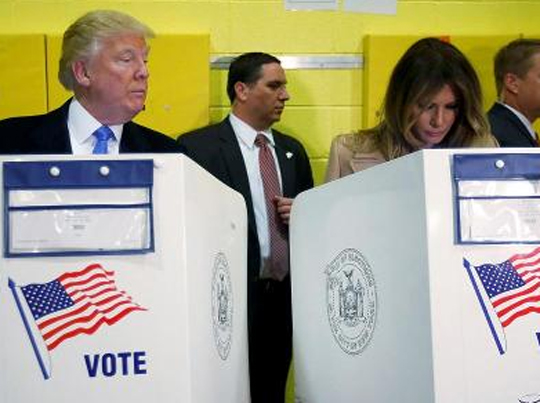
Donald Trump peeks at Melania's ballot

November 9, 2016

New York, Nov 9: Donald Trump cast his ballot under a hail of boos on Tuesday near his home in the Democratic stronghold of New York, in a historic presidential election pitting the billionaire Republican against Democrat Hillary Clinton.

peep

Hundreds of onlookers watched as Trump, his wife Melania, daughter Ivanka, and son-in-law Jared arrived Tuesday morning at their polling place at a public school on Manhattan's East Side.

Trump said: "it's a great honor, a tremendous honor" to be casting his ballot.

He said he's feeling confident about the outcome, citing "tremendous enthusiasm."

However, Donald Trump's day did not start as well as he might have planned.

As he went to cast his ballot, The Donald's fellow New Yorkers were characteristically warmhearted, greeting him with shouts of "New York hates you!"

When Trump was caught on camera seemingly taking a peek over the voting machine's blinder at his wife Melania's ballot, it would invite more mocking and launch the umpteenth social media election meme of 2016.

"Donald Trump doesn't even trust Melania to vote for him" joked @cafedotcom.

When a similar image emerged of Eric Trump stealing a glance toward his own wife Lara Yunaska @JuddLegum tweeted "Like father, like son."

Comments

Add new comment

  • Coastaldigest.com reserves the right to delete or block any comments.
  • Coastaldigset.com is not responsible for its readers’ comments.
  • Comments that are abusive, incendiary or irrelevant are strictly prohibited.
  • Please use a genuine email ID and provide your name to avoid reject.
Agencies
February 7,2020

Washington DC, Feb 7: United States on Thursday asked all countries to speak out against mistreatment of Muslims living in China especially in Xinjiang region by Chinese authorities.

Alice G. Wells, Principal Deputy Assistant Secretary for the Bureau of South and Central Asian Affairs, while talking to reporters appreciated the steps taken by Central Asian states to ensure that no ethnic Kazakh, Uighur, Kyrgyz is refouled to China and that the human rights of individuals who reach Central Asia are observed.

"As a matter of principle we urge all countries, not just Central Asian countries, to speak out against human rights abuses that are evident against Muslims in all of China but certainly in Xinjiang. And the countries of Central Asia, several of the countries of Central Asia have deep first-hand knowledge of those abuses given the direct impact it has on their own populations who have loved ones, family members, that are swept up in these detention centers," Wells said.

"We appreciate steps by Central Asian states to ensure that no ethnic Kazakh, Uighur, Kyrgyz is refouled to China, that the human rights of individuals who reach Central Asia are observed. And we also appreciate I think what countries like Kazakhstan can do to promote the free and safe travel of compatriots, ethnic compatriots across the border," she added.

China has been accused of oppressing the Uighurs by sending them to mass detention camps, interfering in their religious activities and sending the community to undergo some form of forceful re-education or indoctrination. However, Pakistan has stayed mum over this issue.

As many as 1 million people, or about 7 per cent of Xinjiang's Muslim population, have been incarcerated in a sprawling network of "political re-education" camps, according to US and UN studies.

In 2018, the New York-based Human Rights Watch released a report accusing Beijing of a "systematic campaign of human rights violations" against Uighur Muslims in Xinjiang.

Beijing says its camps in Xinjiang are "vocational training centres."

Last year, several documents leaked revealed details about Beijing's fears about religious extremism and its wholesale crackdown on Uighurs.

The US had called on the Chinese government to "immediately release all of those who are arbitrarily detained and to end its draconian policies that have terrorised its own citizens in Xinjiang."

Comments

Add new comment

  • Coastaldigest.com reserves the right to delete or block any comments.
  • Coastaldigset.com is not responsible for its readers’ comments.
  • Comments that are abusive, incendiary or irrelevant are strictly prohibited.
  • Please use a genuine email ID and provide your name to avoid reject.
News Network
May 30,2020

May 30: Warning of the tightrope walk ahead as governments battle the coronavirus crisis, Nobel laureate Peter Charles Doherty has expressed concern about densely populated countries such as India relaxing lockdown norms while also describing a complete shutdown as “an economic and social impossibility”.

The Australian immunologist, who cautioned that the number of COVID-19 cases will rise in the coming days, said the earliest time frame for an effective vaccine “going into large numbers of people” is nine to 12 months.

"If all goes well with testing, we could know if some of the candidate vaccines are both safe and effective as early as September/October. Then, rolling a vaccine out will depend on the type of product and how quickly it can be made, put in vials and so forth," Doherty told PTI in an email interview from Melbourne.

The novel coronavirus, he added, does not change fast like influenza and, from what is known so far, “the same vaccine should work everywhere”.

Doherty, who is with the Department of Microbiology and Immunology at the Doherty Institute, University of Melbourne, won the Nobel Prize for Medicine in 1996 for his discovery of how the body’s immune system distinguishes virus-infected cells from normal ones.

Discussing the lockdown, he said, "If it was purely a matter of hard science, everywhere should stay locked down. But that’s pretty much an economic and social impossibility.”

The expectation, he said, is the numbers will rise and limiting spread will depend on people acting responsibly and the capacity for rapid response and extensive contact testing.

“And in a densely populated country like India I think that it will be very difficult," the scientist said.

Several countries, including India, began relaxing lockdown norms in mid-May despite the WHO’s warning about a second wave. India’s lockdown began on March 25 and has since been extended. The fourth phase ends on Sunday.

Asked whether there are any alternatives to a lockdown, the 79-year-old said, "There is no other option other than closing borders. South Korea, for example, conducted massive, intensive testing and contact tracing in a wealthy country with a very disciplined population. Otherwise, not till we have effective vaccines."

He added that he personally doesn’t see the point of closing borders for people coming in if there’s already a high incidence of disease in the community, “unless it’s to avoid the need to care for them and use scarce hospital beds".

According to Doherty, the coronavirus "is a new virus which has come straight out of nature".

“It (the virus) has moved so rapidly across the world because of people travelling on international planes as well as tourist ships," he added.

The immunologist also warned against the use of hydroxychloroquine to treat COVID-19, and said current and planned trials of the anti-malaria drug should be stopped.

“My understanding is that the use of the drug in severe disease is definitely contra-indicated, but it’s not yet clear whether, if taken under medical supervision, it could have some useful effect if taken early on, or as a preventive. Those trials just haven’t been done properly," Doherty noted.

The Indian Council of Medical Research (ICMR) has backed the use of hydroxychloroquine as a preventive against COVID-19 even after the WHO suspended clinical trials of the drug citing safety concerns.

Asked whether plasma therapy can be an effective treatment for COVID-19, Doherty said, "We lack good properly controlled trials but, especially if the plasma has been tested for antibody levels and there’s evidence of good activity, it could be helpful. If I had the disease and was offered plasma therapy I would certainly accept, but I would not take hydroxychloroquine."

Doherty is also very optimistic about herd immunity developing against the SARS-CoV-2 infection.

"We think that (herd immunity) will cut in and have an obvious effect when, say, 60 per cent of people have been infected. Best hope is to boost herd immunity with a vaccine," he stated.

Herd immunity is a form of indirect protection from infectious disease that occurs when a large percentage of a population has become immune to an infection, whether through vaccination or previous infections.

The number of COVID-19 cases have crossed 5.9 million and the fatalities 3,65,000, according to the Johns Hopkins University on Saturday. 

In India, the death toll has risen to 4,971 and the number of cases to 1,73,763, according to the Union Health Ministry on Saturday.

Several states, including Bihar, Uttar Pradesh, Madhya Pradesh, Jharkhand and Chhattisgarh, have reported a rise in number since lockdown norms were relaxed in early May and migrant workers reached home.

In Uttar Pradesh, for instance, the number of infections rose from around 3,000 on May 4 to 6,532 on May 26. Similarly, Bihar’s numbers increased from around 500 to over 2,700 in the period.


Comments

Add new comment

  • Coastaldigest.com reserves the right to delete or block any comments.
  • Coastaldigset.com is not responsible for its readers’ comments.
  • Comments that are abusive, incendiary or irrelevant are strictly prohibited.
  • Please use a genuine email ID and provide your name to avoid reject.
Agencies
August 7,2020

Colombo, Aug 7: Sri Lankan President Gotabaya Rajapaksa's party and its allies won an overwhelming two-thirds majority in a parliament election, results showed on Friday, giving him the power to enact sweeping changes to the constitution.

The governing Sri Lanka Podujana Peramuna and its allies had won 150 seats in the 225-member parliament, according to the tally published by the election commission from Wednesday's vote.

Rajapaksa had sought a two-thirds majority in parliament to be able to restore full executive powers to the presidency, which he says are necessary to implement his agenda to make the tiny island economically and militarily secure.

He is likely to install his older brother and former President Mahinda Rajapaksa as the next prime minister. The brothers are best known for crushing the Tamil Tiger rebels fighting for a separate homeland for minority Tamils during the elder Rajapaksa's presidency in 2009.

On a congratulatory phone call from Prime Minister Narendra Modi of India, which is keen to check Chinese influence on its southern neighbour, Mahinda Rajapaksa vowed to deepen ties between the two countries.

"With the strong support of the people of Sri Lanka, I look forward to working with you closely to further enhance the long-standing cooperation between our two countries," he told Modi. "Sri Lanka and India are friends and relations."

The tourism-dependent nation of 21 million people has been struggling economically since deadly Islamist militant attacks on hotels and churches last year followed by lockdowns to slow the spread of the coronavirus. 

Comments

Add new comment

  • Coastaldigest.com reserves the right to delete or block any comments.
  • Coastaldigset.com is not responsible for its readers’ comments.
  • Comments that are abusive, incendiary or irrelevant are strictly prohibited.
  • Please use a genuine email ID and provide your name to avoid reject.