



Donald Trump wins key states, edges closer to White House

November 9, 2016

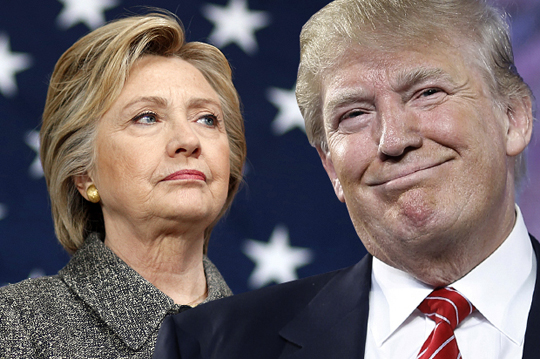
Washington, Nov 9: Donald Trump was on the cusp of creating history as he inched closer to clinching the US presidency with a strong showing in battleground states helping him trump Hillary Clinton in the knife-edge race.
hillary trump7

Major US news networks projected Republican candidate Trump to have won the crucial battleground states of Florida, Ohio and North Carolina.

Clinton, 69, who grabbed the traditional Democratic strongholds of California and Virginia, was now facing a tough challenge from the 70-year-old real estate billionaire, who joined politics only 18 months ago.

"Trump moves closer to White House," said Politico as Trump's total of electoral college votes -- as per CNN projections -- touched 232, against Clinton's 209.To win the presidential election, a candidate needs 270 of the 538 electoral college votes.

The New York Times said there is an increasing chance of Trump being elected as the next president of the United States.

CNN projected that Trump had won 23 states while Clinton emerged victorious in 17.

According to the channel, Trump won Florida (29 electoral college votes), Georgia (16), Ohio (18), North Carolina (15), North Dakota (3), South Dakota (3), Nebraska (4), Kansas (6), Oklahoma (7), Texas (38), Wyoming (3), Indiana (11), Kentucky (8), Tennessee (11), Mississippi (6), Arkansas (6), Louisiana (8), West Virginia (5), Alabama (9), South Carolina (9), Montana (3), Idaho (5) and Missouri (10).

Clinton emerged victorious in California (55), Hawaii (4), Illinois (20), New York (29), New Jersey (14), Maryland (10), District of Columbia (3), Vermont (3), Massachusetts (11), Connecticut (7), Delaware (3), Colorado (9), New Mexico (5), Virginia (13), Oregon (7), Washington (12) and Rhode Island (4).

Trump, who ran an improbable and often ugly campaign against the establishment, was holding on to small but significant leads in a series of key states, upending months of polling that had given the advantage to Clinton and raised Republican hopes of seizing back the White House.

"Reaction to the prospect of a Trump presidency rippled across the globe, with financial markets abroad falling as American television networks raised the prospect that Mrs Clinton might lose," The New York Times said.

Virginia, won by Clinton, has a significant Indian- American population and is home to Democratic vice- presidential nominee, Senator Tim Kaine.

In terms of overall vote percentage, Trump has so far received 48.5 per cent of the votes counted so far as against 47 per cent gained by Clinton.

The incoming returns follow a frenzied day of voting across America marked by long lines and last-minute appeals for support from both campaigns.

Comments

lavanya
 - 
Wednesday, 9 Nov 2016

poojary papa sothe, like always

Add new comment

  • Coastaldigest.com reserves the right to delete or block any comments.
  • Coastaldigset.com is not responsible for its readers’ comments.
  • Comments that are abusive, incendiary or irrelevant are strictly prohibited.
  • Please use a genuine email ID and provide your name to avoid reject.
News Network
May 30,2020

May 30: Warning of the tightrope walk ahead as governments battle the coronavirus crisis, Nobel laureate Peter Charles Doherty has expressed concern about densely populated countries such as India relaxing lockdown norms while also describing a complete shutdown as “an economic and social impossibility”.

The Australian immunologist, who cautioned that the number of COVID-19 cases will rise in the coming days, said the earliest time frame for an effective vaccine “going into large numbers of people” is nine to 12 months.

"If all goes well with testing, we could know if some of the candidate vaccines are both safe and effective as early as September/October. Then, rolling a vaccine out will depend on the type of product and how quickly it can be made, put in vials and so forth," Doherty told PTI in an email interview from Melbourne.

The novel coronavirus, he added, does not change fast like influenza and, from what is known so far, “the same vaccine should work everywhere”.

Doherty, who is with the Department of Microbiology and Immunology at the Doherty Institute, University of Melbourne, won the Nobel Prize for Medicine in 1996 for his discovery of how the body’s immune system distinguishes virus-infected cells from normal ones.

Discussing the lockdown, he said, "If it was purely a matter of hard science, everywhere should stay locked down. But that’s pretty much an economic and social impossibility.”

The expectation, he said, is the numbers will rise and limiting spread will depend on people acting responsibly and the capacity for rapid response and extensive contact testing.

“And in a densely populated country like India I think that it will be very difficult," the scientist said.

Several countries, including India, began relaxing lockdown norms in mid-May despite the WHO’s warning about a second wave. India’s lockdown began on March 25 and has since been extended. The fourth phase ends on Sunday.

Asked whether there are any alternatives to a lockdown, the 79-year-old said, "There is no other option other than closing borders. South Korea, for example, conducted massive, intensive testing and contact tracing in a wealthy country with a very disciplined population. Otherwise, not till we have effective vaccines."

He added that he personally doesn’t see the point of closing borders for people coming in if there’s already a high incidence of disease in the community, “unless it’s to avoid the need to care for them and use scarce hospital beds".

According to Doherty, the coronavirus "is a new virus which has come straight out of nature".

“It (the virus) has moved so rapidly across the world because of people travelling on international planes as well as tourist ships," he added.

The immunologist also warned against the use of hydroxychloroquine to treat COVID-19, and said current and planned trials of the anti-malaria drug should be stopped.

“My understanding is that the use of the drug in severe disease is definitely contra-indicated, but it’s not yet clear whether, if taken under medical supervision, it could have some useful effect if taken early on, or as a preventive. Those trials just haven’t been done properly," Doherty noted.

The Indian Council of Medical Research (ICMR) has backed the use of hydroxychloroquine as a preventive against COVID-19 even after the WHO suspended clinical trials of the drug citing safety concerns.

Asked whether plasma therapy can be an effective treatment for COVID-19, Doherty said, "We lack good properly controlled trials but, especially if the plasma has been tested for antibody levels and there’s evidence of good activity, it could be helpful. If I had the disease and was offered plasma therapy I would certainly accept, but I would not take hydroxychloroquine."

Doherty is also very optimistic about herd immunity developing against the SARS-CoV-2 infection.

"We think that (herd immunity) will cut in and have an obvious effect when, say, 60 per cent of people have been infected. Best hope is to boost herd immunity with a vaccine," he stated.

Herd immunity is a form of indirect protection from infectious disease that occurs when a large percentage of a population has become immune to an infection, whether through vaccination or previous infections.

The number of COVID-19 cases have crossed 5.9 million and the fatalities 3,65,000, according to the Johns Hopkins University on Saturday. 

In India, the death toll has risen to 4,971 and the number of cases to 1,73,763, according to the Union Health Ministry on Saturday.

Several states, including Bihar, Uttar Pradesh, Madhya Pradesh, Jharkhand and Chhattisgarh, have reported a rise in number since lockdown norms were relaxed in early May and migrant workers reached home.

In Uttar Pradesh, for instance, the number of infections rose from around 3,000 on May 4 to 6,532 on May 26. Similarly, Bihar’s numbers increased from around 500 to over 2,700 in the period.

Comments

Add new comment

  • Coastaldigest.com reserves the right to delete or block any comments.
  • Coastaldigset.com is not responsible for its readers’ comments.
  • Comments that are abusive, incendiary or irrelevant are strictly prohibited.
  • Please use a genuine email ID and provide your name to avoid reject.
News Network
May 20,2020

London, May 20: The current physical distancing guidelines of 6 feet may be insufficient to prevent COVID-19 transmission, according to a study which says a mild cough in low wind speeds can propel saliva droplets by as much as 18 feet.

Researchers, including those from the University of Nicosia in Cyprus, said a good baseline for studying the airborne transmission of viruses, like the one behind the COVID-19 pandemic, is a deeper understanding of how particles travel through the air when people cough.

In the study, published in the journal Physics of Fluids, they said even with a slight breeze of about four kilometres per hour (kph), saliva travels 18 feet in 5 seconds.

"The droplet cloud will affect both adults and children of different heights," said study co-author Dimitris Drikakis from the University of Nicosia.

According to the scientists, shorter adults and children could be at higher risk if they are located within the trajectory of the saliva droplets.

They said saliva is a complex fluid, which travels suspended in a bulk of surrounding air released by a cough, adding that many factors affect how saliva droplets travel in the air.

These factors, the study noted, include the size and number of droplets, how they interact with one another and the surrounding air as they disperse and evaporate, how heat and mass are transferred, and the humidity and temperature of the surrounding air.

In the study, the scientists created a computer simulation to examine the state of every saliva droplet moving through the air in front of a coughing person.

The model considered the effects of humidity, dispersion force, interactions of molecules of saliva and air, and how the droplets change from liquid to vapour and evaporate, along with a grid representing the space in front of a coughing person.

Each grid, the scientists said, holds information about variables like pressure, fluid velocity, temperature, droplet mass, and droplet position.

The study analysed the fates of nearly 1,008 simulated saliva droplets, and solved as many as 3.7 million equations.

"The purpose of the mathematical modelling and simulation is to take into account all the real coupling or interaction mechanisms that may take place between the main bulk fluid flow and the saliva droplets, and between the saliva droplets themselves," explained Talib Dbouk, another co-author of the study.

However, the researchers added that further studies are needed to determine the effect of ground surface temperature on the behaviour of saliva in air.

They also believe that indoor environments, especially ones with air conditioning, may significantly affect the particle movement through air.

This work is important since it concerns safety distance guidelines, and advances the understanding of the transmission of airborne diseases, Drikakis said.

Comments

Add new comment

  • Coastaldigest.com reserves the right to delete or block any comments.
  • Coastaldigset.com is not responsible for its readers’ comments.
  • Comments that are abusive, incendiary or irrelevant are strictly prohibited.
  • Please use a genuine email ID and provide your name to avoid reject.
News Network
June 24,2020

Washington, Jun 24: An Indian restaurant in the Sante Fe City of New Mexico, owned by a Sikh, was broken into and vandalised with hate messages scrawled on its walls, a media report said Tuesday.

The damage caused to India Palace restaurant is estimated to be worth USD 100,000, local Santa Fe Reporter said adding that the vandalisation is being investigated by local police and the FBI.

Sikh American Legal Defense and Education Fund (SALDEF) has condemned the incident.

"This kind of hate and violence is unacceptable and swift action must be taken to ensure the safety and security of all Americans," said Kiran Kaur Gill SALDEF executive director.

According to the local daily, tables were overturned, glassware was smashed into piles on the floor, wine racks were emptied, a statue of a goddess was beheaded and computers were stolen.

The vandals also turned over and destroyed food warmers while the front desk area was devastated, plates smashed and the kitchen rendered completely unusable, it said.

"I walked into the kitchen, I saw everything and I was like, hold on, what? What is going on here?" owner Baljit Singh told Santa Fe Reporter. "White power," "Trump 2020," "go home," and far worse were spray-painted on walls, doors, counters and any other available surface.

"Some phrases contained threats of violence and derogatory racial slurs," the daily said.

"Santa Fe is a peaceful town, and the Sikh community has lived here, beautifully integrated, since the 60s," said SALDEF board member Simran Singh, who lives minutes away from the restaurant.

"Tensions have flared recently with the reinvigoration of the Black Lives Matter movement and the removal of statues associated with Spanish colonisers of this area, who committed a number of atrocities," he said.

"Nevertheless, we are seeing an outpouring of love and support around the city and in my experience, our neighbors love and appreciate us, as we love and appreciate them," he added.

SALDEF said that it has seen an unprecedented rise in hate crimes including the April 29 incident wherein a Sikh American Lakhwant Singh was brutally attacked by a man identified as Eric Breeman in Lakewood, Colorado.

Lakhwant Singh was told to "go back to your country," while being attacked. No formal hate crime charges have been brought against the attacker.

Comments

Add new comment

  • Coastaldigest.com reserves the right to delete or block any comments.
  • Coastaldigset.com is not responsible for its readers’ comments.
  • Comments that are abusive, incendiary or irrelevant are strictly prohibited.
  • Please use a genuine email ID and provide your name to avoid reject.