


Donald Trump's Secretary Of State Pick Rex Tillerson Forged Ties With Putin Over Decades

December 14, 2016

Dec 14: When ExxonMobil chief executive Rex Tillerson showed up in June at the annual St. Petersburg international economic forum that is dubbed Russia's Davos, he was asked about the impact international sanctions on Russia were having on his company, which had abandoned ambitious drilling plans there.
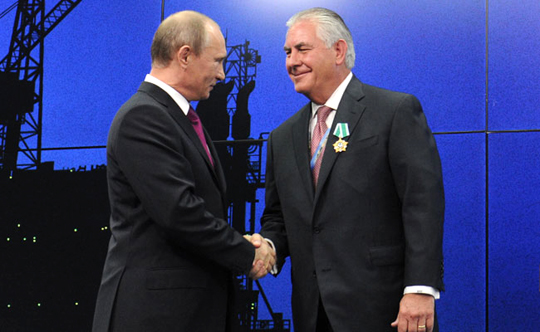
Rex

"It's a question for the government - if you find anyone from the U.S. government who's willing to answer this question," he replied to laughter from the audience of Western executives, who had been lavishing praise on their Russian hosts.

It was the first time in three years that Tillerson or most other chief executives had attended the confab, for the moment laying aside friction over Russia's abrupt annexation of Crimea and its backing of violent separatist forces in eastern Ukraine. Back in Washington, the State Department was not amused. State Department spokesman John Kirby commented that "most American companies understand" that taking part in the forum "sends the wrong message about the acceptability of Russia's actions."

Six months later, Tillerson's relationships with autocrats remain a source of friction after his surprise appointment by President-elect Donald Trump to be secretary of state. The ExxonMobil chief's ties to Russia have alarmed hawks in Congress, who vow to scrutinize Tillerson's good working relationship with President Putin and the latter's longtime confidante Igor Sechin, the chairman of the Russian petroleum giant Rosneft.

With his nomination, the 64-year-old Tillerson has been thrust into the long-standing U.S. foreign-policy divide separating those who value pragmatism and dealmaking, and those who attach greater importance to principles, human rights and democracy. This is a divide that cuts across both parties.

Should he be confirmed, Tillerson will no longer answer to the more than 93,000 shareholders of ExxonMobil but primarily to a single shareholder named Trump. And he will draw on views refined in industry, not diplomacy.

To fans of Tillerson, his relationship with Putin is a sign of his pragmatism, seeking advantage for his company with a blunt, straightforward style that has won respect abroad. Speaking to students from the Texas Tech business school last year, Tillerson said the reason "why I've been able to gain Vladimir Putin's trust" is "because throughout my career I've wanted people to view me as an honest person."

To his critics, however, Tillerson and ExxonMobil come across as arrogant and indifferent to Russia's record in Ukraine or Putin's harsh suppression of domestic opposition. The oil giant's vast enterprise spanning six continents and more than 50 nations has embraced a varied cast of national leaders, including the Saudi oil ministers, Equatorial Guinea's corrupt Teodoro Obiang Nguema, the autocratic government of Kazakhstan and the emir of Qatar.

These contrary views are in some ways connected. Edward Verona, who worked for ExxonMobil for two years and spent several more working in Moscow, said one reason Tillerson was respected in Moscow was because of the way the company dealt with Venezuela's then-president, the voluble Hugo Chávez. In 2007, Chávez had wanted to rewrite contract terms for companies operating in the country's vast, oil-rich Orinoco belt. Exxon said no, abandoning 2 percent of its worldwide reserves and winning arbitration court orders to freeze Venezuelan assets.

In the same way, Exxon exited Nigeria's Niger Delta after insurgents disputed operations there.

"You have to be willing to say, 'No, we aren't going to do it that way, we are going to do it this way; if we can't do it this way, we won't be here,' " Tillerson said about the company's strategy of keeping its Nigerian exploration to offshore areas, where it was safer.

"Rex Tillerson gained the respect of Russians, particularly Sechin and Putin, because he was prepared to stand up and push back when he felt his company was being treated unfairly," said Verona, now a senior adviser to McLarty Associates.

The fight coincided with efforts by Russia's Gazprom, a state-owned company, to horn its way into a Sakhalin Island project off eastern Russia that Tillerson had helped negotiate years earlier. ExxonMobil was able to navigate the dispute with help from Putin and Sechin. The project, built in extremely harsh conditions, remains one of the company's most lucrative, Tillerson has said.

Some of Exxon's perceived arrogance is rooted in the company's history as the largest of the corporations split off from the Standard Oil Trust, the enterprise built by John D. Rockefeller.

Tillerson was born in Wichita Falls, Texas, the son of a Boy Scout administrator. He still lists the rank of Eagle Scout on his resume; and has remained active in the organization. In 2012, he was instrumental in pushing the Boy Scouts board to admit openly gay youths.

His experience as a scout fit well into the company, which insisted on rules that were more detailed than most other oil companies.

In 1997, Exxon sent Tillerson, then a promising executive who had been in Yemen, to Moscow to "pick up the relationship and repair it," Tillerson later recalled. His predecessor had been kicked out of the country. Tillerson met six different prime ministers over the course of 14 months.

The last of those was Putin.

Nearly 15 years later in Sochi, Putin provided the blessing for what could become Exxon's largest Russian deal, a joint exploration agreement with Rosneft covering almost 190 million acres, almost halfway across the Arctic shoreline and covering nine time zones.

Speaking later at Texas Tech, Tillerson cited the Boy Scout motto and urged students to have honor and integrity.

"Those words mean a lot to me," Tillerson said. "And I can tell you they mean a lot in any culture." He added that "integrity is recognized by every government, every leader. It's the most valuable asset you have, your personal integrity."

But while Tillerson preaches the value of honesty and integrity, ExxonMobil has not shied away from doing what is good for its bottom line, which has made environmental groups and others suspicious of its aims.

While Tillerson has acknowledged human involvement in the warming of the globe and backed a carbon tax to deal with it, the oil giant has continued to fund groups such as the American Legislative Exchange Council, whose leading members have cast doubt on climate change or its urgency. The relationship contrasted with that of Shell, which also acknowledges climate change but dropped its membership of ALEC last year citing differences over the issue.

The company is also in the midst of a bitter fight with the attorneys general of New York and Massachusetts and with more than a dozen nongovernmental organizations that are looking at whether the oil giant failed to disclose what it knew 40 years ago about the damage fossil fuels were doing to the Earth's climate. The attorneys general issued broad subpoenas for internal Exxon documents, and the NGOs have encouraged them to consider bringing a fraud case similar to the one that extracted billions of dollars from tobacco companies years ago.

ExxonMobil has fought back, going to a Texas federal court near its headquarters and winning the judge's highly unusual backing for discovery on the attorneys general, including with regard to internal emails, to determine whether they were acting "in good faith."

The company also is scrutinizing individuals and organizations. The day after the presidential election, for example, the company hand-delivered a subpoena to Carroll Muffett, the head of the Center for International Environmental Law, a nonprofit organization focused on environmental and human rights issues.

"The subpoena is in fact a fishing expedition that goes far beyond any issue arguably before the Texas court," Muffett said in an email. "It is clear that Exxon is trying to leverage this case, outrageous as it is, to intimidate and silence its critics."

Another important piece of Tillerson's background is his engineering background. ExxonMobil has been widely seen as a place with a higher "EQ," for engineering quotient, than IQ, or intelligence quotient.

Even the EQ has failed from time to time. The Exxon Valdez oil-tanker accident spilled crude off the pristine coast of Alaska in 1989, and more recently company pipelines leaked in Montana's Yellowstone River and in Mayflower, Arkansas. The company has taken tough legal strategies in those instances, too, and it litigated the Valdez spill for 20 years.

Still, Tillerson draws on that engineering construct and has applied it to the problem of climate change.

"It's an engineering problem, and it has engineering solutions," he said at an event sponsored by the Council on Foreign Relations in 2012.

As he looked back on his career during the Texas Tech event, Tillerson said that he views the company's oil and gas operation on Sakhalin Island - an area beset by poverty, seismic instability, long icebound winters and 100-foot waves in the summer - as one of his crowning achievements.

It might look easy compared to being secretary of state.

Comments

Add new comment

  • Coastaldigest.com reserves the right to delete or block any comments.
  • Coastaldigset.com is not responsible for its readers’ comments.
  • Comments that are abusive, incendiary or irrelevant are strictly prohibited.
  • Please use a genuine email ID and provide your name to avoid reject.
News Network
June 4,2020

Jun 4: A malaria drug President Donald Trump took to try to prevent COVID-19 proved ineffective for that in the first large, high-quality study to test it in people in close contact with someone with the disease.

Results published Wednesday by the New England Journal of Medicine show that hydroxychloroquine was no better than placebo pills at preventing illness from the coronavirus.

The drug did not seem to cause serious harm, though -- about 40% on it had side effects, mostly mild stomach problems.

 “We were disappointed. We would have liked for this to work,” said the study leader, Dr. David Boulware, an infectious disease specialist at the University of Minnesota.

“But our objective was to answer the question and to conduct a high-quality study,” because the evidence on the drug so far has been inconclusive, he said.

Hydroxychloroquine and a similar drug, chloroquine, have been the subject of much debate since Trump started promoting them in March.

Hydroxychloroquine has long been used for malaria, lupus, and rheumatoid arthritis, but no large studies have shown it or chloroquine to be safe or effective for much sicker patients with coronavirus, and some studies have suggested the drugs may do harm.

Trump took a two-week course of hydroxychloroquine, along with zinc and Vitamin D, after two staffers tested positive for COVID-19, and had no ill effects, according to results of his latest physical released by his doctor Wednesday.

Federal regulators have warned against hydroxychloroquine's use except in hospitals and formal studies because of the risk of side effects, especially heart rhythm problems.

Boulware's study involved 821 people in the United States and Canada living with someone diagnosed with COVID-19 or at high risk of getting it because of their job -- doctors, nurses, ambulance workers who had significant exposure to a sick patient while not wearing full protective gear.

They were randomly assigned to get either the nutrient folate as a placebo or hydroxychloroquine for five days, starting within four days of their exposure. Neither they nor others involved in the research knew who was getting which pills.

After 14 days in the study, 12 per cent on the drug developed COVID-19 symptoms versus 14 per cent in the placebo group, but the difference is so small it could have occurred by chance, Boulware said.

“There's basically no effect. It does not prevent infection,” he said of the drug. Even if it were to give some slim advantage, “we'd want a much larger effect” to justify its use and risk of side effects for preventing illness, he said.

Results were no different among a subgroup of participants who were taking zinc or vitamin C, which some people believe might help make hydroxychloroquine more effective or fight the coronavirus.

There are some big caveats: The study enrolled people through the Internet and social media, relying on them to report their own symptoms rather than having them tracked in a formal way by doctors.

Participants were not all tested for the coronavirus but were diagnosed as COVID-19 cases based on symptoms in many cases. And not all took their medicines as directed.

The results “are more provocative than definitive,” and the drug may yet have prevention benefits if tried sooner or in a different way, Dr. Myron Cohen of the University of North Carolina at Chapel Hill wrote in a commentary in the journal.

Others were glad to see a study that had a comparison group and good scientific methods after so many weaker reports on hydroxychloroquine.

“This fits with everything else we've seen so far which suggests that it's not beneficial," said Dr. Peter Bach, director of a health policy center at Memorial Sloan Kettering Cancer Center in New York.

This study was in younger relatively healthy people, but the results “would make me very discouraged about trying to use this in older people” who are most vulnerable to serious illness from the coronavirus, Bach said.

“If it does work, it doesn't work very well.” Dr. Dan Culver, a lung specialist at the Cleveland Clinic, said there's still a chance that giving the drug sooner than four days after someone's exposure to the virus may help prevent illness.

But the study “takes 'home run' off the table” as far as hopes for the drug, he said.

The study was mostly funded by David Baszucki, founder of Roblox, a California-based game software company, and other private donors and the Minnesota university.

Boulware also is leading a study testing hydroxychloroquine for treating COVID-19. The study is finished and results are being analyzed now.

On Tuesday, the journal Lancet posted an “expression of concern” about a study it published earlier this month of nearly 15,000 COVID-19 patients on the malaria drugs that tied their use to a higher risk of dying in the hospital or developing a heartbeat problem.

Scientists have raised serious questions about the database used for that study, and its authors have launched an independent audit.

That work had a big impact: the World Health Organization suspended use of hydroxychloroquine in a study it is leading, and French officials stopped the drug's use in hospitals. On Wednesday, the WHO said experts who reviewed safety information decided that its study could resume.

Comments

Add new comment

  • Coastaldigest.com reserves the right to delete or block any comments.
  • Coastaldigset.com is not responsible for its readers’ comments.
  • Comments that are abusive, incendiary or irrelevant are strictly prohibited.
  • Please use a genuine email ID and provide your name to avoid reject.
News Network
February 26,2020

Feb 26: Looking out over the world’s largest cricket stadium, the seats jammed with more than 100,000 people, India’s prime minister heaped praise on his American visitor.

“The leadership of President Trump has served humanity,” Prime Minister Narendra Modi said Monday, highlighting Trump’s fight against terrorism and calling his 36-hour visit to India a watershed in India-U.S. relations.

The crowds cheered. Trump beamed.

“The ties between India and the U.S. are no longer just any other partnership,” Modi said. “It is a far greater and closer relationship.”

India, it seems, loves Donald Trump. It seemed obvious from the thousands who turned out to wave as his motorcade snaked through the city of Ahmedabad, and from the tens of thousands who filled the city’s new stadium. It seemed obvious from the hug that Modi gave Trump after he descended from Air Force One, and from the hundreds of billboards proclaiming Trump’s visit.

But it’s not so simple.

Because while Trump is genuinely popular in India, his clamorous and carefully choreographed welcome was also about Asian geopolitics, China’s growing power and a masterful Indian politician who gave his American visitor exactly what he wanted.

Modi “is doing this not necessarily because he loves Trump,” said Tanvi Madan, the director of the India Project at the Brookings Institution in Washington, D.C. “It’s very much about Trump as the leader of the U.S. and recognizing what it is that Trump himself likes.”

Trump likes crowds — big crowds — and the foot soldiers of India’s political parties have long known how to corral enough people to make any politician look popular. In a city like Ahmedabad, the capital of Modi’s home state of Gujarat and the center of his power base, it wouldn’t take much effort to fill a cavernous sports stadium. It was more surprising that a handful of seats remained empty, and that some in the stands had left even before Trump had finished his speech.

For India, good relations with the U.S. are deeply important: They signal that India is a serious global player, an issue that has long been important to New Delhi, and help cement an alliance that both nations see as a counterweight to China’s rise.

“For both countries, their biggest rival is China,” said John Echeverri-Gent, a professor at the University of Virginia whose research often focuses on India. “China is rapidly expanding its presence in the Indian Ocean, which India has long considered its backyard and its exclusive realm for security concerns.”

“It’s very clearly a major concern for both India and the United States,” he said.

Trump isn’t the first U.S. president that Modi has courted. In 2015, then-President Barack Obama was the first American chief guest at India’s Republic Day parade, a powerful symbolic gesture. Obama also got a Modi hug, and the media in both countries were soon writing about the two leaders’ “bromance.”

Trump is popular in India, even if some of that is simply because he’s the U.S. president. A 2019 Pew Research Center poll showed that 56% of Indians had confidence in Trump’s abilities in world affairs, one of only a handful of countries where he has that level of approval. But Obama was also popular: Before he left office, he had 58% approval in world affairs among Indians.

The Pew poll also indicated that Trump’s support was higher among supporters of Modi’s Hindu nationalist party.

That’s not surprising. Both men have fired up their nationalist bases with anti-Muslim rhetoric and government policies, from Trump’s travel bans to Modi’s crackdown in Kashmir, India’s only Muslim-majority state.

And Trump’s Indian support is far from universal. Protests against his trip roiled cities from New Delhi to Hyderabad to the far northeastern city of Gauhati, although those demonstrations were mostly overshadowed by protests over a new Indian citizenship law that Modi backs.

Modi, who is widely popular in India, has faced weeks of protests over the law, which provides fast track naturalization for some foreign-born religious minorities — but not Muslims. While Trump talked about ties with India on Tuesday, Hindus and Muslims fought in violent clashes that left at least 10 people dead over two days.

In some ways, Modi and Trump are powerful echoes of each other.

They have overlapping political styles. Both are populists who see themselves as brash, rule-breaking outsiders who disdain their countries’ traditional elites. Both are seen by their critics as having authoritarian leanings. Both surround themselves with officials who rarely question their decisions.

But are they friends?

Trump says yes. “Really, we feel very strongly about each other,” he said at a New Delhi press briefing.

But many observers aren’t so sure.

“The question is how much of this is real chemistry, as opposed to what I’d call planned chemistry” orchestrated for diplomatic reasons, said Madan. “It’s so hard to know if you’re not in the room.”

Certainly, Modi understands America’s importance to India. While the two countries continue to bicker about trade issues, the prime minister organized a welcome that impressed even India’s news media, which have watched countless choreographed mass political rallies.

“There is no other country for whose leader India would hold such an event, and for which an Indian prime minister would lavish such rhetoric,” the Hindustan Times said in an editorial.

“The spectacle and the sound were worth a thousand agreements.”

Comments

Add new comment

  • Coastaldigest.com reserves the right to delete or block any comments.
  • Coastaldigset.com is not responsible for its readers’ comments.
  • Comments that are abusive, incendiary or irrelevant are strictly prohibited.
  • Please use a genuine email ID and provide your name to avoid reject.
Agencies
June 9,2020

Wuhan, Jun 9: China on Tuesday dismissed as "incredibly ridiculous" a Harvard study, which pointed to a surge in traffic outside Wuhan hospitals from August 2019 suggesting that the coronavirus hit the area far earlier than reported.

A whitepaper on coronavirus released by China on Sunday said the virus was first noticed on December 17 and Chinese virologists confirmed human-to-human transmission on January 19, prompting authorities to impose lockdown of Wuhan from January 23.

US President Donald Trump and leaders of several countries have accused China of not being transparent in reporting the deadly disease, leading to huge human casualties and economic crisis across the world.

The new study by Harvard researchers says satellite images show an increase in traffic outside five hospitals in Wuhan from late August to December.

The traffic spike coincided with a rise in online searches for information on symptoms like "cough" and "diarrhoea".

China said the study was "ridiculous" and based on "superficial" information, BBC reported.

It is believed that the virus first appeared in China some time in November. Authorities reported a cluster of pneumonia cases with an unknown cause to the World Health Organization (WHO) on December 31.

"Clearly, there was some level of social disruption taking place well before what was previously identified as the start of the novel coronavirus pandemic," Dr John Brownstein, who led the research, told ABC news.

The study has not been peer-reviewed.

The researchers examined commercial satellite data from outside five Wuhan hospitals, comparing data from late summer and autumn 2018 to the same time period in 2019.

In one case, researchers counted 171 cars parked at one of Wuhan''s largest hospitals, Tianyou Hospital, in October 2018.

Satellite data from the same time in 2019 showed 285 vehicles in the same place, an increase of 67 per cent.

A surge in online searches for words associated with the symptoms of coronavirus on the Chinese search engine Baidu seemed to emerge at the same time.

"This is all about a growing body of information pointing to something taking place in Wuhan at the time," Dr Brownstein said.

"Many studies are still needed to fully uncover what took place and for people to really learn about how these disease outbreaks unfold and emerge in populations. So this is just another point of evidence," he said.

Asked for her reaction at the media briefing, Chinese Foreign Ministry spokeswoman Hua Chunying dismissed the findings as "incredibly ridiculous".

"I think it is ridiculous, incredibly ridiculous, to come up with this conclusion based on superficial observations such as traffic volume," she said.

"(I have) Not seen the research you mentioned. If the conclusion is drawn based on traffic volumes (and) other superficial observations, it won’t be a sound conclusion," she said and referred to the allegations about the COVID-19 originating from the Wuhan Institute of Virology (WIV) by Trump.

"That allegation was proved to be wrong," she said.

When pointed out that China says it respects science based inquiry and Harvard is one of the top universities in the world, Hua said, "on the origin of virus there are lot of conspiracy theories against China”.

"That is very unfair. At the moment, the pressing task is to enhance coordination to contain the spread of the virus. Someday, I am sure the truth will be out. China deserves a fair and objective evaluation," she said and referred to the whitepaper released by the Chinese government detailing evolution of coronavirus in Wuhan and how Beijing handled the situation.

Recently, the World Health Assembly (WHA), the decision-making body of Geneva-based World Health Organization (WHO), passed a resolution to probe the origin of the virus. China also backed the resolution.

As of Monday, the overall confirmed cases on the mainland had reached 83,043, including 58 patients who were still being treated, with no one in severe condition, China’s National Health Commission, (NHC) said.

Altogether 78,351 people had been discharged after recovery and 4,634 people had died of the disease, it said.

Comments

Add new comment

  • Coastaldigest.com reserves the right to delete or block any comments.
  • Coastaldigset.com is not responsible for its readers’ comments.
  • Comments that are abusive, incendiary or irrelevant are strictly prohibited.
  • Please use a genuine email ID and provide your name to avoid reject.