


Donald Trump's Secretary Of State Pick Rex Tillerson Forged Ties With Putin Over Decades

December 14, 2016

Dec 14: When ExxonMobil chief executive Rex Tillerson showed up in June at the annual St. Petersburg international economic forum that is dubbed Russia's Davos, he was asked about the impact international sanctions on Russia were having on his company, which had abandoned ambitious drilling plans there.
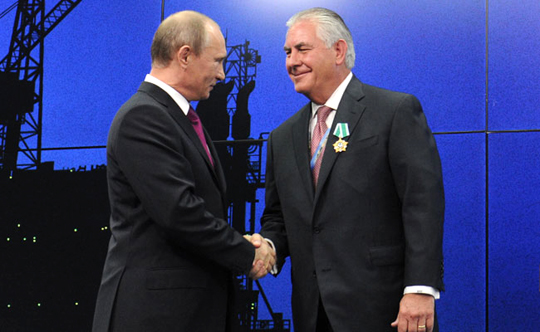
Rex

"It's a question for the government - if you find anyone from the U.S. government who's willing to answer this question," he replied to laughter from the audience of Western executives, who had been lavishing praise on their Russian hosts.

It was the first time in three years that Tillerson or most other chief executives had attended the confab, for the moment laying aside friction over Russia's abrupt annexation of Crimea and its backing of violent separatist forces in eastern Ukraine. Back in Washington, the State Department was not amused. State Department spokesman John Kirby commented that "most American companies understand" that taking part in the forum "sends the wrong message about the acceptability of Russia's actions."

Six months later, Tillerson's relationships with autocrats remain a source of friction after his surprise appointment by President-elect Donald Trump to be secretary of state. The ExxonMobil chief's ties to Russia have alarmed hawks in Congress, who vow to scrutinize Tillerson's good working relationship with President Putin and the latter's longtime confidante Igor Sechin, the chairman of the Russian petroleum giant Rosneft.

With his nomination, the 64-year-old Tillerson has been thrust into the long-standing U.S. foreign-policy divide separating those who value pragmatism and dealmaking, and those who attach greater importance to principles, human rights and democracy. This is a divide that cuts across both parties.

Should he be confirmed, Tillerson will no longer answer to the more than 93,000 shareholders of ExxonMobil but primarily to a single shareholder named Trump. And he will draw on views refined in industry, not diplomacy.

To fans of Tillerson, his relationship with Putin is a sign of his pragmatism, seeking advantage for his company with a blunt, straightforward style that has won respect abroad. Speaking to students from the Texas Tech business school last year, Tillerson said the reason "why I've been able to gain Vladimir Putin's trust" is "because throughout my career I've wanted people to view me as an honest person."

To his critics, however, Tillerson and ExxonMobil come across as arrogant and indifferent to Russia's record in Ukraine or Putin's harsh suppression of domestic opposition. The oil giant's vast enterprise spanning six continents and more than 50 nations has embraced a varied cast of national leaders, including the Saudi oil ministers, Equatorial Guinea's corrupt Teodoro Obiang Nguema, the autocratic government of Kazakhstan and the emir of Qatar.

These contrary views are in some ways connected. Edward Verona, who worked for ExxonMobil for two years and spent several more working in Moscow, said one reason Tillerson was respected in Moscow was because of the way the company dealt with Venezuela's then-president, the voluble Hugo Chávez. In 2007, Chávez had wanted to rewrite contract terms for companies operating in the country's vast, oil-rich Orinoco belt. Exxon said no, abandoning 2 percent of its worldwide reserves and winning arbitration court orders to freeze Venezuelan assets.

In the same way, Exxon exited Nigeria's Niger Delta after insurgents disputed operations there.

"You have to be willing to say, 'No, we aren't going to do it that way, we are going to do it this way; if we can't do it this way, we won't be here,' " Tillerson said about the company's strategy of keeping its Nigerian exploration to offshore areas, where it was safer.

"Rex Tillerson gained the respect of Russians, particularly Sechin and Putin, because he was prepared to stand up and push back when he felt his company was being treated unfairly," said Verona, now a senior adviser to McLarty Associates.

The fight coincided with efforts by Russia's Gazprom, a state-owned company, to horn its way into a Sakhalin Island project off eastern Russia that Tillerson had helped negotiate years earlier. ExxonMobil was able to navigate the dispute with help from Putin and Sechin. The project, built in extremely harsh conditions, remains one of the company's most lucrative, Tillerson has said.

Some of Exxon's perceived arrogance is rooted in the company's history as the largest of the corporations split off from the Standard Oil Trust, the enterprise built by John D. Rockefeller.

Tillerson was born in Wichita Falls, Texas, the son of a Boy Scout administrator. He still lists the rank of Eagle Scout on his resume; and has remained active in the organization. In 2012, he was instrumental in pushing the Boy Scouts board to admit openly gay youths.

His experience as a scout fit well into the company, which insisted on rules that were more detailed than most other oil companies.

In 1997, Exxon sent Tillerson, then a promising executive who had been in Yemen, to Moscow to "pick up the relationship and repair it," Tillerson later recalled. His predecessor had been kicked out of the country. Tillerson met six different prime ministers over the course of 14 months.

The last of those was Putin.

Nearly 15 years later in Sochi, Putin provided the blessing for what could become Exxon's largest Russian deal, a joint exploration agreement with Rosneft covering almost 190 million acres, almost halfway across the Arctic shoreline and covering nine time zones.

Speaking later at Texas Tech, Tillerson cited the Boy Scout motto and urged students to have honor and integrity.

"Those words mean a lot to me," Tillerson said. "And I can tell you they mean a lot in any culture." He added that "integrity is recognized by every government, every leader. It's the most valuable asset you have, your personal integrity."

But while Tillerson preaches the value of honesty and integrity, ExxonMobil has not shied away from doing what is good for its bottom line, which has made environmental groups and others suspicious of its aims.

While Tillerson has acknowledged human involvement in the warming of the globe and backed a carbon tax to deal with it, the oil giant has continued to fund groups such as the American Legislative Exchange Council, whose leading members have cast doubt on climate change or its urgency. The relationship contrasted with that of Shell, which also acknowledges climate change but dropped its membership of ALEC last year citing differences over the issue.

The company is also in the midst of a bitter fight with the attorneys general of New York and Massachusetts and with more than a dozen nongovernmental organizations that are looking at whether the oil giant failed to disclose what it knew 40 years ago about the damage fossil fuels were doing to the Earth's climate. The attorneys general issued broad subpoenas for internal Exxon documents, and the NGOs have encouraged them to consider bringing a fraud case similar to the one that extracted billions of dollars from tobacco companies years ago.

ExxonMobil has fought back, going to a Texas federal court near its headquarters and winning the judge's highly unusual backing for discovery on the attorneys general, including with regard to internal emails, to determine whether they were acting "in good faith."

The company also is scrutinizing individuals and organizations. The day after the presidential election, for example, the company hand-delivered a subpoena to Carroll Muffett, the head of the Center for International Environmental Law, a nonprofit organization focused on environmental and human rights issues.

"The subpoena is in fact a fishing expedition that goes far beyond any issue arguably before the Texas court," Muffett said in an email. "It is clear that Exxon is trying to leverage this case, outrageous as it is, to intimidate and silence its critics."

Another important piece of Tillerson's background is his engineering background. ExxonMobil has been widely seen as a place with a higher "EQ," for engineering quotient, than IQ, or intelligence quotient.

Even the EQ has failed from time to time. The Exxon Valdez oil-tanker accident spilled crude off the pristine coast of Alaska in 1989, and more recently company pipelines leaked in Montana's Yellowstone River and in Mayflower, Arkansas. The company has taken tough legal strategies in those instances, too, and it litigated the Valdez spill for 20 years.

Still, Tillerson draws on that engineering construct and has applied it to the problem of climate change.

"It's an engineering problem, and it has engineering solutions," he said at an event sponsored by the Council on Foreign Relations in 2012.

As he looked back on his career during the Texas Tech event, Tillerson said that he views the company's oil and gas operation on Sakhalin Island - an area beset by poverty, seismic instability, long icebound winters and 100-foot waves in the summer - as one of his crowning achievements.

It might look easy compared to being secretary of state.

Comments

Add new comment

  • Coastaldigest.com reserves the right to delete or block any comments.
  • Coastaldigset.com is not responsible for its readers’ comments.
  • Comments that are abusive, incendiary or irrelevant are strictly prohibited.
  • Please use a genuine email ID and provide your name to avoid reject.
News Network
March 31,2020

Washington, Mar 31: The United States has performed over one million coronavirus tests so far, said President Donald Trump on Monday.

"Today, we reached a historic milestone in our war against coronavirus. Over 1 million Americans have now been tested, more than any other country by far, not even close," Trump said during a press briefing.

US Health Secretary Alex Azar said that approximately 100,000 samples are tested for coronavirus daily.

The number of novel coronavirus (COVID-19) cases within the United States surpassed 150,000 and the death toll has reached 2828, according to Johns Hopkins University. 

Comments

Add new comment

  • Coastaldigest.com reserves the right to delete or block any comments.
  • Coastaldigset.com is not responsible for its readers’ comments.
  • Comments that are abusive, incendiary or irrelevant are strictly prohibited.
  • Please use a genuine email ID and provide your name to avoid reject.
News Network
July 4,2020

Geneva, Jul 4: The World Health Organization has updated its account of the early stages of the COVID crisis to say it was alerted by its own office in China, and not by China itself, to the first pneumonia cases in Wuhan.

The UN health body has been accused by US President Donald Trump of failing to provide the information needed to stem the pandemic and of being complacent towards Beijing, charges it denies.

On April 9, WHO published an initial timeline of its communications, partly in response to criticism of its early response to the outbreak that has now claimed more than 521,000 lives worldwide.

In that chronology, WHO had said only that the Wuhan municipal health commission in the province of Hubei had on December 31 reported cases of pneumonia. The UN health agency did not however specify who had notified it.

WHO director Tedros Adhanom Ghebreyesus told a press conference on April 20 the first report had come from China, without specifying whether the report had been sent by Chinese authorities or another source.

But a new chronology, published this week by the Geneva-based institution, offers a more detailed version of events.

It indicates that it was the WHO office in China that on December 31 notified its regional point of contact of a case of "viral pneumonia" after having found a declaration for the media on a Wuhan health commission website on the issue.

The same day, WHO's epidemic information service picked up another news report transmitted by the international epidemiological surveillance network ProMed -- based in the United States -- about the same group of cases of pneumonia from unknown causes in Wuhan.

After which, WHO asked the Chinese authorities on two occasions, on January 1 and January 2, for information about these cases, which they provided on January 3.

WHO emergencies director Michael Ryan told a press conference on Friday that countries have 24-48 hours to officially verify an event and provide the agency with additional information about the nature or cause of an event.

Ryan added that the Chinese authorities immediately contacted WHO's as soon as the agency asked to verify the report.

US President Donald Trump has announced that his country, the main financial contributor to WHO, will cut its bridges with the institution, which he accuses of being too close to China and of having poorly managed the pandemic.

The WHO denies any complacency toward China.

Comments

Add new comment

  • Coastaldigest.com reserves the right to delete or block any comments.
  • Coastaldigset.com is not responsible for its readers’ comments.
  • Comments that are abusive, incendiary or irrelevant are strictly prohibited.
  • Please use a genuine email ID and provide your name to avoid reject.
News Network
May 15,2020

May 15: Global tensions simmered over the race for a coronavirus vaccine Thursday, as the United States and China traded jabs, and France slammed pharmaceuticals giant Sanofi for suggesting the US would get any eventual vaccine first.

Scientists are working at breakneck speed to develop a vaccine for COVID-19, the disease caused by the virus, which has killed more than 300,000 people worldwide and pummelled economies.

From the US to Europe to Asia, national and local governments are easing lockdown orders to get people back to work -- while fretting over a possible second wave of infections.

Increased freedom of movement means an increased risk of contracting the virus, and so national labs and private firms are labouring to find the right formula for a vaccine.

The European Union's medicines agency offered some hope when it said one could be ready in a year, based on data from clinical trials already underway.

But Marco Cavaleri, the EMA's head of vaccines strategy, acknowledged that timeline was a "best-case scenario," and cautioned that "there may be delays."

The race for a vaccine has exposed a raw nerve in relations between the United States and China, where the virus was first detected late last year in the central city of Wuhan.

Two US agencies warned Wednesday that Chinese hackers were trying to steal COVID-19 vaccine research -- a claim Beijing rejected as "smearing" its reputation.

US President Donald Trump, who has ratcheted up the rhetoric against China, said he doesn't even want to engage with Chinese leader Xi Jinping -- potentially imperilling a trade deal between the world's top two economies.

"I'm very disappointed in China. I will tell you that right now," he said in an interview with Fox Business.

"There are many things we could do. We could do things. We could cut off the whole relationship."

On Capitol Hill, an ousted US health official told Congress that the Trump government had no strategy in place to find and distribute a vaccine to millions of Americans, warning of the "darkest winter" ahead.

"We don't have a single point of leadership right now for this response, and we don't have a master plan," said Rick Bright, who was removed last month as head of the US agency charged with developing a coronavirus vaccine.

The United States has registered nearly 86,000 deaths linked to COVID-19 -- the highest toll of any nation.

World leaders were among 140 signatories to a letter published Thursday saying any vaccine should not be patented and that the science should be shared among nations.

"Governments and international partners must unite around a global guarantee which ensures that, when a safe and effective vaccine is developed, it is produced rapidly at scale and made available for all people, in all countries, free of charge," it said.

But a row erupted in France after drugmaker Sanofi said it would reserve first shipments of any vaccine it discovered to the United States.

The comments prompted a swift rebuke from the French government -- President Emmanuel Macron's office said any vaccine should be treated as "a global public good, which is not submitted to market forces."

Sanofi chief executive Paul Hudson said the US had a risk-sharing model that allowed for manufacturing to start before a vaccine had been finally approved -- while Europe did not.

"The US government has the right to the largest pre-order because it's invested in taking the risk," Hudson told Bloomberg News.

Macron's top officials are scheduled to meet with Sanofi executives about the issue next week.

The search for a vaccine became even more urgent after the World Health Organization said the disease may never go away and the world would have to learn to live with it for good.

"This virus may become just another endemic virus in our communities and this virus may never go away," said Michael Ryan, the UN body's emergencies director.

The prospect of the disease lingering leaves governments facing a delicate balancing act between suppressing the pathogen and getting their economies up and running.

In the US, more grim economic data emerged Thursday, with nearly three million more Americans applying for unemployment benefits.

That takes the overall total to 36.5 million -- more than 10 percent of the US population.

Further signs of the damage to businesses emerged when Lloyd's of London forecast the pandemic will cost the global insurance industry about $203 billion.

European markets closed down, but Wall Street rallied despite the new jobless claims. In a sign of progress, the New York Stock Exchange trading floor was due to reopen on May 26.

The reopening of economies continued in earnest across Europe, where the EU has set out proposals for a phased restart of travel and the eventual lifting of border controls.

"Maybe it's a mistake, but we have no choice. Without tourists, we won't get by!" Enrico Facchetti, a 61-year-old former goldsmith, said of Venice's reopening.

Japan -- the world's third largest economy -- lifted a state of emergency across most of the country except for Tokyo and Osaka.

And Canadian Prime Minister Justin Trudeau said national parks would partially reopen on June 1.

But in Latin America, the virus continued to surge, with a 60 percent leap in cases in the Chilean capital of Santiago.

Authorities said 2,000 new graves were being dug at the main cemetery.

South Sudan reported its first COVID-19 death on Thursday.

And in Bangladesh, the first case was confirmed in the teeming Rohingya refugee camps in Bangladesh, which are home to nearly one million people.

Comments

Add new comment

  • Coastaldigest.com reserves the right to delete or block any comments.
  • Coastaldigset.com is not responsible for its readers’ comments.
  • Comments that are abusive, incendiary or irrelevant are strictly prohibited.
  • Please use a genuine email ID and provide your name to avoid reject.