


Drama galore in India's doubles tennis teams

August 5, 2016

Ravi Ubha, Aug 5: India loves Bollywood, and its Olympic tennis team has inadvertently provided a sequel suitable for the country’s renowned film industry.
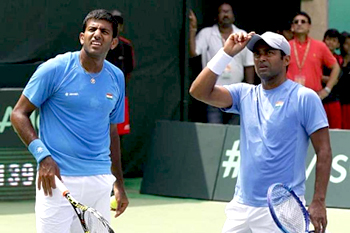
olyAs at the London Games four years ago, personality clashes and animosity are threatening to overshadow Indian players’ reputation for strong doubles play.

Since the 2012 Games, Sania Mirza has risen to No. 1 in the women’s doubles rankings, and Leander Paes, who at 43 is headed to a record seventh Olympics, has collected five more Grand Slam titles in doubles or mixed doubles to raise his career total to 18.

But instead of celebrating Paes’ longevity and the team’s medal chances, Indian players have been rehashing public feuds.

“It doesn’t look good, but it happens in various other countries,” said Bharat Oza, the secretary-general of India’s national tennis governing body, the All India Tennis Association. Oza, however, was not immediately able to give examples.

Four years ago, the tennis association’s preference was for Mahesh Bhupathi to partner in London with Paes, recreating the so-called Indian Express team that won three Grand Slams and in 1999 became the first men’s pair in the Open era to reach all four Grand Slam finals in one season. But Bhupathi, whose doubles partner at the time was Rohan Bopanna, refused to play with Paes.

Bhupathi, who used stinging language like “we don’t speak and have no camaraderie” and said Paes “privately and publicly stabbed me in the back,” could not be convinced.

Disappointing show

Ultimately, Bhupathi and Bopanna formed one team, with Paes forced to play with the unheralded Vishnu Vardhan.

Paes, though, was chosen to play mixed doubles alongside Mirza, even though she had won two mixed doubles Grand Slam titles with Bhupathi, including one at the French Open just weeks earlier.

Mirza, feeling like a pawn, released a lengthy, no-holds-barred statement denouncing the decision.

“As an Indian woman belonging to the 21st century, what I find disillusioning is the humiliating manner in which I was put up as a bait to try and pacify one of the disgruntled stalwarts of Indian tennis,” she said.

None of India’s four doubles teams won more than one Olympic match on the grass of the All England Club.

Any thoughts of a seamless process this year fizzled when Bopanna told the Indian association that he wanted to play in Rio de Janeiro with Saketh Myneni, who has yet to appear in the top 100 in singles or doubles but has regularly played with Bopanna in the Davis Cup.

As a top-10 doubles player at the ranking cutoff for the Olympics in June, Bopanna earned an automatic spot in the Rio tournament and could line up with any country-

man he chose, but his governing body had to approve.

“I have much admiration for Leander Paes and his many achievements, but unfortunately we have not been able to put together a good combination despite our best efforts, and I do not believe our styles of play are either compatible or complementary,” Bopanna said in a statement.

“Considering that this is a team event where two individuals need to jell together

to do well, regardless of individual achievements, it is the team and the combination that matters.”

The Indian tennis association, to no one’s surprise, turned down Bopanna’s request, and he was named Paes’ partner. This time, though, there was no fight.

“The moment we declared this is what the combinations are, immediately, within five minutes, Rohan sent me an email saying that I agree to play because he knew if he refuses, then he knows we don’t send a team,” Oza said.

If Bopanna had prevented Paes from making a record-extending seventh appearance in the Olympic tennis event and deprived the country of men’s participants, he would have been cast as a villain by many in India.

“The best bet would be to field Leander and Rohan, so that’s why we told Rohan,

‘We appreciate what you say, but ultimately we have to think about the country and the medal prospect,’” Oza said. “Naturally Leander is an iconic figure in the Davis Cup and world tennis.”

Measured moves

Mirza avoided being placed in an awkward position again. A team of Bopanna and Mirza was the only one that had a rankings combination that guaranteed India a spot in the 16-team mixed doubles draw.

At Wimbledon, Mirza said she did not “have a take” on the latest turbulent chapter in Indian tennis. “I’m there to represent my country, and I’m looking forward to it,” she added.

Bopanna, in an email, said: “What’s done in the past, there is nothing to dwell on that. It’s time where you look into the future and move on.” Paes did not respond to questions emailed to him.

For Mirza, chemistry in doubles is pivotal. “I think it’s good if you get along on and off the court, but history has said people who don’t get along well on the court can still win,” she said. “It just depends person to person. For me, it’s important.”

Paes and Bopanna won together in a lower-tier Davis Cup series against South Korea in July. Paes would not normally have played in such an event, but he was urged to participate by the Indian tennis association, Oza said.

“Leander has said he would only play at the World Group level, not below that, but we told him that because the government, the public, population of India and people abroad are looking at what you people are doing, you at least better make an appearance saying that we can play good doubles, so that at least will satisfy some of the murmurs that are going around,” Oza said.

“We called him because it was an important tie, and it was before Rio, so at least you can have some exercise together, playing in match conditions.”

Bopanna said, “We had a few strong practice sessions prior to the start of the tie.”

Paes’s lone Olympic medal came not in doubles but in singles, in Atlanta in 1996, when he took home the bronze. If he and Bopanna stand side by side on the podium in Brazil, this Bollywood-style drama would come to a pleasing conclusion for Indian tennis fans.

Comments

Add new comment

  • Coastaldigest.com reserves the right to delete or block any comments.
  • Coastaldigset.com is not responsible for its readers’ comments.
  • Comments that are abusive, incendiary or irrelevant are strictly prohibited.
  • Please use a genuine email ID and provide your name to avoid reject.
Agencies
May 26,2020

Some of the ICC guidelines on resumption of cricket border on the impractical and will need a review when the cricketing world is closer to action, feel former players Aakash Chopra, Irfan Pathan and Monty Panesar.

Last week, the International Cricket Council recommended a host of "back to cricket" guidelines including 14-day pre-match isolation training camps to ensure the teams are free from COVID-19.

The world body issued training as well as playing guidelines which will drastically change the way the game is played.

Among them are regular hand sanitising when in contact with the ball, no loo or shower breaks while training, minimising time spent in the changing room before and after a game, no use of saliva on ball and no handing over of personal items (cap, sunglasses, towels) to fellow teammates or the on-field umpires.

"Social distancing is very doable in individual sport but very tough in a team sport like cricket and football. If you need a slip during the game, would you not employ it?

"If the team is going through a 14-day quarantine and is being tested for COVID-19, I am fine with that process. Now, after that, if we have more guidelines for the players during the game, then you are making things complicated. Then there is no point of a quarantine period," former India pacer Pathan told PTI.

Safety cannot be compromised but regularly sanitising hands during the game will be too much to ask from the players.

"Safety is paramount but we should not make the game complicated. If a bowler or fielder has to sanitise hands every time he touches the ball, then it would be very difficult.

"You can shorten the process of giving the ball to the bowler. Instead of the usual chain (wicket-keeper to cover fielder to bowler), the keeper can straight away give the ball to the bowler but even then the bowler will have to sanitise hands six times in an over," said Pathan seeking more clarity on the guidelines.

Former India opener Chopra said it is still pre-mature to prepare a fixed set of guidelines for resumption of cricket as the situation is evolving "every day".

"That (regular hand sanitisation after contact with ball) is obviously impractical but my big question is when the game happens in a bio secure environment and everyone is quarantined and tested, do these additional measures make a difference?

"On the field, I can still understand but what happens when you go back into the dressing room? How do you practice social distancing there? So it becomes quite complicated.

"To be honest it is all very premature. Once they get closer to resumption, which will take some time, there will be more clarity," said Chopra.

International cricket is likely to resume in July with England hosting West Indies and then Pakistan.

Bundesliga football league has already begun in Germany behind closed doors and by the time cricket resumes, more sporting competitions would have restarted and Chopra feels that will help cricket decide the way forward in post COVID-19 times.

"By the time cricket resumes, more football would have started after Bundesliga. Cricket can take lessons from there, collect data and ideas and see what is practical and what is not."

Former England spinner Panesar foresees the start of the England-West Indies series making things a lot clearer for the entire fraternity than they are at the moment.

"The 14 day quarantine is very much needed and well done to the ICC for including that. I think we will see resumption of international cricket with England hosting West Indies in July. We might have some practical ideas then, the other countries would also be watching keenly and will learn how to go about it.

"But measures like regular hand sanitising is not going to be practical. May be you could sanitise every one hour but it can't be regular during the game," said Panesar.

While Pathan feels the on-field safety measures will make managing over-rate a bigger challenge for teams, Chopra said no loo or shower breaks during training won't be that much of an issue.

"Training is still controllable. You don't have to be there for a long time but you would still have to use the restroom at some stage. You may avoid taking a shower but you will have to use the restroom.

"I think the idea of these guidelines is to make cricketers more aware that you have to take care of yourself and inculcate habits which are in everyone's interest in the current scenario," added Chopra.

Comments

Add new comment

  • Coastaldigest.com reserves the right to delete or block any comments.
  • Coastaldigset.com is not responsible for its readers’ comments.
  • Comments that are abusive, incendiary or irrelevant are strictly prohibited.
  • Please use a genuine email ID and provide your name to avoid reject.
News Network
February 10,2020

Potchefstroom, Feb 10: India's under-19 cricket team manager Anil Patel says the ICC has taken a serious view of the aggressive celebrations by Bangladesh players after their World Cup triumph and will be reviewing the footage of the final game's "last few minutes".

Some Bangladeshi players got carried away while celebrating their historic three-wicket win over India in the final on Sunday. While their captain Akbar Ali apologised for the "unfortunate incident", his Indian counterpart Priyam Garg said their reaction was "dirty".

"We don't know what actually happened," Patel told 'ESPNCricinfo' on Sunday.

"Everybody was in a shock, absolutely, but we don't know what happened exactly. The ICC officials are going to watch the footage of the last few minutes and they are going to let us know," he said.

Even when the match was on, the Bangladesh players were overly aggressive while fielding and their lead pacer Shoriful Islam sledged the Indian batsmen after every delivery.

As soon as the match ended, it became tense with Bangladeshi players rushing to the ground and displaying aggressive body language. The two teams nearly came to blows before the situation was defused by the coaching staff and on-field officials.

Patel claimed that match referee Graeme Labrooy met him and expressed regret at what transpired on the field.

"The referee came to me. He was sorry about the incident. He clarified the ICC is going to take very seriously what has happened during the match and the last session. They are going to witness the footage and they will tell us in the morning (Monday)."

Comments

Add new comment

  • Coastaldigest.com reserves the right to delete or block any comments.
  • Coastaldigset.com is not responsible for its readers’ comments.
  • Comments that are abusive, incendiary or irrelevant are strictly prohibited.
  • Please use a genuine email ID and provide your name to avoid reject.
News Network
June 5,2020

Jun 5: The Asian Football Confederation has awarded the hosting rights of the 2022 Women's Asian Cup to India for the first time since 1979.

The decision was taken at the AFC Women's Football Committee meeting. In February, the AFC Women's Football Committee had recommended India to be hosts.

In a letter to the All India Football Federation, Dato Windsor John, General Secretary, AFC wrote: "The Committee awarded the hosting rights of the AFC Women's Asian Cup 2022 Finals to the All India Football Federation."

The tournament will likely be held in the second half of the year. In the 1979 edition, India had finished as runners-up.

"I need to thank the Asian Football Confederation for finding us suitable to host the AFC Women's Asian Cup in 2022," AIFF President, Praful Patel said.

"The tournament will galvanise the aspiring women players and bring in a holistic social revolution as far as women's football in the country is concerned," he added.

The tournament will feature 12 teams, expanded from the previous slot of eight teams.

India qualifies directly as hosts. The event will also serve as the final qualification tournament for the 2023 FIFA Women's World Cup.

The tournament comes as the latest boost to AIFF as India is slated to host the FIFA U-17 Women's World Cup next year.

India had also hosted the AFC U-16 Championships in 2016 and the FIFA U-17 World Cup in 2017.

"The tournament will play a huge role in further popularising women's football in India. The Women’s Asian Cup 2022 comes on the back of the FIFA U-17 Women's World Cup India 2020, and will help us sustain, and build on the momentum gained," AIFF General Secretary, Kushal Das said.

Comments

Add new comment

  • Coastaldigest.com reserves the right to delete or block any comments.
  • Coastaldigset.com is not responsible for its readers’ comments.
  • Comments that are abusive, incendiary or irrelevant are strictly prohibited.
  • Please use a genuine email ID and provide your name to avoid reject.