


Drama galore in India's doubles tennis teams

August 5, 2016

Ravi Ubha, Aug 5: India loves Bollywood, and its Olympic tennis team has inadvertently provided a sequel suitable for the country’s renowned film industry.
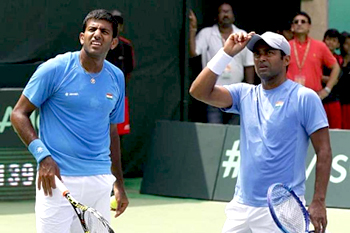
olyAs at the London Games four years ago, personality clashes and animosity are threatening to overshadow Indian players’ reputation for strong doubles play.

Since the 2012 Games, Sania Mirza has risen to No. 1 in the women’s doubles rankings, and Leander Paes, who at 43 is headed to a record seventh Olympics, has collected five more Grand Slam titles in doubles or mixed doubles to raise his career total to 18.

But instead of celebrating Paes’ longevity and the team’s medal chances, Indian players have been rehashing public feuds.

“It doesn’t look good, but it happens in various other countries,” said Bharat Oza, the secretary-general of India’s national tennis governing body, the All India Tennis Association. Oza, however, was not immediately able to give examples.

Four years ago, the tennis association’s preference was for Mahesh Bhupathi to partner in London with Paes, recreating the so-called Indian Express team that won three Grand Slams and in 1999 became the first men’s pair in the Open era to reach all four Grand Slam finals in one season. But Bhupathi, whose doubles partner at the time was Rohan Bopanna, refused to play with Paes.

Bhupathi, who used stinging language like “we don’t speak and have no camaraderie” and said Paes “privately and publicly stabbed me in the back,” could not be convinced.

Disappointing show

Ultimately, Bhupathi and Bopanna formed one team, with Paes forced to play with the unheralded Vishnu Vardhan.

Paes, though, was chosen to play mixed doubles alongside Mirza, even though she had won two mixed doubles Grand Slam titles with Bhupathi, including one at the French Open just weeks earlier.

Mirza, feeling like a pawn, released a lengthy, no-holds-barred statement denouncing the decision.

“As an Indian woman belonging to the 21st century, what I find disillusioning is the humiliating manner in which I was put up as a bait to try and pacify one of the disgruntled stalwarts of Indian tennis,” she said.

None of India’s four doubles teams won more than one Olympic match on the grass of the All England Club.

Any thoughts of a seamless process this year fizzled when Bopanna told the Indian association that he wanted to play in Rio de Janeiro with Saketh Myneni, who has yet to appear in the top 100 in singles or doubles but has regularly played with Bopanna in the Davis Cup.

As a top-10 doubles player at the ranking cutoff for the Olympics in June, Bopanna earned an automatic spot in the Rio tournament and could line up with any country-

man he chose, but his governing body had to approve.

“I have much admiration for Leander Paes and his many achievements, but unfortunately we have not been able to put together a good combination despite our best efforts, and I do not believe our styles of play are either compatible or complementary,” Bopanna said in a statement.

“Considering that this is a team event where two individuals need to jell together

to do well, regardless of individual achievements, it is the team and the combination that matters.”

The Indian tennis association, to no one’s surprise, turned down Bopanna’s request, and he was named Paes’ partner. This time, though, there was no fight.

“The moment we declared this is what the combinations are, immediately, within five minutes, Rohan sent me an email saying that I agree to play because he knew if he refuses, then he knows we don’t send a team,” Oza said.

If Bopanna had prevented Paes from making a record-extending seventh appearance in the Olympic tennis event and deprived the country of men’s participants, he would have been cast as a villain by many in India.

“The best bet would be to field Leander and Rohan, so that’s why we told Rohan,

‘We appreciate what you say, but ultimately we have to think about the country and the medal prospect,’” Oza said. “Naturally Leander is an iconic figure in the Davis Cup and world tennis.”

Measured moves

Mirza avoided being placed in an awkward position again. A team of Bopanna and Mirza was the only one that had a rankings combination that guaranteed India a spot in the 16-team mixed doubles draw.

At Wimbledon, Mirza said she did not “have a take” on the latest turbulent chapter in Indian tennis. “I’m there to represent my country, and I’m looking forward to it,” she added.

Bopanna, in an email, said: “What’s done in the past, there is nothing to dwell on that. It’s time where you look into the future and move on.” Paes did not respond to questions emailed to him.

For Mirza, chemistry in doubles is pivotal. “I think it’s good if you get along on and off the court, but history has said people who don’t get along well on the court can still win,” she said. “It just depends person to person. For me, it’s important.”

Paes and Bopanna won together in a lower-tier Davis Cup series against South Korea in July. Paes would not normally have played in such an event, but he was urged to participate by the Indian tennis association, Oza said.

“Leander has said he would only play at the World Group level, not below that, but we told him that because the government, the public, population of India and people abroad are looking at what you people are doing, you at least better make an appearance saying that we can play good doubles, so that at least will satisfy some of the murmurs that are going around,” Oza said.

“We called him because it was an important tie, and it was before Rio, so at least you can have some exercise together, playing in match conditions.”

Bopanna said, “We had a few strong practice sessions prior to the start of the tie.”

Paes’s lone Olympic medal came not in doubles but in singles, in Atlanta in 1996, when he took home the bronze. If he and Bopanna stand side by side on the podium in Brazil, this Bollywood-style drama would come to a pleasing conclusion for Indian tennis fans.

Comments

Add new comment

  • Coastaldigest.com reserves the right to delete or block any comments.
  • Coastaldigset.com is not responsible for its readers’ comments.
  • Comments that are abusive, incendiary or irrelevant are strictly prohibited.
  • Please use a genuine email ID and provide your name to avoid reject.
News Network
May 1,2020

Melbourne, May 1: Reclaiming the top spot in Test cricket has brought smiles back on their faces but Australia coach Justin Langer says beating India in their own den remains the ultimate test and their numero uno status will be put to test when they clash with the Virat Kohli-led team.

After a tumultuous transition phase post the ball-tampering scandal, Australia on Friday displaced India as number one side in Test format but Langer is aware that it does not take long for the situation to change.

"We recognise how fluid these rankings are, but at this time it was certainly nice to put a smile on our faces," Langer told Cricket Australia website. "We've got lots of work to do to get to be the team that we want to be, but hopefully over the last couple of years not only have we performed well on the field, but also off the field," Langer added.

The former left-handed opener underlined what he felt will be the ultimate test of character.

"Certainly a goal for us has been the World Test Championship ... but ultimately, we have to beat India in India and we've got to beat them when they come back (to Australia).

"You can only judge yourself as being the best if you beat the best and we've got some really tough opposition to come," Langer put his priorities in place. The team he insists needs to get better as now others will come gunning for them.

"Getting to No.1 is a great thing, but when you're No.1, you're always the hunted," Langer said. "We've been the hunters for a while, now we're the hunted and we need to get better and better."

Langer also hoped that white ball team under Aaron Finch will win the World Cup. "I know how hard it is to win World Cups ... everything has to go right. One day, I'd love to see Aaron Finch with all his mates lift that T20 World Cup above his head."

Comments

Add new comment

  • Coastaldigest.com reserves the right to delete or block any comments.
  • Coastaldigset.com is not responsible for its readers’ comments.
  • Comments that are abusive, incendiary or irrelevant are strictly prohibited.
  • Please use a genuine email ID and provide your name to avoid reject.
News Network
June 25,2020

New Delhi, Jun 25: India spinner Ravichandran Ashwin on Thursday called the 1983 World Cup win as the 'landscape' changing moment for the game of cricket in the country.

Today, India is celebrating the completion of the 37 years of the maiden World Cup triumph under the leadership of Kapil Dev.

"Today 37 years ago, changed the cricketing landscape in India. Thank you @therealkapildev and team for making the game a career for many of us today. Deeply indebted," Ashwin tweeted.

In 1983, in the finals between India and West Indies, the latter won the toss and opted to bowl first.

The Kapil Dev-led side managed to score just 183 runs as Andy Roberts took three wickets while Malcolm Marshall, Michael Holding, and Larry Gomes picked up two wickets each.

Defending 183, India did a good job of keeping a check on the Windies run flow, reducing the side to 57/3.

Soon after, the team from the Caribbean was reduced to 76/6 and India was the favourites from there on to win the title.

Mohinder Amarnath took the final wicket of Michael Holding to give India their first-ever World Cup title win.

In the finals, West Indies was bowled out for 140, and as a result, India won the match by 43 runs.

Kapil Dev lifting the trophy at the balcony of Lord's Cricket Ground still remains an image to savour for all the Indian fans.

In the finals, Mohinder Amarnath was chosen as the Man of the Match as he scored 26 runs with the bat and also picked up three wickets with the ball.

India has been the regular participant in the World Cup from its beginning to the latest edition. The first edition was held in 1975 and from there on, it has taken place after a span of every four years.

West Indies won the first two World Cup titles (1975, 1979) and was the runner-up in 1983. India has won the title two times, in 1983 and in 2011.

MS Dhoni captained the 2011 team to win their second title after 28 years. Australia has won the tournament five times (1987, 1999, 2003, 2007, and 2015).

Comments

Add new comment

  • Coastaldigest.com reserves the right to delete or block any comments.
  • Coastaldigset.com is not responsible for its readers’ comments.
  • Comments that are abusive, incendiary or irrelevant are strictly prohibited.
  • Please use a genuine email ID and provide your name to avoid reject.
News Network
April 2,2020

New Delhi, Apr 2: It was on April 2, 2011, when the Men in Blue went on to win their second 50-over World Cup title.

India won its first World Cup in 1983 and then had to wait for 28 years to again lift the title.
Going into the 2011 tournament, India went in as the clear favourites as the competition was to be played in the sub-continent.

Under MS Dhoni's leadership, India lost just one match in the competition against South Africa.
India had defeated arch-rivals Pakistan in the semi-final to set up a summit clash with Sri Lanka.

In the finals, Sri Lanka won the toss and opted to bat first. Mahela Jayawardene top-scored for Sri Lanka as he struck a century to take the team's score to 274/6.

India in their chase got off to a bad start as the side lost Sachin Tendulkar and Virender Sehwag with just 31 runs on the board.

But Gautam Gambhir and MS Dhoni stepped up and stitched a match-winning 109-run partnership.

Gambhir perished after playing a knock of 97 runs, but in the end, Dhoni and Yuvraj took the team over the line by six wickets.

The winning six struck by Dhoni is still viewed as one of the most exciting moments in India's sporting history. 

As the winning six was hit, Ravi Shastri was doing commentary then, and he famously remarked, "Dhoni, finishes it off in style, India lifts the World Cup after 28 years".
As soon as the match-winning shot was hit, Tendulkar erupted with joy and had tears to see his dream finally being fulfilled.

Earlier this year, former Indian batsman Sachin Tendulkar's famous lap around the Wankhede Stadium after the 2011 World Cup win, titled 'Carried On the Shoulders Of A Nation', was voted the greatest Laureus Sporting Moment of the last twenty years.

The lap after the World Cup is still edged into everyone's hearts.

Playing in his last mega 50-over tournament, it was the last chance for Tendulkar to lift the coveted trophy.

Before the 2011 World Cup, Tendulkar had played five tournaments (1992,1996,1999,2003 and 2007), and he fell short every time.

The closest he came to winning the trophy was in 2003 as India made the finals under the leadership of Sourav Ganguly.

But the Men in Blue fell short in the finals against Australia.

Then in 2007, the biggest setback was in store for the legend has India bowed out of the tournament in the group stages.

Comments

Add new comment

  • Coastaldigest.com reserves the right to delete or block any comments.
  • Coastaldigset.com is not responsible for its readers’ comments.
  • Comments that are abusive, incendiary or irrelevant are strictly prohibited.
  • Please use a genuine email ID and provide your name to avoid reject.