


Drama galore in India's doubles tennis teams

August 5, 2016

Ravi Ubha, Aug 5: India loves Bollywood, and its Olympic tennis team has inadvertently provided a sequel suitable for the country’s renowned film industry.
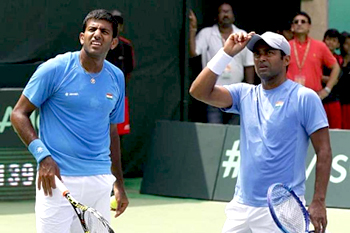
olyAs at the London Games four years ago, personality clashes and animosity are threatening to overshadow Indian players’ reputation for strong doubles play.

Since the 2012 Games, Sania Mirza has risen to No. 1 in the women’s doubles rankings, and Leander Paes, who at 43 is headed to a record seventh Olympics, has collected five more Grand Slam titles in doubles or mixed doubles to raise his career total to 18.

But instead of celebrating Paes’ longevity and the team’s medal chances, Indian players have been rehashing public feuds.

“It doesn’t look good, but it happens in various other countries,” said Bharat Oza, the secretary-general of India’s national tennis governing body, the All India Tennis Association. Oza, however, was not immediately able to give examples.

Four years ago, the tennis association’s preference was for Mahesh Bhupathi to partner in London with Paes, recreating the so-called Indian Express team that won three Grand Slams and in 1999 became the first men’s pair in the Open era to reach all four Grand Slam finals in one season. But Bhupathi, whose doubles partner at the time was Rohan Bopanna, refused to play with Paes.

Bhupathi, who used stinging language like “we don’t speak and have no camaraderie” and said Paes “privately and publicly stabbed me in the back,” could not be convinced.

Disappointing show

Ultimately, Bhupathi and Bopanna formed one team, with Paes forced to play with the unheralded Vishnu Vardhan.

Paes, though, was chosen to play mixed doubles alongside Mirza, even though she had won two mixed doubles Grand Slam titles with Bhupathi, including one at the French Open just weeks earlier.

Mirza, feeling like a pawn, released a lengthy, no-holds-barred statement denouncing the decision.

“As an Indian woman belonging to the 21st century, what I find disillusioning is the humiliating manner in which I was put up as a bait to try and pacify one of the disgruntled stalwarts of Indian tennis,” she said.

None of India’s four doubles teams won more than one Olympic match on the grass of the All England Club.

Any thoughts of a seamless process this year fizzled when Bopanna told the Indian association that he wanted to play in Rio de Janeiro with Saketh Myneni, who has yet to appear in the top 100 in singles or doubles but has regularly played with Bopanna in the Davis Cup.

As a top-10 doubles player at the ranking cutoff for the Olympics in June, Bopanna earned an automatic spot in the Rio tournament and could line up with any country-

man he chose, but his governing body had to approve.

“I have much admiration for Leander Paes and his many achievements, but unfortunately we have not been able to put together a good combination despite our best efforts, and I do not believe our styles of play are either compatible or complementary,” Bopanna said in a statement.

“Considering that this is a team event where two individuals need to jell together

to do well, regardless of individual achievements, it is the team and the combination that matters.”

The Indian tennis association, to no one’s surprise, turned down Bopanna’s request, and he was named Paes’ partner. This time, though, there was no fight.

“The moment we declared this is what the combinations are, immediately, within five minutes, Rohan sent me an email saying that I agree to play because he knew if he refuses, then he knows we don’t send a team,” Oza said.

If Bopanna had prevented Paes from making a record-extending seventh appearance in the Olympic tennis event and deprived the country of men’s participants, he would have been cast as a villain by many in India.

“The best bet would be to field Leander and Rohan, so that’s why we told Rohan,

‘We appreciate what you say, but ultimately we have to think about the country and the medal prospect,’” Oza said. “Naturally Leander is an iconic figure in the Davis Cup and world tennis.”

Measured moves

Mirza avoided being placed in an awkward position again. A team of Bopanna and Mirza was the only one that had a rankings combination that guaranteed India a spot in the 16-team mixed doubles draw.

At Wimbledon, Mirza said she did not “have a take” on the latest turbulent chapter in Indian tennis. “I’m there to represent my country, and I’m looking forward to it,” she added.

Bopanna, in an email, said: “What’s done in the past, there is nothing to dwell on that. It’s time where you look into the future and move on.” Paes did not respond to questions emailed to him.

For Mirza, chemistry in doubles is pivotal. “I think it’s good if you get along on and off the court, but history has said people who don’t get along well on the court can still win,” she said. “It just depends person to person. For me, it’s important.”

Paes and Bopanna won together in a lower-tier Davis Cup series against South Korea in July. Paes would not normally have played in such an event, but he was urged to participate by the Indian tennis association, Oza said.

“Leander has said he would only play at the World Group level, not below that, but we told him that because the government, the public, population of India and people abroad are looking at what you people are doing, you at least better make an appearance saying that we can play good doubles, so that at least will satisfy some of the murmurs that are going around,” Oza said.

“We called him because it was an important tie, and it was before Rio, so at least you can have some exercise together, playing in match conditions.”

Bopanna said, “We had a few strong practice sessions prior to the start of the tie.”

Paes’s lone Olympic medal came not in doubles but in singles, in Atlanta in 1996, when he took home the bronze. If he and Bopanna stand side by side on the podium in Brazil, this Bollywood-style drama would come to a pleasing conclusion for Indian tennis fans.

Comments

Add new comment

  • Coastaldigest.com reserves the right to delete or block any comments.
  • Coastaldigset.com is not responsible for its readers’ comments.
  • Comments that are abusive, incendiary or irrelevant are strictly prohibited.
  • Please use a genuine email ID and provide your name to avoid reject.
News Network
April 6,2020

London, Apr 6: As the coronavirus brings the international sports calendar to a grinding halt, news agency Sport looks at three long-standing habits which could change forever once competition resumes.

Saliva to take shine off swing bowling

It's been a tried and trusted friend to fast bowlers throughout the history of cricket. But the days of applying saliva to one side of the ball to encourage swing could be over in the aftermath of Covid19.

"As a bowler I think it would be pretty tough going if we couldn't shine the ball in a Test match," said Australia quick Pat Cummins.

"If it's at that stage and we're that worried about the spread, I'm not sure we'd be playing sport."

Towels in tennis - no touching

Tennis players throwing towels, dripping with sweat and blood and probably a tear or two, at ball boys and girls, has often left fans sympathising for the youngsters.

Moves by officials to tackle the issue took on greater urgency in March when the coronavirus was taking a global grip.

Behind closed doors in Miki, ball boys and girls on duty at the Davis Cup tie between Japan and Ecuador wore gloves.

Baskets, meanwhile, were made available for players to deposit their towels.

Back in 2018, the ATP introduced towel racks at some events on a trial basis, but not everyone was overjoyed.

"I think having the towel whenever you need it, it's very helpful. It's one thing less that you have to think about," said Greece's Stefanos Tsitsipas when he was playing at the NextGen Finals in Milan.

"I think it's the job of the ball kids to provide towels and balls for the players."

Let's not shake on it

Pre-match handshakes were abandoned in top football leagues just before the sports shutdown.

Premier League leaders Liverpool also banned the use of mascots while Southampton warned against players signing autographs and stopped them posing for selfies.

Away from football, the NBA urged players to opt for the fist bump rather than the long-standing high-five.

"I ain't high-fiving nobody for the rest of my life after this," NBA superstar LeBron James told the "Road Trippin' Podcast".

"No more high-fiving. After this corona shit? Wait 'til you see me and my teammates’ handshakes after this shit."

Basketball stars were also told not to take items such as balls or teams shirts to autograph.

US women's football star Megan Rapinoe says edicts to ban handshakes or even high-fives may be counter-productive anyway.

"We're going to be sweating all over each other all game, so it sort of defeats the purpose of not doing a handshake," she said.

Comments

Add new comment

  • Coastaldigest.com reserves the right to delete or block any comments.
  • Coastaldigset.com is not responsible for its readers’ comments.
  • Comments that are abusive, incendiary or irrelevant are strictly prohibited.
  • Please use a genuine email ID and provide your name to avoid reject.
News Network
March 2,2020

Mar 2: Indian captain Virat Kohli was left frustrated and deflated as New Zealand won the second Test inside three days in Christchurch on Monday to sweep the series.

India started the day at 90 for six and were all out for 124, before New Zealand chased down the required 132 to win for the loss of three wickets in 36 overs.

It ended a disappointing tour for India and Kohli as New Zealand, who won the first Test by 10 wickets early on day four, wrapped up the series with ease.

New Zealand are now unbeaten in their last 13 home Tests, winning nine of them, and in the past decade their record as hosts is played 39, won 20, drawn 13 and lost five.

In the latest series, on traditional New Zealand green wickets, India managed scores of 165, 191, 242 and 124, reflecting the low contributions from Kohli of 2, 19, 3 and 14.

Kohli came to New Zealand as the world's top Test batsman and oozing charm as he described New Zealand as the “nice guys” of cricket.

But during the series he lost his top ranking to Australian Steve Smith and when Kane Williamson went for three in the first innings of the second Test the pressure showed when he gave the New Zealand skipper a very animated send-off.

There was further evidence of frustration when he was caught on camera yelling an obscenity at a group of New Zealand supporters on Sunday.

The end came quickly for India on day three as Tim Southee and Trent Boult tormented the batsmen with their variety of inswing and outswing deliveries targeting both sides of the stumps.

Hanuma Vihari was the first to fall, in Southee's second over, when he turned a legside delivery too fine and was caught by BJ Watling diving to his left.

Five balls later and with no addition to the score, India's other overnight batsman Rishabh Pant was caught behind off a Boult delivery that swung away.

Mohammed Shami was caught for five by Tom Blundell at deep mid-wicket and Jasprit Bumrah was run out when trying to give the strike to Ravindra Jadeja, who was unbeaten on 16.

Boult and Southee signed for most of the dismissals with Boult taking four for 28 and Southee three for 36. The swing pair accounted for 25 of the 40 Indian wickets in the series.

There was enough seam and swing available for India to keep the New Zealand batsmen guessing but Bumrah and Umesh Yadav were unable to apply consistent pressure and Mohammed Shami was troubled by a sore shoulder.

New Zealand coasted through a century opening stand by Tom Latham and Blundell before losing three quick wickets.

Latham notched his 18th half-century and second of the Test before he was caught behind off Yadav for 52, Kane Williamson had a short stay for five, and Blundell went for 55.

Comments

Add new comment

  • Coastaldigest.com reserves the right to delete or block any comments.
  • Coastaldigset.com is not responsible for its readers’ comments.
  • Comments that are abusive, incendiary or irrelevant are strictly prohibited.
  • Please use a genuine email ID and provide your name to avoid reject.
News Network
January 13,2020

Mumbai, Jan 13: India spearhead Jasprit Bumrah on Sunday headlined the BCCI Annual Awards function, grabbing the prestigious Polly Umrigar award apart from annexing the Dilip Sardesai honour for his exploits in international cricket in the 2018-19 season.

Polly Umrigar award is presented to the best male International cricketer and it carries a citation, trophy and cheque for Rs. 15 lakh.

Dilip Sardesai award is conferred on both the highest wicket-taker and highest run-getter in Test cricket. Bumrah took 34 wickets in six matches with three five-wicket hauls.

Prolific Saurashtra batsman Chetshwar Pujara was picked for the honour for scoring 677 runs in 8 matches at an average of 52.07 with three centuries and two half centuries.

Bumrah, the world's number ODI bowler made his Test debut during India's tour of South Africa in January 2018 and hasn't looked back since.

He picked up a five-wicket haul in South Africa, England, Australia and the West Indies, becoming the first and only Asian bowler to achieve the feat.

He played a stellar role in the historic 2-1 Test series win in Australia, India's first Down Under and which helped them retain the Border Gavaskar Trophy.

While Bumrah netted the biggest prize in the men's category, Poonam Yadav claimed the top prize in women's section and was awarded the best international cricketer.

The award will be another feather in the leg-spinner's cap who recently received the Arjuna Award.

Former India captains Krishnamachari Srikkanth and Anjum Chopra were presented the Col CK Nayudu Lifetime Achievement Award and the BCCI Lifetime Achievement Award for women respectively.

A member of the 1983 World Cup-winning team, Srikkanth took on the fearsome West Indies fast bowlers and scored an attacking 38, the top individual score in the low-scoring final at the Lord's.

He also captained India and post-retirement served as the chief selector and it was during his tenure that the 2011 World Cup squad was picked.

Anjum is one of the finest batswomen and the first Indian to play 100 ODIs. In a career spanning 17 years, Anjum represented India in four 50-over World Cups and two T20 World Cup (played in one).

Mayank Agarwal, who emerged as an impact batsman starting with his debut series in Australia in 2018-19, received the best international debut in men's category while talented 15-year-old Shafali Verma grabbed the same in the women's category.

Mumbai all-rounder Shivam Dube, who impressed in the recently concluded T20 series against Sri Lanka, was presented the Lala Amarnath Award for the best all-rounder in the Ranji Trophy while Delhi's Nitish Rana received the same for doing well in the limited overs competition.

India's middle-order batsmwoman Deepti Sharma received the Jagmohan Dalmiya Trophy for best woman cricketer in senior domestic circuit while Shafali was picked for honour in the junior category.

Virender Sharma was adjudged the best umpire in domestic cricket while Vidarbha Cricket Association were presented the best performance award in domestic cricket for wining the Ranji Trophy.

BCCI president Sourav Ganguly said, “The BCCI Awards is our way of recognising the finest on-field performances right from the age group to senior level and also honour our legends.”

Board secretary Jay Shah said, “We wanted to make Naman bigger and better and have introduced four new categories highest run-getter and wicket-takers in WODIs and best international debut men and women from this year.”

Comments

Add new comment

  • Coastaldigest.com reserves the right to delete or block any comments.
  • Coastaldigset.com is not responsible for its readers’ comments.
  • Comments that are abusive, incendiary or irrelevant are strictly prohibited.
  • Please use a genuine email ID and provide your name to avoid reject.