


Drama galore in India's doubles tennis teams

August 5, 2016

Ravi Ubha, Aug 5: India loves Bollywood, and its Olympic tennis team has inadvertently provided a sequel suitable for the country’s renowned film industry.
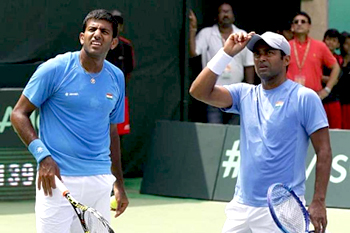
olyAs at the London Games four years ago, personality clashes and animosity are threatening to overshadow Indian players’ reputation for strong doubles play.

Since the 2012 Games, Sania Mirza has risen to No. 1 in the women’s doubles rankings, and Leander Paes, who at 43 is headed to a record seventh Olympics, has collected five more Grand Slam titles in doubles or mixed doubles to raise his career total to 18.

But instead of celebrating Paes’ longevity and the team’s medal chances, Indian players have been rehashing public feuds.

“It doesn’t look good, but it happens in various other countries,” said Bharat Oza, the secretary-general of India’s national tennis governing body, the All India Tennis Association. Oza, however, was not immediately able to give examples.

Four years ago, the tennis association’s preference was for Mahesh Bhupathi to partner in London with Paes, recreating the so-called Indian Express team that won three Grand Slams and in 1999 became the first men’s pair in the Open era to reach all four Grand Slam finals in one season. But Bhupathi, whose doubles partner at the time was Rohan Bopanna, refused to play with Paes.

Bhupathi, who used stinging language like “we don’t speak and have no camaraderie” and said Paes “privately and publicly stabbed me in the back,” could not be convinced.

Disappointing show

Ultimately, Bhupathi and Bopanna formed one team, with Paes forced to play with the unheralded Vishnu Vardhan.

Paes, though, was chosen to play mixed doubles alongside Mirza, even though she had won two mixed doubles Grand Slam titles with Bhupathi, including one at the French Open just weeks earlier.

Mirza, feeling like a pawn, released a lengthy, no-holds-barred statement denouncing the decision.

“As an Indian woman belonging to the 21st century, what I find disillusioning is the humiliating manner in which I was put up as a bait to try and pacify one of the disgruntled stalwarts of Indian tennis,” she said.

None of India’s four doubles teams won more than one Olympic match on the grass of the All England Club.

Any thoughts of a seamless process this year fizzled when Bopanna told the Indian association that he wanted to play in Rio de Janeiro with Saketh Myneni, who has yet to appear in the top 100 in singles or doubles but has regularly played with Bopanna in the Davis Cup.

As a top-10 doubles player at the ranking cutoff for the Olympics in June, Bopanna earned an automatic spot in the Rio tournament and could line up with any country-

man he chose, but his governing body had to approve.

“I have much admiration for Leander Paes and his many achievements, but unfortunately we have not been able to put together a good combination despite our best efforts, and I do not believe our styles of play are either compatible or complementary,” Bopanna said in a statement.

“Considering that this is a team event where two individuals need to jell together

to do well, regardless of individual achievements, it is the team and the combination that matters.”

The Indian tennis association, to no one’s surprise, turned down Bopanna’s request, and he was named Paes’ partner. This time, though, there was no fight.

“The moment we declared this is what the combinations are, immediately, within five minutes, Rohan sent me an email saying that I agree to play because he knew if he refuses, then he knows we don’t send a team,” Oza said.

If Bopanna had prevented Paes from making a record-extending seventh appearance in the Olympic tennis event and deprived the country of men’s participants, he would have been cast as a villain by many in India.

“The best bet would be to field Leander and Rohan, so that’s why we told Rohan,

‘We appreciate what you say, but ultimately we have to think about the country and the medal prospect,’” Oza said. “Naturally Leander is an iconic figure in the Davis Cup and world tennis.”

Measured moves

Mirza avoided being placed in an awkward position again. A team of Bopanna and Mirza was the only one that had a rankings combination that guaranteed India a spot in the 16-team mixed doubles draw.

At Wimbledon, Mirza said she did not “have a take” on the latest turbulent chapter in Indian tennis. “I’m there to represent my country, and I’m looking forward to it,” she added.

Bopanna, in an email, said: “What’s done in the past, there is nothing to dwell on that. It’s time where you look into the future and move on.” Paes did not respond to questions emailed to him.

For Mirza, chemistry in doubles is pivotal. “I think it’s good if you get along on and off the court, but history has said people who don’t get along well on the court can still win,” she said. “It just depends person to person. For me, it’s important.”

Paes and Bopanna won together in a lower-tier Davis Cup series against South Korea in July. Paes would not normally have played in such an event, but he was urged to participate by the Indian tennis association, Oza said.

“Leander has said he would only play at the World Group level, not below that, but we told him that because the government, the public, population of India and people abroad are looking at what you people are doing, you at least better make an appearance saying that we can play good doubles, so that at least will satisfy some of the murmurs that are going around,” Oza said.

“We called him because it was an important tie, and it was before Rio, so at least you can have some exercise together, playing in match conditions.”

Bopanna said, “We had a few strong practice sessions prior to the start of the tie.”

Paes’s lone Olympic medal came not in doubles but in singles, in Atlanta in 1996, when he took home the bronze. If he and Bopanna stand side by side on the podium in Brazil, this Bollywood-style drama would come to a pleasing conclusion for Indian tennis fans.

Comments

Add new comment

  • Coastaldigest.com reserves the right to delete or block any comments.
  • Coastaldigset.com is not responsible for its readers’ comments.
  • Comments that are abusive, incendiary or irrelevant are strictly prohibited.
  • Please use a genuine email ID and provide your name to avoid reject.
News Network
January 23,2020

Melbourne, Jan 23: Sania Mirza's return to her first Grand Slam after a two-year break was cut short on Thursday when the former world number one was forced to retire midway through her first round match in women's doubles at the Australian Open due to a calf injury.

India's Mirza, who won six Grand Slam doubles titles, took a break from the game after the China Open in October 2017 and gave birth to her son a year later.

The 33-year-old made a winning return to the WTA Tour at this month's Hobart International with Ukrainian Nadiia Kichenok, picking up her 42nd WTA doubles title and the first since winning the women's doubles in Brisbane in 2017.

Mirza said she strained her calf muscle in her right leg during the Hobart final.

"It just got worse in the match. It was bit of a bad strain, but I had a few days off," she told reporters. "So I obviously had to try to do whatever I could to try to get on the court.

"It felt okay when I went on the court, but it was tough to move right. I just felt like I'm gonna tear it or something pretty bad."

Mirza won her first Grand Slam in mixed doubles at the Australian Open in 2009 and also bagged the women's doubles in 2016.

Mirza always believed there was tennis left in her which inspired her comeback, she told Reuters on Sunday.

She had already pulled out of the Australian Open mixed doubles, where she was to partner compatriot Rohan Bopanna.

Mirza and Kichenok were trailing the Chinese pair of Xinyun Han and Lin Zhu 6-2 1-0 on Thursday when the Indian had to call it quits due to the injury.

"As a tennis player you want to compete, it is the Grand Slam. If it's any other tournament, you would probably take a call and be like 'I don't want to risk it'," she said.

Mirza, who is married to former Pakistan cricket captain Shoaib Malik, said she would take two weeks to recover and was hoping to play at next month's Dubai championships.

"When you play a professional sport, injuries are really part of it. And it's something that you have to accept," she said. "Sometimes the timing is really not ideal, it's tough that it happened in a Grand Slam, or just before a Grand Slam."

Comments

Add new comment

  • Coastaldigest.com reserves the right to delete or block any comments.
  • Coastaldigset.com is not responsible for its readers’ comments.
  • Comments that are abusive, incendiary or irrelevant are strictly prohibited.
  • Please use a genuine email ID and provide your name to avoid reject.
News Network
May 10,2020

New Delhi, May 10: Former Australia captain Ian Chappell has proposed radical changes in the LBW laws, stating that a batsman should be given out leg before as long as the ball is hitting the stumps irrespective of the spot of its landing and impact.

Chappell also said captains should agree on one way of working up the ball which will encourage swing bowling, even as the ICC is considering the use of artificial substances to shine the ball instead of sweat and saliva in post-COVID-19 scenario.

"The new lbw law should simply say: 'Any delivery that strikes the pad without first hitting the bat and, in the umpire's opinion, would go on to hit the stumps is out regardless of whether or not a shot is attempted'," he wrote in a column for ESPNcricinfo.

"Forget where the ball pitches and whether it strikes the pad outside the line or not; if it's going to hit the stumps, it's out."

The 76-year-old said the change in lbw law would attract expected criticism from the batsmen but it would make the game more fair.

"There will be screams of horror - particularly from pampered batsmen - but there are numerous positives this change would bring to the game. Most important is fairness.

"If a bowler is prepared to attack the stumps regularly, the batsman should only be able to protect his wicket with the bat. The pads are there to save the batsman from injury not dismissal.

"It would also force batsmen to seek an attacking method to combat a wristspinner pitching in the rough outside the right-hander's leg stump," said Chappell.

He cited Sachin Tendulkar's example on how he negotiated Shane Warne's round the wicket tactic during the 1997-98 Test series in India.

"Contrast Sachin Tendulkar's aggressive and successful approach to Shane Warne coming round the wicket in Chennai in 1997-98 with a batsman who kicks away deliveries pitching in the rough and turning in toward the stumps. Which would you rather watch?

"The current law encourages "pad play" to balls pitching outside leg while this change would force them to use their bat. The change would reward bowlers who attack the stumps and decrease the need for negative wide deliveries to a packed off-side field," he said.

Chappell said his proposed change to the lbw law would also cut down "frivolous" DRS challenges.

"This change to the lbw law would also simplify umpiring and result in fewer frivolous DRS challenges. Consequently, it would speed up a game that has slowed drastically in recent times.

"It would also make four-day Tests an even more viable proposition as mind-numbing huge first-innings totals would be virtually non-existent."

On the substitute of shining the ball without sweat and saliva, Chappell said international captains should find out a way of working up the ball.

"With ball-tampering always a hot topic, in the past I've suggested that administrators ask international captains to construct a list (i.e. the use of natural substances) detailing the things bowlers feel will help them to swing the ball.

"From this list, the administrators should deem one method to be legal with all others being punishable as illegal," the cricketer-turned-commentator added.

Comments

Add new comment

  • Coastaldigest.com reserves the right to delete or block any comments.
  • Coastaldigset.com is not responsible for its readers’ comments.
  • Comments that are abusive, incendiary or irrelevant are strictly prohibited.
  • Please use a genuine email ID and provide your name to avoid reject.
News Network
February 5,2020

Aukland, Feb 5: Striker Navneet Kaur scored a brace to guide the Indian women's hockey team to a convincing 3-0 win over New Zealand in the last game of its five-match tour here on Wednesday.

Navneet found the net in the 45th and 58th minutes, while Sharmila scored a field goal in the 54th minute as India drew curtains on the New Zealand tour on a bright note.

After a goalless opening two quarters, Navneet finally broke the deadlock for India in the 45th minute.

Sharmila then doubled the lead when she struck a powerful shot past the New Zealand goalkeeper in the 54th minute. Navneet found the net again just two minutes from the final hooter with a beautiful field strike.

India began the tour by thrashing New Zealand Development squad 4-0 before suffering close 1-2 and 0-1 defeats to the home senior team.

In penultimate game of the tour, skipper Rani's lone strike handed India a 1-0 win over Great Britain.

"...I am happy we produced three goals against New Zealand in the last match. This tour gave us a good insight about where we need to improve and one of the things is to create faster play than we do now," said India's chief Coach Sjoerd Marijne.

Commenting on his side's performance during the tour, Marijne said, "Sometimes we tend to keep the ball too long on the stick and then we create pressure. We need to avoid that by passing faster.

"On the defence side, we need to be a bit more calmer and need to improve our tackling. We will have a four week camp after a short break when we return home and we will be working on these points."

The Indian team will return home on February 7.

Comments

Add new comment

  • Coastaldigest.com reserves the right to delete or block any comments.
  • Coastaldigset.com is not responsible for its readers’ comments.
  • Comments that are abusive, incendiary or irrelevant are strictly prohibited.
  • Please use a genuine email ID and provide your name to avoid reject.