



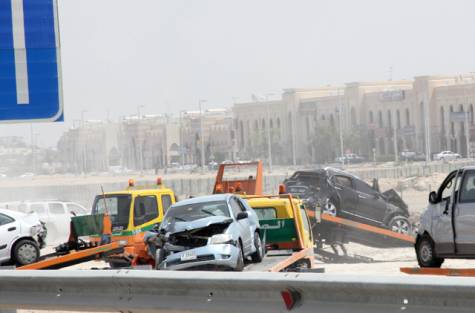
Dubai, Abu Dhabi fog warning: High alerts after 50-car weekend pile-up

January 27, 2014

Abu_Dhabi_fog_warningDubai, Jan 27: The National Centre of Meteorology and Seismology (NCMS) has called on the motorists to be cautious on roads due to low horizontal visibility in Abu Dhabi.

Dubai Police also tweeted: "We call on all drivers to be cautious and to drive safely and leave enough distance between vehicles due to heavy fog and unclear vision."

The NCMS said in a statement that: "As a result of the movement of low clouds adjacent to the coast of Abu Dhabi with the onset of the sea breeze at noon, the clouds veered towards Abu Dhabi city.”

It pointed out that with the presence of high pressure in the upper layers of the atmosphere, the base of the clouds decreased to become so close to the surface of the earth, hence reducing the horizontal visibility in Abu Dhabi.

A series of accidents over the weekend, all fog related, have raised the fog-level warnings to serious.

One driver was seriously injured, while 17 others sustained medium to minor injuries in three pile-ups on the Abu Dhabi-Dubai highway on Friday.

The accidents took place at different locations on both sides of the highway. Fifty vehicles were damaged, two of them burned completely on the spot.

The preliminary investigations showed that the accidents occurred as a result of fog, poor visibility, and the drivers' failure to abide by the traffic rules.

The Traffic and Patrols Directorate at Abu Dhabi Police urged the motorists to exercise caution, pay attention, reduce speed and leave enough safe distance among vehicles during variable weather conditions.

Lt Colonel Mohammed Ahmed Al Mazrouei, Acting Head of the Peripheral Regions Traffic Department at the Traffic and Patrols Directorate in Abu Dhabi Police, noted that as soon as the report was received, the directorate initiated the emergency plan for fog-related incidents, in coordination with Civil Defence and the Emergency and Public Safety Department.

He added that the collisions occurred between 7am and 7.30am at three separate locations on both sides of the highway as a result of heavy fog, speed, and failure to leave enough space among the vehicles.

The second accident took place in the area just before Sih Sameeh area outbound from Abu Dhabi; 11 people sustained minor to moderate injuries and 12 vehicles were damaged.

The third accident occurred just before Al Tawila Bridge outbound from Abu Dhabi; five people sustained minor to moderate injuries and 30 vehicles were damaged," explained Lt Colonel Al Mazroui.

As a part of the 'Safety During Fog' initiative, which is organised by the directorate in cooperation with the Security Media Department at the General Secretariat of the Office of Deputy Prime Minister and Minister of Interior, Al Mazrouei urged all drivers, especially the truck drivers, to reduce speed, refrain from overtaking, and avoid using warning hazard lights.

He noted that the measures adopted by the directorate during foggy conditions, particularly preventing trucks and large vehicles from using roads during fog, until the fog clears and visibility is good.

"Severe penalties will be implemented on those who fail to abide by these rules, which aim to promote traffic safety during foggy conditions and reduce traffic accidents," he said.

"Motorists are advised to follow the traffic instructions during foggy conditions, notably by leaving enough space among vehicles, reducing speed, avoiding overtaking, using low lights, avoiding hazard lights, and listening to awareness messages provided by the Abu Dhabi Police to motorists through the media," Al Mazrouei said.

Comments

Add new comment

  • Coastaldigest.com reserves the right to delete or block any comments.
  • Coastaldigset.com is not responsible for its readers’ comments.
  • Comments that are abusive, incendiary or irrelevant are strictly prohibited.
  • Please use a genuine email ID and provide your name to avoid reject.
News Network
May 21,2020

Dubai, May 21: Around 10,000 Iranian health workers have been infected with the new coronavirus, the semi-official ILNA news agency quoted a deputy health minister as saying on Thursday.

Health services are stretched thin in Iran, the Middle East country hardest hit by the respiratory pandemic, with 7,249 deaths and a total of 129,341 infections. The Health Ministry said in April that over 100 health workers had died of COVID-19.

No more details on infections among health workers were immediately available.

Earlier on Thursday, Health Minister Saeed Namaki appealed to Iranians to avoid travelling during the Eid al-Fitr religious holiday later this month to avoid the risk of a new surge of coronavirus infections, state TV reported.

Iranians often travel to different cities around the country to mark the end of the Muslim holy fasting month of Ramadan, something Namaki said could lead to a disregard of social distancing rules and a fresh outbreak of COVID-19.

"I am urging you not to travel during the Eid. Definitely, such trips mean new cases of infection...People should not travel to and from those high-risk red areas," Namaki was quoted by state television as saying.

"Some 90% of the population in many areas has not yet contracted the disease. In the case of a new outbreak, it will be very difficult for me and my colleagues to control it."

A report by parliament's research centre suggested that the actual tally of infections and deaths in Iran might be almost twice that announced by the health ministry.

However, worried that measures to limit public activities could wreck an economy which has already been battered by U.S. sanctions, the government has been easing most restrictions on normal life in late April.

Infected cases have been on a rising trajectory for the past two weeks. However, President Hassan Rouhani said on Wednesday that Iran was close to curbing the outbreak.

Comments

Add new comment

  • Coastaldigest.com reserves the right to delete or block any comments.
  • Coastaldigset.com is not responsible for its readers’ comments.
  • Comments that are abusive, incendiary or irrelevant are strictly prohibited.
  • Please use a genuine email ID and provide your name to avoid reject.
News Network
May 7,2020

Dubai, May 7: Saudi Arabia will emerge as the victor of the oil price war that sent global crude markets into a spin last month, according to two experts in the energy industry.

Jason Bordoff, professor and founding director of the Center for Global Energy policy at New York’s Columbia University, said: “While 2020 will be remembered as a year of carnage for oil nations, at least one will most likely emerge from the pandemic stronger, both economically and geopolitically: Saudi Arabia.”

Writing in the American publication Foreign Policy, Bordoff said that the Kingdom’s finances can weather the storm from lower oil prices as a result of the drastically reduced demand for oil in economies under pandemic lockdowns, and that it will end up with higher oil revenues and a bigger share of the global market once it stabilizes.

Bordoff’s view was reinforced by Sir Mark Moody-Stuart, former chairman of Royal Dutch Shell and one of the longest-standing directors of Saudi Aramco. In an interview with the Gulf Intelligence energy consultancy, he said that low-cost oil producers such as Saudi Arabia would emerge from the pandemic with increased market share.

“Oil is the only commodity where the lowest-cost producers have contained their production and allowed high-cost producers to benefit. When demand recovers this year or next, we will emerge from it with the lowest-cost producers having increased their market share,” Moody-Stuart said.

Bordfoff said that it would take years for the high-cost American shale industry to recover to pre-pandemic levels of output. “Depending on how long oil demand remains depressed, US oil production is projected to decline from its pre-coronavirus peak of around 13 million barrels per day.

“Shale's heady growth in recent years (with production growing by about 1 million to 1.5 million barrels per day each year) also reflected irrational exuberance in financial markets. Many US companies struggling with uneconomical production only managed to stay afloat with infusions of cheap debt. One quarter of US shale oil production may have been uneconomic even before prices crashed,” he said.

Moody-Stuart said that recent statements about cuts to the Saudi Arabian budget as a result of falling oil revenues were “an important step to wean the population of the Kingdom off an entitlement feeling. It means that everybody is joining in it.”

The former Shell boss said that other big oil companies would follow Shell’s recent decision to cut its dividend for the first time in more than 70 years. But he added that Aramco would stick by its commitment to pay $75 billion of dividends this year.

“When a company looks at its forecasts it looks ahead for one year, so for this year it (the dividend) is fine,” he said.

Bordoff added that Saudi Arabia’s action in cutting oil production in response to the pandemic would improve its global position.

“Saudi Arabia has improved its standing in Washington. Following intense pressure from the White House and powerful senators, the Kingdom’s willingness to oblige by cutting production will reverse some of the damage done when it was blamed for the oil crash after it surged production in March,” he said.

“Only a few weeks ago, the outlook for Saudi Arabia seemed bleak. But looking out a few years, it’s difficult to see the Kingdom in anything other than a strengthened position,” Bordoff said.

Comments

Add new comment

  • Coastaldigest.com reserves the right to delete or block any comments.
  • Coastaldigset.com is not responsible for its readers’ comments.
  • Comments that are abusive, incendiary or irrelevant are strictly prohibited.
  • Please use a genuine email ID and provide your name to avoid reject.
News Network
June 30,2020

Dubai, June 30: The United Arab Emirates is all set to reopen mosques and other places of worship at 30 per cent capacity from July 1.

However, Friday prayers will remain suspended in the country, said Saif Al Dhaheri, Spokesperson for the National Crisis & Emergency Management Authority (NCEMA) during a virtual press briefing on Monday.

The official said certain mosques in industrial areas, labor residential areas, shopping malls and public parks will remain closed until further notice.

He said health authorities already conducted Covid-19 tests for Imams and workers serving at the mosque to ensure health and safety of the worshippers.

Al Dhaheri also spelt out guidelines that worship centres have to follow to welcome worshippers.

A distance of three metres should be observed between each worshippers and no handshakes are allowed. Worshippers will have to perform ablutions at home. People should bring their own personal copies of Holy Quran or read from digital copies. It is also mandatory for all worshippers to download and activate contract tracing app AlHosn.

"We urge the public to cooperate by following precautionary measures including social distancing. Children under 12 years old, the elderly as well as individuals with chronic diseases should avoid going to mosques," said the official.

The UAE first announced the suspension of public prayers in all places of worship on March 16, which was extended until further notice on April 9.

As Khaleej Times reported, places of worship had been preparing to reopen since the last few weeks by sanitizing parking lots and outdoor areas, entrances, main prayer halls and ablution areas.

The spokesperson also announced that the Private and commercial boat trips and water sports will be allowed to operate at reduced capacity of 50 per cent but by following precautionary measures.

The total number of recovered cases of Coronavirus (Covid-19) in the UAE has reached 37,076 with 665 cases recovered today after receiving treatment. Since the beginning of June, UAE has had a daily recovery average of 660 cases, said Dr. Amna Al Shamsi, Spokesperson for the UAE government.

Guidelines

1. Maintain a distance of 3 metres between worshippers.

2. No handshakes allowed.

3. Ablutions must be performed at home.

4. To read the Holy Quran, worshippers must bring their own copies.

5. All worshippers must download and activate contact tracing app AlHosn

6. People in vulnerable categories like those with chronic diseases and the elderly must not visit the mosques.

Comments

Add new comment

  • Coastaldigest.com reserves the right to delete or block any comments.
  • Coastaldigset.com is not responsible for its readers’ comments.
  • Comments that are abusive, incendiary or irrelevant are strictly prohibited.
  • Please use a genuine email ID and provide your name to avoid reject.