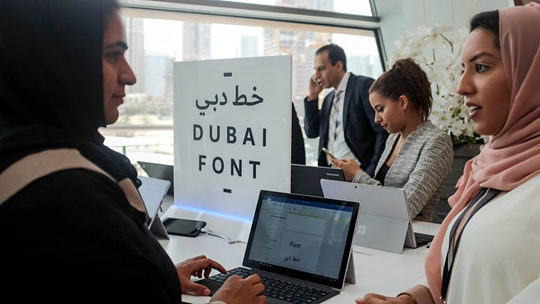
Dubai becomes first city in the world to get its own Microsoft font

May 2, 2017

Dubai, May 2: Dubai has become the first city in the world to get its own Microsoft font, the media reported.

dubai2

Sheikh Hamdan bin Mohammed bin Rashid Al Maktoum, Dubai`s Crown Prince and Chairman of the Executive Council, launched the Dubai Font on Sunday, the Khaleej Times reported.

He directed government institutions all across the city to adopt the font, saying it is considered a positive shift that will boost the emirate`s competitiveness in smart technology.

"This should be a commitment from the Dubai government to guarantee the dissemination and success of this initiative on a local and global level," Sheikh Hamdan said, noting that the font is the new tool for a more tolerant and happy world.

The font, now available to more than 100 million users of Microsoft Office 365 around the world, is the first font to be created by a city and named after it.

Designed for more than 180 countries and 23 languages integrating Arabic and Latin typefaces, the Dubai Font, which will expand over the next phase to include more languages, is aimed to reflect the city`s symbols of tolerance, happiness and respect, enabling people to express, communicate and connect, reports the Khaleej Times.

The Executive Council of Dubai also enabled individuals to download the font from the website: www.dubaifont.com and integrate it into the system for free.

Sheikh Hamdan had directed the General Secretariat of the Executive Council in January 2016 to work on the design of a package of electronic fonts bearing the name of Dubai to include a distinctive font for the Emirate in both Arabic and English, later expanding to 21 other languages.

Nadine Chahine, Type Director and Legibility Expert at Monotype UK, led the design team of six who worked on developing the font.

The font, available in three styles as `Dubai`, `Dubai Medium` and `Dubai Light`, can be in italics, underlined and bold.

Comments

Add new comment

  • Coastaldigest.com reserves the right to delete or block any comments.
  • Coastaldigset.com is not responsible for its readers’ comments.
  • Comments that are abusive, incendiary or irrelevant are strictly prohibited.
  • Please use a genuine email ID and provide your name to avoid reject.
Agencies
May 15,2020

Kolkata, May 15: Veteran Bengali author Debesh Roy, who was conferred the Sahitya Akademi award for his novel 'Teesta Parer Brittanto', died at a private hospital in Kolkata on Thursday, his family members said.

Roy was 84 and he is survived by his son. His wife had died earlier.

He was admitted to the hospital near his residence at Baguihati, in the eastern fringes of the city, on Wednesday after having symptoms like sodium potasium imbalance, sugar problem and breathing problem, his family members said.

He suffered a massive cardiac arrest and died at 10.50 PM.

A regular contributor to a number of Bengali dailies, he was a staunch critic of the attacks on liberals by in the country in recent times and attended protest meetings despite his failing health.

He was born in Pabna in present-day Bangladesh on December 17, 1936. He had five decades of career as a writer.

Besides Teesta Parer Britanta', he will be remembered for books like Borisaler Jogen Mondal , Manush Khun Kore Keno and Samay Asamayer Brittanto . His first book was Jajati.

His last rites will be performed tomorrow.

Comments

Add new comment

  • Coastaldigest.com reserves the right to delete or block any comments.
  • Coastaldigset.com is not responsible for its readers’ comments.
  • Comments that are abusive, incendiary or irrelevant are strictly prohibited.
  • Please use a genuine email ID and provide your name to avoid reject.
Agencies
May 17,2020

As millions of people get hooked to online dating platforms, their proliferation has led to online romance scams becoming a modern form of fraud that have spread in several societies along with the development of social media like Facebook Dating, warn researchers.

For example, extra-marital dating app Gleeden has crossed 10 lakh users in India in COVID-19 times while dating apps like Tinder and Bumble have gained immense popularity.

According to researchers from University of Siena and Scotte University Hospital led by Dr Andrea Pozza, via a fictitious Internet profile, the scammer develops a romantic relationship with the victim for 6-8 months, building a deep emotional bond to extort economic resources in a manipulative dynamic.

"There are two notable features: on the one hand, the double trauma of losing money and a relationship, on the other, the victim's shame upon discovery of the scam, an aspect that might lead to underestimation of the number of cases," the authors wrote in a paper published in the journal Clinical Practice & Epidemiology in Mental Health.

Around 1,400 dating sites/chats have been created over the last decade in North America alone. In the UK, 23 per cent of Internet users have met someone online with whom they had a romantic relationship for a certain period and even 6 per cent of married couples met through the web.

"The online dating industry has given rise to new forms of pathologies and crime, said the authors.

The results showed that 63 per cent of social media users and 3 per cent of the general population reported having been a victim at least once.

Women, middle-aged people, and individuals with higher tendencies to anxiety, romantic idealization of affective relations, impulsiveness and susceptibility to relational addiction are at higher risk of being victims of the scam.

Online romance scams are, in other words, relationships constructed through websites for the purpose of deceiving unsuspecting victims in order to extort money from them.

The scammer always acts empathetically and attempts to create the impression in the victim that the two are perfectly synced in their shared view of life.

"The declarations of the scammer become increasingly affectionate and according to some authors, a declaration of love is made within two weeks from initial contact," the study elaborated.

After this hookup phase, the scammer starts talking about the possibility of actually meeting up, which will be postponed several times due to apparently urgent problems or desperate situations such as accidents, deaths, surgeries or sudden hospitalizations for which the unwitting victim will be manipulated into sending money to cover the momentary emergency.

Using the strategy of "testing-the-water", the scammer asks the victim for small gifts, usually to ensure the continuance of the relationship, such as a webcam, which, if successful, leads to increasingly expensive gifts up to large sums of money.

When the money arrives from the victim, the scammer proposes a new encounter.

The request for money can also be made to cover the travel costs involved in the illusory meeting. In this phase, the victim may start having second thoughts or showing doubt about the intentions of the partner and gradually decide to break off the relationship.

"In other cases, the fraudulent relationship continues or even reinforces itself as the victim, under the influence of ambivalent emotions of ardor and fear of abandonment and deception, denies or rationalizes doubts to manage their feelings," said the study.

In some cases, the scammer may ask the victim to send intimate body photos that will be used as a sort of implicit blackmail to further bind the victim to the scammer.

Once the scam is discovered, the emotional reaction of the victim may go through various phases: feelings of shock, anger or shame, the perception of having been emotionally violated (a kind of emotional rape), loss of trust in people, a sensation of disgust towards oneself or the perpetrator of the crime and a feeling of mourning.

"Understanding the psychological characteristics of victims and scammers will allow at-risk personality profiles to be identified and prevention strategies to be developed," the authors suggested.


Comments

Add new comment

  • Coastaldigest.com reserves the right to delete or block any comments.
  • Coastaldigset.com is not responsible for its readers’ comments.
  • Comments that are abusive, incendiary or irrelevant are strictly prohibited.
  • Please use a genuine email ID and provide your name to avoid reject.
Agencies
July 13,2020

New Delhi, Jul 13: The Income Tax Department has facilitated a new functionality for banks and post offices to ascertain TDS applicability rates on cash withdrawal of above Rs 20 lakh in case of a non-filer of the income-tax return and that of above Rs 1 crore in case of a filer of the income-tax return.

In a statement, the Central Board of Direct Taxes (CBDT) said that now banks and post offices have to only enter the PAN of the person who is withdrawing cash for ascertaining the applicable rate of TDS.

So far, more than 53,000 verification requests have been executed successfully on this facility, a statement by the CBDT said.

"CBDT today said that this functionality available as 'Verification of applicability u/s 194N' on www.incometaxindiaefiling.gov.in since 1st July 2020, is also made available to the Banks through web-services so that the entire process can be automated and be linked to the Bank's internal core banking solution," it said.

On entering PAN by the bank or the post office, a message will be instantly displayed on the departmental utility: "TDS is deductible at the rate of 2 per cent if cash withdrawal exceeds Rs 1 crore", in case the person withdrawing cash is a filer of the income-tax return.

In case the person withdrawing cash is a non-filer of income tax return, the message shown would be: "TDS is deductible at the rate of 2 per cent if cash withdrawal exceeds Rs 20 lakh and at the rate of 5 per cent if it exceeds Rs 1 crore."

The CBDT said that the data on cash withdrawal indicated that huge amount of cash is withdrawn by the persons who have never filed income-tax returns.

To ensure filing of return by these persons and to keep track on cash withdrawals by the non-filers, and to curb black money, the Finance Act, 2020 with effect from July 1, 2020 further amended IT Act to lower threshold of cash withdrawal to Rs 20 lakh for the applicability of this TDS for the non-filers and also mandated TDS at the higher rate of 5 per cent on cash withdrawal exceeding Rs 1 crore by the non-filers.

Comments

Add new comment

  • Coastaldigest.com reserves the right to delete or block any comments.
  • Coastaldigset.com is not responsible for its readers’ comments.
  • Comments that are abusive, incendiary or irrelevant are strictly prohibited.
  • Please use a genuine email ID and provide your name to avoid reject.