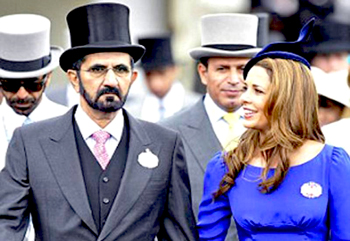
Dubai Emir to build six-storey car park in London for his 114 luxury cars

April 5, 2015

Abu Dhabi, Apr 5: The Vice President of United Arab Emirates (UAE) and Ruler of Dubai Sheikh Mohammed bin Rashid Al Maktoum is planning is build a personal six-story super car park for his fleet of 114 luxury cars in London.

According to a report by MailOnline, a five-star accommodation will also be built which will include offices, bathrooms and three triple-bedroom flats to be used by the chauffeurs and staff of the super car park.

Dubai EmirThe super car park and the five star accommodation will be built next to Battersea heliport by the River Thames.

Once built the car park will allow the Sheikh, his associates along with his 23 children to arrive in the capital city of United Kingdom by helicopter and jump straight into whichever luxury car they like.

Al Maktoum also has business interests including the Godolphin horseracing stables and the Jumeirah luxury hotel group.

The construction cost of the super car park is estimated to be around £20million with construction sources saying that the cost will be alot more if the emir plans to cover it in marble.

The Smech Management Company submitted the plans for the land and planning application was approved by councillors at Wandsworth Borough Council.

The company is also behind the Sheikh's proposed 16-bedroom mansion in the Scottish Highlands.

Dubai is a Gulf Arab emirate that attracts tourists with the promise of an opulent lifestyle. Dubai built the world's tallest building, put a ski slope inside a shopping mall, and gave its cops a Lamborghini for a police car.

UAE officials are also planning to build the world's first temperate-controlled city in Dubai in a bid to become a year-round tourism destination despite soaring temperatures in summer that can reach nearly 50 C.

The city will be built on 48 million square feet which will contain the largest shopping mall on the planet, complete with climate-controlled streets, the world's largest indoor theme park and 100 hotels and apartments.

Comments

Add new comment

  • Coastaldigest.com reserves the right to delete or block any comments.
  • Coastaldigset.com is not responsible for its readers’ comments.
  • Comments that are abusive, incendiary or irrelevant are strictly prohibited.
  • Please use a genuine email ID and provide your name to avoid reject.
News Network
February 21,2020

New Delhi, Feb 21: Global terror financing watchdog FATF on Friday decided continuation of Pakistan in the "Grey List" and warned the country that stern action will be taken if it fails to check flow of money to terror groups like the LeT and the JeM, sources said.

The decision has been taken at the Financial Action Task Force's plenary in Paris.

The FATF decided to continue Pakistani in the "Grey List". The FATF also warned Pakistan that if it doesn't complete a full action plan by June, it could lead to consequences on its businesses, a source said.

Comments

Add new comment

  • Coastaldigest.com reserves the right to delete or block any comments.
  • Coastaldigset.com is not responsible for its readers’ comments.
  • Comments that are abusive, incendiary or irrelevant are strictly prohibited.
  • Please use a genuine email ID and provide your name to avoid reject.
News Network
April 26,2020

Apr 26: The remarkable story of an airman who overcame prejudice to become one of only a handful of Indian fighter pilots in the First World War has emerged in newly-released archive files by the UK's Commonwealth War Graves Commission (CWGC).

Lieutenant Shri Krishna Chanda Welinkar is one of the thousands of moving stories from the war preserved in family correspondence and being brought alive as part of a digitisation project.

The never-before-published files contain thousands of letters, pictures and other papers sent between the Commission and the next of the kin of First World War dead.

Among them is the story of Welinkar, who hailed from Bombay in colonial India. After much hardship and discrimination, he eventually became a pilot and went missing while on patrol over the skies above the Western Front in June 1918.

His family had to wait nearly three years before they finally knew for certain that he had died, and his grave was located.

“For everyone who died in the First World War, there was inevitably a partner, parent or child back home who had questions. The heartbreaking letters in CWGC's archive give us an insight into what it was like for those families trying to come to terms with their loss,” said Andrew Fetherston, chief archivist for CWGC.

“They are stories that show desperate searches for closure, former enemies uniting and, on many occasions, the sad realisation that a missing loved one would always remain so. We are pleased to be able to make this invaluable piece of World War history accessible to a new generation and help deepen our understanding of how the First World War impacted those who were left behind,” he said.

Welinkar was one of the 1.3 million Indians who answered the call to fight for the British Empire. Nearly 74,000 never saw their homeland again and are remembered today in cemeteries and memorials throughout the world, including France, Belgium, the Middle East and Africa.

Welinkar was a well-educated man studying at Cambridge University. He trained to become an aviator in Middlesex and wished to join the Royal Flying Corps, later known as the Royal Air Force.

Upon attempting to enlist, Welinkar encountered the same prejudices as his other fellow Indian airmen and was encouraged to become an air mechanic instead.

He was eventually given a commission in the Royal Flying Corps as an Officer. In 1918, he was posted to France and patrolled the skies above the Western Front.

In June 1918, Lieutenant Welinkar embarked on what would be his final patrol; he did not return and was reported missing. His fate remained unknown for many months afterwards.

The newly-released e-files chronicle the remarkable discovery of Welinkar and his final resting place long after the war had ended. Colonel Barton, who knew Welinkar, acted on behalf of his mother and helped find her missing son. They spoke to former enemies and honed their search to the grave of an unidentified man, buried by the Germans as “Oberleutnant S.C. Wumkar” in a grave in Rouvroy, Belgium.

The body was later moved and reinterred in Hangard Communal Cemetery Extension but it wasn't until the vital clue, found in the original German burial records in February 1921, that it was confirmed beyond doubt this grave was of Welinkar's.

In May 1921, Colonel Barton, on behalf of Welinkar's mother, requested that a Commission headstone be placed on the grave with the following personal inscription: “To the Honoured Memory of One of the Empire's Bravest Sons”.

This records – known as Enquiry Files – are part of a collection of nearly 3,000 files which have never been made available to the public before. Nearly half have been digitised so far, alongside a previously unreleased collection of more than 16,000 photographs held in negatives in the Commission's archive.

The files, internally referred to simply as E-Files, contain correspondence between the CWGC and the next of kin of the war dead. They often contain letters, typed memos between Commission staff and on occasion photos, maps and diagrams.

CWGC only holds an enquiry file for a small proportion of the 1.7 million people it commemorates from the Commonwealth. Today it is only possible to release those surviving records from the First World War because correspondence with families of Second World War casualties often involves people still alive today and cannot be made public for many years, due to the UK's data protection rules.

To date, more than 1,300 of the surviving 3,000 First World War enquiry files have been digitised.

The CWGC commemorates the 1.7 million Commonwealth servicemen and women who died during the two World Wars. It also holds and updates an extensive and accessible records archive, while operating over 23,000 locations in more than 150 countries and territories.


Comments

Add new comment

  • Coastaldigest.com reserves the right to delete or block any comments.
  • Coastaldigset.com is not responsible for its readers’ comments.
  • Comments that are abusive, incendiary or irrelevant are strictly prohibited.
  • Please use a genuine email ID and provide your name to avoid reject.
News Network
May 7,2020

Mumbai, May 7: Maharashtra Minister Nawab Malik on Wednesday accused the BJP-led Uttar Pradesh and Karnataka governments of adopting an uncooperative approach in taking back migrant workers hailing from these two states.

Mr Malik said that such a problem has not arisen with other states like Bihar, Rajasthan and another BJP-ruled state, Madhya Pradesh.

"They are creating new hurdles. There are no such problems in case of other states like Bihar, Rajasthan, Madhya Pradesh and West Bengal though.

"The process (of sending back migrants) has been smooth in the case of these states," Mr Malik said.

The NCP leader alleged that the Uttar Pradesh and Karnataka governments either don't want the people hailing from their states to return or are deliberately creating hurdles so that out of job workers do not go back in big numbers.

The Uttar Pradesh and Karnataka government should understand that the migrant workers are not ready mentally to stay back in Maharashtra and want to return to their native states, Mr Malik said.

The NCP minister said the Maharashtra government has been sending the applications received from migrant workers to the nodal officers of their respective native districts.

Once the nodal officers (of the native districts) concerned approve the applications, the workers are sent back either by trains or private vehicles following their medical tests, Mr Malik added.

Comments

Add new comment

  • Coastaldigest.com reserves the right to delete or block any comments.
  • Coastaldigset.com is not responsible for its readers’ comments.
  • Comments that are abusive, incendiary or irrelevant are strictly prohibited.
  • Please use a genuine email ID and provide your name to avoid reject.