



The dying light of freedom

[email protected] (Mani Shankar Aiyar)
May 17, 2014

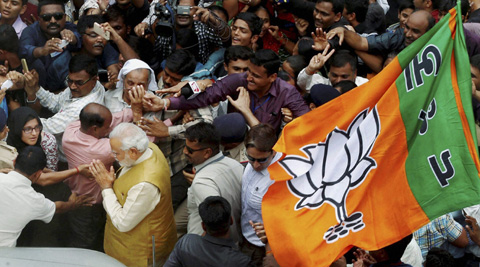
Dying_light_of_freedomDarkness descends. The idea of India gutters. The light that lit our freedom struggle and so defined the nature of our nationhood is going out. We are at a moment of history that can only be compared to Lahore, March 23, 1940, when Jinnah persuaded one section of our society to accept that India was comprised of two nations because nationhood had to be founded in religious identity. Thus was conceived a Muslim Pakistan. But Gandhiji resisted India cloning that example with a Hindu India. For that, he had to pay with his life at the instance of the very forces that are today most avidly celebrating Narendra Modi’s victory.

The campaign has shown the incoming prime minister insisting that for any Hindu, India is his rightful home, thus equating India with Hindudom and reducing to sufferance those who regard India as their home but not Hinduism as their religion. My closest Muslim friend, viewing the imminent catastrophe, asks, “Was it for this that our parents decided to remain in India?”

I have reassured her that even if over a third of Indians voted for the BJP, nearly two-thirds did not. This is a low moment for us, but if Indian secularism is not a Nehruvian whim but the consequence of that secularism, that plurality, that inclusivism being woven into the warp and woof of our millennial civilisation, then this is not a moment of defeat but a moment of challenge.

We have to be on our utmost guard to spot the new government awaiting its Godhra opportunity. Godhra was to Modi what Marinus van der Lubbe’s attempt to set fire to the Reichstag was to Hitler. It gave them the occasion to ride a wave of public anguish to accomplish the deepest purpose of their political lives. We have been forewarned, therefore, we must be forearmed. This is not a moment for armchair secularism. The issue is not a philosophical or polemical one. It is a red alert to be vigilant and activist. We must convert Modi’s Reichstag moment, when it comes, into our Belchi moment. In the Congress, the Sadbhavana Sena died with its first and only chairman, Sunil Dutt.

That needs to be revived and converted into a rapid action force that reaches the spot the minute news comes in of a communal flare-up. Moreover, the sena must concert with other secular forces, irrespective of differences. India’s secular nationhood is too fundamentally important to be left hostage to other considerations.

There are two other fronts on which vigilance is called for. One is development. The so-called Gujarat model blazed the path to unashamed crony capitalism. That is why those thousands of crores of rupees of doubtful provenance poured into the coffers of Modi’s campaign, just as Krupp and Thyssen funded every step of the march of the corporal from the Beer Hall Putsch to the German Chancery. Hitler repaid them with the biggest bonanza ever. Modi waits to confer similar bounty on his benefactors.

Even as the nation’s secular majority must concert its efforts to preserve the quintessence of our nationhood, so must the forces of equity, social justice and human development concert their efforts to keep the country from being gifted to robber barons. The Congress may be in reduced numbers in Parliament but along with others not on the treasury benches, the voices of fair play for the aam aadmi will not be lacking in number. The socialist Lilliputians might yet tie down big business Gullivers and their political cohorts.

That brings me to the next, and related, imperative. Parliamentary institutions have been severely mauled in the BJP’s clambering to power. The last Lok Sabha was rendered by their antics the most non-functional ever. The Rajya Sabha followed suit — and often led the way. The incoming opposition, of which the Congress constitutes the largest single fraction, must unchain the speaker and chairman and insist that both Houses function in accordance with the rules and regulations of the House, its propriety and precedents, with dignity and decorum. Happily the saffron shouting brigade is on the treasury benches.

Hence the opposition can ensure that democracy is restored to its throne. The priority of the largest opposition party must be to restore Parliament as the nation’s highest forum for debate, not demonstration. And it is in Parliament that we can best thwart every effort of the incoming government to move towards its nefarious ulterior agenda.

On the external front, the first duty of every parliamentarian in this centenary year of the start of World War I must be to read all he or she can on the vainglorious strutting of jingoistic leaders that led those the Cambridge historian of the war, Christopher Clark, has called “The Sleepwalkers” blundering into a slaughter they never intended nor wished, a slaughter that began in 1914 and, with but a short interregnum, ended only in 1945, after nearly 50 million people had lost their lives. Shrill and narrow nationalism, as Gurudev Rabindranath Tagore warned, are the worst enemies of peace and humanism.

Yet, those two qualities are precisely the stock-in-trade of the party now coming to power. There is no Atal Bihari Vajpayee — surely the last Nehruvian — to rein in the chauvinism of what passes for “patriotism” in that party. The ideological extremists have taken over and will seize every chance to convert external events into the grand opportunity for flag-waving and mindless brinkmanship. Catastrophe worse than the two World Wars awaits this subcontinent, if those fortunate enough to not be on the treasury benches fail to be ever-vigilant and ready to risk immediate popularity for the larger cause. We have our work cut out for us. Let us put our shoulders to the wheel.

The writer is a Rajya Sabha MP from the Congress

Normal 0 false false false EN-US X-NONE X-NONE MicrosoftInternetExplorer4

The dying light of freedom

by Mani Shankar Aiyar

Darkness descends. The idea of India gutters. The light that lit our freedom struggle and so defined the nature of our nationhood is going out. We are at a moment of history that can only be compared to Lahore, March 23, 1940, when Jinnah persuaded one section of our society to accept that India was comprised of two nations because nationhood had to be founded in religious identity. Thus was conceived a Muslim Pakistan. But Gandhiji resisted India cloning that example with a Hindu India. For that, he had to pay with his life at the instance of the very forces that are today most avidly celebrating Narendra Modi’s victory.

The campaign has shown the incoming prime minister insisting that for any Hindu, India is his rightful home, thus equating India with Hindudom and reducing to sufferance those who regard India as their home but not Hinduism as their religion. My closest Muslim friend, viewing the imminent catastrophe, asks, “Was it for this that our parents decided to remain in India?”

I have reassured her that even if over a third of Indians voted for the BJP, nearly two-thirds did not. This is a low moment for us, but if Indian secularism is not a Nehruvian whim but the consequence of that secularism, that plurality, that inclusivism being woven into the warp and woof of our millennial civilisation, then this is not a moment of defeat but a moment of challenge.

We have to be on our utmost guard to spot the new government awaiting its Godhra opportunity. Godhra was to Modi what Marinus van der Lubbe’s attempt to set fire to the Reichstag was to Hitler. It gave them the occasion to ride a wave of public anguish to accomplish the deepest purpose of their political lives. We have been forewarned, therefore, we must be forearmed. This is not a moment for armchair secularism. The issue is not a philosophical or polemical one. It is a red alert to be vigilant and activist. We must convert Modi’s Reichstag moment, when it comes, into our Belchi moment. In the Congress, the Sadbhavana Sena died with its first and only chairman, Sunil Dutt.

That needs to be revived and converted into a rapid action force that reaches the spot the minute news comes in of a communal flare-up. Moreover, the sena must concert with other secular forces, irrespective of differences. India’s secular nationhood is too fundamentally important to be left hostage to other considerations.

There are two other fronts on which vigilance is called for. One is development. The so-called Gujarat model blazed the path to unashamed crony capitalism. That is why those thousands of crores of rupees of doubtful provenance poured into the coffers of Modi’s campaign, just as Krupp and Thyssen funded every step of the march of the corporal from the Beer Hall Putsch to the German Chancery. Hitler repaid them with the biggest bonanza ever. Modi waits to confer similar bounty on his benefactors.

Even as the nation’s secular majority must concert its efforts to preserve the quintessence of our nationhood, so must the forces of equity, social justice and human development concert their efforts to keep the country from being gifted to robber barons. The Congress may be in reduced numbers in Parliament but along with others not on the treasury benches, the voices of fair play for the aam aadmi will not be lacking in number. The socialist Lilliputians might yet tie down big business Gullivers and their political cohorts.

That brings me to the next, and related, imperative. Parliamentary institutions have been severely mauled in the BJP’s clambering to power. The last Lok Sabha was rendered by their antics the most non-functional ever. The Rajya Sabha followed suit — and often led the way. The incoming opposition, of which the Congress constitutes the largest single fraction, must unchain the speaker and chairman and insist that both Houses function in accordance with the rules and regulations of the House, its propriety and precedents, with dignity and decorum. Happily the saffron shouting brigade is on the treasury benches.

Hence the opposition can ensure that democracy is restored to its throne. The priority of the largest opposition party must be to restore Parliament as the nation’s highest forum for debate, not demonstration. And it is in Parliament that we can best thwart every effort of the incoming government to move towards its nefarious ulterior agenda.

On the external front, the first duty of every parliamentarian in this centenary year of the start of World War I must be to read all he or she can on the vainglorious strutting of jingoistic leaders that led those the Cambridge historian of the war, Christopher Clark, has called “The Sleepwalkers” blundering into a slaughter they never intended nor wished, a slaughter that began in 1914 and, with but a short interregnum, ended only in 1945, after nearly 50 million people had lost their lives. Shrill and narrow nationalism, as Gurudev Rabindranath Tagore warned, are the worst enemies of peace and humanism.

Yet, those two qualities are precisely the stock-in-trade of the party now coming to power. There is no Atal Bihari Vajpayee — surely the last Nehruvian — to rein in the chauvinism of what passes for “patriotism” in that party. The ideological extremists have taken over and will seize every chance to convert external events into the grand opportunity for flag-waving and mindless brinkmanship. Catastrophe worse than the two World Wars awaits this subcontinent, if those fortunate enough to not be on the treasury benches fail to be ever-vigilant and ready to risk immediate popularity for the larger cause. We have our work cut out for us. Let us put our shoulders to the wheel.

The writer is a Rajya Sabha MP from the Congress
Comments

Add new comment

  • Coastaldigest.com reserves the right to delete or block any comments.
  • Coastaldigset.com is not responsible for its readers’ comments.
  • Comments that are abusive, incendiary or irrelevant are strictly prohibited.
  • Please use a genuine email ID and provide your name to avoid reject.
Wafa Sultana
April 4,2020

Over the last couple of days when the world was occupied with unifying efforts to fight the deadly Covid19 pandemic, sections of Indian media provided viewers a familiar scapegoat – the Indian Muslims – who are often stereotyped as a community being constantly at loggerheads with the citizenry and the State. Biased media channels were quick to resort to blaming the entire Muslim community for the spread of the disease in the country, thanks to an ill-timed Tablighi Jamaat gathering at its international headquarters in Delhi’s Nizamuddin. Unsurprisingly, the opprobrium was also marked by a sudden spike in WhatsApp forwards of videos with people wearing skullcaps licking spoons and performing Sufi breathing rituals, suggesting some sort of wild conspiracy on the part of the community to spread the virus.  Some media channels were quick to formulate, hypothesize and provide loose definitions of a newly discovered form of Jihad i.e. ‘Corona Jihad ’ thereby vilifying the Islamic faith and its followers.

While the investigation on the culpability of the organizers of the Nizamuddin event is still ongoing, there is enough information to suggest that the meeting was held before any lockdown was in force, and the problem began when there was no way of getting people out once the curfew was announced. Be that as it may, there is little doubt that organizing a meet of such a scale when there is a global pandemic smacks of gross misjudgment, and definitely the organizers should be held accountable if laws or public orders were defied. Attendees who attempt to defy quarantine measures must be dealt with strictly. However, what is alarming is that the focus and narrative have now shifted from the unfortunate event at Nizamuddin to the Tablighi Jamaat itself.

For those not familiar with the Tablighi Jamaat, the organization was founded in 1926 in Mewat by scholar Maulana Mohammad Ilyas. The Jamaat’s main objective was to get Muslim youth to learn and practice pristine Islam shorn of external influences. This is achieved through individuals dedicating time for moral and spiritual upliftment secluded from the rest of the world for a brief period of time. There is no formal membership process. More senior and experienced participants typically travel from one mosque to other delivering talks on religious topics, inviting local youth to attend and then volunteer for a spiritual retreat for a fixed number of days to a mosque in a nearby town or village to present the message to their co-religionists. Contrary to ongoing Islamophobic rhetoric, the movement does not actively proselytize. The focus is rather on getting Muslims to learn the teachings and practices of Islam.  This grassroots India-based movement has now grown to almost all countries with substantial Muslim populations. Its annual meets, or ‘ijtemas’ are among the largest Islamic congregations in the world after the annual Haj. One of the reasons for its popularity and wide network in the subcontinent and wordwide is the fact that it has eschewed the need for scholarly intervention, focusing on peer learning of fundamental beliefs and practice rather than high-falutin ideological debates. The Tablighi Jamaat also distinguishes itself from other Islamic movements through its strictly apolitical nature, with a focus on individual self-improvement rather than political mobilization. Hardships and difficulty in the world are expected to be face through ‘sabr’ (patience) and ‘dua’ (supplication),  than through quest for political power or influence. In terms of ideology, it is very much based on mainstream Sunni Islamic principles derived from the Deobandi school.

So, why is all this background important in the current context? While biased media entities have expectedly brought out their Islamophobic paraphernalia out for full display, more neutral commentators have tried to paint the Tablighi Jamaat as a fringe group and have tried to distance it from 'mainstream Muslims'. While the intent is no doubt innocent, this is a trap we must not fall into. This narrative, unfortunately, is also gaining ground due to apathy some Muslims have for the group, accusing it of being “disconnected from the realities of the world”. Unlike other Muslim organizations and movements, the Tablighi Jamat, by virtue of its political indifference, does not boast of high-profile advocates and savvy spokespersons who can defend it in mainstream or social media.  The use of adjectives such as 'outdated' and 'orthodox' by liberal columnists to describe the Jamaat feeds into the malignant attempt to change the narrative from the control of the spread of the pandemic due to the Nizamuddin gathering to 'raison d'etre' of the organization itself.

A large mainstream religious group like the Tablighi Jamaat with nearly a hundred-year history, normally considered to be peaceful, apolitical and minding its own business is now suddenly being villainized owing to unfortunate circumstances. Biased media reactions filled with disgust and hate seem to feed the Indian public conscience with a danngerous misconception - to be a nominal Muslim is okay but being a practicing one is not.  For those committed to the truth and fighting the spread of Islamophobia, the temptation to throw the entire Tablighi Jamaat under the bus must be resisted.

The writer is a lawyer and research scholar at Qatar University. Her research interests include Islamic law and politics.

Comments

zahoorahmed
 - 
Saturday, 4 Apr 2020

great article! provides a great perspective on tableeg jamat

Add new comment

  • Coastaldigest.com reserves the right to delete or block any comments.
  • Coastaldigset.com is not responsible for its readers’ comments.
  • Comments that are abusive, incendiary or irrelevant are strictly prohibited.
  • Please use a genuine email ID and provide your name to avoid reject.
Ram Puniyani
March 14,2020

In the wake of Citizenship Amendment Act (CAA) UN High Commissioner, Michele Bachelet, has filed an intervention in the Supreme Court petition challenging the constitutionality of the Citizenship Amendment Act, as she is critical of CAA. Responding to her, India’s Foreign Minister S. Jai Shanker strongly rebutted her criticism, saying that the body (UNHCR) has been wrong and is blind to the problem of cross border terrorism. The issue on hand is the possibility of scores of people, mainly Muslims, being declared as stateless. The problem at hand is the massive exercise of going through the responses/documents from over 120 crore of Indian population and screening documents, which as seen in Assam, yield result which are far from truthful or necessary.

The issue of CAA has been extensively debated and despite heavy critique of the same by large number of groups and despite the biggest mass opposition ever to any move in Independent India, the Government is determined on going ahead with an exercise which is reminiscent of the dreaded regimes which are sectarian and heartless to its citizens, which have indulged in extinction of large mass of people on grounds of citizenship, race etc. The Foreign minister’s assertion is that it is a matter internal to India, where India’s sovereignty is all that matters! As far as sovereignty is concerned we should be clear that in current times any sovereign power has to consider the need to uphold the citizenship as per the principle of non-discrimination which is stipulated in Art.26 of the International Covenant on Civil and Political (ICCPR) rights.

Can such policies, which affect large number of people and are likely to affect their citizenship be purely regarded as ‘internal’? With the World turning into a global village, some global norms have been formulated during last few decades. The norms relate to Human rights and migrations have been codified. India is also signatory to many such covenants in including ICCPR, which deals with the norms for dealing with refugees from other countries. One is not talking of Chicago speech of Swami Vivekanand, which said that India’s greatness has been in giving shelter to people from different parts of the World; one is also not talking of the Tattariaya Upanishad’s ‘Atithi Devovhav’ or ‘Vasudhaiva Kutumbkam’ from Mahaupanishad today.

What are being talked about are the values and opinions of organizations which want to ensure to preserve of Human rights of all people Worldwide. In this matter India is calling United Nations body as ‘foreign party’; having no locus standi in the case as it pertains to India’s sovereignty. The truth is that since various countries are signatories to UN covenants, UN bodies have been monitoring the moves of different states and intervening at legal level as Amicus (Friend of the Court) to the courts in different countries and different global bodies. Just to mention some of these, UN and High Commissioner for Human Rights has often submitted amicus briefs in different judicial platforms. Some examples are their intervention in US Supreme Court, European Court of Human Rights, International Criminal Court, and the Inter-American Court of Human Rights. These are meant to help the Courts in areas where UN bodies have expertise.

 Expertise on this has been jointly formulated by various nations. These interventions also remind the nations as to what global norms have been evolved and what are the obligations of individual states to the values which have evolved over a period of time. Arvind Narrain draws our attention to the fact that, “commission has intervened in the European Court of Human Rights in cases involving Spain and Italy to underscore the principle of non-refoulement, which bars compulsory expulsion of illegal migrants… Similarly, the UN has intervened in the International Criminal Court in a case against the Central African Republic to explicate on the international jurisprudence on rape as a war crime.”

From time to time organizations like Amnesty International and Human Rights Watch have been monitoring the status of Human rights of different countries. This puts those countries in uncomfortable situation and is not welcome by those establishments. How should this contradiction between ‘internal matter’, ‘sovereignty’ and the norms for Human rights be resolved? This is a tough question at the time when the freedom indices and democratic ethos are sliding downwards all over the world. In India too has slid down on the scale of these norms.

In India we can look at the intervention of UN body from the angle of equality and non discrimination. Democratic spirit should encourage us to have a rethink on the matters which have been decided by the state. In the face of the greatest mass movement of Shaheen bagh, the state does need to look inwards and give a thought to international morality, the spirit of global family to state the least.

The popular perception is that when Christians were being persecuted in Kandhmal the global Christian community’s voice was not strong enough. Currently in the face of Delhi carnage many a Muslim majority countries have spoken. While Mr. Modi claims that his good relations with Muslim countries are a matter of heartburn to the parties like Congress, he needs to relook at his self gloating. Currently Iran, Malaysia, Indonesia and many Muslim majority countries have spoken against what Modi regime is unleashing in India. Bangladesh, our neighbor, has also seen various protests against the plight of Muslims in India. More than the ‘internal matter’ etc. what needs to be thought out is the moral aspect of the whole issue. We pride ourselves in treading the path of morality. What does that say in present context when while large section of local media is servile to the state, section of global media has strongly brought forward what is happening to minorities in India.   

The hope is that Indian Government wakes up to its International obligations, to the worsening of India’s image in the World due to CAA and the horrific violence witnessed in Delhi.

Comments

Add new comment

  • Coastaldigest.com reserves the right to delete or block any comments.
  • Coastaldigset.com is not responsible for its readers’ comments.
  • Comments that are abusive, incendiary or irrelevant are strictly prohibited.
  • Please use a genuine email ID and provide your name to avoid reject.
Ram Puniyani
June 29,2020

In Minneapolis, US an African American, George Floyd lost his life as the white policeman, Derek Chauvin, caught hold of him and put his knee on his neck. This is a technique developed by Israel police. For nine long minutes the knee of the while policeman was on the neck of George, who kept shouting, I can’t breathe.

Following this gruesome murder America erupted with protests, ‘Black lives matter’. The protestors were not just African Americans but also a large section of whites. Within US one police Chief apologized for the act of this. In a touching gesture of apology the police force came on its knees. This had reverberations in different parts of the World.

The act was the outcome of the remnants of the racial hatred against blacks by the whites. It is the hatred and the perceptions which are the roots of such acts of violence. What was also touching that the state of democracy in US is so deep that even the police apologized, the nation, whites and blacks, stood up as a sensitive collective against this violence.

US is not the only country where the brutal acts of violence torment the marginalized sections of society. In India there is a list of dalits, minorities and adivasis who are regularly subjected to such acts. But the reaction is very different. We have witnessed the case of Tabrez Ansari, who was tied to the pole by the mob and beaten ruthlessly. When he was taken to police station, police took enough time to take him to hospital and Tabrez died.

Mohsin Sheikh, a Pune techie was murdered by Hindu Rashtra Sena mob, the day Modi came to power in 2014. Afrazul was killed by Shambhulal Regar, videotaped the act released on social media. Regar believed that Muslims are indulging in love Jihad, so deserve such a fate. Mohammad Akhlaq is one among many names who were mob lynched on the issue of beef cow. The list can fill pages after pages.

Recently a young dalit boy was shot dead for the crime of entering a temple. In Una four dalits were stripped above waste and beaten mercilessly. Commenting on this act the Union Minister Ramvilas Paswan commented that it is a minor incident. Again the list of atrocities against dalits is long enough. The question is what Paswan is saying is the typical response to such gruesome murders and tortures. In US loss of one black life, created the democratic and humane response. In India there is a general silence in response to these atrocities. Some times after a good lapse of time, the Prime Minister will utter, ‘Mother Bharati has lost a son’. Most of the time victim is blamed. Some social groups raise their voice in some fora but by and large the deafening silence from the country is the norm.

India is regarded as the largest democracy. Democracy is the rule of law, and the ground on which the injustices are opposed. In America though the present President is insensitive person, but its institutions and processes of democratic articulations are strong. The institutions have deepened their roots and though prejudices may be guiding the actions of some of the officers like the killer of George, there are also police officers who can tell their President to shut up if he has nothing meaningful to say on the issue. The prejudices against Blacks may be prevalent and deep in character, still there are large average sections of society, who on the principles of ‘Black lives matter’. There are large sections of vocal population who can protest the violation of basic norms of democracy and humanism.

In India by contrast there are multiple reasons as to why the lives of Tabrez Ansari, Mohammad Akhlaq, Una dalit victims and their likes don’t matter. Though we claim that we are a democracy, insensitivity to injustices is on the rise. The strong propaganda against the people from margins has become so vicious during last few decades that any violence against them has become sort of a new normal. The large populace, though disturbed by such brutalities, is also fed the strong dose of biases against the victims. The communal forces have a great command over effective section of media and large section of social media, which generates Hate against these disadvantaged groups, thereby the response is muted, if at all.

As such also the process of deepening of our democracy has been weak. Democracy is a dynamic process; it’s not a fixed entity. Decades ago workers and dalits could protest for their rights. Now even if peasants make strong protests, dominant media presents it as blocking of traffic! How the roots of democracy are eroded and are visible in the form where the criticism of the ruling dispensation is labelled as anti National..

Our institutions have been eroded over a period of time, and these institutions coming to the rescue of the marginalized sections have been now become unthinkable. The outreach of communal, divisive ideology, the ideology which looks down on minorities, dalits and Adivasis has risen by leaps and bounds.

The democracy in India is gradually being turned in to a hollow shell, the rule of law being converted in to rule of an ideology, which does not have faith in Indian Constitution, which looks down upon pluralism and diversity of this country, which is more concerned for the privileges of the upper caste, rich and affluent. The crux of the matter is the weak nature of democracy, which was on way to become strong, but from decades of 1980s, as emotive issues took over, the strength of democracy started dwindling, and that’s when the murders of the types of George Floyd, become passé. One does complement the deeper roots of American democracy and its ability to protect the democratic institutions, which is not the case in India, where protests of the type, which were witnessed after George Floyd’s murder may be unthinkable, at least in the present times. 

Comments

Add new comment

  • Coastaldigest.com reserves the right to delete or block any comments.
  • Coastaldigset.com is not responsible for its readers’ comments.
  • Comments that are abusive, incendiary or irrelevant are strictly prohibited.
  • Please use a genuine email ID and provide your name to avoid reject.