



Early detection key to defeating breast cancer, say experts

[email protected] (Arab News)
December 30, 2013

Breast_cancer

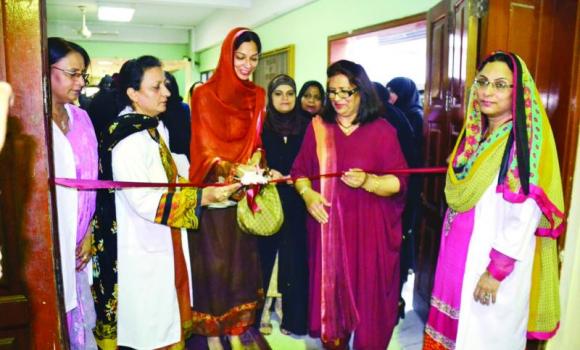
Jeddah, Dec 30: The Pakistan Welfare Society (PWS) organized a women’s health awareness program on Saturday with the aim of enlightening the people about health issues.

The program comprised a panel of four female doctors — Dr. Rabia Khatoon, family consultant at King Fahd Hospital; Dr. Nilofar Azra, gynecologist and obstetrician; Dr. Farzana Iqbal, gynecologist and obstetrician at King Faisal Hospital; and Dr. Samreen Safdar, diabetes and endocrine consultant at King Faisal Hospital.

A number of other doctors and assistants conducted free medical check-ups and gave advice to the attendees on body mass index, weight, blood sugar and regular exercise.

The program started with the recitation of the Holy Qur'an followed by a welcome speech by chief guest Afshan Khokher, wife of the Pakistan consul general.

Imrana Siddiqui, wife of deputy consul general; Farhat Naeem, vice principal of Pakistan International School-Jeddah (PISJ-Aziziah), and members of the community attended the event.

Riffat Arshad explained the importance of health and regular check-ups, activities of PWS, which include free medical camps, school health services and scholarships for needy students, raising awareness through health seminars and the kidney transplant center near Abbotabad.

Khatoon talked about common female cancers such as breast, uterus and cervical, their symptoms and the importance of timely check-up and treatment.

She explained that breast cancer is very common in women and the risk factors increase after the age of 50. “Early diagnosis is the key to survival, and there is a need to create awareness of screening and mammogram,” she said, and explained different factors of breast cancer as faulty genes, heredity, not doing breast feeding, late menopause, having children in late age and others.

She also explained that cervical cancer is the third most common cancer among women which can be easily prevented through regular check-ups of pap smear screening and HPV vaccination.

Azra explained anemia in pregnant women, diabetes or high sugar during pregnancy and importance of regular check-ups.

Iqbal explained the myth and misconceptions about vaginal discharge, the most common problem of almost all women of all ages.

Safdar spoke on diabetes and its problems, the importance of healthy and balanced food, and daily exercise as medicine alone is not enough to take care of the disease.

Khokher thanked all the doctors for the important information and assured them of the support of the consulate for welfare work of the community.

Comments

Add new comment

  • Coastaldigest.com reserves the right to delete or block any comments.
  • Coastaldigset.com is not responsible for its readers’ comments.
  • Comments that are abusive, incendiary or irrelevant are strictly prohibited.
  • Please use a genuine email ID and provide your name to avoid reject.
Agencies
June 29,2020

Washington DC, Jun 29: Young children with narrow retinal artery diameters were more likely to develop higher blood pressure, and children with higher blood pressure levels were more likely to develop retinal microvascular impairment during early childhood, according to a new study.

The first study to show this connection in children was published today in Hypertension, an American Heart Association journal.

High blood pressure, the main risk factor for the development of cardiovascular disease (CVD), can manifest as early as childhood, and the prevalence of high blood pressure among children continues to rise. In previous studies, analysis of blood vessels in the retina has shown promise as a predictor of CVD risk among adults. In the study titled, "Retinal Vessel Diameters and Blood Pressure Progression in Children," researchers sought to predict the development of high blood pressure in children over four years based on retinal blood vessel measurements.

"Hypertension continues as the main risk factor for the development of cardiovascular diseases and mortality," says Henner Hanssen, M.D., the study's lead author and a professor in the department of sport, exercise and health at the University of Basel in Switzerland. 

"Primary prevention strategies are needed to focus on screening retinal microvascular health and blood pressure in young children in order to identify those at increased risk of developing hypertension. The earlier we can provide treatment and implement lifestyle changes to reduce hypertension, the greater the benefit for these children."

Researchers screened 262 children ages six to eight from 26 schools in Basel, Switzerland, in 2014, for baseline blood pressure and retinal arterial measurements. Both measures were taken again in 2018. Blood pressure measurements at both baseline and follow-up were performed in a sitting position after a minimum of five minutes of rest and were categorized based on the American Academy of Pediatrics' blood pressure guidelines. These guidelines utilize the same measurements as the American Heart Association/American College of Cardiology 2017 Guideline for the Prevention, Detection, Evaluation, and Management of High Blood Pressure in Adults.

Results from the analysis indicate: children with narrower retinal vessel diameters at baseline developed higher systolic blood pressure at follow-up; retinal vessel diameters could explain 29 -31 per cent of the changes in systolic blood pressure progression between 2014 and 2018; children with higher blood pressure levels at baseline developed significantly narrower arteriolar diameters at follow-up, depending on weight and cardiorespiratory fitness; and initial blood pressure measures explained 66-69 per cent of the change in retinal arteriolar diameter from baseline to follow-up.

"Early childhood assessments of retinal microvascular health and blood pressure monitoring can improve cardiovascular risk classification. Timely primary prevention strategies for children at risk of developing hypertension could potentially counteract its growing burden among both children and adults," said Hanssen.

Researchers noted limitations of their study include that they could not confirm blood pressure measurements over a single 24-hour period, so they would not account for "white coat" hypertension, a condition where patients have high blood pressure readings when measured in a medical setting.

Developmental stage including puberty status of each child was not accounted for in the study, as well as genetic factors or birth weight - variables that could impact blood pressure development and microvascular health.

In addition, reference values for appropriate retinal vessel diameters in children do not currently exist, so future studies are needed to determine age-related normal values during childhood.

Comments

Add new comment

  • Coastaldigest.com reserves the right to delete or block any comments.
  • Coastaldigset.com is not responsible for its readers’ comments.
  • Comments that are abusive, incendiary or irrelevant are strictly prohibited.
  • Please use a genuine email ID and provide your name to avoid reject.
Agencies
May 25,2020

Singapore, May 25: COVID-19 patients are no longer infectious after 11 days of getting sick even though some may still test positive, according to a new study by infectious disease experts in Singapore.

A positive test "does not equate to infectiousness or viable virus," a joint research paper by Singapore's National Centre for Infectious Diseases and the Academy of Medicine, Singapore said. The virus "could not be isolated or cultured after day 11 of illness."

The paper was based on a study of 73 patents in the city-state.

The latest findings may have implications on the country's patient discharge policy. The discharge criteria is currently based on negative test results rather than infectiousness.

Singapore's strategy on managing COVID-19 patients is guided by the latest local and international clinical scientific evidence, and the Ministry of Health will evaluate if the latest evidence can be incorporated into its patient clinical management plan, according to a report by the Straits Times.

So far, 13,882, or about 45% of the total 31,068 Covid-19 patients in Singapore have been discharged from hospitals and community facilities. Singapore reported 642 new Covid-19 cases as of noon on Saturday.

The government has been actively screening pre-school staff as it prepares to reopen pre-schools from June 2. On Friday, two pre-school employees tested positive for the novel coronavirus, bringing the total number of confirmed cases among pre-school staff to seven, according to the Ministry of Health.

Comments

Add new comment

  • Coastaldigest.com reserves the right to delete or block any comments.
  • Coastaldigset.com is not responsible for its readers’ comments.
  • Comments that are abusive, incendiary or irrelevant are strictly prohibited.
  • Please use a genuine email ID and provide your name to avoid reject.
Agencies
June 12,2020

Global poverty could rise to over one billion people due to the COVID-19 pandemic and more than half of the 395 million additional extreme poor would be located in South Asia, which would be the hardest-hit region in the world, according to a new report.

Researchers from King's College London and Australian National University published the new paper with the United Nations University World Institute for Development Economics Research (UNU-WIDER) said that poverty is likely to increase dramatically in middle-income developing countries and there could be a significant change in the distribution of global poverty.

The location of global poverty could shift back towards developing countries in South Asia and East Asia, the report said.

The paper, 'Precarity and the Pandemic: COVID-19 and Poverty Incidence, Intensity and Severity in Developing Countries,' finds that extreme poverty could rise to over one billion people globally as a result of the crisis.

The cost of the crisis in lost income could reach USD 500 million per day for the world's poorest people, and the intensity and severity of poverty are likely to be exacerbated dramatically.

The report said that based on the USD 1.90 a day poverty line and a 20 per cent contraction, more than half of the 395 million additional extreme poor would be located in South Asia, which would become the hardest hit region in the world mainly driven by the weight of populous India followed by sub-Saharan Africa which would comprise 30 per cent, or 119 million, of the additional poor.

The report added that as the value of the poverty line increases, a larger share of the additional poor will be concentrated in regions where the corresponding poverty line is more relevant given the average income level.

For instance, the regional distribution of the world's poor changes drastically when looking at the USD 5.50 a day poverty line the median poverty line among upper-middle-income countries.

At this level, almost 41 per cent of the additional half a billion poor under a 20 per cent contraction scenario would live in East Asia and the Pacific, chiefly China; a fourth would still reside in South Asia; and a combined 18 per cent would live in the Middle East and North Africa (MENA) and in Latin America and the Caribbean (LAC), whose individual shares are close to that recorded for sub-Saharan Africa.

India plays a significant role in driving the potential increases in global extreme poverty documented previously, comprising almost half the estimated additional poor regardless of the contraction scenario, the report said.

Nonetheless, there are other populous, low and lower-middle- income countries in South Asia, sub-Saharan Africa, and East Asia and the Pacific accounting for a sizeable share of the estimates: Nigeria, Ethiopia, Bangladesh, and Indonesia come next, in that order, concentrating a total of 18 19 per cent of the new poor, whereas the Democratic Republic of Congo, Tanzania, Pakistan, Kenya, Uganda, and the Philippines could jointly add 11 12 per cent.

Taken together, these figures imply that three quarters of the additional extreme poor globally could be living in just ten populous countries.

The report added that this high concentration of the additional extreme poor is staggering , although not necessarily unexpected given the size of each country's population.

On one hand, data shows that three of these ten countries (Ethiopia, India, and Nigeria) were among the top ten by number of extreme poor people in 1990 and remained within the ranks of that group until 2018.

Despite this crude fact, two of these countries have managed to achieve a sustained reduction in their incidence of poverty since the early 1990s, namely Ethiopia and India, reaching their lowest poverty headcount ratio ever recorded at about 22 and 13 per cent, respectively. Nonetheless, the potential contraction in per capita income/consumption imposed by the pandemic's economic effects could erase some of this progress.

The researchers are now calling for urgent global leadership from the G7, G20, and the multilateral system, and propose a three-point plan to address the impact of the COVID-19 on global poverty quickly.

Professor of International Development at King's College London and a Senior Non-Resident Research Fellow at UNU-WIDER Andy Sumner said the COVID-19 crisis could take extreme poverty back over one billion people because millions of people live just above poverty.

Millions of people live in a precarious position one shock away from poverty. And the current crisis could be that shock that pushes them into poverty.

Professor Kunal Sen, Director of UNU-WIDER said the new estimates about the level of poverty in the world and the cost of the COVID-19 pandemic to the world's poor are sobering.

We cannot stand by and see the hard work and effort of so many be eradicated. We will know what the real impact is in time, but the necessary action to ensure we achieve the Sustainable Development Goals by 2030 needs to be planned now, Sen said.

Comments

Add new comment

  • Coastaldigest.com reserves the right to delete or block any comments.
  • Coastaldigset.com is not responsible for its readers’ comments.
  • Comments that are abusive, incendiary or irrelevant are strictly prohibited.
  • Please use a genuine email ID and provide your name to avoid reject.