



Eating in front of mirrors makes meals taste better: study

Agencies
June 9, 2017

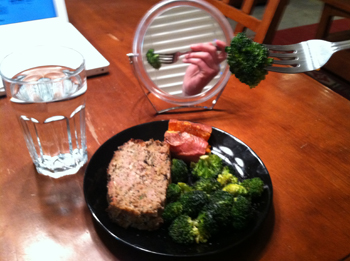
Tokyo, Jun 9: Watching yourself in the mirror while eating can make your meal taste better, a new study has found.food 2
People rate food as tasting better, and eat more of it, when they eat with company than when they eat alone.

This "social facilitation of eating" is a well- established phenomenon. However, exactly what it is about company that produces the effect is not clear.

Researchers have discovered that the same effect can be achieved in individuals eating alone simply by providing a mirror to reflect them while they eat.

"We wanted to find out what the minimum requirement is for the social facilitation of eating," said Ryuzaburo Nakata, from Nagoya University in Japan.

"Does another person have to actually be physically present, or is information suggesting the presence of others sufficient?" said Nakata, lead author of the study published in the journal Physiology and Behavior.

The researchers found that people eating alone reported food as tasting better, and ate more of it, when they could see themselves reflected in a mirror, compared with when they ate in front of a monitor displaying an image of a wall.

The research team initially worked with a group of older adult volunteers.

Approaches to enhance enjoyment of food in people eating without company are particularly relevant for elderly people, because research has shown that many frequently eat alone.

However, when the team repeated the experiment with young adult volunteers, they observed the same social facilitation of eating when a mirror was present, suggesting that the effect is not limited to older people.

When the researchers replaced the mirror with photos of the volunteers eating, they discovered that the volunteers still experienced an increase in the appeal of food and ate more.

Thus, perhaps surprisingly, a static image of a person eating seems sufficient to produce the social facilitation of eating.

"Studies have shown that for older adults, enjoying food is associated with quality of life, and frequently eating alone is associated with depression and loss of appetite," said Nobuyuki Kawai, from Nagoya University.

"Our findings therefore suggest a possible approach to improving the appeal of food, and quality of life, for older people who do not have company when they eat—for example, those who have suffered loss or are far away from their loved ones," said Kawai.

Comments

Add new comment

  • Coastaldigest.com reserves the right to delete or block any comments.
  • Coastaldigset.com is not responsible for its readers’ comments.
  • Comments that are abusive, incendiary or irrelevant are strictly prohibited.
  • Please use a genuine email ID and provide your name to avoid reject.
Agencies
June 10,2020

Early treatment with the antiviral drug remdesivir has been found to reduce viral load and prevent lung disease in macaques infected with SARS-CoV-2 that causes COVID-19, according to a study.

The findings, published in the journal Nature on Tuesday, support the early use of remdesivir treatment in patients with COVID-19 to prevent progression to pneumonia.

Researchers from the National Institutes of Health in the US noted that remdesivir has broad antiviral activity and has been shown to be effective against infections with SARS-CoV and MERS-CoV in animal models.

The drug is being tested in human clinical trials for the treatment of COVID-19, they said.

Researcher Emmie de Wit and colleagues investigated the effects of remdesivir treatment in rhesus macaques, a recently established model of SARS-CoV-2 infection.

Two sets of six macaques were inoculated with SARS-CoV-2.

One group was treated with remdesivir 12 hours later -- close to the peak of virus reproduction in the lungs -- and these macaques received treatment every 24 hours until six days after inoculation.

In contrast to the control group, the researchers found that macaques that received remdesivir did not show signs of respiratory disease, and had reduced damage to the lungs.

Viral loads in the lower respiratory tract were also reduced in the treated animals; viral levels were around 100 times lower in the lower-respiratory tract of remdesivir-treated macaques 12 hours after the first dose, they said.

The researchers said that infectious virus could no longer be detected in the treatment group three days after initial infection, but was still detectable in four out of six control animals.

Despite this virus reduction in the lower respiratory tract, no reduction in virus shedding was observed, which indicates that clinical improvement may not equate to a lack of infectiousness, they said.

Dosing of remdesivir in the rhesus macaques is equivalent to that used in humans, the researchers noted.

They cautioned that it is difficult to directly translate the timing of treatment used in corresponding disease stages in humans, because rhesus macaques normally develop only mild disease.

However, researchers said the results indicate that remdesivir treatment of COVID-19 should be initiated as early as possible to achieve the maximum treatment effect.

Comments

Add new comment

  • Coastaldigest.com reserves the right to delete or block any comments.
  • Coastaldigset.com is not responsible for its readers’ comments.
  • Comments that are abusive, incendiary or irrelevant are strictly prohibited.
  • Please use a genuine email ID and provide your name to avoid reject.
Agencies
July 4,2020

The Union health ministry on Friday revised the dosage of anti-viral drug remdesivir to be administered to coronavirus patients in the moderate stage of illness from the earlier six days to five days as it issued an updated 'Clinical Management Protocols for COVID-19'.

The drug, administered in the form of injection, should be given at a dose of 200 mg on day one followed by 100 mg daily for four days (total five days), the new treatment protocols stated.

The Health Ministry on June 13 had allowed the use of remdesivir for restricted emergency use in moderate cases under "investigational therapies".

"Under emergency use authorisation, remdesivir may be considered for patients in moderate stage requiring oxygen support," the document stated.

It is not recommended for those with severe renal impairment and high level of liver enzymes, pregnant and lactating women, and those below 12 years, it said.

The ministry also okayed off-label application of tocilizumab, a drug that modifies the immune system or its functioning, and convalescent plasma for treating COVID-19 patients in the moderate stage of illness as "investigational therapies".

It also recommended hydroxychloroquine for patients during the early course of the disease and not for critically-ill patients.

On June 27, the ministry had included an inexpensive, widely used steroid dexamethasone in treatment protocols for COVID-19 patients in the moderate to severe stages of their illness among other therapeutic measures.

The ministry advised use of dexamethasone, which is already used in a wide range of conditions for its anti-inflammatory and immunosuppressant effects, as an alternative choice to methylprednisolone for managing moderate to severe cases of coronavirus infection.

India's COVID-19 cases soared by over 20,000 in a day for the first time taking the country's total tally to 6,25,544 on Friday while the death toll climbed to 18,213 with 379 new fatalities, according to the Union Health Ministry data updated at 8 am.

Comments

Add new comment

  • Coastaldigest.com reserves the right to delete or block any comments.
  • Coastaldigset.com is not responsible for its readers’ comments.
  • Comments that are abusive, incendiary or irrelevant are strictly prohibited.
  • Please use a genuine email ID and provide your name to avoid reject.
Agencies
January 16,2020

Thiruvananthapuram, Jan 16: Kerala Tourism on Wednesday shared a recipe of a popular meat dish in the Central Travancore region of Kerala, Beef Ularthiyathu, which is a special delicacy in the region.

Taking to its Twitter handle, the Kerala Tourism wrote, "Tender chunks of beef, slow-roasted with aromatic spices, coconut pieces, and curry leaves. A recipe for the most classic dish, Beef Ularthiyathu, the stuff of legends, from the land of spices, Kerala."

The State Tourism also shared the recipe of the delicacy with Twitteratis.

The tweet which has garnered 3.5 thousand likes so far had received a mixed response

While some said "beef is not Kerala's culture", others termed the recipe 'a match made in heaven".

Dr Vireandta Jilowa wrote, "Surprised to see it, that beef is being consumed despite BJP government in the Centre."

"We are not slaves of BJP at the Centre....people eat whatever they like in this state, including beef, pork, mutton and fish," another user Tatheesh Vijayakumar wrote.

In 2017, The Minister for Environment, Forest and Climate Change Harsh Vardhan had ordered that the ministry has notified the Prevention of Cruelty to Animals (Regulation of Livestock Markets) Rules, 2017 to ensure that the sale of cattle is not meant for slaughter purposes.

Regulating animal trade is a state business, but animal welfare is a central subject.

In lieu of this, there was widespread opposition of the order, with many states openly denying accepting the notification.

Porotta and Kappa biriyani with beef are counted as delicacies by Keralites. 

Also Read: The Art of Prepping Meat

Comments

Add new comment

  • Coastaldigest.com reserves the right to delete or block any comments.
  • Coastaldigset.com is not responsible for its readers’ comments.
  • Comments that are abusive, incendiary or irrelevant are strictly prohibited.
  • Please use a genuine email ID and provide your name to avoid reject.