


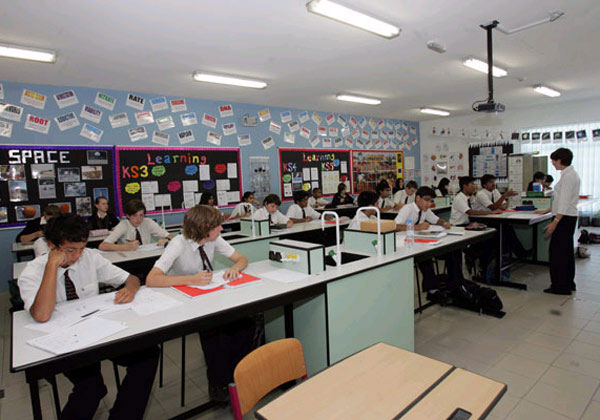
Education gets costlier in Dubai

April 9, 2012

School


Dubai, April 9: Dubai’s private schools received the green signal on Sunday to increase fees as the Knowledge and Human Development Authority (KHDA) announced a new school fees framework.


Fee increases for the new academic year will range between three to six per cent this year based on an educational cost index (ECI), which will be announced regularly by the Dubai Statistics Centre (DSC), and the school inspection report issued by the Dubai School Inspection Bureau (DSIB).


‘Outstanding’ schools will be allowed to increase their fees at double the rate of the ECI, which will amount to six per cent for the new academic year.


‘Good’ schools can increase fees by one and half times, which amounts to 4.5 per cent. ‘Unsatisfactory’ and ‘acceptable’ schools will be allowed to increase fees at three per cent. The DSIB classifies schools into outstanding, good, acceptable and unsatisfactory following an inspection cycle. Fee increases were tied to school inspection results in 2008 as increases were directly linked with the quality of education at schools.


Fee increase requests by most schools have been stalled since 2010 as the Dubai Executive Council had ordered a freeze on school fees. However, a few education operators were given a nod to increase fees over the last three years.


Taking into account the school inspection results, the new rules are aimed at regularising fee increases and tying them with the quality of education in Dubai’s private schools.


Mohammed Darwish, chief of Regulations and Compliance Commission at KHDA, said: “The framework prioritises the interests of students and parents and encourages investment in the education sector by allowing schools to develop long-term growth plans, as well as motivating existing schools to improve the quality of education they offer.”


While the new regulations are being developed after taking feedback from students, parents and schools, the increase comes as a surprise to many parents.


“Every parent wants the best for their child and these schools know about it very well. The fee hikes are something we can’t avoid and we can’t help but feel exploited,” said a parent who did not wish to be named.


In addition to the existing fee increases, ‘outstanding’ and ‘good’ schools can apply for exceptions to meet additional cost of investments in educational infrastructure. Admission and registration costs will also be regulated with the new rules.


The Department of Economic Development, Department of Finance, Dubai Chamber of Commerce, Dubai Real Estate Corporation, Dubai Statistics Centre, Dubai Executive Council and KHDA worked on developing the framework, which will be a medium to long-term solution to review fee increase applications by schools.


Comments

Add new comment

  • Coastaldigest.com reserves the right to delete or block any comments.
  • Coastaldigset.com is not responsible for its readers’ comments.
  • Comments that are abusive, incendiary or irrelevant are strictly prohibited.
  • Please use a genuine email ID and provide your name to avoid reject.
News Network
April 16,2020

Dubai, Apr 16: Saudi Arabia reported 518 new cases of coronavirus, bringing the total number of infections in the country to 6380, the Ministry of Health announced on Thursday.

According to the ministry of health, the number of recoveries today were 59, making total of recoveries in the kingdom 990, with 71 critical cases in intensive care.

The ministry also confirmed 4 deaths, bringing the total number of deaths in the kingdom to 83.

Saudi Arabia imposed a 24-hour curfew and lockdown on the cities of Riyadh, Tabuk, Dammam, Dhahran and Hofuf and throughout the governorates of Jeddah, Taif, Qatif and Khobar. This week the curfew was extended until further notice by king Salman

Overall, Saudi Arabia has reported one of the lowest rates of infections in the region, with around 6000 cases in a population of over 30 million.

Private sector support

Saudi Arabia has allocated SR50 billion (Dhs49 billion)to support the private sector as part of its package of initiatives approved by King Salman on Wednesday aimed at mitigating economic repercussions from the coronavirus disease (COVID-19).

The package targets small and medium-sized enterprises (SMEs) and economic activities that have been most affected by the pandemic.

Comments

Add new comment

  • Coastaldigest.com reserves the right to delete or block any comments.
  • Coastaldigset.com is not responsible for its readers’ comments.
  • Comments that are abusive, incendiary or irrelevant are strictly prohibited.
  • Please use a genuine email ID and provide your name to avoid reject.
News Network
March 11,2020

Mar 11: Energy giant Saudi Aramco on Wednesday said it plans to raise its crude production capacity by one million barrels per day to 13 million bpd as a price war with Russia intensifies.

"Saudi Aramco announces that it received a directive from the ministry of energy to increase its maximum sustainable capacity from 12 million bpd to 13 million bpd," the company said in a statement to the Saudi Stock Exchange.

The decision comes a day after the world's top exporter, Saudi Arabia, decided to hike production by at least 2.5 million bpd to a record 12.3 million from April.

The Saudi moves come after the collapse of an oil production reduction agreement between OPEC and non-OPEC producers, including Russia.

The deal proposed by Saudi Arabia called for additional output cuts of 1.5 million bpd to cope with the severe economic impact of the coronavirus which has sharply reduced world demand for crude.

Boosting production capacity normally takes a long time and requires billions of dollars of investment.

Several years ago, the kingdom had shelved plans to boost its crude production capacity beyond 12 million bpd after demand for OPEC oil declined in the face of stiff competition from North American shale oil and other sources.

Russia on Tuesday said it was open to renewing cooperation with the OPEC cartel even as its kingpin Saudi Arabia escalated a price war with Moscow by announcing it would flood markets with new supplies.

The oil price war broke out after OPEC and a group of non-member countries dominated by Russia -- the world's second largest producer -- on Friday failed to agree on production cuts.

Saudi Arabia responded by announcing unilateral price cuts. This prompted the oil price to plummet and fuelled huge falls on stock markets around the world on Monday.

Comments

Add new comment

  • Coastaldigest.com reserves the right to delete or block any comments.
  • Coastaldigset.com is not responsible for its readers’ comments.
  • Comments that are abusive, incendiary or irrelevant are strictly prohibited.
  • Please use a genuine email ID and provide your name to avoid reject.
Agencies
July 8,2020

Jeddah, Jul 8: The Organization of Islamic Cooperation (OIC) writes to the members of the United Nations Security Council (UNSC), urging the body to come in the way of a plan announced by Israel for annexation of significant portions of the occupied West Bank.

The letter was addressed by the 57-member organization’s Secretary-General Yousef al-Othaimeen to the UNSC’s members as well as the members of the Middle East Quartet — the European Union, Russia, United Nations, and United States— the Arabic-language Rai al-Youm news website reported on Tuesday.

The letter urged the Council to adopt “the necessary measures” that would prevent the annexation and compel Israel to stop all its illegal activities.

The OIC also urged the UNSC to hold an emergency meeting to “salvage the [remaining] opportunities for peace, and revive attempts at reinstatement of the political process under international supervision.” Such meeting, it added, had to enable realization of “the two-state solution, and [creation of] a Palestinian state with East Jerusalem [al-Quds] as its capital.”

Israel’s Prime Minister Benjamin Netanyahu announced the plan to annex 30 percent of the occupied Palestinian territory — namely the areas upon which the regime has built its illegal settlements as well as the Jordan Valley — after US President Donald Trump backed the annexation in January.

Trump pledged the support while unveiling details of his Middle East scheme called the “deal of the century.”

The highly controversial scheme allegedly seeks to resolve the Palestinian-Israeli conflict, but is heavily tilted in favor of the occupying regime. As well as backing the annexation, the scheme re-endorses Washington’s incendiary recognition in late 2017 of al-Quds as “Israel’s capital,” although Palestinians want the occupied holy city’s eastern part to serve as the capital of their future state.

Palestinians have roundly rejected either the American design or the Israeli plan that is rooted in it.

Tel Aviv had previously announced July 1 as the date it sought to start implementing the annexation plan. It, however, is yet to get it off the ground amid far-and-wide international condemnation and speculation that the plan was announced in the first place to deflect attention from a massive corruption scandal involving Netanyahu.

Countries warn Israel of consequences to bilateral ties

Also on Tuesday, Egypt, France, Germany, and Jordan warned Israel against going ahead with the plan, saying that doing so could have consequences for their bilateral relations with the Tel Aviv regime.

In a statement distributed by the German Foreign Ministry, the countries said their foreign ministers had discussed how to restart talks between Israel and the Palestinian Authority.

Most other European countries have likewise communicated their objection to the plan.

“We concur that any annexation of Palestinian territories occupied in 1967 would be a violation of international law and imperil the foundations of the peace process,” the European and Middle Eastern foreign ministers said, referring to the year, when Israel occupied the West Bank.

“We would not recognize any changes to the 1967 borders that are not agreed by both parties in the conflict,” they added. “It could also have consequences for the relationship with Israel.”

Israel had no immediate response. In a separate statement, however, Netanyahu’s office communicated Tel Aviv’s intransigence on the matter.

The statement said the Israeli premier had told his British counterpart Boris Johnson on Monday that he was committed to Trump’s “realistic” plan.

“Israel is prepared to conduct negotiations on the basis of President Trump’s peace plan, which is both creative and realistic, and will not return to the failed formulas of the past,” the statement alleged.

Comments

Add new comment

  • Coastaldigest.com reserves the right to delete or block any comments.
  • Coastaldigset.com is not responsible for its readers’ comments.
  • Comments that are abusive, incendiary or irrelevant are strictly prohibited.
  • Please use a genuine email ID and provide your name to avoid reject.