


Egypt and Turkey turn soft on Syria's Assad

December 17, 2016

The Syrian government, flush with pivotal battlefield gains and bolstered by support from Iran and Russia, is finding itself the beneficiary of an evolving regional realignment spurred by the war in Syria.
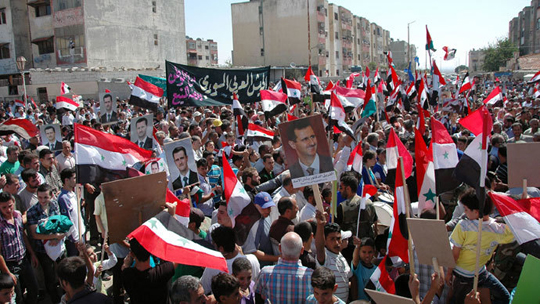
assad

Egypt and Turkey, countries that were once vocal opponents of Syria’s president, Bashar Assad, have, to varying degrees, softened their positions. Egypt, the region’s most populous Sunni country and wary of Iran’s Shiite theocracy, has made its tacit, increasing support of the Syrian government public for the first time. And Turkey, a Sunni regional power, is reshaping the Syrian battlefield by edging closer to Russia and dampening its longtime support for rebels fighting Assad.

The shifts come at a volatile time as countries in West Asia long aligned with the United States are hedging their bets and looking to Moscow for support as Russian intervention transforms the conflict in Syria. The manoeuvring comes as Russia asserts itself across the region to a degree not seen since Soviet times, partnering with an increasingly ambitious Iran. Long-standing US alliances with Turkey, Egypt and Saudi Arabia are frayed, and face new uncertainty with the election of Donald Trump, whose foreign policy remains largely undefined, except for an avowed eagerness to shake things up.

Egypt, which has seen its influence wane, is seeking allies and relevance wherever it can find them, even if that means shelving concerns about Iran. While Russia’s goal seems to be to expand its influence and pave the way for the international rehabilitation of Assad’s government, the scrambling of alliances remains in motion and the results unclear. The new relationships are messy, contradictory works in progress.

“In today’s regional context, this tactical hedging by countries on multiple fronts is likely to continue and may accelerate under a Trump administration,” said Brian Katulis, a senior fellow at the Centre for American Progress in Washington. Egypt and Turkey both provide examples of hedging, testing realignments but not jumping in with both feet.

Turkey has reached a potentially game-changing understanding with Russia in northern Syria – slackening support for besieged rebels in the divided city of Aleppo in exchange for a sphere of influence along its border – but continues to push the deal’s boundaries politically and militarily. And Egypt is diverging from its traditional allies in some ways, by splitting from Saudi Arabia on Syria; it remains financially dependent on the kingdom and hopes to mend fences with the US under Trump.

Egypt, Katulis said, is “seeking to signal that it has an independent perspective and position” on the Syrian conflict and on regional policy, balancing the United States and Russia, not aligning entirely with either the Gulf Arab states or Iran. The emerging “Sissi doctrine,” named for President Abdel-Fattah el-Sissi of Egypt, said Michael Wahid Hanna, a senior fellow at the Century Foundation, a New York research institute, is “rigid anti-Islamism and rigid anti-militancy and a very vocal support for nation states and sovereignty.”

Those positions are congruent with Assad’s. However, they diverge from those of Saudi Arabia, which has long been one of Egypt’s main financial lifelines, supplying aid worth tens of billions of dollars. El-Sissi is also increasingly wary of Turkey. He sees the recent defeat of a coup attempt against Erdogan’s Islamist government as “the birth of a religious state in Europe,” he told Katulis in July during a two-hour interview for a forthcoming report on US policy in Egypt.

Yet, Katulis said, the Egyptian president also made clear that he remained suspicious of Iran’s Shiite brand of Islamism despite its alignment with Assad and opposition to Turkey in Syria. But for now, el-Sissi seems to be putting concerns about Iran on the back burner and focusing more on Sunni Islamist movements, which he sees as a bigger threat. And lending support to Syria helps a weakened Egypt evoke its glory days as the leader of Arab nationalism in the 1960s.

El-Sissi’s emphasis on state sovereignty, supporting Arab states against insurgents, is also a major boon to the Syrian government’s quest for legitimacy, said Kamal Alam, a visiting fellow at the Royal United Services Institute in London and Levant Consultant for the Hoplite Group. Three years ago, Turkey and Egypt were prominent supporters of the Syrian rebellion, aligned with Saudi Arabia in what the Saudis saw as a geopolitical and sectarian struggle against Iran.

Jordan’s role

Today, both countries have tilted to different degrees away from Saudi Arabia and toward Russia, if not directly Iran. So has Jordan, another US ally and mostly Sunni country whose support for rebels had always been relatively lukewarm. All three seek to insulate themselves from the upheaval in Syria — from refugees and migrants, from the Islamist militants like Islamic State and al-Qaeda affiliates that gained footholds within the insurgency they helped support, and from any possible popular revolt.

The first to peel away was Egypt, in 2013, after el-Sissi, an army general, seized power from Mohammed Morsi, a Muslim Brotherhood leader who had emphatically supported the Syrian revolt. Pro-government news media made it clear that the Egyptian stance on Syria had changed; Syrian refugees were even attacked on the streets. Even as an outcry arose over the intensive bombing of Aleppo this week, Egypt in an emergency Security Council meeting justified its decision not to support “any side against the other.” The statement was seen as a polite way of refusing to apologise for not hewing to the Saudi line.

Turkey, too, has been unusually quiet on Aleppo. That, to many observers, confirms it has essentially agreed with Russia on a trade: Turkey allows rebel defeat in Aleppo, in exchange for Russia’s blessing of its incursion into Syria farther north to keep Kurdish militias away from its border. President Recep Tayyip Erdogan of Turkey even submitted to public censure from Russia for declaring his country was still trying to topple Assad. After being asked for clarification by Moscow, Erdogan reversed himself, insisting that Turkey’s goal in Syria was solely to fight terrorism.

But the parameters of the Turkey-Russia deal remain murky and possibly undefined even between the parties, Hanna said, making for a volatile situation. Turkey entered Syria with a force of anti-Assad rebels to set up what it calls a safe zone along the border. But as they move farther south and east, the likelihood increases that they will come into conflict with Russian-backed government forces, or U.S.-backed Kurdish forces.

“It’s a dangerous fault line,” Hanna said. “If you put anti-Assad rebels who have sublimated their goals to serve Turkish interests in very close proximity to regime forces, how much control does Turkey have over its proxies?”

Comments

Add new comment

  • Coastaldigest.com reserves the right to delete or block any comments.
  • Coastaldigset.com is not responsible for its readers’ comments.
  • Comments that are abusive, incendiary or irrelevant are strictly prohibited.
  • Please use a genuine email ID and provide your name to avoid reject.
Agencies
May 1,2020

Saudi Arabia has initiated refund of work visa fee to foreigners unable to travel to the Kingdom due to the suspension of international flights in the aftermath of Covid-19 pandemic.

Several work visas were cancelled, following which the Ministry of Human Resources and Social Development, in cooperation and coordination with the Ministry of Foreign Affairs, announced the refund. The cancellation and refunding of the stamped visas will be considered effective from the date of issuance of the royal decree on March 18, reported Saudi Gazette.

As a precautionary measure to curb the spread of coronavirus, the Kingdom suspended all international flight. The ministry of health in Saudi Arabia on Wednesday announced 1,325 new Covid-19 coronavirus cases and 169 recoveries. With this, the total number of cases in the Kingdom now stands at 21,402, while recoveries stand at 2,953, as on Wednesday reported KT.

Comments

Add new comment

  • Coastaldigest.com reserves the right to delete or block any comments.
  • Coastaldigset.com is not responsible for its readers’ comments.
  • Comments that are abusive, incendiary or irrelevant are strictly prohibited.
  • Please use a genuine email ID and provide your name to avoid reject.
News Network
January 16,2020

Abu Dhabi, Jan 16: The number of people being killed by terrorism activities worldwide has decreased significantly over the recent years, according to the latest Global Terrorism Index.

The 2019 Global Terrorism Index, which was presented at a forum in Abu Dhabi on Wednesday also showed that the UAE improved its ranking in the index by coming down to 130th rank among the 163 countries. The terrorism impact in the UAE is categorised as 'very low'. In the UAE, only two terrorism incidents were reported over the past decade - one in 2010 and another in 2014 - and there were no casualties.

Commenting on the report, Mansour Al Mansouri, director of the UAE National Media Council (NMC) said: "These findings rightly show the UAE as one of the safest countries in the world in terms of terror threat."

The index showed that the total number of deaths from terrorism declined for the fourth consecutive year in 2018, falling by 15.2 per cent to 15,952 deaths. This represents a 53 per cent reduction since its peak in 2014 when 33,555 people were killed in terrorist attacks.

The index published for the seventh year in a row, ranks 163 countries across the globe according to the relative impact of terrorism. This takes into account the number of terrorist incidents, deaths caused by terror and total value of property damage.

The latest results saw three Middle East countries - Iraq, Syria and Yemen - continue in the top 10 positions of the index.

The findings also showed Taleban overtaking Daesh as the deadliest terrorist group in the world, accounting for 38 per cent of all terrorist deaths. This is an increase of 71 per cent. Afghanistan is the country most affected by terrorism in 2018 followed by Iraq, Nigeria, Syria and Pakistan, according to the report. The least impacted nations were Belarus, Guinea-Bissau, Oman, The Gambia and North Korea.

During his presentation of the key findings of the index at the Foreign Correspondent's Club of the UAE (FCC), Serge Stroobants, director of Europe and Mena at the Institute of Economics and Peace, said lesser people were now being killed in terrorism activities.

"There have been long-term trends in global terrorism, with deaths caused by terror down by 52 per cent compared to high point of 2014, which saw Daesh and Boko Haram at their peak," said Stroobants attributing the decrease in the deaths to the increase in security measures and cooperation among nations in the fight against terrorism.

In contrast to this, there has been a 320 per cent increase in far-right terrorist incidents in the West, with political ideology being the driving force behind an increased proportion of terror motivation.

"There has been an increase in far-right terrorism in Western Europe, North America and Oceania for the third consecutive year," said Stroobants.

Terrorism still remains a global security threat, according the index, with 71 countries recording more than one death - the second highest number of countries since 2002.

Stroobants said conflicts remain the main cause of terrorism with 90 per cent of terrorist incidents occurring in places where there are conflicts or insurgencies.

The report said the global economic impact of terrorism was $33 billion in 2018, a substantial decrease of 38 per cent from the previous year.

Boko Haram was responsible for 80 per cent of all female suicide attacks, said the terrorism index.

Global Terrorism Index: Most affected countries

>Afghanistan (7379 deaths)

>Iraq (1,054 deaths)

>Nigeria (2,040 deaths)

>Syria (662 deaths)

>Pakistan (537 deaths)

>Somalia (646 deaths)

>India (350 deaths)

>Yemen (301 deaths)

>The Philippines (297 deaths)

>Democratic Republic of the Congo (410 deaths)

Comments

Add new comment

  • Coastaldigest.com reserves the right to delete or block any comments.
  • Coastaldigset.com is not responsible for its readers’ comments.
  • Comments that are abusive, incendiary or irrelevant are strictly prohibited.
  • Please use a genuine email ID and provide your name to avoid reject.
News Network
May 7,2020

Dubai, May 7: Saudi Arabia will emerge as the victor of the oil price war that sent global crude markets into a spin last month, according to two experts in the energy industry.

Jason Bordoff, professor and founding director of the Center for Global Energy policy at New York’s Columbia University, said: “While 2020 will be remembered as a year of carnage for oil nations, at least one will most likely emerge from the pandemic stronger, both economically and geopolitically: Saudi Arabia.”

Writing in the American publication Foreign Policy, Bordoff said that the Kingdom’s finances can weather the storm from lower oil prices as a result of the drastically reduced demand for oil in economies under pandemic lockdowns, and that it will end up with higher oil revenues and a bigger share of the global market once it stabilizes.

Bordoff’s view was reinforced by Sir Mark Moody-Stuart, former chairman of Royal Dutch Shell and one of the longest-standing directors of Saudi Aramco. In an interview with the Gulf Intelligence energy consultancy, he said that low-cost oil producers such as Saudi Arabia would emerge from the pandemic with increased market share.

“Oil is the only commodity where the lowest-cost producers have contained their production and allowed high-cost producers to benefit. When demand recovers this year or next, we will emerge from it with the lowest-cost producers having increased their market share,” Moody-Stuart said.

Bordfoff said that it would take years for the high-cost American shale industry to recover to pre-pandemic levels of output. “Depending on how long oil demand remains depressed, US oil production is projected to decline from its pre-coronavirus peak of around 13 million barrels per day.

“Shale's heady growth in recent years (with production growing by about 1 million to 1.5 million barrels per day each year) also reflected irrational exuberance in financial markets. Many US companies struggling with uneconomical production only managed to stay afloat with infusions of cheap debt. One quarter of US shale oil production may have been uneconomic even before prices crashed,” he said.

Moody-Stuart said that recent statements about cuts to the Saudi Arabian budget as a result of falling oil revenues were “an important step to wean the population of the Kingdom off an entitlement feeling. It means that everybody is joining in it.”

The former Shell boss said that other big oil companies would follow Shell’s recent decision to cut its dividend for the first time in more than 70 years. But he added that Aramco would stick by its commitment to pay $75 billion of dividends this year.

“When a company looks at its forecasts it looks ahead for one year, so for this year it (the dividend) is fine,” he said.

Bordoff added that Saudi Arabia’s action in cutting oil production in response to the pandemic would improve its global position.

“Saudi Arabia has improved its standing in Washington. Following intense pressure from the White House and powerful senators, the Kingdom’s willingness to oblige by cutting production will reverse some of the damage done when it was blamed for the oil crash after it surged production in March,” he said.

“Only a few weeks ago, the outlook for Saudi Arabia seemed bleak. But looking out a few years, it’s difficult to see the Kingdom in anything other than a strengthened position,” Bordoff said.

Comments

Add new comment

  • Coastaldigest.com reserves the right to delete or block any comments.
  • Coastaldigset.com is not responsible for its readers’ comments.
  • Comments that are abusive, incendiary or irrelevant are strictly prohibited.
  • Please use a genuine email ID and provide your name to avoid reject.