


Either we win election or we are going to lose country: Trump

October 15, 2016

Washington, Oct 15: Asserting that the US cannot afford to have another four years of Obama Administration, Republican presidential nominee Donald Trump has said that failing to win the upcoming general elections would amount to losing the country.
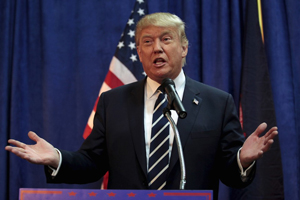
dt"Either we win this election or we're going to lose our country, because four more years of Obama, you can't take," Trump told his supporters at an election rally in North Carolina yesterday.

"I know it's not about me, it's about you, and that's why I'm doing this. I didn't need to do this, but it's about you. It's about bringing our country, making our country great again. I'm taking these slings and arrows for you, so we can have our borders, so we can get back our jobs, so we can be a safe nation again," he said.

Terming Barack Obama as an "incompetent president", 70-year old Trump claimed that the US president did not know what he was doing.

"He's out campaigning all day long, he talking about me like he knows me. I don't know him, he doesn't know me. And why doesn't some woman maybe come up and say what they say falsely about me, they could say about him. They could say it about anybody. I'll tell you what, better be careful, because they could say it about anybody, anybody at all," he alleged.

"Obama is in incompetent, as a president, he's about as bad as it gets. Look at what's happening, how Iran is taunting us. Look at what's going on, look at the world. He gives away USD 400 million in cash, but it turns out to USD 1.7 billion in cash. Gives them USD 150 billion," he said amidst booing from the audience.Noting that Obama is an "embarrassment", Trump alleged the US president's Middle East policy was a "total disaster".

"We have an incompetent president. I hate to say it, but it 100 per cent true. All he's doing, instead of working on your jobs and your companies leaving for Mexico and other places, he's campaigning for crooked Hillary. That's all he does," Trump alleged.

Referring to the Wikileaks revelations, Trump alleged Clinton was saying something in the public but has a different opinion in private.

"WikiLeaks documents, Hillary Clinton speaking in secret, a secret Brazilian bank. Hillary Clinton said 'my dream is a hemisphere common market with open trade and open borders," he said.

"Even though she doesn't say that, but that's what she said in a very, very secret meeting. The e-mails show that behind closed doors speaking to these international bankers, Hillary Clinton's pledged to destroy the sovereignty of the US," Trump said.

He said a Trump administration will secure and defend the US' borders like never before. "We will build a wall. Crooked Hillary also wants a 550 per cent increase in Syrian refugees to pour into our country," he said.

Trump said he will keep that the radical Islamic terrorists "the hell out" of the country. "At the same time, we're going to take care of our military and we're going to take care of our great, great, great veterans," he said.

"We're going to stand up to China, we're going to stop their currency manipulation and product dumping, which is killing us. And they don't follow the rules and, if they don't, we're going to institute tariffs. When they send something into our country - and, believe me, they're going to obey our rules so quickly, you have no idea. And we'll end up with a better relationship with China than we do now," he said.

Referring to South China Sea, Trump said the Chinese were building a massive fortress against everything.

"A massive fortress in the South China Sea. Yet they're ripping us off. Now, if they're going to rip us off, you wouldn't think they'd be building fortresses. They have no respect for our President - which I can understand that - they have no respect for Obama, they have no respect for our country, and they're getting away with murder," he said.

Comments

Add new comment

  • Coastaldigest.com reserves the right to delete or block any comments.
  • Coastaldigset.com is not responsible for its readers’ comments.
  • Comments that are abusive, incendiary or irrelevant are strictly prohibited.
  • Please use a genuine email ID and provide your name to avoid reject.
News Network
June 9,2020

Jun 9: The World Health Organization says it still believes the spread of the coronavirus from people without symptoms is “rare,” despite warnings from numerous experts worldwide that such transmission is more frequent and likely explains why the pandemic has been so hard to contain.

Maria Van Kerkhove, WHO''s technical lead on COVID-19 said at a press briefing on Monday that many countries are reporting cases of spread from people who are asymptomatic, or those with no clinical symptoms.

But when questioned in more detail about these cases, Van Kerkhove said many of them turn out to have mild disease, or unusual symptoms.

Although health officials in countries including Britain, the U.S. and elsewhere have warned that COVID-19 is spreading from people without symptoms, WHO has maintained that this type of spread is not a driver of the pandemic and is probably accounts for about 6 per cent of spread, at most.

Numerous studies have suggested that the virus is spreading from people without symptoms, but many of those are either anecdotal reports or based on modeling.

Van Kerkhove said that based on data from countries, when people with no symptoms of COVID-19 are tracked over a long period to see if they spread the disease, there are very few cases of spread.

“We are constantly looking at this data and we''re trying to get more information from countries to truly answer this question,” she said. “It still appears to be rare that asymptomatic individuals actually transmit onward.”

Comments

Add new comment

  • Coastaldigest.com reserves the right to delete or block any comments.
  • Coastaldigset.com is not responsible for its readers’ comments.
  • Comments that are abusive, incendiary or irrelevant are strictly prohibited.
  • Please use a genuine email ID and provide your name to avoid reject.
News Network
February 17,2020

Feb 17: Chinese authorities on Monday reported a slight upturn in new virus cases and 105 more deaths for a total of 1,770 since the outbreak began two months ago.

The 2,048 new cases followed three days of declines but was up by just 39 cases from the previous day’s figure. Another 10,844 people have recovered from COVID-19, a disease caused by the new coronavirus, and have been discharged from hospitals, according to Monday’s figures.

The update followed the publication late Saturday in China’s official media of a recent speech by President Xi Jinping in which he indicated for the first time that he had led the response to the outbreak from early in the crisis. While the reports were an apparent attempt to demonstrate the Communist Party leadership acted decisively from the start, it also opened Xi up to criticism over why the public was not alerted sooner.

In his speech, Xi said he gave instructions on fighting the virus on Jan. 7 and ordered the shutdown of the most-affected cities that began on Jan. 23.

The disclosure of his speech indicates top leaders knew about the outbreak’s potential severity at least two weeks before such dangers were made known to the public. It was not until late January that officials said the virus can spread between humans and public alarm began to rise.

New cases in other countries are raising growing concerns about containment of the virus.

Taiwan on Sunday reported its first death from COVID-19, the fifth fatality outside of mainland China. Taiwan’s Central News Agency, citing health minister Chen Shih-chung, said the man who died was in his 60s and had not traveled overseas recently and had no known contact with virus patients.

Japanese Prime Minister Shinzo Abe convened an experts meeting to discuss containment measures in his country, where more than a dozen cases have emerged in the past few days without any obvious link to China.

“The situation surrounding this virus is changing by the minute,” Abe said.

Japanese Health Minister Katsunobu Kato said the country is “entering into a phase that is different from before,” requiring new steps to stop the spread of the virus.

Japan now has 413 confirmed cases, including 355 from a quarantined cruise ship, and one death from the virus. Its total is the highest number of cases among about two dozen countries outside of China where the illness has spread.

Hundreds of Americans from the cruise ship took charter flights home, as Japan announced another 70 infections had been confirmed on the Diamond Princess. Canada, Hong Kong and Italy were planning similar flights.

The 300 or so Americans flying on U.S.-government chartered aircraft back to the U.S. will face another 14-day quarantine at Travis Air Force Base in California and Lackland Air Force Base in Texas. The U.S. Embassy said the departure was offered because people on the ship were at a high risk of exposure to the virus. People with symptoms were banned from the flights.

About 255 Canadians and 330 Hong Kong residents are on board the ship or undergoing treatment in Japanese hospitals. There are also 35 Italians, of which 25 are crew members, including the captain.

In China’s Hubei province, where the outbreak began in December, all vehicle traffic will be banned in another containment measure. It expands a vehicle ban in the provincial capital, Wuhan, where public transportation, trains and planes have been halted for weeks.

Exceptions were being made for vehicles involved in epidemic prevention and transporting daily necessities.

Hubei has built new hospitals with thousands of patient beds and China has sent thousands of military medical personnel to staff the new facilities and help the overburdened health care system.

Last Thursday, Hubei changed how it recognized COVID-19 cases, accepting a doctor’s diagnosis rather than waiting for confirmed laboratory test results, in order to treat patients faster. The tally spiked by more than 15,000 cases under the new method.

Comments

Add new comment

  • Coastaldigest.com reserves the right to delete or block any comments.
  • Coastaldigset.com is not responsible for its readers’ comments.
  • Comments that are abusive, incendiary or irrelevant are strictly prohibited.
  • Please use a genuine email ID and provide your name to avoid reject.
News Network
April 15,2020

Wuhan, Apr 15: In the six days after top Chinese officials secretly determined they likely were facing a pandemic from a new coronavirus, the city of Wuhan at the epicenter of the disease hosted a mass banquet for tens of thousands of people; millions began traveling through for Lunar New Year celebrations.

President Xi Jinping warned the public on the seventh day, Janaury 20. But by that time, more than 3,000 people had been infected during almost a week of public silence, according to internal documents obtained by The Associated Press and expert estimates based on retrospective infection data.

That delay from Jan 14 to Jan. 20 was neither the first mistake made by Chinese officials at all levels in confronting the outbreak, nor the longest lag, as governments around the world have dragged their feet for weeks and even months in addressing the virus.

But the delay by the first country to face the new coronavirus came at a critical time — the beginning of the outbreak. China's attempt to walk a line between alerting the public and avoiding panic set the stage for a pandemic that has infected almost 2 million people and taken more than 126,000 lives.

A This is tremendous, a said Zuo-Feng Zhang, an epidemiologist at the University of California, Los Angeles. If they took action six days earlier, there would have been much fewer patients and medical facilities would have been sufficient. We might have avoided the collapse of Wuhan's medical system.

Other experts noted that the Chinese government may have waited on warning the public to stave off hysteria, and that it did act quickly in private during that time.

But the six-day delay by China's leaders in Beijing came on top of almost two weeks during which the national Center for Disease Control did not register any cases from local officials, internal bulletins obtained by the AP confirm. Yet during that time, from Jan 5 to Jan 17, hundreds of patients were appearing in hospitals not just in Wuhan but across the country.

It's uncertain whether it was local officials who failed to report cases or national officials who failed to record them. It's also not clear exactly what officials knew at the time in Wuhan, which only opened back up last week with restrictions after its quarantine.

But what is clear, experts say, is that China's rigid controls on information, bureaucratic hurdles and a reluctance to send bad news up the chain of command muffled early warnings. The punishment of eight doctors for rumor-mongering, broadcast on national television on Jan. 2, sent a chill through the city's hospitals.

Doctors in Wuhan were afraid, said Dali Yang, a professor of Chinese politics at the University of Chicago. It was truly intimidation of an entire profession. Without these internal reports, it took the first case outside China, in Thailand on Jan 13, to galvanize leaders in Beijing into recognising the possible pandemic before them. It was only then that they launched a nationwide plan to find cases distributing CDC-sanctioned test kits, easing the criteria for confirming cases and ordering health officials to screen patients, all without telling the public.

The Chinese government has repeatedly denied suppressing information in the early days, saying it immediately reported the outbreak to the World Health Organization.

Allegations of a cover-up or lack of transparency in China are groundless, said foreign ministry spokesman Zhao Lijian at a Thursday press conference.

The documents show that the head of China's National Health Commission, Ma Xiaowei, laid out a grim assessment of the situation on Jan. 14 in a confidential teleconference with provincial health officials.

A memo states that the teleconference was held to convey instructions on the coronavirus from President Xi Jinping, Premier Li Keqiang and Vice Premier Sun Chunlan, but does not specify what those instructions were.

The epidemic situation is still severe and complex, the most severe challenge since SARS in 2003, and is likely to develop into a major public health event, the memo cites Ma as saying.

The National Health Commission is the top medical agency in the country. In a faxed statement, the Commission said it had organised the teleconference because of the case reported in Thailand and the possibility of the virus spreading during New Year travel. It added that China had published information on the outbreak in an open, transparent, responsible and timely manner," in accordance with important instructions repeatedly issued by President Xi.

The documents come from an anonymous source in the medical field who did not want to be named for fear of retribution. The AP confirmed the contents with two other sources in public health familiar with the teleconference. Some of the memo's contents also appeared in a public notice about the teleconference, stripped of key details and published in February.

Under a section titled sober understanding of the situation, the memo said that clustered cases suggest that human-to-human transmission is possible. It singled out the case in Thailand, saying that the situation had changed significantly because of the possible spread of the virus abroad.

With the coming of the Spring Festival, many people will be traveling, and the risk of transmission and spread is high, the memo continued.

Comments

Add new comment

  • Coastaldigest.com reserves the right to delete or block any comments.
  • Coastaldigset.com is not responsible for its readers’ comments.
  • Comments that are abusive, incendiary or irrelevant are strictly prohibited.
  • Please use a genuine email ID and provide your name to avoid reject.