


Either we win election or we are going to lose country: Trump

October 15, 2016

Washington, Oct 15: Asserting that the US cannot afford to have another four years of Obama Administration, Republican presidential nominee Donald Trump has said that failing to win the upcoming general elections would amount to losing the country.
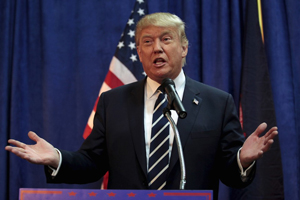
dt"Either we win this election or we're going to lose our country, because four more years of Obama, you can't take," Trump told his supporters at an election rally in North Carolina yesterday.

"I know it's not about me, it's about you, and that's why I'm doing this. I didn't need to do this, but it's about you. It's about bringing our country, making our country great again. I'm taking these slings and arrows for you, so we can have our borders, so we can get back our jobs, so we can be a safe nation again," he said.

Terming Barack Obama as an "incompetent president", 70-year old Trump claimed that the US president did not know what he was doing.

"He's out campaigning all day long, he talking about me like he knows me. I don't know him, he doesn't know me. And why doesn't some woman maybe come up and say what they say falsely about me, they could say about him. They could say it about anybody. I'll tell you what, better be careful, because they could say it about anybody, anybody at all," he alleged.

"Obama is in incompetent, as a president, he's about as bad as it gets. Look at what's happening, how Iran is taunting us. Look at what's going on, look at the world. He gives away USD 400 million in cash, but it turns out to USD 1.7 billion in cash. Gives them USD 150 billion," he said amidst booing from the audience.Noting that Obama is an "embarrassment", Trump alleged the US president's Middle East policy was a "total disaster".

"We have an incompetent president. I hate to say it, but it 100 per cent true. All he's doing, instead of working on your jobs and your companies leaving for Mexico and other places, he's campaigning for crooked Hillary. That's all he does," Trump alleged.

Referring to the Wikileaks revelations, Trump alleged Clinton was saying something in the public but has a different opinion in private.

"WikiLeaks documents, Hillary Clinton speaking in secret, a secret Brazilian bank. Hillary Clinton said 'my dream is a hemisphere common market with open trade and open borders," he said.

"Even though she doesn't say that, but that's what she said in a very, very secret meeting. The e-mails show that behind closed doors speaking to these international bankers, Hillary Clinton's pledged to destroy the sovereignty of the US," Trump said.

He said a Trump administration will secure and defend the US' borders like never before. "We will build a wall. Crooked Hillary also wants a 550 per cent increase in Syrian refugees to pour into our country," he said.

Trump said he will keep that the radical Islamic terrorists "the hell out" of the country. "At the same time, we're going to take care of our military and we're going to take care of our great, great, great veterans," he said.

"We're going to stand up to China, we're going to stop their currency manipulation and product dumping, which is killing us. And they don't follow the rules and, if they don't, we're going to institute tariffs. When they send something into our country - and, believe me, they're going to obey our rules so quickly, you have no idea. And we'll end up with a better relationship with China than we do now," he said.

Referring to South China Sea, Trump said the Chinese were building a massive fortress against everything.

"A massive fortress in the South China Sea. Yet they're ripping us off. Now, if they're going to rip us off, you wouldn't think they'd be building fortresses. They have no respect for our President - which I can understand that - they have no respect for Obama, they have no respect for our country, and they're getting away with murder," he said.

Comments

Add new comment

  • Coastaldigest.com reserves the right to delete or block any comments.
  • Coastaldigset.com is not responsible for its readers’ comments.
  • Comments that are abusive, incendiary or irrelevant are strictly prohibited.
  • Please use a genuine email ID and provide your name to avoid reject.
News Network
June 30,2020

Six months since the new coronavirus outbreak, the pandemic is still far from over, the World Health Organization said Monday, warning that "the worst is yet to come".

Reaching the half-year milestone just as the death toll surpassed 500,000 and the number of confirmed infections topped 10 million, the WHO said it was a moment to recommit to the fight to save lives.

"Six months ago, none of us could have imagined how our world -- and our lives -- would be thrown into turmoil by this new virus," WHO chief Tedros Adhanom Ghebreyesus told a virtual briefing.

"We all want this to be over. We all want to get on with our lives. But the hard reality is this is not even close to being over.

"Although many countries have made some progress, globally the pandemic is actually speeding up.

"We're all in this together, and we're all in this for the long haul.

"We will need even greater stores of resilience, patience, humility and generosity in the months ahead.

"We have already lost so much -- but we cannot lose hope."

Tedros also said that the pandemic had brought out the best and worst humanity, citing acts of kindness and solidarity, but also misinformation and the politicisation of the virus.

In an atmosphere of global political division and fractures on a national level, "the worst is yet to come. I'm sorry to say that," he said.

"With this kind of environment and condition, we fear the worst."

Comments

Add new comment

  • Coastaldigest.com reserves the right to delete or block any comments.
  • Coastaldigset.com is not responsible for its readers’ comments.
  • Comments that are abusive, incendiary or irrelevant are strictly prohibited.
  • Please use a genuine email ID and provide your name to avoid reject.
News Network
May 30,2020

May 30: Warning of the tightrope walk ahead as governments battle the coronavirus crisis, Nobel laureate Peter Charles Doherty has expressed concern about densely populated countries such as India relaxing lockdown norms while also describing a complete shutdown as “an economic and social impossibility”.

The Australian immunologist, who cautioned that the number of COVID-19 cases will rise in the coming days, said the earliest time frame for an effective vaccine “going into large numbers of people” is nine to 12 months.

"If all goes well with testing, we could know if some of the candidate vaccines are both safe and effective as early as September/October. Then, rolling a vaccine out will depend on the type of product and how quickly it can be made, put in vials and so forth," Doherty told PTI in an email interview from Melbourne.

The novel coronavirus, he added, does not change fast like influenza and, from what is known so far, “the same vaccine should work everywhere”.

Doherty, who is with the Department of Microbiology and Immunology at the Doherty Institute, University of Melbourne, won the Nobel Prize for Medicine in 1996 for his discovery of how the body’s immune system distinguishes virus-infected cells from normal ones.

Discussing the lockdown, he said, "If it was purely a matter of hard science, everywhere should stay locked down. But that’s pretty much an economic and social impossibility.”

The expectation, he said, is the numbers will rise and limiting spread will depend on people acting responsibly and the capacity for rapid response and extensive contact testing.

“And in a densely populated country like India I think that it will be very difficult," the scientist said.

Several countries, including India, began relaxing lockdown norms in mid-May despite the WHO’s warning about a second wave. India’s lockdown began on March 25 and has since been extended. The fourth phase ends on Sunday.

Asked whether there are any alternatives to a lockdown, the 79-year-old said, "There is no other option other than closing borders. South Korea, for example, conducted massive, intensive testing and contact tracing in a wealthy country with a very disciplined population. Otherwise, not till we have effective vaccines."

He added that he personally doesn’t see the point of closing borders for people coming in if there’s already a high incidence of disease in the community, “unless it’s to avoid the need to care for them and use scarce hospital beds".

According to Doherty, the coronavirus "is a new virus which has come straight out of nature".

“It (the virus) has moved so rapidly across the world because of people travelling on international planes as well as tourist ships," he added.

The immunologist also warned against the use of hydroxychloroquine to treat COVID-19, and said current and planned trials of the anti-malaria drug should be stopped.

“My understanding is that the use of the drug in severe disease is definitely contra-indicated, but it’s not yet clear whether, if taken under medical supervision, it could have some useful effect if taken early on, or as a preventive. Those trials just haven’t been done properly," Doherty noted.

The Indian Council of Medical Research (ICMR) has backed the use of hydroxychloroquine as a preventive against COVID-19 even after the WHO suspended clinical trials of the drug citing safety concerns.

Asked whether plasma therapy can be an effective treatment for COVID-19, Doherty said, "We lack good properly controlled trials but, especially if the plasma has been tested for antibody levels and there’s evidence of good activity, it could be helpful. If I had the disease and was offered plasma therapy I would certainly accept, but I would not take hydroxychloroquine."

Doherty is also very optimistic about herd immunity developing against the SARS-CoV-2 infection.

"We think that (herd immunity) will cut in and have an obvious effect when, say, 60 per cent of people have been infected. Best hope is to boost herd immunity with a vaccine," he stated.

Herd immunity is a form of indirect protection from infectious disease that occurs when a large percentage of a population has become immune to an infection, whether through vaccination or previous infections.

The number of COVID-19 cases have crossed 5.9 million and the fatalities 3,65,000, according to the Johns Hopkins University on Saturday. 

In India, the death toll has risen to 4,971 and the number of cases to 1,73,763, according to the Union Health Ministry on Saturday.

Several states, including Bihar, Uttar Pradesh, Madhya Pradesh, Jharkhand and Chhattisgarh, have reported a rise in number since lockdown norms were relaxed in early May and migrant workers reached home.

In Uttar Pradesh, for instance, the number of infections rose from around 3,000 on May 4 to 6,532 on May 26. Similarly, Bihar’s numbers increased from around 500 to over 2,700 in the period.

Comments

Add new comment

  • Coastaldigest.com reserves the right to delete or block any comments.
  • Coastaldigset.com is not responsible for its readers’ comments.
  • Comments that are abusive, incendiary or irrelevant are strictly prohibited.
  • Please use a genuine email ID and provide your name to avoid reject.
News Network
February 17,2020

Feb 17: Chinese authorities on Monday reported a slight upturn in new virus cases and 105 more deaths for a total of 1,770 since the outbreak began two months ago.

The 2,048 new cases followed three days of declines but was up by just 39 cases from the previous day’s figure. Another 10,844 people have recovered from COVID-19, a disease caused by the new coronavirus, and have been discharged from hospitals, according to Monday’s figures.

The update followed the publication late Saturday in China’s official media of a recent speech by President Xi Jinping in which he indicated for the first time that he had led the response to the outbreak from early in the crisis. While the reports were an apparent attempt to demonstrate the Communist Party leadership acted decisively from the start, it also opened Xi up to criticism over why the public was not alerted sooner.

In his speech, Xi said he gave instructions on fighting the virus on Jan. 7 and ordered the shutdown of the most-affected cities that began on Jan. 23.

The disclosure of his speech indicates top leaders knew about the outbreak’s potential severity at least two weeks before such dangers were made known to the public. It was not until late January that officials said the virus can spread between humans and public alarm began to rise.

New cases in other countries are raising growing concerns about containment of the virus.

Taiwan on Sunday reported its first death from COVID-19, the fifth fatality outside of mainland China. Taiwan’s Central News Agency, citing health minister Chen Shih-chung, said the man who died was in his 60s and had not traveled overseas recently and had no known contact with virus patients.

Japanese Prime Minister Shinzo Abe convened an experts meeting to discuss containment measures in his country, where more than a dozen cases have emerged in the past few days without any obvious link to China.

“The situation surrounding this virus is changing by the minute,” Abe said.

Japanese Health Minister Katsunobu Kato said the country is “entering into a phase that is different from before,” requiring new steps to stop the spread of the virus.

Japan now has 413 confirmed cases, including 355 from a quarantined cruise ship, and one death from the virus. Its total is the highest number of cases among about two dozen countries outside of China where the illness has spread.

Hundreds of Americans from the cruise ship took charter flights home, as Japan announced another 70 infections had been confirmed on the Diamond Princess. Canada, Hong Kong and Italy were planning similar flights.

The 300 or so Americans flying on U.S.-government chartered aircraft back to the U.S. will face another 14-day quarantine at Travis Air Force Base in California and Lackland Air Force Base in Texas. The U.S. Embassy said the departure was offered because people on the ship were at a high risk of exposure to the virus. People with symptoms were banned from the flights.

About 255 Canadians and 330 Hong Kong residents are on board the ship or undergoing treatment in Japanese hospitals. There are also 35 Italians, of which 25 are crew members, including the captain.

In China’s Hubei province, where the outbreak began in December, all vehicle traffic will be banned in another containment measure. It expands a vehicle ban in the provincial capital, Wuhan, where public transportation, trains and planes have been halted for weeks.

Exceptions were being made for vehicles involved in epidemic prevention and transporting daily necessities.

Hubei has built new hospitals with thousands of patient beds and China has sent thousands of military medical personnel to staff the new facilities and help the overburdened health care system.

Last Thursday, Hubei changed how it recognized COVID-19 cases, accepting a doctor’s diagnosis rather than waiting for confirmed laboratory test results, in order to treat patients faster. The tally spiked by more than 15,000 cases under the new method.

Comments

Add new comment

  • Coastaldigest.com reserves the right to delete or block any comments.
  • Coastaldigset.com is not responsible for its readers’ comments.
  • Comments that are abusive, incendiary or irrelevant are strictly prohibited.
  • Please use a genuine email ID and provide your name to avoid reject.