End politics of caste and appeasement, says Adityanath

Agencies
October 16, 2017

Gorakhpur (UP), Oct 16: Uttar Pradesh Chief Minister Yogi Adityanath today stressed on freeing the state from the "politics of caste and appeasement" claiming it had been rampant during the last 15 years.

"To make Uttar Pradesh strong, it is essential that we end the kind of politics being practiced here during the past 15 years," he said.

Adityanath said the focus of his government is on farmers, women, villages and people who were not part of the mainstream, he said.

"India can become able and powerful only when UP becomes able and powerful, and for this we need to end the politics of caste and appeasement which has been in practice for the last 15-20 years," Adityanath, who arrived here on a two-day visit, said.

The chief minister was speaking at the 'bhumi pujan' ceremony of a GAIL gas terminal and a unit of the Hindustan Fertiliser Corporation Limited here.

The chief minister mentioned a number of works being undertaken by his government for the development of the state's Purvanchal region.

"We purchased 37 lakh metric tonnes of wheat from farmers whereas the previous government was not able to purchase even 30 lakh metric tonnes in five years...A new sugar mill will be inaugurated in Gorakhpur which will also have a distillery and power generation unit. It will increase employment in the area," he said.

Asking people concerned to send a proposal for setting up a central school as the one functioning earlier had been closed down, he said development is the way for everyone to move forward.

The chief minister is likely to come here again on October 19 to spend Diwali with the Vantangiyas, a community of forest dwellers.

The Vantangiya community comprises people who were brought from Mayanmar to plant trees for afforestation during the colonial rule.

The community faces problems related to the use of natural forest produce like fruits, honey, wax, wood and leaves to meet their daily needs as the forests inhabited by them are not considered as revenue villages.

Conversion of tribal-dominated forest villages to revenue villages under the provisions of the Scheduled Tribes and Other Traditional Forest Dwellers (Recognition of Forest Rights) Act will enable the administration to adopt development measures such as setting up of schools, dispensaries, and other such facilities in these villages.

Officials said the chief minister, who had raised issues concerning Vantangiyas in the Parliament as an MP, will accord revenue village status to 23 hamlets.

Comments

Fairman
 - 
Monday, 16 Oct 2017

Yogiji said correct for others took 15years, he took less than a year

Add new comment

  • Coastaldigest.com reserves the right to delete or block any comments.
  • Coastaldigset.com is not responsible for its readers’ comments.
  • Comments that are abusive, incendiary or irrelevant are strictly prohibited.
  • Please use a genuine email ID and provide your name to avoid reject.
News Network
February 16,2020

Varanasi, Feb 16: Amidst continuing protests against the amended citizenship law, Prime Minister Narendra Modi on Sunday said his government stood by the decision despite all pressure.

"Be it the decision on Article 370 or the Citizenship Amendment Act, it was necessary in the interest of the country. Despite pressure, we stand by our decision and will remain so," he said.

Modi was addressing a public meeting in his Lok Sabha constituency.

Prime Minister Narendra Modi also asserted that the trust set up for construction of the Ram temple in Ayodhya will work "rapidly".

"A trust has been formed for construction of a grand Ram temple in Ayodhya. This trust will work rapidly," he said at a public meeting during his day-long visit to his Lok Sabha constituency.

The government had recently set up the Shri Ram Janmabhoomi Teerth Kshetra on the Supreme Court's directive to the Union government to form a trust that can look into the construction and management of the temple.

Comments

Add new comment

  • Coastaldigest.com reserves the right to delete or block any comments.
  • Coastaldigset.com is not responsible for its readers’ comments.
  • Comments that are abusive, incendiary or irrelevant are strictly prohibited.
  • Please use a genuine email ID and provide your name to avoid reject.
Agencies
May 5,2020

Jammu and Kashmir, May 5: Awarding the prestigious Pulitzer Prize to three Indian photographers, the Pulitzer Board at Columbia University claimed that it was for their work in Kashmir as "India revoked its independence".

The award to Channi Anand, Mukhtar Khan and Dar Yasin in the feature photography category for their pictures for the Associated Press was announced on Monday.

The prizes, considered the most prestigious for US journalism, are associated with the university's Graduate School of Journalism where the judging is done and is announced, although this year it was done remotely.

Besides a certificate, the prizes carry a cash award of $15,000, except the public service category for which a gold medal is awarded.

The public service prize went to The Anchorage Daily News for a series that dealt with policing in Alaska state.

In making the award to the three, the Board said on its website that it was "for striking images of life in the contested territory of Kashmir as India revoked its independence, executed through a communications blackout".

Besides making the false claim about "independence" of Kashmir being "revoked", the board that includes several leading journalists did not explain how their photographs could have reached the AP within hours of the incidents recorded "through a communication blackout".

India's Central government only revoked Article 370 of the Constitution that gave Jammu and Kashmir a special status and it was not independent.

Indian journalists were allowed to operate in Kashmir, while only non-Indian journalists were barred.

The wording of the award announcement calls into question the credibility of the Pulitzer Board that gives out what are considered prestigious journalism awards.

The portfolio of pictures by the three on the Pulitzer web site included one of a masked person attacking a police vehicle and another of masked people with variants of the Kashmir flag, besides photos of mourners and protesters.

One of the finalists for the Pulitzer Prize for explanatory journalism was a reporter of Indian descent at The Los Angeles Times, Swetha Kannan, who was nominated for her work with two colleagues on the seas rising due to climate change.

Comments

Add new comment

  • Coastaldigest.com reserves the right to delete or block any comments.
  • Coastaldigset.com is not responsible for its readers’ comments.
  • Comments that are abusive, incendiary or irrelevant are strictly prohibited.
  • Please use a genuine email ID and provide your name to avoid reject.
Agencies
August 3,2020

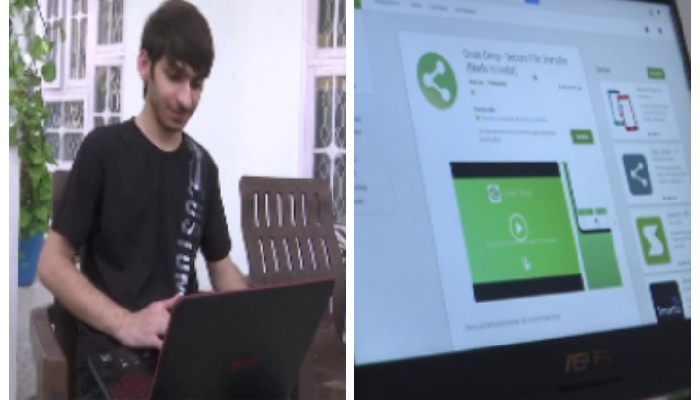
Rajouri, Aug 3: Ashfaq Mehmood Choudhary, a 17-year-old boy from Chattyear of Jammu and Kashmir's Rajouri district, has developed a file-sharing app 'Dodo Drop' which would enable users to share audios, videos, images, and texts between two devices without Internet access.

While speaking to media persons, Ashfaq Mehmood said that the 'Dodo Drop' application is an alternative to the Chinese 'SHAREit' app. "The Indian government has banned several Chinese apps due to data breaching, and among those apps was SHAREit which was used for sharing files.

Users faced a lot of problems due to the ban, and so I decided to make this file-sharing app. With 'Dodo Drop', users can share audios, videos, images, and even texts," he said.

Ashfaq said that it took him four weeks to develop the application, and it was launched on August 1 this year. The 'Dodo Drop' application has a transfer rate of up to 480 mbps, which is faster than the SHAREit app and is "quite easy" to use.

"Users can transfer data comprising photos, videos, audios, apps, texts, etc. between two devices with no Internet access. The transfers are fully encrypted and secure," he added.

"Our Prime Minister has always asserted the need for decreasing the dependency on foreign products and apps and to focus on the development of India-based apps. I tried to be part of the initiative of 'Aatmanirbhar Bharat' by developing an India-based file-sharing app. I want to develop global-standard apps for India," he added.

"We support and cooperate with him. He generates his own income by working on some projects and utilises it. We will continue to support him," said Parvez Ahmed Choudhary, Ashfaq's father.

In July, the Ministry of Electronics and Information Technology (MEITY) banned 47 apps, which were variants and cloned copies of the 59 apps banned earlier in June. These banned clones included SHAREit Lite, Tiktok Lite, Helo Lite, BIGO LIVE Lite, and VFY Lite.

The 59 apps had been banned by the Centre in June in view of the information available that they were engaged in activities which were "prejudicial to sovereignty and integrity and defence" of the country.

Almost all the apps banned had some preferential Chinese interest and the majority had parent Chinese companies.

The ban came amid border tensions with China in the Eastern Ladakh region.

Comments

Add new comment

  • Coastaldigest.com reserves the right to delete or block any comments.
  • Coastaldigset.com is not responsible for its readers’ comments.
  • Comments that are abusive, incendiary or irrelevant are strictly prohibited.
  • Please use a genuine email ID and provide your name to avoid reject.