


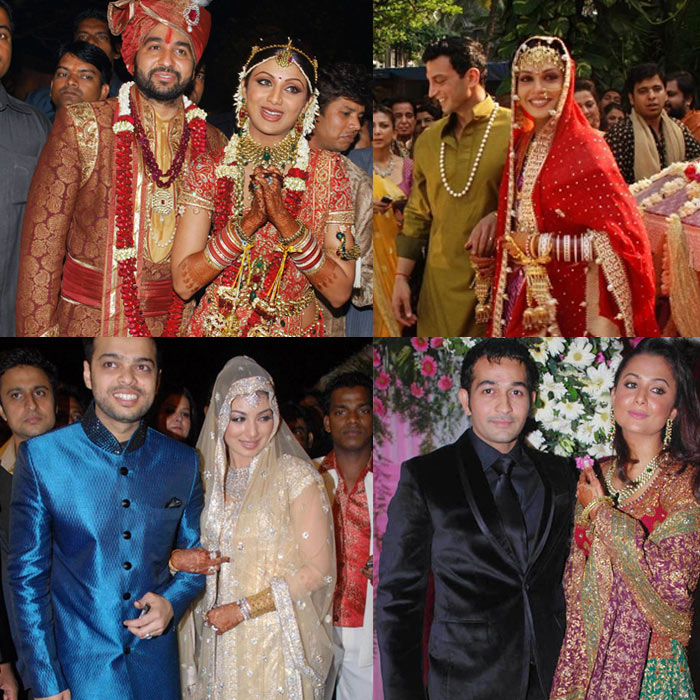
Traditional or innovative, wedding events, games and rituals have been ‘regimented’ by larger-than-life Bollywood films, writes Vimla Patil.
This wedding season, a sweeping phenomenon is visible throughout India.
Even middle class weddings are being celebrated in full Bollywood style, with the enthusiastic brides and their anxious grooms getting jittery over how to dress for each event and ritual.
And a list of the events and rituals — as well as the games and shenanigans planned by both parties — show a distinct influence of films made by Karan Johar, Dharmesh and Sunil Darshan, Yash Chopra, Suraj Barjatya, Abbas Mastaan and other well-known wedding-video directors.
No longer are there South Indian kalyanams, Maharashtrian lagnas, Punjabi shaadis, Bengali vivahas or Rajasthani lagans. There is only the Great Bollywood Wedding — with its glamour and fun ingredients planned with immaculate attention — which is setting a worldwide trend.
According to the regimen of this trend, the new bridegrooms are busy choosing saafas and sehras for the D-day. They are buying their kurta pyjamas for the sangeet and suits for their cocktails. They are eyeing elaborate sherwanis for the wedding and formal wear for the receptions.
Brides are busy trying out their ghagra chunnis with elaborate zardozi work over pink or peach-coloured silk. Their jewellery is pan-Indian or international in style rather than typical of their communities or region.
They are visiting mid-level boutiques to choose their salwar kameezes for the events that create the hoopla around the actual wedding day. The mantra of the marriage market today is: Enjoy! Do not worry about your community or regional origins.
Do as the stars do. Dance away the Punjabi bhangra, sing erotic Rajasthani ditties, dangle around a Maharashtrian mangalsutra and smear Bengali sindoor all over your hair. And most important: Offer the guests a feast of ‘international’ cuisines including Thai, Chinese, Italian and of course Indian delicacies.
Routine sacraments
Routine sacraments of a wedding decree that the bride and groom exchange jaymalas (exchange of garlands); go through the kanyadaan (giving away the bride), take their oaths of loyalty and love during their pheras around the sacred fire and then begin the humdrum task of setting up their new home.
Things have changed dramatically. Indian weddings have become colourful, joyous, noisy celebrations to which such rituals and games add humour, fun and even healthy rivalry between the two families, which are newly bonded together by a marriage between their offspring.
Though the traditional three events named above legalise a Hindu marriage, they have acquired a certain Bollywood patina. The brides certainly look like replicas of Preity Zinta, Rani Mukherjee or Kareena Kapoor with their coy looks and downcast, shy eyes.
And the bridegrooms look closest to Shah Rukh Khan or Saif Ali Khan in their clothes, headgear and more important, in their mischievous attitudes. The ‘mangalsutra routine’ is common to many marriages, a la Bollywood. So also, is the haldi lagaana ritual.
Pre-and post-wedding events are planned months before.
Mehendi
Most Indian weddings today have a mehendi ceremony with both parties coming together for a chaat party. Women from both the families, their friends and relatives stretch out their hands before a bevy of mehendi artists, nail artists and tattoo makers to embellish their palms with the latest designs imported from Islamic countries, African societies, Lebanese customs and so on.
The demand for unusual mehendi feasts has brought into limelight bhelpuriwalas, panipuri sellers, idli-dosa makers and wada pauwalas who are normally considered ‘common street food hawkers’. For wedding functions, they dress up their stalls and create a sort of mela where the spirit is to just enjoy.
Some families also set up bangle and tika stalls where family and friends satisfy their lust for glass, lac and acrylic ‘shaadi ka chudas’ and bangle combinations. Often, this ritual is copied exactly from a Bollywood film. Even Christian brides from India and European countries are asking for mehendi designs on their cream-softened palms and dainty feet.
Sangeet
Gone are the days of family women singing songs to felicitate their daughters and sons during the weddings. Today, there are choreographers and DJs who are commissioned to play or sing Bollywood hits to which the wedding parties dance. Women do sing but they are rehearsed and trained by professionals. India’s cities are crawling with commercial music groups, which perform at sangeet ceremonies wherever a wedding may be.
Pre-wedding cocktails or dinner
Most weddings are preceded with a party where everyone gets to know the other. The bride and bridegroom are mostly in high-end casual clothes and mingle with the guests who look forward to the actual wedding and reception — again Bollywood style.
Wedding games
In bygone ages, it was customary for conservative parents to arrange marriages within the community or a circle of known families while the girl and boy were hardly in their teens. The custom of ‘dating’ did not exist.
Extended introductory meetings between the couple — which are common today in arranged marriages — were not allowed. The elders took all the decisions, often without consulting the pair. Raunchy and erotic rituals and games, which broke the ice and made the bridal couple comfortable with each other as well as their new families, were therefore part of wedding celebrations.
Some games and events have become nationally popular because they are shown in Hindi movies. These are: hiding the shoes of the bridegroom after he is welcomed at the venue by his new in-laws.
This is called jutti chhupai. The young sisters of the bride steal the shoes of the groom and hide them till the wedding rituals are over and demand money for returning them. The bridegroom usually comes prepared with gold rings for all of them. In another game, the bride and groom, after being welcomed in their home, are engaged in a game of juwa or gambling.
A large pot containing water mixed with milk or vermilion is placed before them. A ring and some coins are dropped into the water. Both have to dip their hands in the water to find the ring.
Cheering observers shout around them, saying that whoever finds the ring would be the dominant partner of the two. In a third common game, the bridegroom is asked to find the first letter of his name, lovingly hidden in an intricate henna pattern on the palm of his bride.
In each case, a groom who loses in any game has to reward his bride with a piece of jewellery or a present. Mooh dikhai, or seeing the bride’s face for the first time after the marriage, is yet another popular ritual. Here, the women of the bridegroom’s family lift the veil of the bride and upon seeing her shy face, gift her with money or jewellery.
In Maharashtra, the groom holds a clove or a betel leaf beeda in his mouth and naughtily invites his bride to bite off a piece from it so that the couple end up kissing in front of onlookers.
‘Naav ghena’ or ‘name taking’ is yet another funny ritual in this Western state. Since an orthodox Indian woman does not ever say the first name of her husband, ‘name taking’ gives her an opportunity to string it in extempore poetry couplets. Her skill at rhyming and romanticising the poem gives her full marks and prizes.
The feast after a wedding also hosts an interesting game. The bridegroom bites off a piece of a sweet — such as a gulab jamun — and offers the other half to his bride in the midst of revelry. This is the first time they share food in this intimate manner and the bride is rewarded with a gift for accepting the offer.
In yet another game, the women of the bride’s family hide her away and dress another young girl of her height and look in bridal finery. If the bridegroom cannot locate his real bride, he has to pay a fine — by giving a gift to her. A newly-married couple is encouraged to take the first bath together with turmeric-touched water — with clothes on — to entertain the onlookers.
There are as many events as there are communities in India. But trends and fads change with time. Whereas several traditional games described above have been replicated in Bollywood films made after the ‘wedding video’ type of film (Hum Aapke Hain Kaun? was the pioneer) became popular, films and television soaps have also spawned newer, tech-age games.
Today, with weddings becoming more and more elaborate, ever new games and rituals continue to be invented by modern wedding planners to make 21st century celebrations memorable not only for a young couple, but also for extended families on both sides.
Highly-paid organisers conduct antaksharis, musical housie, kisme kitna hai dum, find your partner, carefully choreographed garbas and filmi dance competitions for weddings not only in Indian cities and towns, but also in every part of the world where people of Indian origin live in large numbers. Long after the wedding is over, Bollywood continues to impact marriages with women all over India replicating karwa chouth scenes from films in their real lives.
Highly-paid dance choreographers and game designers and even leading film stars are taken to wealthy NRI or PIO (people of Indian origin) weddings, where every imaginable Bollywood style event is improvised for the enjoyment of the international celebrity guests.
It is now possible that in the not too distant future, Western as well as Far Eastern societies will emulate the raunchy fun of the pomp-and-pageantry-loaded, lusty, rip-roaring Bollywood-style weddings of India. In the increasingly ‘globalised-village’ world, this is a distinct possibility.

Comments
Add new comment