


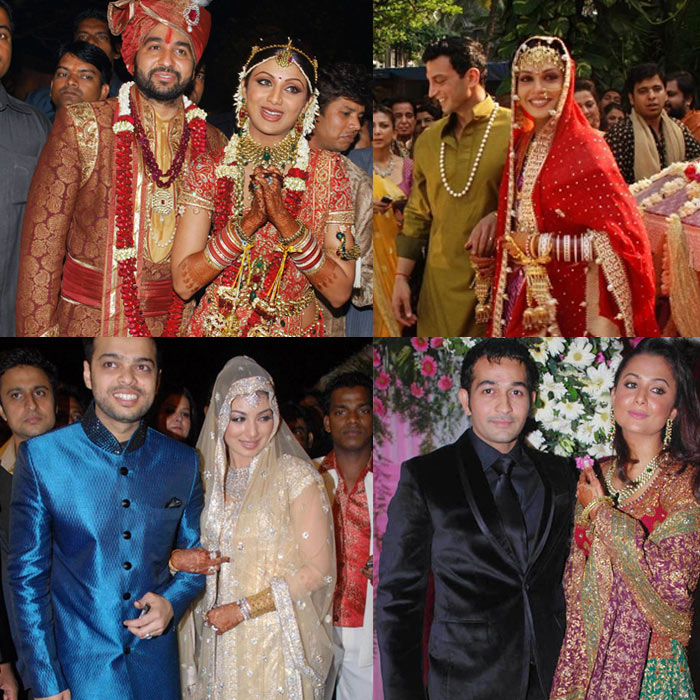
Weddings: Inspired by Bollywood

[email protected] (News Network)
May 5, 2012

bollywood

Traditional or innovative, wedding events, games and rituals have been ‘regimented’ by larger-than-life Bollywood films, writes Vimla Patil.


This wedding season, a sweeping phenomenon is visible throughout India.


Even middle class weddings are being celebrated in full Bollywood style, with the enthusiastic brides and their anxious grooms getting jittery over how to dress for each event and ritual.


And a list of the events and rituals — as well as the games and shenanigans planned by both parties — show a distinct influence of films made by Karan Johar, Dharmesh and Sunil Darshan, Yash Chopra, Suraj Barjatya, Abbas Mastaan and other well-known wedding-video directors.


No longer are there South Indian kalyanams, Maharashtrian lagnas, Punjabi shaadis, Bengali vivahas or Rajasthani lagans. There is only the Great Bollywood Wedding — with its glamour and fun ingredients planned with immaculate attention — which is setting a worldwide trend.


According to the regimen of this trend, the new bridegrooms are busy choosing saafas and sehras for the D-day. They are buying their kurta pyjamas for the sangeet and suits for their cocktails. They are eyeing elaborate sherwanis for the wedding and formal wear for the receptions.


Brides are busy trying out their ghagra chunnis with elaborate zardozi work over pink or peach-coloured silk. Their jewellery is pan-Indian or international in style rather than typical of their communities or region.


They are visiting mid-level boutiques to choose their salwar kameezes for the events that create the hoopla around the actual wedding day. The mantra of the marriage market today is: Enjoy! Do not worry about your community or regional origins.


Do as the stars do. Dance away the Punjabi bhangra, sing erotic Rajasthani ditties, dangle around a Maharashtrian mangalsutra and smear Bengali sindoor all over your hair. And most important: Offer the guests a feast of ‘international’ cuisines including Thai, Chinese, Italian and of course Indian delicacies.


Routine sacraments

Routine sacraments of a wedding decree that the bride and groom exchange jaymalas (exchange of garlands); go through the kanyadaan (giving away the bride), take their oaths of loyalty and love during their pheras around the sacred fire and then begin the humdrum task of setting up their new home.


Things have changed dramatically. Indian weddings have become colourful, joyous, noisy celebrations to which such rituals and games add humour, fun and even healthy rivalry between the two families, which are newly bonded together by a marriage between their offspring.


Though the traditional three events named above legalise a Hindu marriage, they have acquired a certain Bollywood patina. The brides certainly look like replicas of Preity Zinta, Rani Mukherjee or Kareena Kapoor with their coy looks and downcast, shy eyes.


And the bridegrooms look closest to Shah Rukh Khan or Saif Ali Khan in their clothes, headgear and more important, in their mischievous attitudes. The ‘mangalsutra routine’ is common to many marriages, a la Bollywood. So also, is the haldi lagaana ritual.


Pre-and post-wedding events are planned months before.


Mehendi

Most Indian weddings today have a mehendi ceremony with both parties coming together for a chaat party. Women from both the families, their friends and relatives stretch out their hands before a bevy of mehendi artists, nail artists and tattoo makers to embellish their palms with the latest designs imported from Islamic countries, African societies, Lebanese customs and so on.


The demand for unusual mehendi feasts has brought into limelight bhelpuriwalas, panipuri sellers, idli-dosa makers and wada pauwalas who are normally considered ‘common street food hawkers’. For wedding functions, they dress up their stalls and create a sort of mela where the spirit is to just enjoy.


Some families also set up bangle and tika stalls where family and friends satisfy their lust for glass, lac and acrylic ‘shaadi ka chudas’ and bangle combinations. Often, this ritual is copied exactly from a Bollywood film. Even Christian brides from India and European countries are asking for mehendi designs on their cream-softened palms and dainty feet.


Sangeet

Gone are the days of family women singing songs to felicitate their daughters and sons during the weddings. Today, there are choreographers and DJs who are commissioned to play or sing Bollywood hits to which the wedding parties dance. Women do sing but they are rehearsed and trained by professionals. India’s cities are crawling with commercial music groups, which perform at sangeet ceremonies wherever a wedding may be.


Pre-wedding cocktails or dinner

Most weddings are preceded with a party where everyone gets to know the other. The bride and bridegroom are mostly in high-end casual clothes and mingle with the guests who look forward to the actual wedding and reception — again Bollywood style.


Wedding games

In bygone ages, it was customary for conservative parents to arrange marriages within the community or a circle of known families while the girl and boy were hardly in their teens. The custom of ‘dating’ did not exist.


Extended introductory meetings between the couple — which are common today in arranged marriages — were not allowed. The elders took all the decisions, often without consulting the pair. Raunchy and erotic rituals and games, which broke the ice and made the bridal couple comfortable with each other as well as their new families, were therefore part of wedding celebrations.


Some games and events have become nationally popular because they are shown in Hindi movies. These are: hiding the shoes of the bridegroom after he is welcomed at the venue by his new in-laws.


This is called jutti chhupai. The young sisters of the bride steal the shoes of the groom and hide them till the wedding rituals are over and demand money for returning them. The bridegroom usually comes prepared with gold rings for all of them. In another game, the bride and groom, after being welcomed in their home, are engaged in a game of juwa or gambling.


A large pot containing water mixed with milk or vermilion is placed before them. A ring and some coins are dropped into the water. Both have to dip their hands in the water to find the ring.


Cheering observers shout around them, saying that whoever finds the ring would be the dominant partner of the two. In a third common game, the bridegroom is asked to find the first letter of his name, lovingly hidden in an intricate henna pattern on the palm of his bride.


In each case, a groom who loses in any game has to reward his bride with a piece of jewellery or a present. Mooh dikhai, or seeing the bride’s face for the first time after the marriage, is yet another popular ritual. Here, the women of the bridegroom’s family lift the veil of the bride and upon seeing her shy face, gift her with money or jewellery.


In Maharashtra, the groom holds a clove or a betel leaf beeda in his mouth and naughtily invites his bride to bite off a piece from it so that the couple end up kissing in front of onlookers.


‘Naav ghena’ or ‘name taking’ is yet another funny ritual in this Western state. Since an orthodox Indian woman does not ever say the first name of her husband, ‘name taking’ gives her an opportunity to string it in extempore poetry couplets. Her skill at rhyming and romanticising the poem gives her full marks and prizes.


The feast after a wedding also hosts an interesting game. The bridegroom bites off a piece of a sweet — such as a gulab jamun — and offers the other half to his bride in the midst of revelry. This is the first time they share food in this intimate manner and the bride is rewarded with a gift for accepting the offer.


In yet another game, the women of the bride’s family hide her away and dress another young girl of her height and look in bridal finery. If the bridegroom cannot locate his real bride, he has to pay a fine — by giving a gift to her. A newly-married couple is encouraged to take the first bath together with turmeric-touched water — with clothes on — to entertain the onlookers.


There are as many events as there are communities in India. But trends and fads change with time. Whereas several traditional games described above have been replicated in Bollywood films made after the ‘wedding video’ type of film (Hum Aapke Hain Kaun? was the pioneer) became popular, films and television soaps have also spawned newer, tech-age games.


Today, with weddings becoming more and more elaborate, ever new games and rituals continue to be invented by modern wedding planners to make 21st century celebrations memorable not only for a young couple, but also for extended families on both sides.


Highly-paid organisers conduct antaksharis, musical housie, kisme kitna hai dum, find your partner, carefully choreographed garbas and filmi dance competitions for weddings not only in Indian cities and towns, but also in every part of the world where people of Indian origin live in large numbers. Long after the wedding is over, Bollywood continues to impact marriages with women all over India replicating karwa chouth scenes from films in their real lives.


Highly-paid dance choreographers and game designers and even leading film stars are taken to wealthy NRI or PIO (people of Indian origin) weddings, where every imaginable Bollywood style event is improvised for the enjoyment of the international celebrity guests.


It is now possible that in the not too distant future, Western as well as Far Eastern societies will emulate the raunchy fun of the pomp-and-pageantry-loaded, lusty, rip-roaring Bollywood-style weddings of India. In the increasingly ‘globalised-village’ world, this is a distinct possibility.



Comments

Add new comment

  • Coastaldigest.com reserves the right to delete or block any comments.
  • Coastaldigset.com is not responsible for its readers’ comments.
  • Comments that are abusive, incendiary or irrelevant are strictly prohibited.
  • Please use a genuine email ID and provide your name to avoid reject.
News Network
February 27,2020

Mumbai, Feb 27: Bollywood superstar Shah Rukh Khan on Wednesday said it's with constant education that a country, a family can move forward as there is never an end to learning.

In December last year, when the actor visited the Indian Film Festival of Melbourne, the La Trobe University announced the 'Shah Rukh Khan La Trobe University PhD Scholarship'. At the event to announce therecipient of the scholarship here on Wednesday, Shah Rukh said it was his honour to lend his name or be attached to the scholarship.

"I am a big believer in education. I truly believe that the way forward for any country, any family, city, state is by educating itself more and more.

"There is never an end to education. I've come to realise the more I know, I figure out, the less I understand. It's very important to keep educating ourselves for the rest of our lives.

"I've always believed education in India and elsewhere in the world, is the most important step forward for any nation," he said.

The scholarship aims to provides an opportunity for an aspiring female researcher from India to undertake research.

The 54-year-old superstar said what also will help taking the world move ahead is educating women.

"Related to the fact, is of course, education of women, empowering women, to look after themselves to look after their families...

"If you are able to empower them with education, the world goes even further forward," the actor added.

Comments

Add new comment

  • Coastaldigest.com reserves the right to delete or block any comments.
  • Coastaldigset.com is not responsible for its readers’ comments.
  • Comments that are abusive, incendiary or irrelevant are strictly prohibited.
  • Please use a genuine email ID and provide your name to avoid reject.
News Network
February 6,2020

Feb 6: The Income Tax Department on Thursday recovered Rs 65 crores from the residence of Tamil actor Joseph Vijay's financer in Chennai during raids which were carried out in the connection with an alleged tax evasion case linked to AGS Cinemas, said sources.

The department is conducting raids and surveys at Actor Vijay, Financer and Producer Anbu Chezhiyan residences.

Around 38 premises have been covered in the raid.

According to IT sources the counting of money is still on so there are chances that the amount will rise. Vijay's wife was at Chennai home when IT sleuths carried out a raid at his residence.

Speaking on the reports of the Actor being intervened during the shooting of the film, the income tax official said, "Actor Vijay was not picked up between his shooting as reported in some media reports."

The actor was shooting for his upcoming film "Master in Neyveli" when he received the news of the raid.

"Actor Vijay had cut short his shooting and returned to his home immediately after getting the news of raids, now the officials are ready to facilitate him to continue his shooting if he wishes to," sources from Income Tax told news agency.

Comments

Add new comment

  • Coastaldigest.com reserves the right to delete or block any comments.
  • Coastaldigset.com is not responsible for its readers’ comments.
  • Comments that are abusive, incendiary or irrelevant are strictly prohibited.
  • Please use a genuine email ID and provide your name to avoid reject.
News Network
February 6,2020

Los Angeles, Feb 6: U.S. silver screen legend Kirk Douglas, the son of Jewish Russian immigrants who rose through the ranks to become one of Hollywood's biggest stars, has died, his family said Wednesday. He was 103.

One of the last survivors of the golden age of cinema and the father of Oscar-winning actor and film-maker Michael Douglas, the Spartacus actor was renowned for the macho tough guy roles he took on in around 90 movies over a six-decade career.

"It is with tremendous sadness that my brothers and I announce that Kirk Douglas left us today at the age of 103," Michael Douglas said in a statement posted to Facebook.

"To the world he was a legend, an actor from the golden age of movies who lived well into his golden years, a humanitarian whose commitment to justice and the causes he believed in set a standard for all of us to aspire to."

Douglas was Oscar-nominated for his roles as a double-crossing and womanizing boxer in Champion (1949), a ruthless movie producer in The Bad and the Beautiful (1952) and tortured artist Vincent Van Gogh in Lust for Life (1956).

But his only Academy Award came in 1995 -- an honorary lifetime achievement statuette "for 50 years as a creative and moral force in the motion picture community."

Douglas is survived by second wife Anne Buydens, 100, and three sons. A fourth child, Eric, died of a drug overdose in his 40s, in 2004.

"(To) me and my brothers Joel and Peter he was simply Dad, to Catherine (Zeta-Jones), a wonderful father-in-law, to his grandchildren and great grandchild their loving grandfather, and to his wife Anne, a wonderful husband," said Michael.

"Kirk's life was well lived, and he leaves a legacy in film that will endure for generations to come, and a history as a renowned philanthropist who worked to aid the public and bring peace to the planet."

Kirk Douglas rose to the heights of Hollywood from an impoverished childhood as the son of Jewish Russian immigrants.

He was one of the last survivors of the golden age of cinema, often portraying the macho and not-always-likeable tough guy in around 90 movies over a six-decade career.

With charming dimples and a cleft chin, Douglas was a renowned ladies' man but also admitted to being angry into adulthood because of his difficult New York childhood.

"I still have anger in me," he said in a New York Times article in 1988 after the release of his first autobiography.

"I think I'm loath to let it go because I think that anger was the fuel I used in accomplishing what I wanted to do; you see it in my films, you see it in imitations people do of me."

Screen legend

The role that perhaps immortalized him as a star was that of a rebellious Roman Empire slave turned gladiator in the 1960 epic Spartacus.

Douglas also produced the film, which took four Oscars. He won praise for listing in the credits the real name of Hollywood screenwriter Dalton Trumbo, who was blacklisted for his Communist sympathies and wrote under a pen name.

There were Oscar nominations for his roles as a double-crossing and womanizing boxer in Champion (1949), a ruthless movie producer in The Bad and the Beautiful (1952) and of tortured artist Vincent Van Gogh in Lust for Life (1956).

But his only Oscar came in 1995 as an honorary lifetime achievement award "for 50 years as a creative and moral force in the motion picture community."

Other major acting roles were as a French private in a botched suicidal mission in World War I in Paths of Glory (1957) and American Western legend Doc Holliday in Gunfight at the O.K. Corral (1957).

"Often cast as a villain, amoral climber or self-obsessed grabber, Kirk Douglas took care to color his hard edges with suggestions of pain, wit and sympathy," says American Film Institute, which ranks him as 17th on its list of the greatest male screen legends.

In the 1970s he stood behind the camera, directing Scalawag (1973) and Posse (1975).

He also took up writing, penning his first autobiography The Ragman's Son in 1988 and following with around 10 other titles.

In the autobiography, Douglas writes: "I always worked in the theory that when you play a weak character, find a moment when he's strong. And if you're playing a strong character, find a moment when he's weak."

Tough childhood

Douglas was born in New York on December 9, 1916 to illiterate Jewish Russian immigrants, an only boy with six sisters.

He started out as Issur Danielovitch, later Izzy Demsky. It was tough, he recounted later, with the family poor, anti-Semitism rife and his distant alcoholic father forced to earn a living as a ragman.

"In a sense, I've always felt on the outside, looking in," he said in the New York Times article.

"It's my background, damn it. My father was an illiterate Russian immigrant, a ragman, the lowest rung on the economic scale."

His dream of a way out was through acting and he started in high school, eventually entering the American Academy of Dramatic Arts and changing his name along the way.

To survive he took jobs as a waiter, labourer and porter. In 1941 he hit Broadway but his budding career was interrupted by service in the Navy. After the war, he headed for Hollywood.

His romantic conquests were many, although he once said he had never counted, and included starls such as Rita Hayworth, Marlene Dietrich, Joan Crawford and Ava Gardner.

Douglas' four sons followed him into cinema.

Oscar-winning actor and producer Michael and Joel were from a marriage to actress Diana Webster, whom he divorced in 1951.

Three years later he married Belgian-American Anne Buydens, having Peter and then Eric, who died in 2004 from an accidental overdose.

Douglas has also brushed death: he survived a helicopter crash in 1991 and a massive stroke in 1996 that nearly robbed him of speech.

Around the time of his 100th birthday in 2016, he attributed his remarkable longevity to his second marriage.

"I was lucky enough to find my soulmate 63 years ago, and I believe our wonderful marriage and our nightly 'golden hour' chats have helped me survive all things," he said in celebrity magazine Closer Weekly.

Comments

Add new comment

  • Coastaldigest.com reserves the right to delete or block any comments.
  • Coastaldigset.com is not responsible for its readers’ comments.
  • Comments that are abusive, incendiary or irrelevant are strictly prohibited.
  • Please use a genuine email ID and provide your name to avoid reject.