



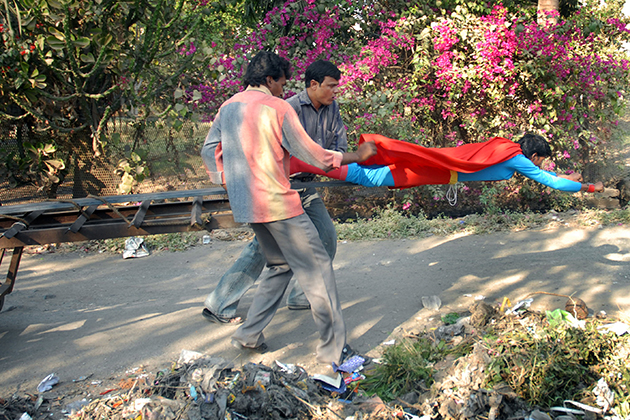
'Supermen Of Malegaon' will be released on June 29, 2012. The film has been directed by Faiza Ahmad Khan and produced by Chung Yong Park, Hee Yah Ong, Junichi Katayama and The Asian Pitch. It stars Farogh Jafri, Nazir Shaikh, Shafique, Shakeel Bharati and Akram Khan. Mollywood actor Shafique Shaikh, the lead actor of Malegaon Ka Superman, died of mouth cancer. Director Khan talks about what inspired the film.
What is the film about?
'Supermen Of Malegaon' is a documentary film that follows a group of intrepid filmmakers in Malegaon, Maharashtra as they attempt to make Malegaon ka Superman; transposing the Man of Steel onto the landscape of a town known for its power looms and power cuts, and its communal riots. While the idea was to record this astonishing journey from a dream to a finished film, it is also a record of the people trying to make the film, and of Malegaon itself, and their hopes and their fears, and the charm and grace with which they live their lives.
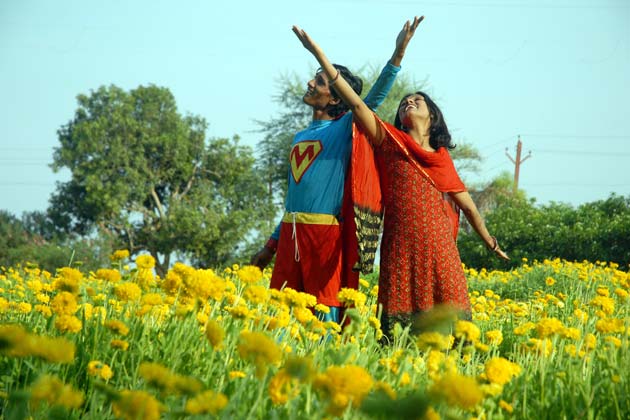
What is this Malegaon film industry?
Most of the population of Malegaon is crazy about cinema. With a crippled economy and twelve-hour power-cuts every day, films have become the principal way to pass the time. There are twelve cinema halls and twice as many video halls. There are fan-clubs everywhere. On Fridays, after the Jumma namaaz, there is a stampede outside the theatres. The old Agneepath, starring Mithun and Amitabh Bachchan, is still a favourite and played regularly in Malegaon. The Mithun fans will sit together on one side of the aisle and the Amitabh fans will sit together on the other side and there is a competition about who is louder. They set off fireworks inside the hall. The halls actually have 'pathake le jaana mana hai' written outside. The Mithun fan club has a little place of worship plastered with pictures of Mithun and a TV that only plays his films.
In the middle of this, about twelve years ago, Nasir - who used to shoot and still shoots wedding videos, and used to run a video parlour- finally decided that he needs to make a film. He picked the biggest hit of all time, SHOLAY. Made on a budget of Rs 50,000, the film was a massive hit in Malegaon- it ran houseful shows for a long time. The famous robbery sequence was done with dacoits on bicycles trying to rob a bus. And it kind of set the template for the work that has followed. The film industry in Malegaon is a cottage industry, and these are handmade films, done on ridiculously low budgets, localized to Malegaon, about things and films that people dreamt up in their free time. As a result, there is an extraordinary degree of innovation- cycles used for tracking shots and bullock carts for crane shots. But the greatest trick the Malegaon filmmakers employ is their street-smart transposition of these famous films to local situations and problems. And now are many groups, with fluid and constantly changing crews, who continue to make these films.
How did you get the idea for the film?
As with most things, you start with a central image or an idea. In this case, a thriving film industry in Malegaon, which in itself is an intriguing statement and made us want to know more. But the thing about documentaries is, much like life, once you make the journey across to where you think you’re going, you find that you’ve arrived somewhere else. Like one of them says in the film, he’s been trying to get to Mumbai for fifteen years, but it always seems like Mumbai is moving further away. We got to Malegaon hoping to capture the local industry making a film.
Instead, we discovered a series of characters who were compelling, very human, brave and funny at the same time. So, suddenly, this film industry in the hinterland is populated by fascinating people. And then you start to uncover the strange dynamic of the place. The power looms that have been crippled by the twelve hour power cuts. An economy and a town in tatters. A place that is obsessed with cinema; it is the only real entertainment, and people will queue for hours to get into cinemas and video halls, where they play old movies, dubbed movies, strange B and C international releases. A place with a history of communal violence. Hindu and Muslim population neatly divided by the river that flows through the center of the town. A thriving film industry run solely by the Muslim population. A strict policy about not letting local women work in those films. And all of it located in this forbidding, half-surreal landscape. So then the film became about capturing these Supermen in this Malegaon.
What drew you to the idea?
Well, as I mentioned, the central idea opened up a world of its own. And beyond that, what’s happening in Malegaon is very interesting at a sociological level. Because this isn’t about people simply trying to ape Bollywood. They take these templates from well-known films and turn them on their heads to try and engage with problems that are particular to Malegaon. So, at one point, Superman has to fly upwards because the cell-phone reception in Malegaon is so bad. And he falls ill because the pollution is so bad. The villain is obsessed with dirt and filth, because that is what ails their world. These films are enormously successful, they’re hits with their target audiences, and yet they’re funny, vivid and come from a unique viewpoint. And everyone who heard about the idea before we went over to film the documentary was very intrigued about the premise.
And everyone who watched the film eventually reacted to this absurd, good-humored sense of bravery that seems to be the biggest take-home from our film. You would think that capturing a group of men trying to make a film in Malegaon would largely be comic. Instead, what we saw and hopefully were able to capture, was a very moving experience. We watched them as they fought past this bad hand that life and the State has dealt them. Nothing fazed them. Not the idea, the scale, the ambition, their backgrounds, the stunning lack of resources. They found a way past everything. And, of course, once we discovered that they had moved beyond Bollywood and were ready to take on Hollywood, that they had set their eyes on Superman, the idea was just irresistible.
How was it shooting another film crew?
The other film crew thought we’d leave in three or four days, perhaps like a news crew or something. But we hung around for three months. And we were not only filming the filmmaking process, but their lives as well. So we’d be there, at Nasir’s - the director of Malegaon Ka Superman - house every morning, with our cameras. At some point, he even got a little exasperated with us. But he understood, maybe as a film maker himself, that we needed to do this if we were to get under the skin of the city to better understand the men who from that city who would push themselves so hard for something that seemed sort of trivial at first. I’m glad that we moved beyond that, beyond his initial exasperation, because that was when so many things started to become accessible to us. And we also spent a lot of time there, under fairly unusual circumstances. We became as much part of their process of making the film.
Eventually, it led to a rapport and that enabled us to exist like flies on the wall.
What was the process like?
I had just finished assisting on a feature film and seen first-hand just what it cost the director on that project, to simply get that film on the floor. And I heard about these people in this town, sort of in the middle of nowhere, who make films for the sole reason that they love cinema. Siddharth, my co-producer, and I went to Malegaon and met Nasir- the director of Malegaon ka Superman- and his gang of collaborators. These are all people who have day-jobs, all these mundane things they do to put food on the table. And, in their free time, they dream of making films. And then they make them. On the way we speculated that if there was a film that we might want to see these fantastic real-life characters make, then Superman would top that list. In the first ten minutes of our meeting Nasir said that there was a film that he wanted to make and that film was Malegaon ka Superman. The signs were all pointing in one direction. And we were on.
We came back to Mumbai. Narrated the entire idea and the experience to a friend who told his friend, Gargey, who in turn came on board as co-producer and we pitched it to the Asian Pitch in Singapore, which is a collaboration of three TV networks in Asia- Mediacorp, KBS and NHK. They loved the idea, we won the pitch and got full funding. In literally two weeks, from being just an idea in my head, we had funding for the film. And a month later, we were in Malegaon, filming.
We didn’t go in with a set script. There were a few basic guidelines – the idea was to largely observe the process, the idea was to be a fly on the wall. We were going to document the filmmaking process and the lives of the people making that film. We had to find our own rhythm as a working unit under adverse conditions. We had to earn the trust of our subjects. We had to resist the temptation to help out with their film, because that would have altered the experience. It became a little difficult for us to decide what to shoot and what not to shoot, because there was so much happening around the film and the people we were filming with. So we shot as much of it as we could. By the end of the shoot, we had about 250 hours of footage. And then we had to go back and find the story we wanted to tell while editing the film, through all those hours of footage, going back and forth with a few trusted opinions, shaping, pruning, destroying, building again.
All the while, trying to stay true to the nature of what we had witnessed, trying to capture and retain what we all regard as such a fundamentally brave act. We had to edit those 250 hours down to a 52 min film. And we had a deadline that was two months away. Enter Shweta Venkat.... Superwoman editor!
How did you react to Superman being scrawny?
Well, my feeling was that this Superman kind of represented Malegaon in a way. He’s a bit confused, not the strongest, gets beaten up in the film but emerges victorious in the end. It was a clever bit of writing or casting. In that sense, Superman ended up representing the town, kind of a joke, but you’re pulling for him very strongly. And victory in the end, for him, leaves you with a sense of hope for the whole enterprise and the whole town. Which is great. They’re under no illusions, but there’s still so much hope about all things.
Why such a quirky name?
Their film is called Malegaon ka Superman. The process we were privileged to record was a bunch of these ordinary men pulling off this crazy feat, driven by passion and guts alone. And therefore, they were, quite simply, the SUPERMEN OF MALEGAON, making Malegaon ka Supermen. Nothing else could capture the extraordinary nature of this experience.
As a woman, what were your observances about Malegaon and the film industry?
One glaring thing about Malegaon is how women are absent from public life and from their films. Only men watch films in cinemas and only men make films. There is absolute refusal to allow any women from Malegaon to work in these films. Of course it has a lot to do with it being a Muslim community that is not very liberal when it comes to women, but it raises a whole host of uncomfortable questions about the perception of women in cinema that fosters that kind of thinking. Actress in Malegaon films are brought in from outside Malegaon. For this film, the actress was brought in from Dhulia for two days. The script, all the way back in pre-production, was written with this in mind. So, the actress is never required for more than two days so as to keep costs down.
That was the only point during this process that I found myself incapable of not interfering. And Nasir and I ended up having a fight about this very issue.
What are your thoughts as a documentary film maker in a country obsessed with Bollywood?
We have a tradition of really good documentary cinema in India. I'd even go as far as to say we make better documentaries than most fiction that comes out of Mumbai. There is huge appreciation for our films abroad, then why not here? There is an audience for these films. So what if it is small as compared to an audience for a Bollywood film? We're not even looking to compete. There’s way too much that goes into creating hype about those films. What we need is many spaces within this larger space for many kinds of films- documentaries, regional, shorts, experimental, to exist, so there is an overall healthy kind of cinema in India.
There are a couple of stories about Shafique, who ended up playing the scrawny superhero in Malegaon ka Superman. He was largely the butt of all jokes because of his physique, but he thought it the greatest honour of his life to play Superman. And he worked as hard as anyone on the film. Including being thrown into a river repeatedly, not knowing how to swim. I remember him standing there, shivering, almost like he had hypothermia. They had to wrap him up in blankets in the makeshift changing room, and let him sit for a while before he could walk properly. And later, he provided another, much more amusing distraction, when his family decided that he was getting married. It didn’t matter if he was still in the middle of playing Superman. The shoot stopped for a few days to allow him to get married.
Nasir worried endlessly about the colour of Shafique’s skin changing because of the haldi ceremony. And Shafique bore it all with good humour, because he genuinely believed this film was the best thing that happened to him. It is terribly unfortunate that he recently passed away. He had oral cancer from chewing tobacco, ironically the same thing he fights as Superman in the film.

Comments
Add new comment