



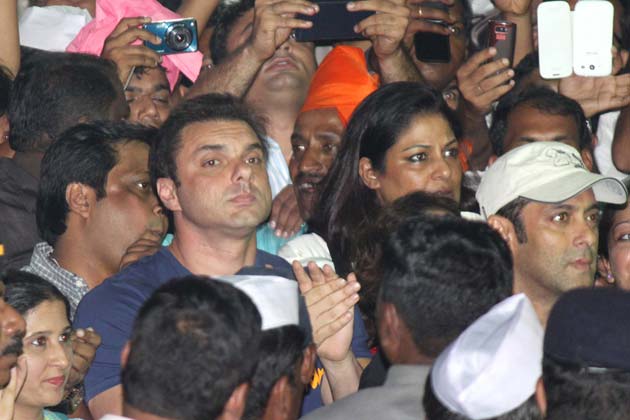
Salman Khan and family celebrate Ganesh Chaturthi

September 22, 2012

salman

A month after hosting a big Eid celebration, Galaxy apartments in Bandra, home to Salman Khan and his family, is buzzing with Ganesh Chaturthi celebrations today.

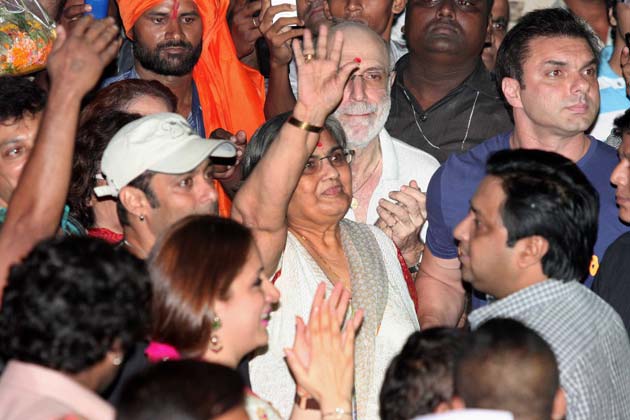
Even as you read this, all the members of the Khan family are participating in the religious rituals centered around Lord Ganesha.

“We brought in Lord Ganesha 11 years ago because Arpita (Salman’s little sister) insisted,” says Salma Khan, their mother. “She was very keen and took it upon herself to organise every detail of the festival. As she promised, she has been organising it single-handedly every year since then.”

In this modern Muslim home, a very secular atmosphere exists, as Hinduism, Islam and Christianity co-exist here happily, thanks to the efforts of Marathi-Brahmin Salma Khan (originally Sushila Charak), her husband Salim Khan and his second wife Helen, who is Catholic.

Earlier, when the Khans did not celebrate Ganesh Chaturthi at home, Salman, brothers Arbaaz and Sohail and sister Alvira would be taken to their aaji’s (maternal grandmother’s) home in Mahim for the festivities.

“In the evenings, I would dress up the kids and go to my mother’s house so the children could celebrate with our neighbours there,” Salma recollects fondly.

Her daughter Alvira, married to filmmaker Atul Agnihotri, recalls her childhood memories of the festival. “Though it wasn’t celebrated at home, Ganpati was great fun. Salman bhai, Arbaaz bhai, Sohail and I would run down the street to join the Ganpati processions that would halt before our house. We would participate in the aarti dance,” laughs Alvira.
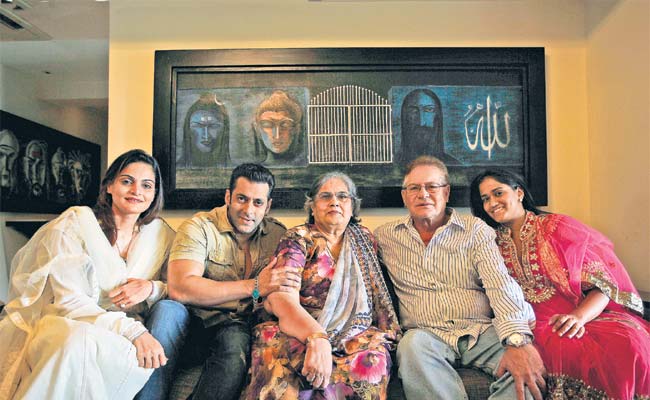
salman-khan-family

Today, she and her younger sister Arpita have become extremely devoted to Ganesha. They sometimes even walk barefoot to the Siddhivinayak Temple situated in Prabhadevi on Tuesdays.


In the one-and-a-half days that Ganesha resides in Galaxy, the religious rules of the festival are strictly adhered to.

Non-vegetarian food and alcohol are banned. Instead, the kitchen turns out delicacies like modak, masale bhaat, puri and aloo bhaji, vatlidal, pitthi and chana usal. “I love cooking and feeding people,” says Salma. “During Ganpati and Eid, I work in the kitchen with the assistance of my cooks.”

Salman, who has taken a two-day break from the shooting of Dabangg 2 in Satara, joins us, looking fresh after a rigorous workout and shower. “I feel blessed to be born and brought up in a house that respects every religion,” says the actor.

“The credit goes to mom, dad and Helen aunty. In Galaxy, God is one, though our paths to reach the almighty are different.”

In fact, all paths to God are open, if you take Salma as an example. Though she adopted Islam after marrying Salim, she did not let go of her faith: “I offer namaaz every day and recite the Quran verses just as I do my pujas and recite the Gayatri Mantra and the Hanuman Chalisa,” she explains. “On Wednesdays, we used to go to the church for Novena prayers as well. Choosing their faith is something we left to the children. However, Salim miya and I have taught them the basics of all the religions.”
salman2

salman1


Comments

Add new comment

  • Coastaldigest.com reserves the right to delete or block any comments.
  • Coastaldigset.com is not responsible for its readers’ comments.
  • Comments that are abusive, incendiary or irrelevant are strictly prohibited.
  • Please use a genuine email ID and provide your name to avoid reject.
News Network
January 23,2020

Mumbai, Jan 23: Actor Tiger Shroff is set to share the screen with his father and veteran actor Jackie Shroff for the first time in "Baaghi 3", the makers announced on Thursday.In the third installment of action-drama, directed by Ahmed Khan, Jackie will play the on-screen father of Tiger and his co-star Riteish Deshmukh's characters.

In a cameo appearance, the 62-year-old actor will essay the role of a police inspector in "Baaghi 3", producer Sajid Nadiadwala said.

"Everyone has been waiting to see Tiger team up with his 'Hero' father Jackie since we launched him. There have been plenty of speculations and no one has been able to bring them together in the last six years as the duo was categorical they would only share the screen when a film and role merited their presence.

"Ahmed and I feel the story line required Jackie to be a part of them film and I believe our visions matched to understand how it's a pivotal role in the film," Nadiadwala said in a statement.

The producer said having Jackie on board will add to the film's expectations.

"... I am confident no one will be disappointed by this double dose of Shroffs and will stand as a strong USP," Nadiadwala added.

Jackie started shooting for the film on Wednesday.

Also starring Shraddha Kapoor and Ankita Lokhande, "Baagi 3" is scheduled to be released on March 6.

Comments

Add new comment

  • Coastaldigest.com reserves the right to delete or block any comments.
  • Coastaldigset.com is not responsible for its readers’ comments.
  • Comments that are abusive, incendiary or irrelevant are strictly prohibited.
  • Please use a genuine email ID and provide your name to avoid reject.
News Network
February 12,2020

London, Feb 12: Oscar-winning British director Steve McQueen is returning to his art roots with a series of short films at London's Tate Modern art gallery, offering a sensory exploration of black identity.

McQueen, who became the first black director to win the best picture Academy Award in 2014 for "12 Years a Slave", is now based between London and Amsterdam and is focused on championing diversity in the film industry.

Visitors to his new exhibition will be greeted by "Static", a film of New York's Statue of Liberty, scrutinising the iconic symbol from every possible angle at very close range against a deafening backdrop of the helicopter from where the footage was filmed.

"What interests Steve is our view of the world, how humans are trying to represent Liberty," said Fiontan Moran, assistant curator of the exhibition.

"7th Nov, 2001" features a still shot of a body while McQueen's cousin Marcus tells of how he accidentally killed his brother, a particularly traumatic experience for the artist.

"Western Deep" is another visceral work, giving a sense through sights and sounds in an interactive installation of the experiences of miners in South Africa, following them to the bottom of the mine.

"Ashes", meanwhile, is a tribute to a young fisherman from Grenada, the island where McQueen's family originated.

The images of beauty and sweetness filmed from his boat are tragically reversed on the other side of the projection screen, which shows a grave commissioned by McQueen for the eponymous young fisherman, who was killed by drug traffickers.

African-American singer, actor and civil rights activist Paul Robeson (1898-1976) is honoured in "End Credits".

The film shows censored FBI documents detailing the agency's surveillance of Robeson, read by a voice-over artist, for five hours.

"He is... testing the limits of how people can be documented in an era of mass surveillance," said Moran.

In a similarly militant vein, the exhibition features the sculpture "Weight", which was first shown in the prison cell where the writer and playwright Oscar Wilde was imprisoned.

It depicts a golden mosquito net draped over a metal prison bed frame, addressing the theme of confinement and the power of the imagination to break free.

The show runs alongside an exhibition of McQueen's giant portraits of London school classes, many of which appeared on the streets of London last year.

"I remember my first school trip to Tate when I was an impressionable eight-year-old, which was really the moment I gained an understanding that anything is possible," said McQueen, adding it was "where in some ways my journey as an artist first began".

He recently told the Financial Times newspaper the difference between his art films and his feature films was that the former were poetry, the latter like a novel.

"Poetry is condensed, precise, fragmented," he said. "The novel is the yarn".

The exhibition opens on February 13 and runs until May 11.

Comments

Add new comment

  • Coastaldigest.com reserves the right to delete or block any comments.
  • Coastaldigset.com is not responsible for its readers’ comments.
  • Comments that are abusive, incendiary or irrelevant are strictly prohibited.
  • Please use a genuine email ID and provide your name to avoid reject.
News Network
January 23,2020

Jan 23: Calling himself an optimist who believes in the goodness of people, director Kabir Khan says everything these days is being looked at through the prism of religion but India is about more than that.

The director of blockbusters such as Bajrangi Bhaijaan and Ek Tha Tiger said he is happy he has a platform as a filmmaker to present a counterpoint to the prevailing narrative based on religious fault lines.

"I’m an optimist who believes in the goodness of the people. But yes, there is a certain level of bigotry that has crept in. Everything is being looked at through the prism of religion but India is not about that.

"It sounds like a cliché but when I was growing up, I was not aware of my religion. That was the greatness of this country,” Kabir told news agency.

He said he is a product of a mixed marriage and is pained to see the social fabric being tattered.

“I have celebrated the best that Indian secularism has to offer. But to see the greatness of this country being simplified and broken down into religious fault lines is a painful experience,” he added.

According to Kabir, it is dangerous to see history through the prism of religion, whether in cinema or society. But it is important to revisit history to know what happened and one can always find something that is relevant for the present, he said.

The director, who started as a documentary filmmaker, returns to his roots for a five-episode series on Subhas Chandra Bose's Indian National Army, The Forgotten Army: Azaadi Ke Liye, on Amazon Prime, his most expensive project yet.

Asked whether this is a difficult time for filmmakers, Kabir said he believes art thrives in the time of strife and, as a storyteller, his politics will always reflect in his work.

“Every film has its politics and every filmmaker has to reflect his or her politics. Every film of mine will reflect my politics and it will never change according to the popular mood of the audience. But a film should not be just about that. Politics should be in the layers beneath," he said.

He terms his 2015 Salman Khan-starrer Bajrangi Bhaijaan an "extremely political" film. At face value, it can also be enjoyed as the story of a mute Pakistani girl who drifts into India and is taken back to her homeland by a Hanuman devotee. But there is so much more. The "chicken song", for instance, was a sly reference to the beef ban controversy at the time, he said.

"I won’t say it is a difficult time for me as a filmmaker. It is good that I have a platform where I can talk and present a counterpoint and I refuse to believe that the entire country believes the narrative that is being sent out. There are millions and millions of people, and perhaps the majority, that does not believe. And if I present the counterpoint, they will think about it.”

Discussing his new series, the director said it has always fascinated him that the sacrifice of the men and women who comprised the INA is just a forgotten footnote in history.

“I wanted to make something that stands the test of time. It goes down in posterity,” Khan, who first explored the subject in a Doordarshan documentary 20 years ago, said.

For the documentary, he traveled with former INA officers Captain Lakshmi Sahgal and Captain Gurbaksh Singh Dhillon from Singapore to India via erstwhile Burma, retracing the route that the INA followed.

“The documentary got me a lot of attention and acclaim but the story just never left me. It's actually the first script I ever wrote and I landed up with that script in Bombay from Delhi. I realised very soon that nobody's going to give me a budget of this size to make my first film.

"And then after every film, I would pick up the script and say, ‘Okay, this is the one I want to make’, because this is the story that made me want to become a filmmaker. On the way, I ended up making eight other films but this is really the story that I wanted to make,” he said.

Kabir is happy that the story has come out as a series, not a film, as it would have required to compromise with the budget and other elements.

"Without giving any numbers, this is the most expensive project I have ever worked on… It required that kind of budget."

Kabir believes the INA was responsible for bringing down the morale of the British establishment, which realised it would be impossible to keep the country colonised without the support of the local army.

"There are a lot of debates and discussions about what happened with the INA and the controversies around it. The whole point is that, if you want to judge what the Army did, sure that's your prerogative, but at least get to know what they did. Nobody knows what happened with the Army from 1942 to 1945."

He added that 55,000 men and women of the INA fought for independence and 47,000 of them died.

"Not a single person from that Army was ever taken back into the independent Army, which is such an amazing fact... the fact that the British called them traitors became the narrative and we also started assuming that they were traitors."

"They were the only women's regiment in the whole world 70 years ago. That's what they thought about women's importance in society. I don't know whether they will be happy with what the current situation is," he said.

Comments

Add new comment

  • Coastaldigest.com reserves the right to delete or block any comments.
  • Coastaldigset.com is not responsible for its readers’ comments.
  • Comments that are abusive, incendiary or irrelevant are strictly prohibited.
  • Please use a genuine email ID and provide your name to avoid reject.
