


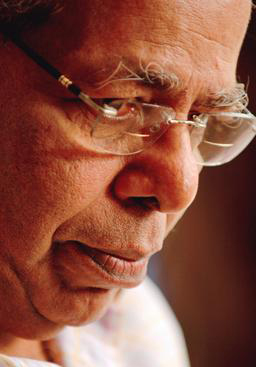
Malayalam thespian Thilakan dead

[email protected] (The Hindu)
September 24, 2012

ThilakanThiruvananthapuram, September 24: National award-winning Malayalam film actor Thilakan is dead. He was 77.

Thilakan, who had acted in around 200 films and had won for the national award for the best actor in a supporting role, died at a private hospital in Thiruvananthapuram around 3.30 a.m. on Monday after battling with multiple organ failure over the last one month.

Thilkan's body would be kept for public viewing at the Victoria Jubilee Memorial Town Hall in Thuruvananthapuram from 11 a.m. and cremated at the electric crematorium around 4 p.m.

Thilakan was born at Ayroor (now in Pathanamthitta district) on July 15, 1938. And he was born to act. His tryst with acting began while he was still at school. Acting – or theatre, to be more precise – was his vocation. It did not take him too long to make a mark as an exceptional performer on stage. His mentor P.J. Antony was his biggest influence in his theatre days.

Though he made his debut in cinema in 1972 with Periyar, it was with K.G. George’s Kolangal (1981) that he truly arrived in the tinsel town. As a drunkard, he put in a superb performance in a brilliantly written and directed film. It was followed by Yavanika, another masterpiece from Geroge, in which Thilakan played a theatre manager.

The film went on to attain cult status in Malayalam cinema, and though it was Mammootty, as sub inspector Jacob Eraly, who gained most from its success, Thilakan too made a huge impact.

Films like Panchagni, Dhwani, Sanmanassullavarkku Samadhanam, Namukku Parkkan Munthirithoppukal, Rithubhedam, Jathakam and Nadodikkattu established him as a versatile actor.

Then came Kireedom, in 1989. As Achuthan Nair, an ageing police constable who sees the dream for his son getting shattered, his performance was critically acclaimed. Many of his scenes with Mohanlal from Kireedom shows his mastery in acting.

Now, roles were written for him. A luxury often only the superstars could boast of.

Like in 1980s, the golden age of Malayalam cinema, the 90s also saw Thilakan giving life to one memorable character after another. He was the hero in films such as Kattukuthira, Perunthachan, Santhangopalam, Gamanam and his performances were no less than the heroes in films such as Sandesam, Kilukkam, Georgekutty C/O Georgekutty, Radhamadhavam, Kauravar, Sphadikam and Veendum Chila Veettukaryangal.

Age did not wither him as the new millennium too witnessed masterpieces from the actor. Films like Ekantham and Achan and more recently Indian Rupee and Ustad Hotel reminded us, yet again, that he was in a class of his own.

Ekantham fetched him a special jury award in 2007. He had won the National award for the best supporting actor for Rithubhedam in 1988.

He won the State award for the best actor twice, for Perunthachan (1990) and Gamanam and Santhanagopalam (both released in1994). He was the recipient of the second State best actor on six occasions, beginning with Yavanika (1982); the last was for Kattathoru Penpoovu (1998).

He would be a strong contender for an award in Ustad Hotel, one of his last releases, too, as the jury meets to decide the State Awards next year.

Thilakan, of course, had dominated the headlines more for controversies than his films over the last four years. He took on the Association of Malayalam Movie Artists (AMMA), which expelled him and he also faced a ban. Politicians and cultural icons, including Sukumar Azhikode, batted for him, but he was not part of the mainstream cinema for a while. But these couldn't stop Thilakan from acting.

So, Thilakan returned to deliver an impressive performance with Indian Rupee, which fetched rave reviews.

“I have never got as many phone calls as I did for Indian Rupee and that made me happy,” he had admitted. “I think people loved to see my comeback also because I had fought against certain evil practices in Malayalam cinema.”

They would have loved to see him act, anyway. They always have.



Comments

Add new comment

  • Coastaldigest.com reserves the right to delete or block any comments.
  • Coastaldigset.com is not responsible for its readers’ comments.
  • Comments that are abusive, incendiary or irrelevant are strictly prohibited.
  • Please use a genuine email ID and provide your name to avoid reject.
Agencies
February 10,2020

Hollywood star Joaquin Phoenix finally ended his dry run at the Oscars as he picked up the best actor trophy for his performance in and as "Joker" at the 92nd Academy Awards.

The 45-year-old actor had earlier bagged a BAFTA, a Golden Globe and a Screen Actors Guild Award for his turn as a failed, unhinged stand-up comedian who descends into chaos.

In a lengthy and rambling speech, Phoenix touched upon racism, climate change and gender inequality. He also remembered his brother River Phoenix, who died of a drug overdose at the age of 23 in 1993.

"When he was 17, my brother wrote this lyric. He said, 'run to the rescue with love and peace will follow'," Phoenix said. At the Academy Awards and the entire Hollywood award season, Phoenix had emerged as an undisputed frontrunner even though he was up against the likes of Leonardo DiCaprio ("Once Upon a Time in Hollywood"), Adam Driver ("Marriage Story"), "Antonio Banderas ("Pain & Glory") and Jonathan Pryce ("The Two Popes").

An Oscar had eluded Phoenix for the most part of his career, despite his successful collaborations with Ridley Scott ("Gladiator"), James Mangold ("Walk The Line") and Paul Thomas Anderson ("The Master"), all of which had earned him nominations.

But as Arthur Fleck aka The Joker, Phoenix finally managed to break that jinx and became the second actor to win an Oscar for playing the DC comic book villain after the posthumous best supporting actor win to Heath Ledger in 2008.

As Joker, Phoenix took a deep dive into character, capturing its essence as well as maniacal spirit in both body and soul.

He lost 52 pounds to get into the physicality of Fleck and turned to a pathological disorder to get his distinct laughter right.

Phillips wrote the part keeping Phoenix in mind though the actor took some convincing to play the role.

Phoenix started the film's festival circuit tour on a positive note at Cannes last year that followed by stops at Venice and Toronto.

The film had also courted controversies, owing to its theme of gun violence in the movie as well as Phoenix's temperamental press tour that saw him walking out of an interview midway.

But critics and the fans loved the actor's riveting turn in the movie and his pointed speeches.

At the Golden Globes, he called out the industry for its insensitivity towards climate change and pulled up his peers for using private jets for travel, while at the SAGs, he joked how he would always lose a role to DiCaprio and asked Christian Bale to deliver a bad performance for once in his career.

In his acceptance speech at the BAFTAs, Phoenix acknowledged the lack of diversity in the nominations, calling himself a part of the problem. Phoenix's career most praised performances include "Signs ", "We Own the Night", "Two Lovers", "The Immigrant", "Her", "You Were Never Really Here" and "Inherent Vice".

Comments

Add new comment

  • Coastaldigest.com reserves the right to delete or block any comments.
  • Coastaldigset.com is not responsible for its readers’ comments.
  • Comments that are abusive, incendiary or irrelevant are strictly prohibited.
  • Please use a genuine email ID and provide your name to avoid reject.
News Network
June 16,2020

Mumbai, Jun 16: Filmmaker Dibakar Banerjee remembers Sushant Singh Rajput as a dance loving 'chhokra' from an engineering college who, having made it in Bollywood, was “enthused, sincere and totally focused” on his craft.

Banerjeee said the actor always had “a book or two” with him and took pride in the fact that he had an “inner intellectual life away from the shallower aspects of showbiz”.

Rajput was found dead in his Bandra apartment on Sunday at the age of 34, leaving his friends, colleagues and collaborators in a state of shock.

The Patna-born actor and the director worked together in 2015 film "Detective Byomkesh Bakshy!" when Rajput was a relative newcomer in the industry. Banerjee says it was Rajput's vulnerability and willingness to do different that made him stand out for the role.

In an interview with news agency, the filmmaker looks back at Rajput's sincerity, his love for science and astronomy and how an outsider has to work harder than a "mediocre, unmotivated and entitled establishment elite" to succeed in Bollywood.

Excerpts:

You worked with Sushant when he was less than two-year-old in the film industry. What struck you the most in him to cast as Detective Byomkesh Bakshy?

Banerjee: His vulnerability and intensity and the ambition to do different things than the usual Bollywood stuff.

What were your memories of Sushant- the actor and the person?

Banerjee: As an actor he would tense himself up for the scene and then completely plunge in take after take. He would put a lot of value on preparation. He would be up the previous night of the shoot, reading the scene and making notes and land up on the sets all raring to go.

He would be on, ready and give his hundred per cent throughout the shoot of Byomkesh - no matter how hard or long the day. The unit did not really have to worry about him - considering he was the star. That's what I remember - a total pro, enthused, sincere and totally focused.

As a person, he seemed to me a happy dance loving 'chhokra' from an engineering college who had made it in showbiz and now was serious about acting. He was deeply nostalgic about his carefree student days in Delhi. We used to laugh a lot - I remember that quite clearly.

Sushant's friends say that he spoke more about books and his love for astronomy than films and their fate, which is rare for an actor in the industry. Do you also remember him that way?

Banerjee: Totally true. He was a science and astronomy nut. Always had a book or two with him - and was proud of the fact that he had an inner intellectual life away from the shallower aspects of showbiz. I recognized it as a reflex, protective action to prevent the Bollywood swamp sucking him in totally. And also an identity he wanted to protect and project.

Sushant's death has brought to the fore the struggles of outsiders and the alienation they often face from the nepotistic culture of the industry. Did you feel that Sushant was also fighting this battle despite being a successful actor?

Banerjee: We all fight it, day in and out - whether successful or failing. But the trick is to define that success and failure ourselves and not let the narrative constantly forced by the establishment to get to you. Those who know this weather the storm and ultimately survive and thrive.

The biggest unfairness in all this is that it takes double the talent, energy and hard work for an outsider to convince the audience and the industry that he or she is as safe a box office bet as a mediocre, unmotivated and entitled establishment elite.

The media colludes in this by wallowing in family, coterie and celebrity worship. This leads to deep anger and frustration. Those who can let this slide survive. Those who can't - those who hurt a little more or are vulnerable and impressionable - they are at risk.

Comments

Add new comment

  • Coastaldigest.com reserves the right to delete or block any comments.
  • Coastaldigset.com is not responsible for its readers’ comments.
  • Comments that are abusive, incendiary or irrelevant are strictly prohibited.
  • Please use a genuine email ID and provide your name to avoid reject.
News Network
January 2,2020

New Delhi, Jan 2: Hoping her cinematic voice can help bring about lasting change in how society perceives acid attack survivors, actor Deepika Padukone says her latest film Chhapaak should ideally be so impactful that there won't be need for another story on acid violence.

After all, cinema is in itself such a powerful medium, Deepika told news agency ahead of the release of the film, which is based on the life of acid attack survivor and activist Laxmi Agarwal.

The idea behind the social drama is to invoke empathy and understanding rather than paint women who have undergone the ordeal as victims, the actor, who has also produced the film, said in a telephonic interview from Mumbai.

"Beyond the gruesomeness, the violence and all of that, there is a story of the human spirit and hope. That's why we're telling the story," she said.

Deepika, 33, said it was a story that spoke to her and she felt pride in attaching herself to the project.

Chhapaak, directed by Meghna Gulzar and featuring Vikrant Massey, is the second mainstream film to focus on the subject after 2019 Malayalam movie Uyare starring Parvathy Thiruvothu.

"I hope we won't have to constantly tell stories on acid attack survivors for us to see change. I hope with our film we begin to see that change for ourselves as a society and for acid attack survivors.

"If we don't, then we've done something wrong as a society. Cinema in itself is such a powerful medium that hopefully just through this one film we will hopefully be able to see that kind of change and impact," Deepika said.

The actor said there was not much planning behind the decision to back the film financially.

"Sometimes certain films need a little more hand holding, a little more love and support. I felt like I would be adding a little more value as a producer.

"This is a film I'm very proud of, not just from the script point of view but even in terms of the story and its message," she said.

The film, which releases on January 10, will be Deepika's first release in two years and comes after her marriage to frequent co-star Ranveer Singh.

The actor said she used the time to creatively replenish herself.

"It was about finding a film worthy of putting out there. It's not that work at my end had stopped. I was constantly looking for scripts that challenged and excited me.

"I would look at it as time for creative fertility. It's important to nurture yourself. The work that goes on behind the scenes... most often we're constantly on a film set, but whether it's meeting with writers and directors, looking for scripts... That is also part of the creative process and that's what I've been doing."

The title Chhapaak instantly evokes the image of acid being splattered, and Deepika said the director wanted a word for the film's name that could also lend itself to a song.

"I think she said 'chhapaak', which is the sound of a splash, is something that could adapt or lend itself beautifully to a song. Perhaps, it also has to do with fluidity. So on one hand, liquid is known to take different forms, a liquid such as this (acid) can change someone's life forever," she said.

Comments

Add new comment

  • Coastaldigest.com reserves the right to delete or block any comments.
  • Coastaldigset.com is not responsible for its readers’ comments.
  • Comments that are abusive, incendiary or irrelevant are strictly prohibited.
  • Please use a genuine email ID and provide your name to avoid reject.