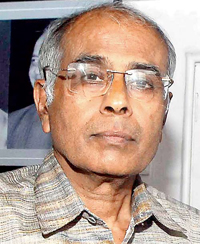
Now, a short film to spread rationalist Dabholkar's message

October 13, 2013

DabholkarPune, Oct 13: A short film made to support the anti-superstition mission undertaken by slain rationalist Narendra Dabholkar will now become a vehicle for propagating the cause for which he campaigned relentlessly.

A Mumbai-based duo - Amandeep Singh and Amarnath Chandaliya - closely associated with Dabholkar, has produced an 18-minute film titled `Bhooth Bada Ki Bhookh` (which is bigger - ghost or hunger?).

Rights of this film will be passed on to the Andhashraddha Nirmulan Samiti (ANS), the anti-superstition movement group founded by the social activist who was murdered here on August 20.

According to Amandeep, the film`s director, they had conceived and completed the film revolving around the theme of eradication of superstition and development of scientific temper, in March this year, just five months before unknown gunmen shot the rationalist dead during a morning walk.

Still recovering from the shock of his sudden exit, Singh and Chandaliya, who has written the screenplay, decided to hand over the film - shot in just two days with a modest budget of Rs 2 lakh - to ANS as a tribute to selfless crusader who fought and died for a cause dear to his heart.

Singh said they would give 200 copies of of the film to ANS which would also have the distribution rights. The film DVDs/CDs will be supplied to the Pune-based organisation as per requirement at a nominal copying charge as the project was not a commercial one, he added.

The film, which seeks to convey the anti-superstition message with a story of a young boy and his mother, was screened in the city on Friday in the presence of Hamid, Dabholkar`s son, and other ANS activists.

"The mother, though uneducated, removes the fears of the boy who is scared of ghosts, offering simple explanations," Singh said, adding the entire narrative is presented in a sequence lasting just one day.

While noted Marathi actress Mitalee Jagtap has played the role of mother, two children were drafted from the Mumbai slums for the film produced under the banner `Junoon`.

The crew associated with the film`s production worked without any remuneration, Singh and Chandaliya noted.

Comments

Add new comment

  • Coastaldigest.com reserves the right to delete or block any comments.
  • Coastaldigset.com is not responsible for its readers’ comments.
  • Comments that are abusive, incendiary or irrelevant are strictly prohibited.
  • Please use a genuine email ID and provide your name to avoid reject.
News Network
February 10,2020

Feb 10: Bong Joon-ho’s film “Parasite” starts in a dingy, half-basement apartment with a family of four barely able to scratch out a life. There must be no place to go but up, right? Yes and no. There’s nothing predictable when the South Korean director is on his game.

This dark, socially conscious film about the intertwining of two families is an intricately plotted, adult thriller. We can go up, for sure, but Bong can also take us deeper down. There’s always an extra floor somewhere in this masterpiece.

It tells the story of the impoverished four-person Kim family who, one by one, and with careful and devious planning, all get employed by the four-person affluent Park family — as a tutor, an art teacher, a driver and a housekeeper. They are imposters stunned by the way wealth can make things easier: “Money is an iron. It smooths out all the creases,” says the Park patriarch with wonder.

Bong, who directed and wrote the story for “Parasite,” has picked his title carefully, of course. Naturally, he’s alluding to the sycophantic relationship by a clan of scammers to the clueless rich who have unwittingly opened the doors of their home on a hill. But it’s not that simple. The rich family seem incapable of doing anything — from dishes to sex — without help. Who’s scamming who?

Bong’s previous films play with film genres and never hide their social commentary — think of the environmentalist pig-caper “Okja” and the dystopian sci-fi global warming scream “Snowpiercer.” But this time, Bong’s canvas is a thousand times smaller and his focus light-years more intense. There are no CGI train chases on mountains or car chases through cities. (There is also, thankfully, 100% less Tilda Swinton, a frequent, over-the-top Bong collaborator.

The two Korean families first make contact when a friend of the Kim’s son asks him to take over English lessons for the Park daughter. Soon the son (a dreamy Choi Woo-sik) convinces them to hire his sister (the excellent Park So-dam) as an art teacher, but doesn’t reveal it’s his sis. She forges her diploma and spews arty nonsense she learned on the internet, impressing the polite but firm Park matriarch (a superb Jo Yeo-jeong.)

The Park’s regular chauffer is soon let go and replaced by the Kim patriarch (a steely Lee Sun-kyun). Ditto the housemaid, who is dumped in favor of the Kims’ mother (a feisty Jang Hye-jin.) All eight people seem happy with the new arrangement until Bong reveals a twist: There are more parasites than you imagined. The clean, impeccably furnished Park home will have some blood splashing about.

Bong’s trademark slapstick is still here but the rough edges of his often too-loud lessons are shaved down nicely and his actors step forward. “Keep it focused,” the Kim’s son counsels his father at one point. Bong has followed that advice.

There are typically dazzling Bong touches throughout. Just look for all the insect references — stink bugs at the beginning to flies at the end, and a preoccupation with odor across the frames. And there’s a scene in which the rich matriarch skillfully winds noodles in a bowl while, in another room, duct tape is being wrapped around a victim and classical music plays.

Bong could have been more strident in his social critique but hasn’t. There are no villains in “Parasite” — and also no heroes. Both families are forever broken after chafing against each other, a bleak message about the classes ever really co-existing (Take that, “Downton Abbey”).

“Parasite” is a worthy winner of the Palme d’Or at the Cannes Film Festival, the first South Korean movie to win the prestigious top prize. The director has called it an “unstoppably fierce tragicomedy.” We just call it brilliant.

Comments

Add new comment

  • Coastaldigest.com reserves the right to delete or block any comments.
  • Coastaldigset.com is not responsible for its readers’ comments.
  • Comments that are abusive, incendiary or irrelevant are strictly prohibited.
  • Please use a genuine email ID and provide your name to avoid reject.
Agencies
August 4,2020

New York, Aug 4: National Award-winning documentary "Son Rise" and Geetu Mohandas-directed "Moothon" were among the films that took home the big honours at the 20th New York Indian Film Festival (NYIFF), which switched to a virtual edition this year amid the ongoing Covid-19 pandemic.

Over 45 feature-length narratives, shorts and documentaries from the Indian subcontinent were showcased at the festival’s virtual edition that ran for 10 days beginning July 24.

The films programmed were in various languages including Assamese, Bengali, Haryanvi, Hindi, English, Ladakhi, Maithili, Malayalam, Marathi, Nepali and Tamil.

The award ceremony for the festival was held virtually Sunday, with the filmmakers, cast, award winners and festival officials joining from across India and the US.

The award for the Best Documentary (Short) went to Saurav Vishnu-directed "Tailing Pond", which highlights the "horrifying effects of uranium extraction on the health of the indigenous population" of Jadugoda, Jharkhand.

"Son Rise" by Vibha Bakshi won the award for Best Documentary (Feature).

The documentary had won the National Award for the Best non-feature film in 2019 and was among the two centrepieces hosted by the festival this year. NYIFF called "Son Rise" “a powerful documentary about patriarchy in Haryana and efforts by a few good men to bring meaningful change in the society.”

The award for Best Short (Narrative) went to Sanat Ganu's "Arabian Nights". The narrative focuses on a child, his imaginary friend and a family that attends a conference where the attendees believe the earth is flat.

Director and scriptwriter Sudhanshu Saria accepted the award for Best Screenplay for "Knock Knock Knock". Saria’s screenplay “explores the lonely life of a man, an unlikely friendship that may or may not be real.”

Sanjana Dipu won the award for Best Child Actor for "Moothon" for her performance of a teenager in search of a brother.

Garggi Ananthan won the Best Actress award for her role as Kalyani in the film "Run Kalyani" and the Best Actor award went to Malayalam star Nivin Pauly for "Moothon". The award for the Best Director went to 23-year old Achal Mishra for "Gamak Ghar".

"Moothon" won the award for Best Film and its director Mohandas accepted the award for the film, which is "about love and loss that travels from the quiet, lush beaches of Lakshadweep to the mad hustle-bustle of the streets of Mumbai."

Produced by award-winning Indian film director and writer Anurag Kashyap, "Moothon" had premiered at last year’s Toronto International Film Festival.

NYIFF festival director Aseem Chhabra said that the process of searching for films for the festival began last fall and they were ready to showcase them to audiences in New York in April but had to change plans for the festival due to the pandemic.

"I know the best way to enjoy films is in a theatre with the audience and have live interactions, conversations. But the virtual festival is the next best option and in the process, we have been able to reach out to a much larger audience in the US, North America as well in several other countries.”

NYIFF said that a virtual edition expanded the reach of the festival and audiences from 95 countries were able to access and view the films.

Dr Nirmal Mattoo, Chairman of the Indo-American Arts Council, co-founder and owner of Atlantic Dialysis Management services, the largest private dialysis provider in New York State, said NYIFF works with an independent jury - filmmakers, film professors, writers and critics.

Indo-American Arts Council (IAAC), the leading cultural organisation, presents the festival.

"The Covid-19 pandemic has forced the closure of theatres but we believe that in such trying times arts, including films are even more important for the community’s well-being. So, this year we have decided to bring the films directly into your living rooms.” IAAC Vice-Chairman Rakesh Kaul had said.

The New York Indian Film Festival is the oldest Indian film event in North America. Over the years, the festival has held New York premieres of a wide range of films, many of them critically acclaimed, including "Monsoon Wedding", "The Namesake", "Slumdog Millionaire", "Shahid", "Dum Laga Ke Haisha" and "Gangs of Wasseypur". 

Comments

Add new comment

  • Coastaldigest.com reserves the right to delete or block any comments.
  • Coastaldigset.com is not responsible for its readers’ comments.
  • Comments that are abusive, incendiary or irrelevant are strictly prohibited.
  • Please use a genuine email ID and provide your name to avoid reject.
News Network
June 26,2020

New Delhi, Jun 26: Actor Sushant Singh Rajput’s death has exposed the deep faultlines in the Hindi film industry with issues such as bullying, nepotism and discrimination emerging from tinsel town’s rarely discussed dark corners into the spotlight of introspection and debate.

The days since the death of the 34-year-old actor, whose body was found in his Mumbai apartment on June 14, have split the glamour industry down the middle – between ‘insiders’ and ‘outsiders’, 'us' vs 'them', and those born to fame and those who sweated for it.

That Rajput, who came from a middle class home in Patna and made his mark in mainstream Hindi cinema in what could be the classic fairytale, ended his life led to soul searching about power structures in Bollywood and also angry accusations at the biggies who call the shots.

'Outsider' Manoj Bajpayee said the structural shift that everyone in the industry wants to see will begin once the powerful abolish the "insider-outsider" divide.

"Nepotism has been in the debate for a few years now. It'll change only if each and every individual who is positioned well, who is established and powerful starts making efforts to make it healthy and democratic for all the talented people who are coming in," Bajpayee said.

“We will have to work very hard to turn this industry into a fraternity where each and everyone is welcomed," he said. Dibakar Banerjee, who directed Rajput in Detective Byomkesh Bakshy!, added that outsiders need to put in twice the amount of work as compared to star children to convince the industry, the public and the box office of their talent.

"The biggest unfairness in all this is that it takes double the talent, energy and hard work for an outsider to convince the audience and the industry that he or she is as safe a box office bet as a mediocre, unmotivated and entitled establishment elite," he told news agency.

Rajput was considered that rare actor, after Shah Rukh Khan perhaps, to have transitioned from television to Bollywood stardom and his death opened the proverbial can of worms.

Detective Byomkesh Bakshy! was produced by Yash Raj Films, which also backed Rajput’s Shuddh Desi Romance. As rumours swirled about unfair contract details, the powerful production house and other industry bigwigs and star children such as Karan Johar, Alia Bhatt and Sonam Kapoor faced ire from not just the public but even some of their colleagues.

The untimely death of the young actor had clearly not just touched a chord but triggered a rallying cry for change.

An out of context, old clip from Johar's chat show Koffee with Karan in which Bhatt is seen joking about Rajput and Kapoor confesses not knowing him fuelled the anger.

Hashtags like #BoycottKhans, #boycottnepotism and #JusticeForSushantSinghRajput started trending online a day after the actor's death with many calling for a boycott for the films made by Johar and featuring star children.

An online petition on Change.org asking fans to boycott Johar, YRF and Salman Khan has gathered almost 38 lakh signatures so far.

Reflecting the split in filmdom, Johar unfollowed everyone on Twitter except eight people, including Prime Minister Narendra Modi, Shah Rukh Khan and Amitabh Bachchan.

Hate comments also made actor Sonakshi Sinha, daughter of veteran actor-politician Shatrughan Sinha, deactivate her Twitter account last week.

Kapoor, too, disabled the comments section on her Instagram page and that of her father, veteran actor Anil Kapoor.

The public's angst found resonance in Bollywood with many in the fraternity saying the industry needs to introspect on how it treats outsiders.

Actors Gulshan Devaiah and Sushmita Sen, directors Hansal Mehta and Onir and singers Sonu Nigam and Kumar Sanu were amongst the many people who spoke out on the deeply disturbing issues that Rajput’s death had thrown up.

Mehta made a distinction between nepotism and bullying. 

He said his son Jai Mehta was an assistant director in his own film Shahid and also in Anurag Kashyap's Gang of Wasseypur series. He stepped inside the door because of his father but got ahead because he is talented.

“So when people take off on nepotism they do not really address the elephant in the room. They belittle the real battle -- the battle is between the powerful and the rising, between old and new, between rigidity and change, between secure and insecure,” Mehta said.

The director also criticised those bullying people in the guise of criticism.

“People in power (inherited/earned) have no business bullying those perceived to be less powerful or dependent on them,” he said, adding that the debate had been narrowed down to target certain people not for reform or the larger good.

According to Sen, nepotism is a truth as old as the industry.

“I think competition is a great thing but it should be a fair one for everyone… We have lived with it for many years. If it needs to change then all of us need to take responsibility, no one person,” she told PTI.

Onir said calling out nepotism does not mean denying talent just because someone belongs to the industry.

“It is about empowering all those deserving and talented denied opportunity by blatant discrimination. It’s about marginalising talent and creating a non-inclusive space,” he said.

Devaiah, known for his roles in Shaitan and A Death in the Gunj, said there is a lot of "toxicity" in showbiz because of the power structures but actors need to safeguard themselves from getting into a position where they can "lose control".

The debate was just not about actors but also the music industry.

“I have a request for music companies. Today, Sushant Singh Rajput has died. An actor has died. Tomorrow you might such news about a singer, a composer or a lyricist. The state of affairs in the music industry... there is a bigger mafia in the music industry than the film industry…,” singer Sonu Nigam said in a heartfelt video after Rajput’s death.

His colleague Kumar Sanu also uploaded a video on Facebook this week, saying he can sense a "revolution".

"Since his demise, I can see a different revolution emerging. Nepotism exists everywhere. It's a little more in our industry. You (the audience) make us who we are… Filmmakers or the top people (in the industry) cannot decide. It is in your hand to make us," he said.

As the debate intensified, Aligarh scriptwriter Apurva Asrani said some ‘woke’ friends were trying to crush the movement the actor’s death had sparked.

“Claiming to want dignity for him, they want others to suffer indignity in silence,” he tweeted, sharing a thread in which other such as Shekhar Kapur Ranvir Shorey and Abhay Deol also discussed nepotism and the camp culture in Bollywood.


Comments

Add new comment

  • Coastaldigest.com reserves the right to delete or block any comments.
  • Coastaldigset.com is not responsible for its readers’ comments.
  • Comments that are abusive, incendiary or irrelevant are strictly prohibited.
  • Please use a genuine email ID and provide your name to avoid reject.