



Epic nuclear case: Island nation takes on India, Pak, Britain

October 5, 2016

Majuro/Marshall Islands, Oct 5: As the Marshall Islands awaits an international court ruling on Wednesday on whether its lawsuit against three nuclear powers can proceed, many in the western Pacific nation question the merit of the David-versus-Goliath legal battle.
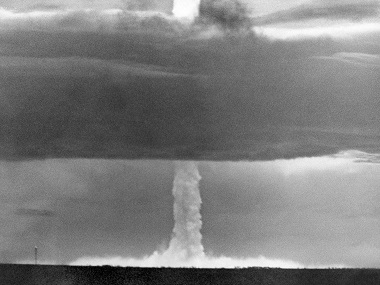
hydrogenThe country of 55,000 people is taking on India, Pakistan and Britain in the International Court of Justice (ICJ), arguing they have failed to comply with the 1968 nuclear Non-Proliferation Treaty.

Initially the lawsuit was even more ambitious — also including China, France, Israel, North Korea, Russia and the United States — none of which recognised the ICJ's jurisdiction on the matter.

The Marshalls has a long, bitter history with nuclear weapons, making it one of the few nations that can argue with credibility before the ICJ about their impact.

The island nation was ground zero for 67 American nuclear weapons tests from 1946-58 at Bikini and Enewetak atolls, when it was under US administration.

The tests included the 1954 "Bravo" hydrogen bomb, the most powerful ever detonated by the United States, about 1,000 times bigger than the atomic bomb dropped on Hiroshima.

They fed into an apocalyptic zeitgeist in Cold War popular culture, giving a name to the bikini swimsuit and leading to the development of Japan's Godzilla movie monster.

In "Godzilla", the creature is awakened by a hydrogen bomb test, rising from a roiling sea to destroy Tokyo, in a walking, radiation-breathing analogy for nuclear disaster.

'Sky turned blood red'

On the Marshall Islands, the impacts of the nuclear tests were all too real.

Numerous islanders were forcibly evacuated from ancestral lands and resettled, while thousands more were exposed to radioactive fallout.

"Several islands in my country were vaporised and others are estimated to remain uninhabitable for thousands of years," Tony deBrum, a former Marshall Islands foreign minister, told an ICJ hearing earlier this year.

He recalled witnessing the Bravo test as a nine-year-old while fishing with his grandfather in an atoll, some 200 kilometres (125 miles) from the blast's epicentre.

"The entire sky turned blood red," he said. "Many died, or suffered birth defects never before seen and cancers as a result of contamination."

DeBrum launched the Marshall's ICJ action in 2014 with cooperation from the California-based Nuclear Age Peace Foundation.

His actions prompted the International Peace Bureau to nominate him in January for the 2016 Nobel Peace Prize, which is yet to be awarded.

Yet critics argue the ICJ action is a distraction and the islanders' real fight is with Washington, which carried out the tests in their backyard.

They contend the case has no relationship to victims' claims for increased compensation, better health care and clean-ups to make sites habitable again.

Official criticism has been muted recently to avoid undermining deBrum's Nobel nomination.

But his successor as foreign minister, John Silk, made his views clear before an election last November when voters ousted 40 percent of the parliament, including deBrum.

Labelling the action "unauthorised" and "a publicity stunt", he said the focus should remain on petitioning the US Congress for increased compensation.

"What do these lawsuits have to do with resolving the legacy of the US nuclear testing programme?" he asked.

The Nuclear Age Peace Foundation argues that the Marshalls is taking a broader perspective in trying to re-start nuclear disarmament talks that have stalled over the past 20 years.

"The Republic of the Marshall Islands acts for the seven billion of us who live on this planet to end the nuclear weapons threat hanging over all humanity," its website says.

"Everyone has a stake in this."

The ICJ, the UN's top court, will decide on Wednesday whether it believes the case should go to a full hearing.

Comments

Ashwin
 - 
Wednesday, 5 Oct 2016

Haha. CD u are very slow. The UN Court has already rejected nuclear case against India. But you are very quick to post something about BJP

Add new comment

  • Coastaldigest.com reserves the right to delete or block any comments.
  • Coastaldigset.com is not responsible for its readers’ comments.
  • Comments that are abusive, incendiary or irrelevant are strictly prohibited.
  • Please use a genuine email ID and provide your name to avoid reject.
News Network
June 17,2020

Washington, Jun 17: The United States is closely monitoring the situation following a fierce clash between Indian and Chinese forces in eastern Ladakh and hopes that the differences will be resolved peacefully, officials said here.

Twenty Indian Army personnel including a colonel were killed in the clash with Chinese troops in the Galwan Valley in eastern Ladakh on Monday night, the biggest military confrontation in over five decades that has significantly escalated the already volatile border standoff in the region.

"We are closely monitoring the situation between Indian and Chinese forces along the Line of Actual Control," a State Department spokesperson said.

"We note the Indian military has announced that 20 soldiers have died, and we offer our condolences to their families," the official said.

Both India and China have expressed their desires to de-escalate and the US supports a peaceful resolution of the current situation, the spokesperson said.

"During their phone call on June 2, 2020, President Donald Trump and Prime Minister Narendra Modi had discussed the situation along the India-China border," the official added.

Comments

Add new comment

  • Coastaldigest.com reserves the right to delete or block any comments.
  • Coastaldigset.com is not responsible for its readers’ comments.
  • Comments that are abusive, incendiary or irrelevant are strictly prohibited.
  • Please use a genuine email ID and provide your name to avoid reject.
Agencies
July 9,2020

The new visa regulations requiring international students in the US with an F-1 visa to take at least one in-person course or face the prospect of deportation is likely to "cause uncertainties and difficulties" for some students, the Indian Embassy has said.

"These new modifications at a time when many of the US universities and colleges are yet to announce their plans for the new academic year are likely to cause uncertainties and difficulties for some Indian students wishing to pursue their studies in the US," said a spokesperson of the Indian Embassy.

Responding to media queries, the spokesperson said the Indian government has taken up the matter with concerned US officials.

At the India US Foreign Office Consultations held on July 7, Foreign Secretary Harsh Vardhan Shringla conveyed India's concerns on the matter to Under Secretary of State for Political Affairs David Hale.

According to a recent report of Student and Exchange Visitor Program (SEVP), there were 1,94,556 Indian students enrolled in various academic institutions of the US in January this year. Of these 1,26,132 were males and 68,405 were females.

Noting that partnership in higher education is a key component of the strong people-to-people ties between India and the US, the spokesperson said in the last two decades Indian students in American universities and colleges have been the harbingers of a strong partnership between technology and innovation sectors between the two countries.

The spokesperson hoped that the US authorities would provide adequate flexibility in their visa rule, keeping in mind the extraordinary circumstances created by the COVID-19 pandemic for the Indian students community.

We continue to engage all the stakeholders in the matters, including the US administration officials, Congressional leaders, universities and colleges as well as the Indian students community in the US as we move forward towards the 2020-21 academic year to further strengthen our bilateral partnership in higher education, the spokesperson said.

Announced by the SEVP on July 6, the new rules provide temporary exemptions for nonimmigrant students on F-1 and M-1 visas taking online classes due to the COVID-19 pandemic for the fall semester of the 2020 academic year.

While these modifications do provide some flexibility for US universities and colleges to adopt a hybrid model -- that is a mixture of online and in person classes -- they also restrict international students on F-1 and M-1 visas from taking courses entirely online, the spokesperson said.

Comments

Add new comment

  • Coastaldigest.com reserves the right to delete or block any comments.
  • Coastaldigset.com is not responsible for its readers’ comments.
  • Comments that are abusive, incendiary or irrelevant are strictly prohibited.
  • Please use a genuine email ID and provide your name to avoid reject.
Agencies
January 20,2020

For the first time in the 15 years of the Global Risks Report, the climate change and environment risk has occupied all the top five slots.

According to the 15th edition of the World Economic Forum's (WEF) Global Risks Report, the top five risks in terms of likelihood are extreme weather, climate action failure, natural disasters, biodiversity loss and human-made environmental disasters. They all fall in the one category of climate change and related environmental disasters.

WEF President Borge Brende said the world was feeling long-mounting and interconnected risks.

The report also points to how citizens are protesting across the world as discontent rises with failed systems that are creating inequality. The citizens' discontent had hardened with systems that had failed to promote advancement, it said.

"Disapproval of how governments are addressing profound economic and social issues has sparked protests throughout the world, potentially weakening the ability of governments to take decisive action should a downturn occur. Without economic and social stability, countries could lack the financial resources, fiscal margin, political capital or social support needed to confront key global risks," it said.

Listing the grim scenario, Borge said the global economy was faced with "synchronised slowdown", the past five years had been the warmest on record and cyber attacks were expected to increase this year.

The report warns that while the myriad risks were rising, time was running out on how to prevent them.

Borge said the growing palpability of shared economic, environmental and societal risks indicated that the horizon had shortened for preventing "or even mitigating" some of the direst consequences of global risks.

"It's sobering that in the face of this development, when the challenges before us demand immediate collective action, fractures within the global community appear to only be widening," he said.

The report points to grave concern about the consequences of continued environmental degradation, including the record pace of species decline.

Pointing to an unsettled geopolitical environment, the report said today's risk landscape was one in which new centres of power and influence were forming and old alliance structures and global institutions were being tested.

"While these changes can create openings for new partnership structures in the immediate term, they are putting stress on systems of coordination and challenging norms around shared responsibility. Unless stakeholders adapt multilateral mechanisms for this turbulent period, the risks that were once on the horizon will continue to arrive," it said.

Calling it a "an unsettled world", the WEF report notes that powerful economic, demographic and technological forces were shaping a new balance of power. "The result is an unsettled geopolitical landscape in which states are increasingly viewing opportunities and challenges through unilateral lenses," it said.

"What were once givens regarding alliance structures and multilateral systems no longer hold as states question the value of long-standing frameworks, adopt more nationalist postures in pursuit of individual agendas and weigh the potential geopolitical consequences of economic decoupling. Beyond the risk of conflict, if stakeholders concentrate on immediate geo-strategic advantage and fail to re-imagine or adapt mechanisms for coordination during this unsettled period, opportunities for action on key priorities may slip away," the WEF said.

In a chapter on risks to economic stability and social cohesion, it said a challenging economic climate might persist this year and members of the multi-stakeholder community saw "economic confrontations" and "domestic political polarisation" as the top risks in 2020.

The report also warned of downward pressure on the global economy from macroeconomic fragilities and financial inequality. These pressures continued to intensify in 2019, increasing the risk of economic stagnation.

Low trade barriers, fiscal prudence and strong global investment, once seen as fundamentals for economic growth, are fraying as leaders advance nationalist policies. The margins for monetary and fiscal stimuli are also narrower than before the 2008-2009 financial crisis, creating uncertainty about how well countercyclical policies will work.

The strategic partners for the WEF report included Marsh & McLennan and Zurich Insurance Group. The academic advisers were National University of Singapore, Oxford Martin School, University of Oxford and Wharton Risk Management and Decision Processes Center, University of Pennsylvania.

Comments

Add new comment

  • Coastaldigest.com reserves the right to delete or block any comments.
  • Coastaldigset.com is not responsible for its readers’ comments.
  • Comments that are abusive, incendiary or irrelevant are strictly prohibited.
  • Please use a genuine email ID and provide your name to avoid reject.