Expats’ fingerprinting expedited

December 15, 2014

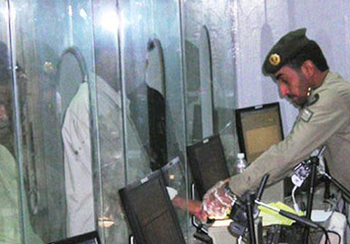
Finger printingRiyadh, Dec 15: The Passport Department has expedited the fingerprint registration of sponsors and residents accompanied by dependents above 15 ahead of the Jan. 21 deadline.

“Those who have failed to get their fingerprints registered risk denial of access to all passport department services including the request for an exit-re-entry visa during an emergency,” said the spokesman of the department, Maj. Ahmad bin Fahd Al-Luhaidan.

He added that the only service that could be availed without fingerprints was the iqama renewals for female members of the family but even this would be required after the deadline is over. “All services will now be fully online,” he stressed.

Al-Luhaidan told Arab News that the department has completed linking the fingerprint registration with all passport services including iqama issuance and renewal, exit-re-entry visas, change of profession and information transfers.

The department has mobilized all its passport offices across the Kingdom to take fingerprint registrations, he said.

It also worked to deploy mobile units for this purpose to facilitate people living in remote locations in addition to providing an online fingerprint checking service for residents, he said.

Comments

Add new comment

  • Coastaldigest.com reserves the right to delete or block any comments.
  • Coastaldigset.com is not responsible for its readers’ comments.
  • Comments that are abusive, incendiary or irrelevant are strictly prohibited.
  • Please use a genuine email ID and provide your name to avoid reject.
News Network
July 23,2020

Beirut, Jul 23: The pandemic will exact a heavy toll on Arab countries, causing an economic contraction of 5.7% this year, pushing millions into poverty and compounding the suffering of those affected by armed conflict, a U.N. report said Thursday.

The U.N.'s Economic and Social Commission for Western Asia expects some Arab economies to shrink by up to 13%, amounting to an overall loss for the region of $152 billion.

Another 14.3 million people are expected to be pushed into poverty, raising the total number to 115 million — a quarter of the total Arab population, it said. More than 55 million people in the region relied on humanitarian aid before the COVID-19 crisis, including 26 million who were forcibly displaced.

Arab countries moved quickly to contain the virus in March by imposing stay-at-home orders, restricting travel and banning large gatherings, including religious pilgrimages.

Arab countries as a whole have reported more than 830,000 cases and at least 14,717 deaths. That equates to an infection rate of 1.9 per 1,000 people and 17.6 deaths per 1,000 cases, less than half the global average of 42.6 deaths, according to the U.N.

But the restrictions exacted a heavy economic toll, and authorities have been forced to ease them in recent weeks. That has led to a surge in cases in some countries, including Lebanon, Iraq and the Palestinian territories.

Wealthy Gulf countries were hit by the pandemic at a time of low oil prices, putting added strain on already overstretched budgets. Middle-income countries like Jordan and Egypt have seen tourism vanish overnight and a drop in remittances from citizens working abroad.

War-torn Libya and Syria have thus far reported relatively small outbreaks. But in Yemen, where five years of civil war had already generated the world's worst humanitarian crisis, the virus is running rampant in the government-controlled south while rebels in the north conceal its toll.

Rola Dashti, the head of the U.N. commission, said Arab countries need to “turn this crisis into an opportunity” and address longstanding issues, including weak public institutions, economic inequality and over-reliance on fossil fuels.

“We need to invest in survival, survival of people and survival of businesses,” she said.

Comments

Add new comment

  • Coastaldigest.com reserves the right to delete or block any comments.
  • Coastaldigset.com is not responsible for its readers’ comments.
  • Comments that are abusive, incendiary or irrelevant are strictly prohibited.
  • Please use a genuine email ID and provide your name to avoid reject.
News Network
July 1,2020

Riyadh, Jul 1: Saudis braced Wednesday for a tripling in value added tax, another unpopular austerity measure after the twin shocks of coronavirus and an oil price slump triggered the kingdom's worst economic decline in decades.

Retailers in the country reported a sharp uptick in sales this week of everything from gold and electronics to cars and building materials, as shoppers sought to stock up before VAT is raised to 15 percent.

The hike could stir public resentment as it weighs on household incomes, pushing up inflation and depressing consumer spending as the kingdom emerges from a three-month coronavirus lockdown.

"Cuts, cuts, cuts everywhere," a Saudi teacher in Riyadh told AFP, bemoaning vanishing subsidies as salaries remain stagnant.

"Air conditioner, television, electronic items," he said, rattling off a list of items he bought last week ahead of the VAT hike.

"I can't afford these things from Wednesday."

With its vast oil wealth funding the Arab world's biggest economy, the kingdom had for decades been able to fund massive spending with no taxes at all.

It only introduced VAT in 2018, as part of a push to reduce its dependence on crude revenues.

Then, seeking to shore up state finances battered by sliding oil prices and the coronavirus crisis, it announced in May that it would triple VAT and halt a cost-of-living monthly allowance to citizens.

The austerity push underscores how Saudi Arabia's once-lavish spending is becoming a thing of the past, with the erosion of the welfare system leaving a mostly young population to cope with reduced incomes and a lifestyle downgrade.

That could pile strain on a decades-old social contract whereby citizens were given generous subsidies and handouts in exchange for loyalty to the absolute monarchy.

The rising cost of living may prompt many to ask why state funds are being lavished on multi-billion-dollar projects and overseas assets, including the proposed purchase of English football club Newcastle United.

Shopping malls in the kingdom have drawn large crowds in recent days as retailers offered "pre-VAT sales" and discounts before the hike kicks in.

A gold shop in Riyadh told AFP it saw a 70 percent jump in sales in recent weeks, while a car dealership saw them tick up by 15 percent.

Once the new rate is in place, businesses are predicting depressed sales of everything from cars to cosmetics and home appliances.

Capital Economics forecast inflation will jump up to six percent year-on-year in July, from 1.1 percent in May, as a result.

"The government ended the country's lockdown (in June) and there are signs that economic activity has started to recover," Capital Economics said in a report.

"Nonetheless, we expect the recovery to be slow-going as fiscal austerity measures bite."

The kingdom also risks losing its edge against other Gulf states, including its principal ally the United Arab Emirates, which introduced VAT at the same time but has so far refrained from raising it beyond five percent.

"Saudi Arabia is taking massive risks with contractionary fiscal policies," said Tarek Fadlallah, chief executive officer of the Middle East unit of Nomura Asset Management.

But the kingdom has few choices as oil revenue declines.

Its finances have taken another blow as authorities massively scaled back this year's hajj pilgrimage, from 2.5 million pilgrims last year to around a thousand already inside the country, and suspended the lesser umrah because of coronavirus.

Together the rites rake in some $12 billion annually.

The International Monetary Fund warned the kingdom's GDP will shrink by 6.8 percent this year -- its worst performance since the 1980s oil glut.

The austerity drive would boost state coffers by 100 billion riyals ($26.6 billion), according to state media.

But the measures are unlikely to plug the kingdom's huge budget deficit.

The Saudi Jadwa Investment group forecasts the shortfall will rise to a record $112 billion this year.


Comments

Add new comment

  • Coastaldigest.com reserves the right to delete or block any comments.
  • Coastaldigset.com is not responsible for its readers’ comments.
  • Comments that are abusive, incendiary or irrelevant are strictly prohibited.
  • Please use a genuine email ID and provide your name to avoid reject.
Agencies
May 26,2020

Dubai, May 26: An Indian expat, who recently recovered from COVID-19, fell to his death from a building in Dubai, police said.

The 26-year-old Indian national identified as Neelath Muhammed Firdous from Kerala, fell from the seventh floor balcony of his building where he stayed with six others including his uncle, Naushad Ali, 33.

A Dubai Police official confirmed the incident to Gulf News on Monday and said it had been a suicide.

"He was suffering from a mental disorder and there is no criminal suspicions behind his death," said the official.

"The incident happened on Sunday," the official confirmed.

The victim's relative said: "(He) awoke early to perform prayers and everyone was getting on with their daily morning chores when he walked to the balcony and jumped.

"He was suffering from a mental disorder and had been disturbed for some time. He thought everyone was out to attack him and had stopped eating his food as he thought people were feeding him poison. He was refusing to even take water from us."

The victim had tested positive for COVID-19 on April 10. On May 7, he was discharged from a Dubai hospital after clearing all tests.

The relative told Gulf News that he had registered the victim in the Department of Non-Resident Keralites Affairs (NORKA) last month in order to repatriate him, however he was unsuccessful in procuring a ticket.

Comments

Add new comment

  • Coastaldigest.com reserves the right to delete or block any comments.
  • Coastaldigset.com is not responsible for its readers’ comments.
  • Comments that are abusive, incendiary or irrelevant are strictly prohibited.
  • Please use a genuine email ID and provide your name to avoid reject.