


Expected? Key documents in Malegaon blasts case missing from NIA court!

April 7, 2016

Mumbai, Apr 7: All the statements were given in front of a magistrate and hence admissible as evidence to nail the alleged culprits that include a 'sadhvi' and a serving Indian Army officer.
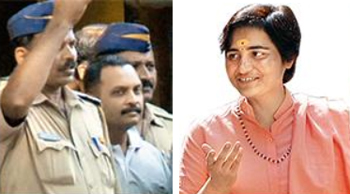
blastIn a major setback to the 2008 Malegaon blasts case, seven statements of witnesses - all recorded in the presence of a magistrate and admissible as evidence - have gone missing from the Special NIA Court.

Coming in the wake of Special Public Prosecutor Rohini Salian's statement in June last year that National Investigation Agency (NIA) officers were putting pressure on her to go soft in the case, the disappearance of the crucial court documents will again call into question the prosecution's intent and ability to take the case, in which members of an alleged Hindu radical group stand accused, to its logical conclusion.

Two low-intensity explosions in Malegaon's Bhikku Chowk on September 29, 2008, had left seven people dead and left over 80 injured. The Maharashtra police's Anti Terrorist Squad, which investigated the case before it was handed over to NIA in 2011, arrested a dozen-odd accused, including self-styled Sadhvi Pragya Singh Thakur and serving Indian Army officer Lt Col Srikant Purohit. Both worked for Hindu radical group Abhinav Bharat.

An embarrassed NIA has formed three teams to look for the missing statements, while the court officials have also joined in the search. Salian, who quit the case last year over, what she called, NIA's pressure to not push too hard, on Wednesday told media that an official from the Special NIA Court came to her looking for the documents. "One of the staff from the special court enquired with me if I am in the possession of the key documents, including several witness statements recorded under section 164 of the Criminal Procedure Code, which, he said, were not traceable in the court," she said.

Salian said she had handed over all documents to the designated special prosecutor Avinash Rasal in the presence of NIA officials. "I have not kept a single document related to the case with me," she said.

Rasal, on his part, said he had no knowledge of any witness statements having gone missing, but said that it is possible that some documents may have been misplaced. "The documents have been moved frequently from one court to the other. If the documents are not in the Special NIA Court, then they are probably some place else and the court officials should be able to locate them," he said.

Top NIA officials, including DIG Abhin Modak, all through Wednesday did not respond to calls and text messages and an agency spokesman said he had no comment to offer on the matter.

Among the witness statements gone missing is that of Dharmendra Bairagi, a close aid of Ramji Kalsangra, a key accused in the case who is absconding. Bairagi, in his statement recorded before a magistrate, had said that he was witness to a meeting between Kalsangra and Pragya Thakur in Ujjain just months before the 2008 blasts. He had also said he had heard the two discussing a plan to engineer blasts.

Another key statement that is missing is that of the founder of Abhinav Bharat Hemani Savarkar. Savarkar's statement details a meeting between Lt Col Purohit and Pragya Thakur in Nashik in 2007. It also accuses Lt Col Purohit of misusing Abhinav Bharat's name to raise funds.

Top criminal lawyer Majid Memon called the disappearance of the documents shocking. "In a case relating to terror, which is considered a serious offence, if lethargy, negligence or deliberate removal of important documents surfaces, it is an extremely serious matter. The court should not tolerate such lapses."

He added that this appears as a deliberate attempt at weakening the case and helping the accused. "On the face of it, this cannot be accidental or a case of omission."

While copies of the missing statements are available with the accused, these, in the absence of the originals, become secondary evidence. Statements recorded in the presence of a magistrate have evidentiary value before the trial court. Though a witness can still be called for deposition before the trial court so that he can be cross-examined, if the witness deviates from the statement given before the magistrate, the trial court can still rely on the statement.

Advocate Shirikant Bhat said that while statements can be reconstructed from a copy of the same available either with the prosecution or the defence, it all depends on how reliable or authentic this document being relied upon is. "And whether or not that document should be relied upon for reconstruction is for the court to decide," he said.

Advocate Shrikant Shivade, who is appearing for Col. Purohit in the case, said reconstruction based on the copies available either with the prosecution or the defense will be possible only if the process of filing the documents on record has been followed. "We will have to check if the statements were ever on record in this case," he said.

Comments

PONDER & Use UR
 - 
Saturday, 9 Apr 2016

Naren, Bopanna..
I dont think U guys have read QURAN...
I feel U just quoted the same thing which the devils agent salman rusdie... explained in his book...
If U read QURAN with its content ... U will understand the TRUTH. Sometimes try to read by yourself and dont be like animals, whatever is fed, U accept it.
Also If we quote from the Hindu scriptures... We can find many such wars & violence done ... But we use our intellectual which ALLAH and Prophet Muhammad pbuh taught us... not to insult other religion.
Please quote from hindu scriptures also, there are plenty of verse of Violence.... and some verses, I feel disgusting to read ... which u people say its from god... But its NOT and which was added by some shaukuni along with the word of God.....to FOOL U and those who blindly follow without using the intellect that God has given us.

Please read with open mind and Stop following blindly..

Curious
 - 
Friday, 8 Apr 2016

NIA looks like a RSS wing works pro for some community and anti for other communities.

Naren kotian
 - 
Thursday, 7 Apr 2016

Jai Sri ram ...god knew that nationalist Indians will never commit henious crimes like one particular community... So documents disappeared...welcome nationalist Indians ..soon we will make sure all sangh parivar guys are out from jail .hara hara modi ..death to jihad ...we must create terror in the hearts of terrorist community ..its the mossad policy ...jai ho Israel jai ho Indo Israel relationshi ...sangh parivar must double up nexus with Israel in all fields covertly and overtly ...hahaha jihadi galige menasina kaayi itta haage madlikke ishtu saaku ...ummah muah chummah ..

Bopanna
 - 
Thursday, 7 Apr 2016

Koran instruct in violence, 4:89; 5:33. 9,5,111,123. 47;4. but still further the Koran also teaches that the Jewish people are descendants of swine and apes.2:65.; 7:166; 5:60. T

PONDER & Dont
 - 
Thursday, 7 Apr 2016

When Tiger bit human --- There is no law to punish the Tiger
When leopard bit human --- There is no law to punish the leopard
When snake bit human --- There is no law to punish the snake
When Dog bites the human --- There is no law to punish the Dog

Dear HUMAN, when human makes trouble to other human, there is LAW to protect the innocent... (cos humans are intelligent creature, Created by God)
Some people in the authorities are joining the ANIMALs category and they are proving it by their EVIL plans & DECEPTION.

HONeST
 - 
Thursday, 7 Apr 2016

Our system in the hands of DECIEVERS and LIARS... An OPEN LIE to protect the KILLERS

ummar
 - 
Thursday, 7 Apr 2016

AAB KI BAAAR MODHI SARKAAR ,,'

EFFECT OF FEKUUMODHII

Rikaz
 - 
Thursday, 7 Apr 2016

That means no justice for those who killed due to their heinous crime. They should have put to gallows.

Add new comment

  • Coastaldigest.com reserves the right to delete or block any comments.
  • Coastaldigset.com is not responsible for its readers’ comments.
  • Comments that are abusive, incendiary or irrelevant are strictly prohibited.
  • Please use a genuine email ID and provide your name to avoid reject.
News Network
March 13,2020

Bengaluru, Mar 13: Senior IPS officer KSR Charan Reddy, who was the Additional Director General of Police in Criminal Investigation Department, Karnataka passed away in Bengaluru on Friday after prolonged illness. 

He was reportedly battling cancer for at least three years now and had suffered multiple recurs after treatment. 

"Shri Charan Reddy, IPS, ADGP, Karnataka State, passed away this morning, after a prolonged illness. He was one of our finest officers. Always stood tall and held his head high!! May his soul rest in peace," Retired IPS officer and former Director General of Police (Fire Services) MN Reddi tweeted. 

IPS officer Charan Reddy was heading the Special Investigation Team of the Lokayukta when he arrested Vijayanagara MLA Anand Singh in 2015 for illegally transporting iron ore out of Ballari. The illegal mining scam had rocked the former BJP government in 2011.

Karnataka Chief Minister BS Yediyurappa condoled his death and said that he was an honest officer in the state. "Charan Reddy was a dedicated and honest officer. I pray that his soul rests in peace. I pray that god gives his family the strength to go through such a turbulent time after his departure," BS Yediyurappa tweeted. 

A 1993-batch IPS officer, Charan Reddy KSR is originally from Chittoor and has served under various departments of the state's police force. He was serving as the Inspector General of Police in Belagavi division in 2013, when he was transferred to Bengaluru as the IGP (Training). In 2014, he was posted as the IGP of the SIT probing the illegal mining scam in which former Tourism Minister Gali Janardhana Reddy is also allegedly involved.

He was transferred out of the SIT in Lokayukta in 2016 and posted as Additional Commissioner of Police (law and order) in Bengaluru. He served as the ADGP of Crime in Mangaluru in 2018 and was later appointed as the Additional Director General of Police (training) the same year. In 2019, he was transferred and appointed as the ADGP of CID.

Comments

Add new comment

  • Coastaldigest.com reserves the right to delete or block any comments.
  • Coastaldigset.com is not responsible for its readers’ comments.
  • Comments that are abusive, incendiary or irrelevant are strictly prohibited.
  • Please use a genuine email ID and provide your name to avoid reject.
Ram Puniyani
January 14,2020

In the beginning of January 2020 two very disturbing events were reported from Pakistan. One was the attack on Nankana Sahib, the holy shrine where Sant Guru Nanak was born. While one report said that the place has been desecrated, the other stated that it was a fight between two Muslim groups. Prime Minister of Pakistan Imran Khan condemned the incident and the main accused Imran Chisti was arrested. The matter related to abduction and conversion of a Sikh girl Jagjit Kaur, daughter of Pathi (One who reads Holy Guru Granth Sahib in Gurudwara) of the Gurudwara. In another incident one Sikh youth Ravinder Singh, who was out on shopping for his marriage, was shot dead in Peshawar.

While these condemnable attacks took place on the Sikh minority in Pakistan, BJP was quick enough to jump to state that it is events like this which justify the Citizenship Amendment Act (CAA). Incidentally CAA is the Act which is discriminatory and relates to citizenship with Religion, which is not as per the norms of Indian constitution. There are constant debates and propaganda that population of Hindus has come down drastically in Pakistan and Bangla Desh. Amit Shah, the Home minister stated that in Pakistan the population of Hindus has come down from 23% at the time of partition to 3.7% at present. And in Bangla Desh it has come down from 22% to present 8%.

While not denying the fact that the religious minorities are getting a rough deal in both these countries, the figures which are presented are totally off the mark. These figures don’t take into consideration the painful migrations, which took place at the time of partition and formation of Bangla Desh later. Pakistan census figures tell a different tale. Their first census was held in 1951. As per this census the overall percentage of Non Muslim in Pakistan (East and West together) was 14.2%, of this in West Pakistan (Now Pakistan) it was 3.44 and in Eat Pakistan it was 23.2. In the census held in Pakistan 1998 it became 3.72%. As far as Bangla Desh is concerned the share of Non Muslims has gone down from 23.2 (1951) to 9.6% in 2011.

The largest minority of Pakistan is Ahmadis, (https://minorityrights.org/country/pakistan/) who are close to 4 Million and are not recognised as Muslims in Pakistan. In Bangla Desh the major migrations of Hindus from Bangla Desh took place in the backdrop of Pakistan army’s atrocities in the then East Pakistan.

As far as UN data on refugees in India it went up by 17% between 2016-2019 and largest numbers were from Tibet and Sri Lanka.  (https://www.un.org/en/development/desa/population/migration/publication…)

The state of minorities is in a way the index of strength of democracy. Most South Asian Countries have not been able to sustain democratic values properly. In Pakistan, the Republic began with Jinnah’s classic speech where secularism was to be central credo of Pakistan. This 11th August speech was in a way what the state policy should be, as per which people of all faiths are free to practice their religion. Soon enough the logic of ‘Two Nation theory” and formation of Pakistan, a separate state for Muslim took over. Army stepped in and dictatorship was to reign there intermittently. Democratic elements were suppressed and the worst came when Zia Ul Haq Islamized the state in collusion with Maulanas. The army was already a strong presence in Pakistan. The popular formulation for Pakistan was that it is ruled by three A’s, Army, America and Allah (Mullah).

Bangla Desh had a different trajectory. Its very formation was a nail in the coffin of ‘two nation theory’; that religion can be the basis of a state. Bangla Desh did begin as a secular republic but communal forces and secular forces kept struggling for their dominance and in 1988 it also became Islamic republic. At another level Myanmar, in the grip of military dictatorship, with democratic elements trying to retain their presence is also seeing a hard battle. Democracy or not, the army and Sanghas (Buddhist Sang has) are strong, in Myanmar as well. The most visible result is persecution of Rohingya Muslims.

Similar phenomenon is dominating in Sri Lanka also where Budhhist Sanghas and army have strong say in the political affairs, irrespective of which Government is ruling. Muslim and Christian minorities are a big victim there, while Tamils (Hindus, Christians etc.) suffered the biggest damage as ethnic and religious minorities. India had the best prospect of democracy, pluralism and secularism flourishing here. The secular constitution, the outcome of India’s freedom struggle, the leadership of Gandhi and Nehru did ensure the rooting of democracy and secularism in a strong way.

India so far had best democratic credentials amongst all the south Asian countries. Despite that though the population of minorities rose mainly due to poverty and illiteracy, their overall marginalisation was order of the day, it went on worsening with the rise of communal forces, with communal forces resorting to identity issues, and indulging in propaganda against minorities.

While other South Asian countries should had followed India to focus more on infrastructure and political culture of liberalism, today India is following the footsteps of Pakistan. The retrograde march of India is most visible in the issues which have dominated the political space during last few years. Issues like Ram Temple, Ghar Wapasi, Love Jihad, Beef-Cow are now finding their peak in CAA.

India’s reversal towards a polity with religion’s identity dominating the political scene was nicely presented by the late Pakistani poetess Fahmida Riaz in her poem, Tum bhi Hum Jaise Nikle (You also turned out to be like us). While trying to resist communal forces has been an arduous task, it is becoming more difficult by the day. This phenomenon has been variously called, Fundamentalism, Communalism or religious nationalism among others. Surely it has nothing to do with the religion as practiced by the great Saint and Sufi traditions of India; it resorts mainly to political mobilization by using religion as a tool.

Comments

Ashi
 - 
Tuesday, 14 Jan 2020

If Malaysia implement similar NRC/CAA, India and China are the loser.

Add new comment

  • Coastaldigest.com reserves the right to delete or block any comments.
  • Coastaldigset.com is not responsible for its readers’ comments.
  • Comments that are abusive, incendiary or irrelevant are strictly prohibited.
  • Please use a genuine email ID and provide your name to avoid reject.
coastaldigest.com news network
May 30,2020

Kasaragod, May 30: Karnataka origin IPS officer D Shilpa has been appointed the new Superintendent of Police of Kasargod district.

The 35-year-old 2016-batch IPS officer is the first woman SP of Kasaragod. 

Her appointment follows the sudden transfer of P S Sabu who was hitherto holding the post. He has now been appointed as SP of Alappuzha.

Shilpa has earlier served as ASP of Kasargod. She was also ASP of Kannur during the 2019 Lok Sabha elections.

Shilpa was one of the three IPS officers assigned to Kasaragod with IG Vijay Sakhare during the first phase of covid lockdown.

A native of HSR Layout in Bengaluru, Shilpa holds a Bachelor's degree in Electronics Engineering and a Masters Degree in Business Administration.

Comments

Add new comment

  • Coastaldigest.com reserves the right to delete or block any comments.
  • Coastaldigset.com is not responsible for its readers’ comments.
  • Comments that are abusive, incendiary or irrelevant are strictly prohibited.
  • Please use a genuine email ID and provide your name to avoid reject.