



Experts question safety features of China's straddling bus

August 8, 2016

Beijing, Aug 8: China's "straddling bus", trumpeted as an innovative idea to deal with traffic jams, is facing increasing scrutiny with many questioning the vehicle's safety features and whether it would ever come into service, a media report said today.
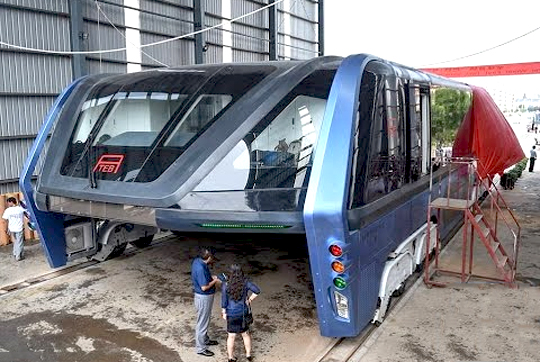
straddlingbus1

The Transit Elevated Bus (TEB), grabbed worldwide attention last week after China's official published pictures of the vehicle during a test run on a 300-metre track in Qinhuangdao city in Hebei province.

The bus is designed to run on rails and rises two metres above the road, allowing cars to pass underneath to ease congestion.

While the state-run Xinhua suggested last week the project was an excuse to raise funds rather than create an innovative solution to traffic problem, the experts have also questioned the safety and practicality of the technology, Hong-Kong based South China Morning Post reported.

It would be difficult for the bus to negotiate turns and motorists driving under it would have their line of sight severely limited, increasing the chance of accidents on the road, said Sun Zhang, a transportation professor at Tongji University in Shanghai and an expert in urban track transport systems.

"It can only run on wide and straight roads. In big cities where roads are winding and jammed [with traffic], such roads are in shortly supply. The biggest advantage of this project is that its designers have rich imaginations," he said.
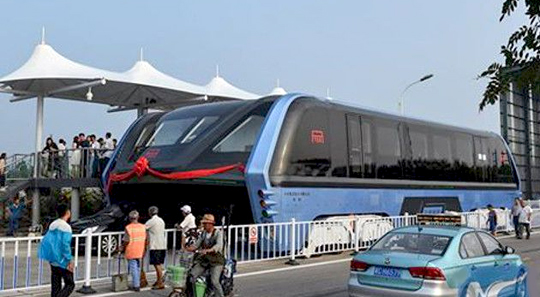
straddlingbus2

Several employees of the TEB at Qinhuangdao city draped the bus with black curtains to prevent bystanders looking at the vehicle as the project has kindled the interest of curious local residents, the report said.

Also the idea of a bus to ease road congestion is attractive in China where car ownership is rapidly increasing, along with the number of traffic jams.

China had 172 million cars on the road at the end of last year, with 280 million licensed drivers. Research by the car-hailing service Didi Chuxing, based on data gathered in 400 Chinese cities, said the average car speed was less than 25 kmph in the first half of this year, the report said.

The publicity has created a wave of interests specially among the investors. After a series of media reports in China have questioned the technological viability and the feasibility of the project, some investors worried about the scheme to come down to check out the site.

"The company and the project are beset by so many questions. We are all worried," Zhang Ying, an investor, said

He has invested about 500,000 yuan (USD 75085) into Huaying after its sales staff told him annual returns could be as high as 14 per cent, the report said.

Yao Xu, an official in charge of press inquiries at TEB Technology told 'Morning Post' that an "official test run" would be arranged in the coming weeks.

Comments

Add new comment

  • Coastaldigest.com reserves the right to delete or block any comments.
  • Coastaldigset.com is not responsible for its readers’ comments.
  • Comments that are abusive, incendiary or irrelevant are strictly prohibited.
  • Please use a genuine email ID and provide your name to avoid reject.
Agencies
February 17,2020

Google on Monday announced it is gradually winding down its free public Wi-Fi Station programme currently available at over 400 railway stations in India, and will work with the Indian Railways and Railtel Corporation to help them with existing sites so they can remain useful resources for people.

Google launched its Station initiative in India in 2015 to bring fast, free public Wi-Fi to over 400 of the busiest railway stations in the country by mid-2020.

"We crossed that number by June 2018 and implemented Station in thousands of other locations around the country in partnership with telecommunications companies, ISPs and local authorities," Caesar Sengupta, Vice President, Payments and Next Billion Users, Google, said in a statement.

"Over time, partners in other countries asked for Station too and we responded accordingly. We're grateful for these partnerships, especially with the Indian Railways and the Government of India, that helped us serve millions of users over the last few years," he added.

According to Google, the decision to shut Station has been taken keeping the affordable mobile data plans and mobile connectivity in mind that is improving globally including in India.

"India, specifically now has among the cheapest mobile data per GB in the world, with mobile data prices having reduced by 95 per cent in the last 5 years, as per TRAI in 2019," said Sengupta.

The Indian users consume close to 10GB of data, each month, on average, according to reports.

"Our commitment to supporting the next billion users remains stronger than ever, from continuing our efforts to make the internet work for more people and building more relevant and helpful apps and services," Sengupta noted.

Global networking giant Cisco last year teamed up with Google to roll out free, high-speed public Wi-Fi access globally, starting with India.

The first pilot under the partnership was rolled out at 35 locations in Bengaluru.

Sengupta said that in addition to the changed context, the challenge of varying technical requirements and infrastructure among our partners across countries has also made it difficult for Station to scale and be sustainable, especially for our partners.

"And when we evaluate where we can truly make an impact in the future, we see greater need and bigger opportunities in building products and features tailored to work better for the next billion user markets," he said.

Comments

Add new comment

  • Coastaldigest.com reserves the right to delete or block any comments.
  • Coastaldigset.com is not responsible for its readers’ comments.
  • Comments that are abusive, incendiary or irrelevant are strictly prohibited.
  • Please use a genuine email ID and provide your name to avoid reject.
Agencies
June 19,2020

Denser places, assumed by many to be more conducive to the spread of the coronavirus that causes COVID-19, are not linked to higher infection rates, say researchers.

The study, led by Johns Hopkins University, published in the Journal of the American Planning Association, also found that dense areas were associated with lower COVID-19 death rates.

"These findings suggest that urban planners should continue to practice and advocate for compact places rather than sprawling ones, due to the myriad well-established benefits of the former, including health benefits," says study lead author Shima Hamidi from Johns Hopkins Bloomberg School of Public Health in the US.

For their analysis, the researchers examined SARS-CoV-2 infection rates and COVID-19 death rates in 913 metropolitan counties in the US.

When other factors such as race and education were taken into account, the authors found that county density was not significantly associated with county infection rate.

The findings also showed that denser counties, as compared to more sprawling ones, tended to have lower death rates--possibly because they enjoyed a higher level of development including better health care systems.

On the other hand, the research found that higher coronavirus infection and COVID-19 mortality rates in counties are more related to the larger context of metropolitan size in which counties are located.

Large metropolitan areas with a higher number of counties tightly linked together through economic, social, and commuting relationships are the most vulnerable to the pandemic outbreaks.

According to the researchers, recent polls suggest that many US citizens now consider an exodus from big cities likely, possibly due to the belief that more density equals more infection risk.

Some government officials have posited that urban density is linked to the transmissibility of the virus.

"The fact that density is unrelated to confirmed virus infection rates and inversely related to confirmed COVID-19 death rates is important, unexpected, and profound," said Hamidi.

"It counters a narrative that, absent data and analysis, would challenge the foundation of modern cities and could lead to a population shift from urban centres to suburban and exurban areas," Hamidi added.

The analysis found that after controlling for factors such as metropolitan size, education, race, and age, doubling the activity density was associated with an 11.3 per cent lower death rate.

The authors said that this is possibly due to faster and more widespread adoption of social distancing practices and better quality of health care in areas of denser population.

The researchers concluded that a higher county population, a higher proportion of people age 60 and up, a lower proportion of college-educated people, and a higher proportion of African Americans were all associated with a greater infection rate and mortality rate.

Comments

Add new comment

  • Coastaldigest.com reserves the right to delete or block any comments.
  • Coastaldigset.com is not responsible for its readers’ comments.
  • Comments that are abusive, incendiary or irrelevant are strictly prohibited.
  • Please use a genuine email ID and provide your name to avoid reject.
Agencies
June 22,2020

Chennai, Jun 22: Commuting the death sentence to life imprisonment for five convicts, the Madras High Court on Monday set free Chinnasamy, the main convict, who had also been sentenced to death in the Udumalpet Shankar honour killing case.

A Division Bench comprising Justice M. Sathyanarayanan and Justice M. Nirmal Kumar also dismissed the appeal by the state police against the acquittal of three persons by a lower court.

The Bench ordered the five convicts sentenced for life to undergo a jail term of not less than 25 years.

In 2016, V. Shankar, who had married C. Kausalya, was killed by a gang in Udumalpet in Tamil Nadu. The gang also injured Kausalya in the attack.

It was alleged the parents of Kausalya -- Chinnasamy, Annalakshmi -- were against the marriage.

P. Pandidurai, the uncle of Kausalya at the behest of Chinnasamy and Annalakshmi had hired a gang to kill Shankar.

The gang killed Shankar in broad daylight in a public place and Kausalya too got injured in the attack as she tried to save her husband.

The Principal District and Sessions Court in Tiruppur had convicted and sentenced to death six accused persons -- Chinnasamy, P. Jagadeesan, P. Selvakumar, M. Manikandan, M. Mathan alias Michael and P. Kalaithamilvaanan.

The court also sentenced two other accused, K. Dhanraj for life and Manikandan to a five year jail term, while acquitting Annalakshmi, Pandidurai and Prasanna.

The convicts had filed an appeal against their sentence in the Madras High Court while the police filed an appeal against the acquittal of three persons.

Comments

Add new comment

  • Coastaldigest.com reserves the right to delete or block any comments.
  • Coastaldigset.com is not responsible for its readers’ comments.
  • Comments that are abusive, incendiary or irrelevant are strictly prohibited.
  • Please use a genuine email ID and provide your name to avoid reject.