


Exposed: The Houthi charge sheet: killing civilians, recruiting child-soldiers

January 4, 2017

Cairo, Jan 4: A report alleging human rights violations in Yemen by Houthi rebels has recorded 949 cases of damaged public property and 2,673 instances of private property damage, the Saudi Embassy here reported on Tuesday.
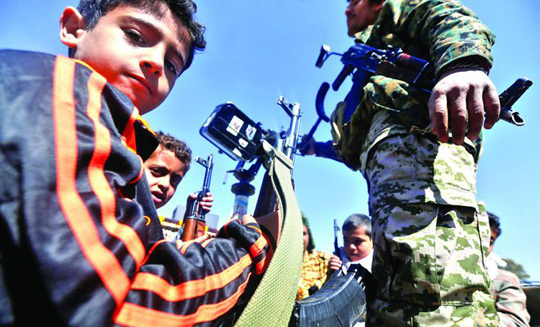
Exposed

The damage varied between complete and partial by bombardment from Houthi militants and loyalists of deposed President Abdullah Saleh against civilian homes and government and private facilities, according to a statement released on Tuesday by the embassy.

The statement also said that Houthi rebels attacked and looted facilities. They also occupied some civilian buildings to be used as military barracks.

The report recorded 3,027 cases in which Houthi militias and Saleh loyalists allegedly undermined the powers of the state — which included financial, administrative imbalances, intervention in the tasks, issuance of appointments outside the framework of law, exclusion of some civil servants from their jobs and their positions, creating private prisons and checkpoints — and other acts of looting and tampering with public money during the first half of 2016.

The statement said the Houthis and Saleh militias are using heavy weapons against populated areas. As a result, more than 1,529 people were killed, including 102 women and 221 children in the governorate of Taiz.

Saudi Arabia and coalition forces are keen to use targeted, sophisticated and high-cost smart weapons to avoid civilian loss of life.

Saudi Foreign Minister Adel Al-Jubeir said on Sept. 7 during a speech at Chatham House Institute: “There is a lot of criticism to our (military) operations in Yemen, but the matter that is not understood by many people is that we run it with the utmost care and caution.”

He pointed out: “We have a highly professional air force and high-precision weapons. We try as much as possible to avoid causing any civilian casualties, and when accidents occur or questions arise, we do the necessary investigation and then work on changing the mechanisms we follow in order to avoid repetition. But the same criticisms do not address the Houthis and Saleh rebels who recruit children aged 9, 10, 11 and 12. They indiscriminately shell towns and villages, imposing blockades on them. They are starving people and stealing the humanitarian aid to use it as a bargaining tool in order to make political progress.”

He added: “We are working under Article 51 of the Charter of the United Nations Security Council Resolution (2216), which condemned the Houthis for their role in the seizure of the government and calls on them to withdraw from the territories they occupied and requires them to hand over their weapons. But they flagrantly violated all these demands, and yes I do not see any criticism to them.”

The embassy’s statement stressed that the achievements of “Restoring Hope” and “Decisive Storm” operations could not be ignored. The coalition has succeeded in liberating more than 80 percent of the land of Yemen and handed it over to the legitimate government.

The “Decisive Storm” managed to destroy the Houthi air force and more than 95 percent of ballistic missiles captured by the militias, in addition to destroying 98 percent of tanks and armored vehicles seized by them.

The Arab coalition has also secured the international shipping lines across Bab Al-Mandab Strait, which led to the elimination of alleged Iranian influence in Yemen and the end of the threat posed by the Houthi militias against the Kingdom.

Comments

Add new comment

  • Coastaldigest.com reserves the right to delete or block any comments.
  • Coastaldigset.com is not responsible for its readers’ comments.
  • Comments that are abusive, incendiary or irrelevant are strictly prohibited.
  • Please use a genuine email ID and provide your name to avoid reject.
News Network
July 9,2020

Dubai, Jul 9: The Government of India has announced an additional 104 special repatriation flights from the UAE to India as part of the Vande Bharat Mission, Phase 4 from July 15 - 31.

According to a flight schedule listed on the Ministry of External Affairs (MEA) website, national carriers Air India and Air India Express flights have been scheduled to various cities in 10 Indian states. Each flight has a capacity of 177 passengers.

Vande Bharat Phase 4 officially began on July 3, and in an earlier press briefing Anurag Srivastava, spokesperson of India's Ministry of External Affairs had said 'Phase 4 will focus on repatriation of Gulf-based Indians.

The new additional flights have been organised to cities in Tamil Nadu, Maharashtra, Delhi, Telangana, Punjab, Haryana, Kerala, Uttar Pradesh, Karnataka, and Rajasthan, according to the MEA schedule. To the joy of expats from Maharashtra, at least seven flights have been planned to Mumbai, which has been a less serviced state since the start of the Vande Bharat Mission.

Consul Press, Information, and Culture, Consulate General of India in Dubai Neeraj Agarwal said, "Approximately 100 repatriation flights are planned for the next 23 days, including 50 from Dubai and Sharjah each. If all flights are full, we are looking to evacuate anything between 17,000 to 18,000 passengers in the coming days."

Booking for the newly announced flights will open soon, said Agarwal. "Some of them are already open, and others will be open in the next few days. However, a few flights are subject to slot approvals," he explained.

Commenting on the possibility of flights from India to the UAE, Agarwal said, "We express hope that this too will happen soon."  The flight schedule can be seen here: https://www.mea.gov.in/phase-4.htm

Comments

Hurrah, that's what I was exploring for, what a information! existing here
at this blog, thanks admin of this web site.

Add new comment

  • Coastaldigest.com reserves the right to delete or block any comments.
  • Coastaldigset.com is not responsible for its readers’ comments.
  • Comments that are abusive, incendiary or irrelevant are strictly prohibited.
  • Please use a genuine email ID and provide your name to avoid reject.
Agencies
July 31,2020

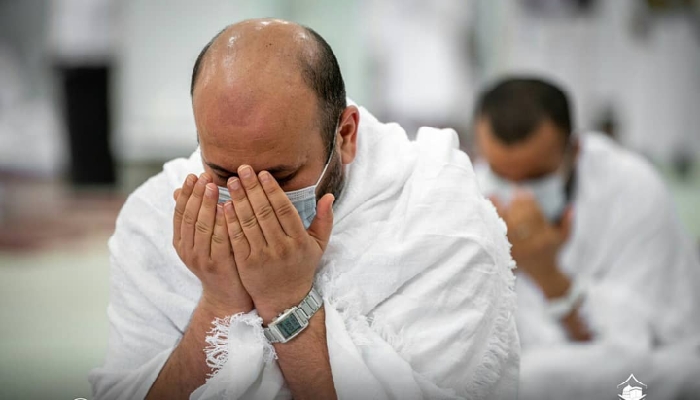
Mount Arafat, July 30: Muslim pilgrims converged Thursday on Saudi Arabia's Mount Arafat for the climax of this year's hajj, the smallest in modern times and a sharp contrast to the massive crowds of previous years.

A tight security cordon has been erected all around the foot of the rocky hill outside Mecca, also known as Jabal al-Rahma or Mount of Mercy.

Pilgrims, donning masks and observing social distancing, were brought in buses from neighbouring Mina, state television showed, as Saudi authorities impose measures to prevent a coronavirus outbreak.

They were subject to temperature checks and attended a sermon -- which state media said was translated into 10 languages -- before they set off on the climb to the summit for hours of Koran recitals and prayers to atone for their sins.

The scene was strikingly different to last year's ritual when a sea of pilgrims ascended Mount Arafat, marshalled by tens of thousands of stewards in a bid to prevent any crushes.

After sunset prayers, pilgrims will make their way down Mount Arafat to Muzdalifah, another holy site where they will sleep under the stars to prepare for the final stage of hajj, the symbolic "stoning of the devil".

It takes place on Friday and also marks the beginning of Eid al-Adha, the festival of sacrifice.

The hajj, one of the five pillars of Islam and a must for able-bodied Muslims at least once in their lifetime, is usually one of the world's largest religious gatherings.

But only up to 10,000 people already residing in the kingdom will participate in this year's ritual, compared with 2019's gathering of some 2.5 million from around the world.

"You are not our guests but those of God, the custodian of the two holy mosques (Saudi Arabia's King Salman) and the nation," Hajj Minister Mohammad Benten said in a video released by the media ministry on Wednesday.

Security cordon

A security cordon has been thrown around the holy sites to prevent any security breaches, an interior ministry spokesman said.

Riyadh faced strong criticism in 2015 when some 2,300 worshippers were killed in the deadliest stampede in the gathering's history.

But this year, those risks are greatly reduced by the much smaller crowd.

The pilgrims have all been tested for the virus, and foreign journalists were barred from this year's hajj, usually a huge global media event.

As part of the rites completed over five days in the holy city of Mecca and its surroundings, the pilgrims converged on Mount Arafat after spending the night in Mina.

A district of Mecca, Mina sits in a narrow valley surrounded by rocky mountains, and is transformed each year into a vast encampment for pilgrims.

They began the hajj on Wednesday with their first "tawaf", the circumambulation of the Kaaba, a large structure in Mecca’s Grand Mosque towards which Muslims around the world pray.

The Kaaba is draped in a black cloth embroidered in gold with Koranic verses and known as the kiswa, which is changed each year during the pilgrimage.

Pilgrims were brought inside the mosque in small batches, walking along paths marked on the floor, in sharp contrast to the normal sea of humanity that swirls around the Kaaba during hajj.

Comments

Add new comment

  • Coastaldigest.com reserves the right to delete or block any comments.
  • Coastaldigset.com is not responsible for its readers’ comments.
  • Comments that are abusive, incendiary or irrelevant are strictly prohibited.
  • Please use a genuine email ID and provide your name to avoid reject.
News Network
March 11,2020

Mar 11: Energy giant Saudi Aramco on Wednesday said it plans to raise its crude production capacity by one million barrels per day to 13 million bpd as a price war with Russia intensifies.

"Saudi Aramco announces that it received a directive from the ministry of energy to increase its maximum sustainable capacity from 12 million bpd to 13 million bpd," the company said in a statement to the Saudi Stock Exchange.

The decision comes a day after the world's top exporter, Saudi Arabia, decided to hike production by at least 2.5 million bpd to a record 12.3 million from April.

The Saudi moves come after the collapse of an oil production reduction agreement between OPEC and non-OPEC producers, including Russia.

The deal proposed by Saudi Arabia called for additional output cuts of 1.5 million bpd to cope with the severe economic impact of the coronavirus which has sharply reduced world demand for crude.

Boosting production capacity normally takes a long time and requires billions of dollars of investment.

Several years ago, the kingdom had shelved plans to boost its crude production capacity beyond 12 million bpd after demand for OPEC oil declined in the face of stiff competition from North American shale oil and other sources.

Russia on Tuesday said it was open to renewing cooperation with the OPEC cartel even as its kingpin Saudi Arabia escalated a price war with Moscow by announcing it would flood markets with new supplies.

The oil price war broke out after OPEC and a group of non-member countries dominated by Russia -- the world's second largest producer -- on Friday failed to agree on production cuts.

Saudi Arabia responded by announcing unilateral price cuts. This prompted the oil price to plummet and fuelled huge falls on stock markets around the world on Monday.

Comments

Add new comment

  • Coastaldigest.com reserves the right to delete or block any comments.
  • Coastaldigset.com is not responsible for its readers’ comments.
  • Comments that are abusive, incendiary or irrelevant are strictly prohibited.
  • Please use a genuine email ID and provide your name to avoid reject.