



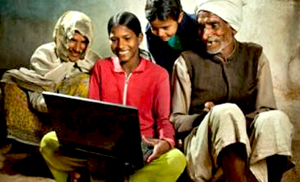
Facebook, Unilever to study Internet adoption in rural India

February 25, 2014

Internet_adoptionBarcelona, Feb 25: FMCG giant Unilever has partnered Internet.org, a Facebook-led alliance, to study how Internet adoption can be increased in rural communities in India.

As an initial step, Internet.org and Unilever will carry out a comprehensive study to examine the opportunities to increase internet adoption in rural communities.

Apart from infrastructure and cost -- which are known barriers to connectivity, the partnership will carefully evaluate other educational and cultural factors that limit Internet use.

"Lowering the barriers to Internet access requires a collaborative effort. Through this partnership, Unilever and Internet.org are pursuing the mission of bringing the benefits of internet access to the two-thirds of the world who are not yet connected," Facebook said.

Internet.org is focussed on enabling the next five billion people without access to come online and has companies like Facebook, Ericsson, MediaTek, Nokia, Opera, Qualcomm and Samsung as its founding members.

The initiative will see the partners collaborate on developing lower-cost, higher-quality smartphones and deploying Internet access in underserved communities.

Unilever and Internet.org will leverage this research to inform on the development of a series of on-the-ground projects with the aim of improving lives in rural India through better connectivity.

"Internet is the foundation of global knowledge economy and a way to deliver basic financial services, health and educational tools. In partnership with Unilever, we hope to break down the barriers to access and, in turn, provide millions of people with the information that can help them, and their communities, thrive," Facebook Director Global Connectivity Chris Weasler said.

Unilever already has extensive experience developing and deploying programmes for rural consumers.

For example, Lifebuoy, a leading health soap, has been promoting hand washing awareness in rural India for several years and has successfully enabled women in remote communities to enhance their incomes through the Shakti ( 526KB ) project.

"Access to the internet is improving in countries like India but there is still a very high proportion of people that would love the opportunity to connect and engage but who cannot enjoy what many of us take for granted."

"Having no Internet access naturally removes all associated opportunities that it brings which, in turn, can be a barrier to learning and ultimately hinder economic development," Unilever Chief Marketing and Communications Officer Keith Weed said.

Comments

Add new comment

  • Coastaldigest.com reserves the right to delete or block any comments.
  • Coastaldigset.com is not responsible for its readers’ comments.
  • Comments that are abusive, incendiary or irrelevant are strictly prohibited.
  • Please use a genuine email ID and provide your name to avoid reject.
Agencies
March 25,2020

In an unprecedented crisis despite Prime Minister Narendra Modi assuring the continuation of essential services like food and groceries, online marketplaces like Flipkart and Amazon along with delivery platforms like Bigbasket, Grofers and FreshToHomes hit a major blockade on Wednesday as local authorities shut warehouses and sent delivery boys back, even harassed them.

Millions of people across cities were left helpless at homes as essential items like fruits and vegetables, dairy and milk, meat and fish etc did not reach their doors despite placing orders well in advance. Later, the orders went dry.

While Grofers' warehouse in Faridabad was closed by the local law enforcement agencies, Bigbasket complained that the police stopped its delivery partners and "some of them were even beaten up by for no fault of theirs".

"We are not operational due to restrictions imposed by local authorities on movement of goods in spite of clear guidelines provided by central authorities to enable essential services. We are working with the authorities to be back soon,' Bigbasket tweeted.

In a statement to IANS, Bigbasket said that it will help to have better coordination between the Centre and state, and between the state and local police to "ensure that our delivery vans and bikes don't get stopped by the police. Bigbasket and bb daily are not taking new orders".

Furious people stormed the social media platforms, writing their plight to NITI Aayog CEO Amitabh Kant on Twitter.

"Sir, all e-commerce are down. Believe me I tried everything (Grofers, Bigbasket, Flipkart, Amazon, Big Bazaar), no delivery till 31st March or Server Down or No Service. Need to think how we can enable them through digital India," tweeted one user.

Kant tweeted back to Bigbasket: "They should give me specifics - State & location. I will act on it by getting in touch with concerned authorities & sorting it out. Govt guidelines exempt them. We will ensure that citizens are not impacted".

Kant also responded to Grofers: "Cold storages & Warehouses as well as delivery of all essentials goods including food, pharma thru E-Commerce are exempted under MHA order. I have spoken to CS & DGP, Haryana . They have taken immediate action to ensure that supply chains efficiently function for the citizens".

The subscription-based hyperlocal delivery startup FreshToHome sent messages to its customers, saying that despite the government declaring food delivery as essential, "we are facing hardships in continuing our operations".

"Please bear with us as we are working hard to unblock local authority hurdles," said the FreshToHome team.

Reports later surfaced that the Department for Promotion of Industry and Internal Trade (DPIIT) has initiated talks with the state Chief Secretaries asking them not to restrict movement of people engaged in home delivery of essential items, mentioned in the list of exempted items circulated by the Home Ministry.

Meanwhile, Flipkart said it has temporarily suspended its operations and services - including grocery items. The marketplace has decided to halt all orders from March 25 for all three supply chains -- groceries, non-large goods and large items.

"Flipkart has temporarily suspended orders as we assess the possibilities of operating in the lockdown. We are prioritising the safety of our delivery executives and seeking the support of the local governments and police authorities to meet the needs of our customers as they stay home during this lockdown," Rajneesh Kumar, Chief Corporate Affairs Officer, Flipkart, said in a statement.

E-commerce giant Amazon said the company has to "temporarily stop taking orders and disable shipments for lower-priority products.

"For all pending customer orders on lower-priority products, we are reaching out to customers and giving them a choice to cancel their orders, and receive a refund for prepaid items," said the company.

Witnessing a surge in demand, supermarket chain Biz Bazaar entered the fray, with launching doorstep delivery services in major cities like Delhi, Mumbai, Bengaluru and Gurugram.

However, within no time, Big Bazaar was flooded with calls, forcing the company to issue a statement, saying that "In light of the recent announcement, we are receiving an unprecedented number of requests for doorstep delivery. There could be a delay due to the restrictions on movements".

Already battling massive surge in demand, the online delivery platforms faced other issues too, including zero access to several high-rises across the country which have gone under complete lockdown with all entry and exit gates locked.

Comments

Add new comment

  • Coastaldigest.com reserves the right to delete or block any comments.
  • Coastaldigset.com is not responsible for its readers’ comments.
  • Comments that are abusive, incendiary or irrelevant are strictly prohibited.
  • Please use a genuine email ID and provide your name to avoid reject.
Agencies
July 25,2020

In a study conducted in 117 countries, researchers have found that the world is experiencing the most dramatic reduction in the seismic noise (the hum of vibrations in the planet's crust) in recorded history due to global COVID-19 lockdowns.

Measured by instruments called seismometers, seismic noise is caused by vibrations within the Earth, which travel like waves and the waves can be triggered by earthquakes, volcanoes, and bombs - but also by daily human activity like travel and industry.

This quiet period was likely caused by the total global effect of social distancing measures, closure of services and industry, and drops in tourism and travel, the study published in the journal Science, reported.

The new research, led by the Royal Observatory of Belgium and five other institutions around the world including Imperial College London (ICL), showed that the dampening of 'seismic noise' caused by humans was more pronounced in more densely populated areas.

"Our study uniquely highlights just how much human activities impact the solid Earth, and could let us see more clearly than ever what differentiates human and natural noise," said study co-author Stephen Hicks from ICL in the UK.

For the findings, the research team looked at seismic data from a global network of 268 seismic stations in 117 countries and found significant noise reductions compared to before any lockdown at 185 of those stations.

Researchers tracked the 'wave' of quietening between March and May as worldwide lockdown measures took hold.

The largest drops in vibrations were seen in the most densely populated areas, like Singapore and New York City, but drops were also seen in remote areas like Germany's the Black Forest and Rundu in Namibia.

Citizen-owned seismometers, which tend to measure more localised noise, noted large drops around universities and schools around Cornwall, UK and Boston, US - a drop in noise 20 per cent larger than seen during school holidays.

The findings showed that countries like Barbados, where lockdown coincided with the tourist season, saw a 50 per cent decrease in noise.

"The changes have also given us the opportunity to listen in to the Earth's natural vibrations without the distortions of human input," the study authors wrote.

Earlier in April, a study published in the journal Nature, reported at least a 30 per cent reduction in that amount of ambient human noise since lockdown began in Belgium.

Comments

Add new comment

  • Coastaldigest.com reserves the right to delete or block any comments.
  • Coastaldigset.com is not responsible for its readers’ comments.
  • Comments that are abusive, incendiary or irrelevant are strictly prohibited.
  • Please use a genuine email ID and provide your name to avoid reject.
Agencies
June 24,2020

New Delhi, Jun 24: The Centre has made it mandatory for sellers to enter the 'Country of Origin' while registering all new products on government e-marketplace (GeM).

The e-marketplace is a special purpose vehicle (SPV) under the Ministry of Commerce and Industry which facilitates the entry of small local sellers in public procurement, while implementing 'Make in India' and MSE Purchase Preference Policies of the Centre.

Accordingly, the ministry said the move has been made to promote 'Make in India' and 'Atma Nirbhar Bharat'.

The provision has been enabled via the introduction of new features on GeM.

Besides the registration process, the new feature also reminds sellers who have already uploaded their products, to disclose their products' 'Country of Origin' details.

The ministry further said that failing to disclose the detail will lead to removal of the products from the e-marketplace.

"GeM has taken this significant step to promote 'Make in India' and 'Aatmanirbhar Bharat'," the ministry said in a statement.

"GeM has also enabled a provision for indication of the percentage of local content in products. With this new feature, now, the 'Country of Origin' as well as the local content percentage are visible in the marketplace for all items. More importantly, the 'Make in India' filter has now been enabled on the portal. Buyers can choose to buy only those products that meet the minimum 50 per cent local content criteria."

In case of bids, the ministry said that buyers can now reserve any bid for a "Class I Local suppliers. For those bids below Rs 200 crore, only Class I and Class II Local Suppliers are eligible to bid, with Class I supplier getting purchase preference".

In addition to this, the Department for Promotion of Industry and Internal Trade (DPIIT) has reportedly called for a meeting with all e-commerce companies such as Amazon and Flipkart to display the country of origin on the products sold on their platform, as well as the extent of value added in India.

Comments

Add new comment

  • Coastaldigest.com reserves the right to delete or block any comments.
  • Coastaldigset.com is not responsible for its readers’ comments.
  • Comments that are abusive, incendiary or irrelevant are strictly prohibited.
  • Please use a genuine email ID and provide your name to avoid reject.