Faith defeats desert heat as Hajis flock to Hera cave

September 21, 2015

Makkah, Sep 21: Their faces bathed in sweat, cheeks stained with tears, dozens of Muslim pilgrims scale Makkah’s Jabal Al-Noor mountain, undertaking the arduous ascent to follow in the footsteps of the Prophet Muhammad (peace be upon him).

md1

It was in a cave in this rugged, rocky peak overlooking the holy city of Makkah that Muslims believe the Qur'an was first revealed to the prophet when he was 40 years old.

The annual Haj pilgrimage begins on Tuesday, and more than a million faithful have already flocked to Saudi Arabia in preparation for what will for many be the highlight of their spiritual lives.

In sneakers or slippers, and some even using walking sticks, men and women of all ages take the challenge to climb the 642-meter (2,100-foot) peak, whose name means “Mountain of Light,” despite the scorching heat.

The prophet was said to have frequently climbed the mountain to meditate well into his later years.

Prophet Muhammad “was old and he used to climb,” says Fuad Tajelddin, a Senegalese pilgrim in his fifties.

“Even his older wife Khadeeja used to climb the mountain twice every day. So for us... it’s an obligation,” said the pilgrim, wearing sweatpants, a sweat-drenched shirt and a cap as he climbed the stairs leading to the summit.

Many of the elderly climbers sit on the sides of the hill to rest and sip water before resuming their journey, which is usually done at dawn or a few hours before sunset.

Others send images of the climb on their phones while many pause every now and then for a selfie.

At the peak, pilgrims gather to enter the Hira’a cave where Muhammad is believed to have spent much of his time pondering nature and creation.

At the cave, they pray, cry, rest and seek blessings by touching and kissing its walls.

But members of Saudi Arabia’s religious police deployed in the area try to convince the faithful to refrain from such emotive behavior.

The cave visit itself is not part of the rituals of the Haj, which this year goes ahead against the backdrop of a deadly crane collapse at Makkah’s Grand Mosque, which killed more than 100 people earlier this month.

However, the sacred site “is part of our faith,” said Shawqi Haydous, a Lebanese pilgrim who was almost at the mountain summit.

Muhammad “received part of the Qur'an and revelation came to him” in the cave.

“This is the fifth time I visit the cave. I feel happy every time I come,” he told AFP. “It’s very beautiful to see where Khadeeja came to bring him food even though it’s not a must in the Haj rituals.”

The Haj will officially start next week but many have arrived earlier to perform the lesser pilgrimage, the umrah, and to visit holy sites in Makkah and Medina, where Muhammad is buried.

“I don’t encourage all people to come here because it’s risky,” said Haydous, stopping to wipe his brow. “But I think all who are able to come here must do it.”

Almost an hour later, the call to prayer echoes through the city which begins to light up from below, drawing the pilgrims back down the slippery stone steps before darkness and silence descend on the hill for another night.

md2

md3

Comments

Add new comment

  • Coastaldigest.com reserves the right to delete or block any comments.
  • Coastaldigset.com is not responsible for its readers’ comments.
  • Comments that are abusive, incendiary or irrelevant are strictly prohibited.
  • Please use a genuine email ID and provide your name to avoid reject.
Agencies
July 31,2020

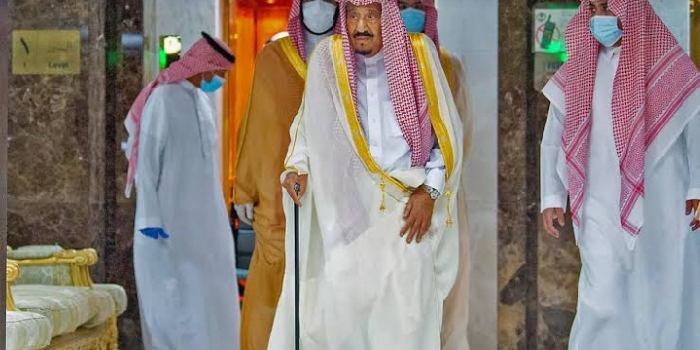
Makkah, Jul 31: Organising this year's scaled-down hajj required "double efforts" by Saudi authorities amid the coronavirus pandemic, King Salman said Friday after being discharged from hospital following gall bladder surgery.

Only up to 10,000 people already residing in the kingdom are participating in this year's pilgrimage, compared with 2019's gathering of some 2.5 million from around the world.

"Holding the ritual in the shadow of this pandemic... required reducing the numbers of pilgrims, but it obliged various official agencies to put in double efforts," 84-year-old King Salman said in a speech read out on state television by acting media minister Majid Al-Qasabi.

"The hajj this year was restricted to a very limited number of people from multiple nationalities, ensuring the ritual was completed despite the difficult circumstances," he said.

The speech came on the occasion of Eid al-Adha, the Muslim festival of sacrifice, a day after the king left hospital following a 10-day stay for surgery to remove his gall bladder.

The hajj, which began on Wednesday, is one of the five pillars of Islam and a must for able-bodied Muslims at least once in their lifetime.

Authorities implemented the "highest health precautions" during the rituals, the king said.

Pilgrims, who were all tested for the virus, are required to wear masks and observe social distancing.

For Friday's "stoning of the devil", the last major ritual of the hajj, Saudi authorities offered the pilgrims pebbles that were sanitised to protect against the pandemic.

In a sign that its strict measures were working, the health ministry reported no coronavirus cases in the holy sites on Wednesday or Thursday.

Comments

Add new comment

  • Coastaldigest.com reserves the right to delete or block any comments.
  • Coastaldigset.com is not responsible for its readers’ comments.
  • Comments that are abusive, incendiary or irrelevant are strictly prohibited.
  • Please use a genuine email ID and provide your name to avoid reject.
Agencies
March 15,2020

Riyadh, Mar 15: Saudi Aramco on Sunday reported a 20.6 percent drop in its net profit for 2019 due to low oil prices and production levels, the company said in a statement.

These are the first annual results to be announced by the energy giant after its historical $29.4 billion initial public offering and listing on the Saudi Tadawul market last December.

Aramco posted net profits of $88.2 billion last year compared to $111.1 billion in 2018, Monday's statement said.

"The decrease was primarily due to lower crude oil prices and production volumes, coupled with declining refining and chemical margins," it said.

The company also made $1.6 billion of impairment provisions for losses associated with Sadara Chemical Company, an Aramco subsidiary.

"2019 was an exceptional year for Saudi Aramco. Through a variety of circumstances -- some planned and some not -- the world was offered unprecedented insight into Saudi Aramco's agility and resilience," CEO Amin Nasser said.

"Our unique scale, low costs, and resilience came together to deliver both growth and world-leading returns, while also maintaining our position as one of the world's most reliable energy companies," Nasser said.

The earnings for last year are not affected by the coronavirus outbreak or the ongoing price war between Saudi Arabia and Russia that has sent oil prices crashing.

Aramco said it will distribute dividends worth $73.2 billion for 2019 but based on its commitments under the IPO, its dividends for the next five years starting this year will be at least $75 billion.

It said its capital spending last year dropped to $32.8 billion from $35.1 billion in 2018.

The company expects capital spending, which is expenditure on projects, to be between $25 billion and $30 billion this year "in light of current market conditions and recent commodity price volatility."

But it said that capital expenditure for 2021 and beyond is currently under review.

The results were announced amid a price war between Saudi Arabia and Russia after they failed to agree on additional output cuts to support prices dented by the outbreak of the coronavirus pandemic.

"The recent COVID-19 outbreak and its rapid spread illustrate the importance of agility and adaptability in an ever-changing global landscape," Nasser said.

The kingdom said last week Aramco will pump 12.3 million barrels of oil per day, boosting output by at least 2.5 million bpd.

It also announced plans to raise production capacity from 12 million bpd to 13 million bpd.

Forecasts for future crude prices and demand are also bleak.

In its latest monthly report, the Organization of Petroleum Exporting Countries lowered its forecast for global average daily demand by 0.92 million barrels to 99.73 million barrels.

Saudi Arabia is also in the midst of a royal purge that saw King Salman's brother and nephew detained after sources said they were accused of plotting a palace coup to unseat the crown prince, heir to the Saudi throne.

Aramco shares rallied immediately after the listing on December 11, rising by 19 percent to 38 riyals ($10.1) and temporarily lifting the company's valuation above the $2 trillion mark, which was sought by Crown Prince Mohammed bin Salman, Saudi Arabia's de facto ruler.

But as oil prices tumble, Aramco shares have lost 29 percent from its highest point, slipping below the listing price.

On Thursday, Aramco's market value dropped to around $1.55 trillion, but it still remains the world's largest publicly listed company.

Comments

Add new comment

  • Coastaldigest.com reserves the right to delete or block any comments.
  • Coastaldigset.com is not responsible for its readers’ comments.
  • Comments that are abusive, incendiary or irrelevant are strictly prohibited.
  • Please use a genuine email ID and provide your name to avoid reject.
Agencies
July 16,2020

Riyadh, Jul 16: Prince Abdul Aziz bin Saud bin Naif, minister of interior and chairman of the Hajj Supreme Committee, chaired a virtual meeting on Wednesday with the heads of  security agencies and officials in charge of this year’s Hajj season.

During the meeting, the minister and security officials discussed organizational issues related to Hajj, including preventive and precautionary steps related to fighting the coronavirus disease, procedures related to pilgrims commuting to the holy sites, and mechanisms to facilitate performing the Hajj rituals.

Prince Abdul Aziz confirmed abiding by the directives of King Salman and Crown Prince Mohammed bin Salman to take all precautions to preserve the safety of the pilgrims, and facilitate their performance of their Hajj rituals, according to the highest health standards to contain the new coronavirus pandemic.

Saudi Arabia has decided to allow only a limited number of domestic pilgrims to perform Hajj this year in the wake of the COVID-19 outbreak.

Only those expatriates between the ages of 20 and 50 who are not suffering from any chronic diseases can apply for the pilgrimage.

Earlier, the Ministry of Hajj and Umrah said that requests from people of 160 nationalities in the Kingdom have been screened electronically to select who will perform Hajj this year.

Of the pilgrims who will receive approval, 70 percent will be non-Saudis residing in the Kingdom and the remaining 30 percent will be Saudi citizens.

Meanwhile, the Ministry of Interior said that anyone found entering the sites of Hajj (Mina, Muzdalifah and Arafat) without a permit from July 18 till the end of Dhu Al-Hijjah 12 will be issued with a fine of SR10,000 ($2,600).

The fine will be doubled if the offence is repeated. Security personnel will be posted on roads leading to the holy sites to ensure that anyone who breaks the law will be stopped and fined.

Around 2.5 million foreign and domestic pilgrims performed Hajj last year.

Comments

Add new comment

  • Coastaldigest.com reserves the right to delete or block any comments.
  • Coastaldigset.com is not responsible for its readers’ comments.
  • Comments that are abusive, incendiary or irrelevant are strictly prohibited.
  • Please use a genuine email ID and provide your name to avoid reject.