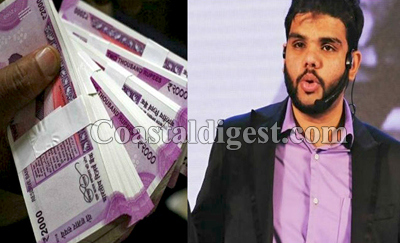
Fake In India': Techie praised by Modi arrested for printing fake Rs 2K notes

[email protected] (CD Network)
December 3, 2016

New Delhi, Dec 3: A budding engineer, whose “innovation” was appreciated by the Prime Minister Narendra Modi at aMake In India' event last year, has now been arrested for printing fake notes of newly introduced currency of Rs 2,000.

abhinavThe 21-year-old B.Tech graduate Abhinav Verma, who also belongs to an Indian Army family, was arrested by Punjab police wit Rs 42 lakh fake currency in the denomination of Rs 2,000 notes in Mohali, Punjab on Thursday.

He was arrested over a tip-off provided to Punjab police, along with two of his accomplices – his cousin Vishakha Verma and Ludhiana-based property dealer Suman Nagpal. According to sources, the trio were duping people by exchanging fake currency (of Rs 2,000) with old Rs 500 and Rs 1,000 notes on a 30 per cent commission.

Parminder Singh, SP Mohali said that the fake currency was recovered on Wednesday from a brand new luxury Audi SUV which was used by Abhinav. The vehicle also had a red beacon, which is allowed only for VVIPs only.

In last few days Punjab police officials across India have been conducting raids to arrest two members of the gang who slipped away. The cops said that the currency given by the gang to their customers even after charging customers was fake.

The cops were stunned when they found that Abhinav Verma is the same person whose work was appreciated by Narendra Modi at Make India event last year.

According to reports, Abhinav is an engineering graduate who is into manufacturing sensors which are supposed to be installed in the sticks for visually handicapped. Abhinav's office is in Chandigarh and it was also used to print fake currency of Rs 2,000 denomination at his office only.

While Abhinav and his cousin Vishakha Verma, an MBA student printed the fake currency, the property dealer was responsible played the role of dispensing it to people who were looking to convert their unaccounted wealth to the new currency. The cops found notes with same serial number.

Last year, Abhinav got a mention from PM Modi in December at the Indian Science Congress in Bengaluru. At the age of 18, he created “Live Braille”, a device to help the vision-impaired to walk without a walking stick.

It gained popularity and was touted as an innovation under the “Make In India' programme. Live Braille has reportedly won awards at major engineering institutes across the country and at Illinois State University. It also won the TiEGER Award by TiE Silicon Valley USA.

Comments

A. Mangalore
 - 
Saturday, 3 Dec 2016

One of Bangladeshi terrorist has liked Zakir Naik's face book talk.
His organization is banned.
Now Modi praised Abhinav and Abhinav is inspired with Mr. Modi
Now what action you take against Modi ????
Thousand dollar question.

abdullah
 - 
Saturday, 3 Dec 2016

Now Modi should be arrested and his all outfits should be banned.
Because this youth is inspired by Modi...

Add new comment

  • Coastaldigest.com reserves the right to delete or block any comments.
  • Coastaldigset.com is not responsible for its readers’ comments.
  • Comments that are abusive, incendiary or irrelevant are strictly prohibited.
  • Please use a genuine email ID and provide your name to avoid reject.
News Network
March 21,2020

Hubbali, Mar 21: South Western Railway suspended an employee on Thursday, for allegedly hiding her son's travel history who returned from Spain. The employee's son has now been kept under isolation.

Earlier it was reported that the man had a travel history of Italy- among the worst affected countries by Coronavirus.

He was working in Germany and had taken a flight from Spain to return to India.

In an order issued by General Manager of South Western Railway, the employee was further asked to leave the headquarter without obtaining permission from the competent authority.

The suspended Railway Officer is posted in Bengaluru.
According to the official data, the total number of Covid-19 cases in India has risen to 206, according to ICMR. Timely diagnosis and isolation have been considered vital to check the spread of the deadly disease.

Comments

Add new comment

  • Coastaldigest.com reserves the right to delete or block any comments.
  • Coastaldigset.com is not responsible for its readers’ comments.
  • Comments that are abusive, incendiary or irrelevant are strictly prohibited.
  • Please use a genuine email ID and provide your name to avoid reject.
Ram Puniyani
January 14,2020

In the beginning of January 2020 two very disturbing events were reported from Pakistan. One was the attack on Nankana Sahib, the holy shrine where Sant Guru Nanak was born. While one report said that the place has been desecrated, the other stated that it was a fight between two Muslim groups. Prime Minister of Pakistan Imran Khan condemned the incident and the main accused Imran Chisti was arrested. The matter related to abduction and conversion of a Sikh girl Jagjit Kaur, daughter of Pathi (One who reads Holy Guru Granth Sahib in Gurudwara) of the Gurudwara. In another incident one Sikh youth Ravinder Singh, who was out on shopping for his marriage, was shot dead in Peshawar.

While these condemnable attacks took place on the Sikh minority in Pakistan, BJP was quick enough to jump to state that it is events like this which justify the Citizenship Amendment Act (CAA). Incidentally CAA is the Act which is discriminatory and relates to citizenship with Religion, which is not as per the norms of Indian constitution. There are constant debates and propaganda that population of Hindus has come down drastically in Pakistan and Bangla Desh. Amit Shah, the Home minister stated that in Pakistan the population of Hindus has come down from 23% at the time of partition to 3.7% at present. And in Bangla Desh it has come down from 22% to present 8%.

While not denying the fact that the religious minorities are getting a rough deal in both these countries, the figures which are presented are totally off the mark. These figures don’t take into consideration the painful migrations, which took place at the time of partition and formation of Bangla Desh later. Pakistan census figures tell a different tale. Their first census was held in 1951. As per this census the overall percentage of Non Muslim in Pakistan (East and West together) was 14.2%, of this in West Pakistan (Now Pakistan) it was 3.44 and in Eat Pakistan it was 23.2. In the census held in Pakistan 1998 it became 3.72%. As far as Bangla Desh is concerned the share of Non Muslims has gone down from 23.2 (1951) to 9.6% in 2011.

The largest minority of Pakistan is Ahmadis, (https://minorityrights.org/country/pakistan/) who are close to 4 Million and are not recognised as Muslims in Pakistan. In Bangla Desh the major migrations of Hindus from Bangla Desh took place in the backdrop of Pakistan army’s atrocities in the then East Pakistan.

As far as UN data on refugees in India it went up by 17% between 2016-2019 and largest numbers were from Tibet and Sri Lanka.  (https://www.un.org/en/development/desa/population/migration/publication…)

The state of minorities is in a way the index of strength of democracy. Most South Asian Countries have not been able to sustain democratic values properly. In Pakistan, the Republic began with Jinnah’s classic speech where secularism was to be central credo of Pakistan. This 11th August speech was in a way what the state policy should be, as per which people of all faiths are free to practice their religion. Soon enough the logic of ‘Two Nation theory” and formation of Pakistan, a separate state for Muslim took over. Army stepped in and dictatorship was to reign there intermittently. Democratic elements were suppressed and the worst came when Zia Ul Haq Islamized the state in collusion with Maulanas. The army was already a strong presence in Pakistan. The popular formulation for Pakistan was that it is ruled by three A’s, Army, America and Allah (Mullah).

Bangla Desh had a different trajectory. Its very formation was a nail in the coffin of ‘two nation theory’; that religion can be the basis of a state. Bangla Desh did begin as a secular republic but communal forces and secular forces kept struggling for their dominance and in 1988 it also became Islamic republic. At another level Myanmar, in the grip of military dictatorship, with democratic elements trying to retain their presence is also seeing a hard battle. Democracy or not, the army and Sanghas (Buddhist Sang has) are strong, in Myanmar as well. The most visible result is persecution of Rohingya Muslims.

Similar phenomenon is dominating in Sri Lanka also where Budhhist Sanghas and army have strong say in the political affairs, irrespective of which Government is ruling. Muslim and Christian minorities are a big victim there, while Tamils (Hindus, Christians etc.) suffered the biggest damage as ethnic and religious minorities. India had the best prospect of democracy, pluralism and secularism flourishing here. The secular constitution, the outcome of India’s freedom struggle, the leadership of Gandhi and Nehru did ensure the rooting of democracy and secularism in a strong way.

India so far had best democratic credentials amongst all the south Asian countries. Despite that though the population of minorities rose mainly due to poverty and illiteracy, their overall marginalisation was order of the day, it went on worsening with the rise of communal forces, with communal forces resorting to identity issues, and indulging in propaganda against minorities.

While other South Asian countries should had followed India to focus more on infrastructure and political culture of liberalism, today India is following the footsteps of Pakistan. The retrograde march of India is most visible in the issues which have dominated the political space during last few years. Issues like Ram Temple, Ghar Wapasi, Love Jihad, Beef-Cow are now finding their peak in CAA.

India’s reversal towards a polity with religion’s identity dominating the political scene was nicely presented by the late Pakistani poetess Fahmida Riaz in her poem, Tum bhi Hum Jaise Nikle (You also turned out to be like us). While trying to resist communal forces has been an arduous task, it is becoming more difficult by the day. This phenomenon has been variously called, Fundamentalism, Communalism or religious nationalism among others. Surely it has nothing to do with the religion as practiced by the great Saint and Sufi traditions of India; it resorts mainly to political mobilization by using religion as a tool.


Comments

Ashi
 - 
Tuesday, 14 Jan 2020

If Malaysia implement similar NRC/CAA, India and China are the loser.

Add new comment

  • Coastaldigest.com reserves the right to delete or block any comments.
  • Coastaldigset.com is not responsible for its readers’ comments.
  • Comments that are abusive, incendiary or irrelevant are strictly prohibited.
  • Please use a genuine email ID and provide your name to avoid reject.
News Network
February 4,2020

Bengaluru, Feb 4: The possibility of defeated MLA CP Yogeshwar being inducted into chief minister BS Yediyurappa’s cabinet is causing ripples within the ruling BJP, with many legislators, especially from Kalyana-Karnataka region, raising a banner of revolt.

Several MLAs led by Surapur legislator Narasimha Nayak, also known as Raju Gouda, held a meeting at the Legislators Home on Monday and voiced their opposition.

"When there are more than two dozen MLAs aspiring for a cabinet berth, making a former MLA a minister is beyond logic," Gouda said. "We will convey our feelings to Yediyurappa and state BJP president Nalin Kumar Kateel." Murugesh Nirani, Paranna Munavalli, Rajkumar Patil, Dattatreya Patil Revoor, Basavaraj Mattimud are among others who attended the meeting. MP Renukacharya, political secretary to the CM and Honnali MLA, was also present at the meeting. "Some more MLAs will join us when we meet again tomorrow," Gouda said.

The MLAs highlighted the issue of caste and regional imbalance in the council of ministers to further their cause. With four from Bengaluru and three from Belagavi district set to take oath on February 6, the share of MLAs from these districts in the cabinet will rise to seven and five respectively. Currently, 16 districts have no representation.

Sources say Yediyurappa and BJP’s national leadership decided to reward Yogeshwar with a cabinet berth for his "active" role in getting 17 Congress-JD(S) MLAs to resign and join the BJP, enabling the party to grab power. The party also believes he has the potential to become the Vokkaliga face of the BJP in the Old Mysuru region, where the party’s organisation is weak.

If Yogeshwar is inducted, he will be the second former MLA to make it to Yediyurappa cabinet after deputy CM Laxman Savadi, who lost the 2018 assembly polls. Several party MLAs were unhappy with Savadi’s elevation and are now upping the ante against the party leadership.

"Let Yogeshwar be made Rajya Sabha or council member. We have no problem. But making him minister is not acceptable. If they want to make defeated MLAs ministers, then why not AH Vishwanath and MTB Nagaraj, whose sacrifices brought BJP to power?" said Gouda.

Reports say Yediyurappa has promised Vishwanath and Nagaraj, the disqualified MLAs who lost the bypolls, that they would be made ministers in June. Both met Yediyurappa and secured this assurance. The two were demanding that they be inducted into the cabinet on Thursday.

Meanwhile, Vijayapura MLA Basavanagouda Patil Yatnal urged the CM to evaluate the performance of existing ministers and drop those found non-performing. "Many ministers don’t even come to the Vidhana Soudha. What is the use of having such ministers?" he asked.

Yediyurappa also continued to face pressure to induct Athani MLA Mahesh Kumatalli into the cabinet. The Jarkiholi brothers, Ramesh and Balachandra met Yediyurappa separately on Monday with a request to make Kumatalli, their confidant, a minister.

Comments

Add new comment

  • Coastaldigest.com reserves the right to delete or block any comments.
  • Coastaldigset.com is not responsible for its readers’ comments.
  • Comments that are abusive, incendiary or irrelevant are strictly prohibited.
  • Please use a genuine email ID and provide your name to avoid reject.