


Fake In India': Techie praised by Modi arrested for printing fake Rs 2K notes

[email protected] (CD Network)
December 3, 2016

New Delhi, Dec 3: A budding engineer, whose “innovation” was appreciated by the Prime Minister Narendra Modi at aMake In India' event last year, has now been arrested for printing fake notes of newly introduced currency of Rs 2,000.
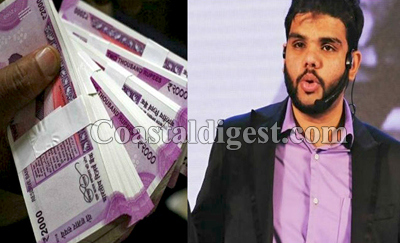
abhinavThe 21-year-old B.Tech graduate Abhinav Verma, who also belongs to an Indian Army family, was arrested by Punjab police wit Rs 42 lakh fake currency in the denomination of Rs 2,000 notes in Mohali, Punjab on Thursday.

He was arrested over a tip-off provided to Punjab police, along with two of his accomplices – his cousin Vishakha Verma and Ludhiana-based property dealer Suman Nagpal. According to sources, the trio were duping people by exchanging fake currency (of Rs 2,000) with old Rs 500 and Rs 1,000 notes on a 30 per cent commission.

Parminder Singh, SP Mohali said that the fake currency was recovered on Wednesday from a brand new luxury Audi SUV which was used by Abhinav. The vehicle also had a red beacon, which is allowed only for VVIPs only.

In last few days Punjab police officials across India have been conducting raids to arrest two members of the gang who slipped away. The cops said that the currency given by the gang to their customers even after charging customers was fake.

The cops were stunned when they found that Abhinav Verma is the same person whose work was appreciated by Narendra Modi at Make India event last year.

According to reports, Abhinav is an engineering graduate who is into manufacturing sensors which are supposed to be installed in the sticks for visually handicapped. Abhinav's office is in Chandigarh and it was also used to print fake currency of Rs 2,000 denomination at his office only.

While Abhinav and his cousin Vishakha Verma, an MBA student printed the fake currency, the property dealer was responsible played the role of dispensing it to people who were looking to convert their unaccounted wealth to the new currency. The cops found notes with same serial number.

Last year, Abhinav got a mention from PM Modi in December at the Indian Science Congress in Bengaluru. At the age of 18, he created “Live Braille”, a device to help the vision-impaired to walk without a walking stick.

It gained popularity and was touted as an innovation under the “Make In India' programme. Live Braille has reportedly won awards at major engineering institutes across the country and at Illinois State University. It also won the TiEGER Award by TiE Silicon Valley USA.

Comments

A. Mangalore
 - 
Saturday, 3 Dec 2016

One of Bangladeshi terrorist has liked Zakir Naik's face book talk.
His organization is banned.
Now Modi praised Abhinav and Abhinav is inspired with Mr. Modi
Now what action you take against Modi ????
Thousand dollar question.

abdullah
 - 
Saturday, 3 Dec 2016

Now Modi should be arrested and his all outfits should be banned.
Because this youth is inspired by Modi...

Add new comment

  • Coastaldigest.com reserves the right to delete or block any comments.
  • Coastaldigset.com is not responsible for its readers’ comments.
  • Comments that are abusive, incendiary or irrelevant are strictly prohibited.
  • Please use a genuine email ID and provide your name to avoid reject.
News Network
May 10,2020

Bengaluru, May 10: Amid the coronavirus lockdown, two police inspectors were suspended for their alleged involvement in the illegal sale of cigarettes.

"Two police inspectors suspended after an enquiry found their involvement in illegal sale of cigarettes during the lockdown in Bengaluru," informed Joint Commissioner of Police (Crime) Sandeep Patil while speaking to news agency.

More details in this regard are awaited.

Comments

Add new comment

  • Coastaldigest.com reserves the right to delete or block any comments.
  • Coastaldigset.com is not responsible for its readers’ comments.
  • Comments that are abusive, incendiary or irrelevant are strictly prohibited.
  • Please use a genuine email ID and provide your name to avoid reject.
News Network
March 28,2020

Bengaluru, Mar 28: Sun Tsu, in 'The Art of War' speaks of a skilful general who can subdue his enemy without any fighting. This constitutes the ultimate triumph which is referred to as stratagem. Today, we would need one such when we are faced with the '21-day corona challenge' for India.
Nearly four weeks back, Dr Jyothsna Rao, Dr Gururaj Rao and I sat across the OPD in the afternoon at HCG Bengaluru discussing our ongoing cancer immunology research. While on this topic, we drifted into the discussion on the coronavirus. During this engaging discussion, we wondered the similarity of the enigma between the virus and cancer. I paused to ask Dr Jyothsna and Dr Guru - how we wish we could do something against this virus.
Dr Jyothsna is a PhD from NCBS and had worked under Dr Ralph Steinman, physician and researcher from Rockefeller University, who won the Nobel Prize for his discovery of the dendritic cell and its role in adaptive immunity in 2011. Dr Gururaj is a molecular and cell biologist who did his PhD at the Chapel Hill, University of North Carolina and is the Director of iCrest.
Jyothsna while hearing our perplexing conversation on the covid intervened, "Yes, surely. I think we should take a break from cancer and focus on the innate and adaptive immunity role in COVID-19."
Thus began this sincere attempt to relook the human immune system from the eyes of the COVID-19.
We have 10 types of immune cells at the least which are widely dispersed in millions across the body. When our body is invaded by a foreign organism (bacteria, fungi or virus), these cells work with each other to destroy the invader.
Now, the question is - how do the immune cells talk to each other? They use small-molecule substances called cytokines (cyto means cells; kine means movement). There are many cytokines that are involved in work on the immune system. The most relevant for viruses are interferons.
Interferons (IFN) as the name reflects have an ability to interfere with the viral activity and stop their multiplication. These specialised signal proteins are released by our cells in response to a viral attack to forewarn other cells. They help build the antiviral proteins within the cells to kill the virus as it tries to invade the new cells.
Historically, interferons are a group of cytokines known to be potent antiviral agents against viruses and a hallmark cytokine induced by the host upon viral infections. Interferons possess unique immunoregulatory activities and are signature cytokines released by (TH1) T immune cells, which are crucial in viral infections.
As the outbreak of COVID-19 grapples us, an urgent need for finding strategies to combat the virus is growing. Coronaviruses (CoVs) are a group of RNA viruses. In patients infected with coronavirus, it was indicated that the activation of the IFN does not occur until 48 hours post-infection. Thus the delayed IFN-related antiviral response by the healthy cells leads to coronavirus evade the immune response.
Numerous studies have presented the success in defeating CoVs by the direct administration of IFNs. In a combination as a concoction, it was shown to synergistically inhibit the virus replication in vitro.
Moreover, it is understood that the earlier induction of IFNs in children although they have a less developed immune system could be the reason behind the children being least affected.
The key to success in reducing the disease fatality might be the stimulation of the immune responses to trigger IFN production at the very early stages of the disease, which might be done through the administration of IFN. Despite the evidence for the efficacy of IFNs in treating CoV-induced infections, the proper dosing and ideal timing for such interventions needs to be verified in clinical trials.
For the later stages of the diseases in advance stages where patients are on ventilator and have developed respiratory distress, we propose to utilise the mesenchymal cells derived from donor bone marrow that have been known to treat acute respiratory syndrome. Mesenchymal cells are known to possess anti-inflammatory activity and thus used often in autoimmune diseases.
With this scientific background, we have activated T cells from healthy donors, in a cGMP facility at iCrest - HCG hospital with an enriched cocktail of cytokines rich in Interferons. Injections of this cocktail we believe will result in a surge of cytokines in the body of the infected person and will boost his ability to fight the virus in the early phases. We are in the initial phases of this study and hope to be ready in the coming weeks with meaningful data on its potential utility.
Currently, it awaits government approvals (Union and state) and we have applied to central drugs authority for their initial evaluation and further directions.
As my Guru often expounded the philosophy of 'Seva' - the goal of education is knowledge, the end goal of knowledge is service. In this attempt to serve our fellow humans at this brink of unprecedented crisis, medical fraternity stands with you and promises to do our best for your safety.
We assure to exhaust every bit of our spirit in this fight against coronavirus. We have lost the sight of shores and travelled thus far, but that is the mandatory first step to cross the ocean. Are we going to succeed in this battle, is something only time will answer. 

Comments

Add new comment

  • Coastaldigest.com reserves the right to delete or block any comments.
  • Coastaldigset.com is not responsible for its readers’ comments.
  • Comments that are abusive, incendiary or irrelevant are strictly prohibited.
  • Please use a genuine email ID and provide your name to avoid reject.
News Network
May 23,2020

Bengaluru, May 23: The Karnataka government on Friday said returnees from six states with high COVID-19 cases will be kept in institutional quarantine for seven days.

The states are - Maharashtra, Gujarat, Delhi, Tamil Nadu, Rajasthan and Madhya Pradesh.

As per the standard operating procedure released by the government, all people to arrive via rain, air road are expected to quarantine.

After they test negative for the disease in pool testing, they will be sent for home quarantine for another seven days, the government said.

Returnees from other low prevalence states will be asked to follow 14 days of home quarantine, according to the standard operating procedure (SOP) for entry of persons from other states to Karnataka issued by the state health department late on Friday night.

However home quarantine is allowed for pregnant ladies, people above 80 years, patients with comorbidities and children below 10 years of age, along with one attendant after they test negative.

In special cases like businessmen coming for urgent work, the quarantine period will be waived if they furnish a report from an ICMR-approved laboratory showing they tested negative for COVID-19, it said.

However, if they don't have reports, they will have to stay in institutional quarantine and can leave once their results test negative.

In case their stay exceeds 5 days, they will be sent to the fever clinic and get a five-day extension if found asymptomatic.

The report should not be more than two days old from the date of travel.

All Karnataka returnees who entered from 4 May will be tested from 5-7 days from the time of their arrival.

If found COVID-19 negative, they will be sent to home quarantine and will have to follow due precautions, the SOP stated.

Comments

Add new comment

  • Coastaldigest.com reserves the right to delete or block any comments.
  • Coastaldigset.com is not responsible for its readers’ comments.
  • Comments that are abusive, incendiary or irrelevant are strictly prohibited.
  • Please use a genuine email ID and provide your name to avoid reject.