


Fake In India': Techie praised by Modi arrested for printing fake Rs 2K notes

[email protected] (CD Network)
December 3, 2016

New Delhi, Dec 3: A budding engineer, whose “innovation” was appreciated by the Prime Minister Narendra Modi at aMake In India' event last year, has now been arrested for printing fake notes of newly introduced currency of Rs 2,000.
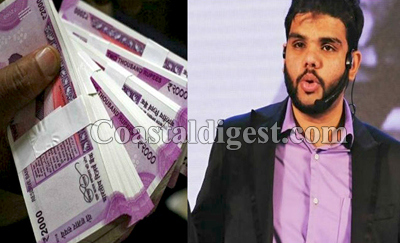
abhinavThe 21-year-old B.Tech graduate Abhinav Verma, who also belongs to an Indian Army family, was arrested by Punjab police wit Rs 42 lakh fake currency in the denomination of Rs 2,000 notes in Mohali, Punjab on Thursday.

He was arrested over a tip-off provided to Punjab police, along with two of his accomplices – his cousin Vishakha Verma and Ludhiana-based property dealer Suman Nagpal. According to sources, the trio were duping people by exchanging fake currency (of Rs 2,000) with old Rs 500 and Rs 1,000 notes on a 30 per cent commission.

Parminder Singh, SP Mohali said that the fake currency was recovered on Wednesday from a brand new luxury Audi SUV which was used by Abhinav. The vehicle also had a red beacon, which is allowed only for VVIPs only.

In last few days Punjab police officials across India have been conducting raids to arrest two members of the gang who slipped away. The cops said that the currency given by the gang to their customers even after charging customers was fake.

The cops were stunned when they found that Abhinav Verma is the same person whose work was appreciated by Narendra Modi at Make India event last year.

According to reports, Abhinav is an engineering graduate who is into manufacturing sensors which are supposed to be installed in the sticks for visually handicapped. Abhinav's office is in Chandigarh and it was also used to print fake currency of Rs 2,000 denomination at his office only.

While Abhinav and his cousin Vishakha Verma, an MBA student printed the fake currency, the property dealer was responsible played the role of dispensing it to people who were looking to convert their unaccounted wealth to the new currency. The cops found notes with same serial number.

Last year, Abhinav got a mention from PM Modi in December at the Indian Science Congress in Bengaluru. At the age of 18, he created “Live Braille”, a device to help the vision-impaired to walk without a walking stick.

It gained popularity and was touted as an innovation under the “Make In India' programme. Live Braille has reportedly won awards at major engineering institutes across the country and at Illinois State University. It also won the TiEGER Award by TiE Silicon Valley USA.

Comments

A. Mangalore
 - 
Saturday, 3 Dec 2016

One of Bangladeshi terrorist has liked Zakir Naik's face book talk.
His organization is banned.
Now Modi praised Abhinav and Abhinav is inspired with Mr. Modi
Now what action you take against Modi ????
Thousand dollar question.

abdullah
 - 
Saturday, 3 Dec 2016

Now Modi should be arrested and his all outfits should be banned.
Because this youth is inspired by Modi...

Add new comment

  • Coastaldigest.com reserves the right to delete or block any comments.
  • Coastaldigset.com is not responsible for its readers’ comments.
  • Comments that are abusive, incendiary or irrelevant are strictly prohibited.
  • Please use a genuine email ID and provide your name to avoid reject.
News Network
March 9,2020

Mangaluru, Mar 9: Deputy Commissioner Dakshina Kannada, Sindhu B Rupesh on Monday refuted reports that a passenger who arrived in Mangaluru from Dubai showed coronavirus symptoms had skipped a hospital visit.

While replying to reporters on the issue, Rupesh said: "Passenger who arrived from Dubai has not shown any coronavirus related symptoms. He just had a fever. He was shifted to district hospital last night, but he is not cooperating with us. He is not ready to stay in a hospital. We are convincing him".

"Till now, no positive case of coronavirus has been found in Mangaluru", she added.

Earlier, the Centre had suspended visas and e-visas granted on or before March 3 to people travelling from Italy, Iran, South Korea, and Japan, effective immediately, after a surge in cases of COVID-19 in these countries.

The coronavirus has affected 43 people in India so far and caused the deaths of over 3,800 people globally.

Comments

Add new comment

  • Coastaldigest.com reserves the right to delete or block any comments.
  • Coastaldigset.com is not responsible for its readers’ comments.
  • Comments that are abusive, incendiary or irrelevant are strictly prohibited.
  • Please use a genuine email ID and provide your name to avoid reject.
News Network
June 11,2020

Bengaluru, Jun 11: Chief Minister BS Yediyurappa on Thursday allowed the Opposition Congress party's newly elected state president DK Shivakumar to have a formal swearing-in function.

He told media, “I have spoken to Shivakumar and informed him to conduct the event after taking precautionary measures against the spread of the COVID-19 disease”.

The move came after the state government received flak from the main Opposition Congress leaders, for refusing to permit the newly elected State Congress president to have a formal swearing-in function take reigns from his predecessor Dinesh Gundu Rao.

Comments

Add new comment

  • Coastaldigest.com reserves the right to delete or block any comments.
  • Coastaldigset.com is not responsible for its readers’ comments.
  • Comments that are abusive, incendiary or irrelevant are strictly prohibited.
  • Please use a genuine email ID and provide your name to avoid reject.
Agencies
May 8,2020

Washington D.C., May 8: The prime time for brain development in a child's life is the first year, where the infant spends most of the time asleep. It is the time when neural connections form and sensory memories are encoded.

However, when sleep is disrupted, as occurs more often among children with autism, brain development may be affected, too.

New research led by the University of Washington finds that sleep problems in a baby's first 12 months may not only precede an autism diagnosis but also may be associated with altered growth trajectory in a key part of the brain, the hippocampus.

The study, which was published in the American Journal of Psychiatry, researchers report that in a sample of more than 400 taken of 6- to 12-month-old infants, those who were later diagnosed with autism were more likely to have had difficulty falling asleep.

It also states that this sleep difficulty was associated with altered growth trajectories in the hippocampus.

"The hippocampus is critical for learning and memory, and changes in the size of the hippocampus have been associated with poor sleep in adults and older children.

As many as 80 per cent of the children with autism spectrum disorder have sleep problems," said Annette Estes, director of the UW Autism Center and senior author of the study.

"In our clinical experience, parents have a lot of concerns about their children's sleep, and in our work on early autism intervention, we observed that sleep problems were holding children and families back," added Estes, who is also a UW professor of speech and hearing sciences.

"It could be that altered sleep is part-and-parcel of autism for some children. One clue is that behavioural interventions to improve sleep don't work for all children with autism, even when their parents are doing everything just right. This suggests that there may be a biological component to sleep problems for some children with autism," said Estes.

To consider links among sleep, brain development, and autism, researchers at the IBIS Network looked at MRI scans of 432 infants, surveyed parents about sleep patterns, and measured cognitive functioning using a standardized assessment.

At the outset of the study, infants were classified according to their risk for developing autism: Those who were at higher risk of developing autism -- about two-thirds of the study sample -- had an older sibling who had already been diagnosed.

Infant siblings of children with autism have a 20 per cent chance of developing autism spectrum disorder -- a much higher risk than children in the general population.

In the current study, 127 of the 432 infants were identified as "low risk" at the time the MRI scans were taken because they had no family history of autism.

They later evaluated all the participants at 24 months of age to determine whether they had developed autism. Of the roughly 300 children originally considered "high familial risk," 71 were diagnosed with autism spectrum disorder at that age.

Problems with sleep were more common among the infants later diagnosed with an autism spectrum disorder, as were larger hippocampi. No other subcortical brain structures were affected, including the amygdala, which is responsible for certain emotions and aspects of memory, or the thalamus, a signal transmitter from the spinal cord to the cerebral cortex.

The authors note that while parents reported more sleep difficulties among infants who developed autism compared to those who did not, the differences were very subtle and only observed when looking at group averages across hundreds of infants.

Sleep patterns in the first years of life change rapidly as infants transition from sleeping around the clock to a more adult-like sleep/wake cycle. Until further research is completed, Estes said, it is not possible to interpret challenges with sleep as an early sign of increased risk for autism.

Comments

Add new comment

  • Coastaldigest.com reserves the right to delete or block any comments.
  • Coastaldigset.com is not responsible for its readers’ comments.
  • Comments that are abusive, incendiary or irrelevant are strictly prohibited.
  • Please use a genuine email ID and provide your name to avoid reject.