


Fake In India': Techie praised by Modi arrested for printing fake Rs 2K notes

[email protected] (CD Network)
December 3, 2016

New Delhi, Dec 3: A budding engineer, whose “innovation” was appreciated by the Prime Minister Narendra Modi at aMake In India' event last year, has now been arrested for printing fake notes of newly introduced currency of Rs 2,000.
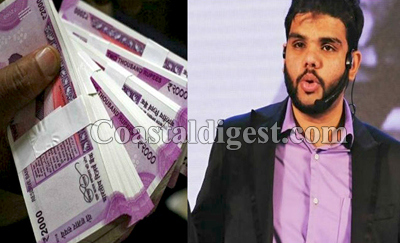
abhinavThe 21-year-old B.Tech graduate Abhinav Verma, who also belongs to an Indian Army family, was arrested by Punjab police wit Rs 42 lakh fake currency in the denomination of Rs 2,000 notes in Mohali, Punjab on Thursday.

He was arrested over a tip-off provided to Punjab police, along with two of his accomplices – his cousin Vishakha Verma and Ludhiana-based property dealer Suman Nagpal. According to sources, the trio were duping people by exchanging fake currency (of Rs 2,000) with old Rs 500 and Rs 1,000 notes on a 30 per cent commission.

Parminder Singh, SP Mohali said that the fake currency was recovered on Wednesday from a brand new luxury Audi SUV which was used by Abhinav. The vehicle also had a red beacon, which is allowed only for VVIPs only.

In last few days Punjab police officials across India have been conducting raids to arrest two members of the gang who slipped away. The cops said that the currency given by the gang to their customers even after charging customers was fake.

The cops were stunned when they found that Abhinav Verma is the same person whose work was appreciated by Narendra Modi at Make India event last year.

According to reports, Abhinav is an engineering graduate who is into manufacturing sensors which are supposed to be installed in the sticks for visually handicapped. Abhinav's office is in Chandigarh and it was also used to print fake currency of Rs 2,000 denomination at his office only.

While Abhinav and his cousin Vishakha Verma, an MBA student printed the fake currency, the property dealer was responsible played the role of dispensing it to people who were looking to convert their unaccounted wealth to the new currency. The cops found notes with same serial number.

Last year, Abhinav got a mention from PM Modi in December at the Indian Science Congress in Bengaluru. At the age of 18, he created “Live Braille”, a device to help the vision-impaired to walk without a walking stick.

It gained popularity and was touted as an innovation under the “Make In India' programme. Live Braille has reportedly won awards at major engineering institutes across the country and at Illinois State University. It also won the TiEGER Award by TiE Silicon Valley USA.

Comments

A. Mangalore
 - 
Saturday, 3 Dec 2016

One of Bangladeshi terrorist has liked Zakir Naik's face book talk.
His organization is banned.
Now Modi praised Abhinav and Abhinav is inspired with Mr. Modi
Now what action you take against Modi ????
Thousand dollar question.

abdullah
 - 
Saturday, 3 Dec 2016

Now Modi should be arrested and his all outfits should be banned.
Because this youth is inspired by Modi...

Add new comment

  • Coastaldigest.com reserves the right to delete or block any comments.
  • Coastaldigset.com is not responsible for its readers’ comments.
  • Comments that are abusive, incendiary or irrelevant are strictly prohibited.
  • Please use a genuine email ID and provide your name to avoid reject.
News Network
July 4,2020

Bengaluru, Jul 4: Amid the rising COVID-19 cases in the state, the Karnataka COVID-19 Task Force has decided to set up booth-level committees across the state including 8,800 here for effective monitoring and surveillance.

The task force also released detailed guidelines for home isolation for asymptomatic cases including 17 days ''home isolation'' for patients below 50 years of age. It also warned of legal action against those health workers for disrespect to the bodies.

Briefing reporters after the meeting on Friday, Medical Education Minister Dr K Sudhakar said the local management will be strengthened for effective monitoring and surveillance of COVID-19 cases. "There will be booth-level task force committees throughout the state right from the village to Bengaluru.

These task force committees will act at the ultra local level. The task force will act as a structural and functional unit of COVID-19 dealing with monitoring, surveillance, checking of all the ILI cases, ambulances and hospitals," he added.

He also said the committees will comprise one member each from the Health department, police department, municipalities or Panchayat, volunteers, valveman. The committee will have five to six members.

The principal secretary in the Village Development and Panchayat Raj department L K Ateeq has been appointed as the nodal officer to manage the task force in the rural areas whereas in the urban areas, the Urban Development secretary, the municipal administration directors and the municipal commissioner will form the local task force.

"In Bengaluru alone 8,800 teams will be formed, which will be coterminous with the 8,800 booths in the city. They will provide the real-time data. They will be imparted training," the minister added. Noting that there were about 8,800 electoral booths in Bengaluru city and each booth will have a task force committee, he said a nodal officer has been appointed to oversee this.

The state level task force also came out with a slew of conditions. As far as home isolation is concerned, it would apply for patients who are below 50 years and have no symptoms of any other disease, and their homes should have a toilet and have an attendant.

He also said home isolation duration has been increased from 14 to 17 days. "People should not get fever in the next three days after completing 14 days, else they will be quarantined for another seven days. If they don''t get fever then they will be freed to perform their personal activities," Sudhakar said.

Those who are above 50 years and have comorbidities, will be treated at the COVID care centres only and they will be under medical supervision and be subjected to regular tests. The state is also making arrangements for telecommunication for those who are asymptomatic but wish to speak to a doctor.

It was also decided to have at least two ambulances in each of the 198 wards of Bengaluru. The minister said the additional commissioner of police (traffic) will be the nodal officer to coordinate the movement of ambulances. The task force has also appointed a nodal officer to manage the hospitals based on the availability of beds and ventilators. The officer will provide real time information about beds.

"We want to make sure that no one has to run from one hospital to another," Sudhakar said. On the cremation of the bodies, Sudhakar said guidelines have been issued on how to handle bodies at mortuaries, taking them in the ambulances, human treatment to the deceased while performing the last rites and fumigation of the bed. "Legal action will be taken against those who treat bodies in an inhuman way," Sudhakar said.

The state-level task force has also decided to arrange for test reports within 24 hours. It has also been decided to increase the testing capacity from the existing 15,000 a day to 25,000. In view of the spurt in COVID-19 cases, the task force also recommended antigen tests in crowded areas to check whether there was community spread.

To a question on closing down the border, the minister said there is no question of lockdown. "We cannot hide from this disease. It is not a solution. We have to live with it now, yet maintain a distance from it," he added. Sudhakar, who is a doctor himself, said COVID-19 is not as deadly a virus as those he had seen in the past and asked people not to be scared of it.

Comments

Add new comment

  • Coastaldigest.com reserves the right to delete or block any comments.
  • Coastaldigset.com is not responsible for its readers’ comments.
  • Comments that are abusive, incendiary or irrelevant are strictly prohibited.
  • Please use a genuine email ID and provide your name to avoid reject.
News Network
April 16,2020

New Delhi, Apr 16: Minority Affairs Minister Mukhtar Abbas Naqvi on Thursday directed state waqf boards to ensure strict implementation of lockdown and social distancing guidelines during the holy month of Ramzan starting next week amid the coronavirus pandemic.

At a meeting via video conferencing, Naqvi asked the state waqf boards' officials to create awareness among people to offer prayers and perform other religious rituals like "iftar (breaking of fast)" during Ramzan, which begins on April 24 or 25, staying inside their homes.

More than seven lakh registered mosques, eidgahs, imambadas, dargahs and other religious and social institutions come under state waqf boards across the country. The Central Waqf Council is the regulatory body of state waqf boards in India.

"We should cooperate with health workers, security forces, administrative officers, sanitation workers. They are working for our safety and well-being even putting their own lives at risk in this coronavirus pandemic," Naqvi said.

"We should also demolish rumours and misinformation being spread about quarantine and isolation centres by creating awareness among people that such centres are only meant to protect people, their families and the society from the pandemic," the minister said.

Naqvi told all the state waqf boards and religious and social organisations that everyone should remain cautious of any type of fake news and conspiracies aimed at creating misinformation. 

"Authorities have been working for safety and well-being of all citizens of the country without any discrimination. Such type of rumours and conspiracies are a nefarious design to weaken the fight against coronavirus," he said.

"We should work united to win this fight against corona by defeating any type of rumour, misinformation and conspiracy," the minister said.

Naqvi asked officials of all the state waqf boards to play an active and effective role in ensuring that people follow the guidelines of the Union Home Ministry, state governments and the Central Waqf Council while fulfilling religious responsibilities during Ramzan.

In view of the challenges of the COVID-19 pandemic, all religious and social activities and mass gatherings in all the temples, gurdwaras, churches and other religious and social places of the country have been stopped, he said. 

Similarly, any mass gatherings in mosques and other Muslim religious places of the country has also been stopped, Naqvi said.

He said that due to the COVID-19 threat, religious leaders as well as religious and social organisations from all regions of the country, have appealed to people to offer prayers and perform all other religious rituals staying inside their homes during Ramzan. 

Most of the Muslim nations of the world have also banned mass gatherings at mosques and other religious places during the holy month, he pointed out.

Prime Minister Narendra Modi, in cooperation with all the state governments, has been working effectively for the safety and well-being of the people, he said.

The cooperation of the people has brought great relief to India in the war against COVID-19 Naqvi said, adding that several challenges are still there before the country. 

"We can defeat these challenges of the coronavirus pandemic by following all the guidelines of the central and state governments strictly," he asserted.

Chairman and senior officials from state waqf boards such as Uttar Pradesh (Shia & Sunni), Andhra Pradesh, Bihar (Shia & Sunni), Dadra & Nagar Haveli, Haryana, Karnataka, Kerala, Madhya Pradesh, Punjab, West Bengal, Andaman & Nicobar, Assam, Manipur, among others participated in the meeting.

State waqf boards from Rajasthan, Telangana, Delhi, Chhattisgarh, Gujarat, Himachal Pradesh, Jammu and Kashmir, Jharkhand, Maharashtra, Odisha, Puducherry, Tamil Nadu, Tripura and Uttarakhand also participated.

Comments

Add new comment

  • Coastaldigest.com reserves the right to delete or block any comments.
  • Coastaldigset.com is not responsible for its readers’ comments.
  • Comments that are abusive, incendiary or irrelevant are strictly prohibited.
  • Please use a genuine email ID and provide your name to avoid reject.
News Network
February 29,2020

Kochi, Feb 29: The Kerala Non-Resident Indians' Commission on Friday passed a resolution to request the Centre and Election Commission (EC) to make appropriate amendments in the Representation of Peoples Act, 1951, to ensure voting rights to the non-resident Indians working abroad. According to People’s Representation Act, 1951, None-Resident Indians (NRIs) can vote by proxy.

The Commission is a statutory body constituted for the welfare of Non-Resident Keralites working outside India.

The Centre had introduced a bill for this purpose which was passed by the Lok Sabha in 2018, but the same has since lapsed.

Therefore, the Kerala NRI Commission decided to request the Centre to consider introducing the bill in the next session of Parliament considering the interest of the NRI community at large.

The resolution was moved by commission member and NRI entrepreneur Shamsheer Vayalil, who is also a petitioner in the writ petition, filed regarding this in the Supreme Court.

"The central government may consider introducing the bill in the next session of the Parliament session considering the interest of the NRI community at large," read the resolution which will now be sent to the Ministry of Law and the Election Commission (EC).

Commission chairman Justice PD Rajan said the right to vote for NRIs is a genuine demand.

"This is the time that we step up pressure on the agencies concerned to implement this. Voting from the workplace would be a different experience for them. It would be a decisive step," he said.

This fresh development comes at a time when a petition filed in the Supreme Court on the same topic last week came before a bench headed by Justice Deepak Gupta, which considered the case and said it will be heard in April.

"We are expecting a favourable decision from the Supreme Court. We would also approach the NRI commission in other states and request them to raise the same demand," said Vayalil.

If implemented, millions of NRIs around the world would be able to exercise their franchise in the electoral processes of the nation. According to the estimate of the Ministry of External Affairs, there are about 3.10 crore NRIs.

Comments

Add new comment

  • Coastaldigest.com reserves the right to delete or block any comments.
  • Coastaldigset.com is not responsible for its readers’ comments.
  • Comments that are abusive, incendiary or irrelevant are strictly prohibited.
  • Please use a genuine email ID and provide your name to avoid reject.