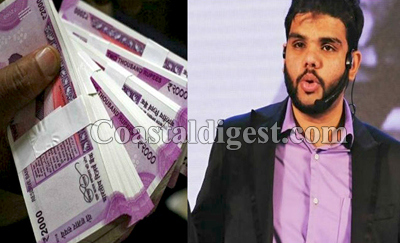
Fake In India': Techie praised by Modi arrested for printing fake Rs 2K notes

[email protected] (CD Network)
December 3, 2016

New Delhi, Dec 3: A budding engineer, whose “innovation” was appreciated by the Prime Minister Narendra Modi at aMake In India' event last year, has now been arrested for printing fake notes of newly introduced currency of Rs 2,000.

abhinavThe 21-year-old B.Tech graduate Abhinav Verma, who also belongs to an Indian Army family, was arrested by Punjab police wit Rs 42 lakh fake currency in the denomination of Rs 2,000 notes in Mohali, Punjab on Thursday.

He was arrested over a tip-off provided to Punjab police, along with two of his accomplices – his cousin Vishakha Verma and Ludhiana-based property dealer Suman Nagpal. According to sources, the trio were duping people by exchanging fake currency (of Rs 2,000) with old Rs 500 and Rs 1,000 notes on a 30 per cent commission.

Parminder Singh, SP Mohali said that the fake currency was recovered on Wednesday from a brand new luxury Audi SUV which was used by Abhinav. The vehicle also had a red beacon, which is allowed only for VVIPs only.

In last few days Punjab police officials across India have been conducting raids to arrest two members of the gang who slipped away. The cops said that the currency given by the gang to their customers even after charging customers was fake.

The cops were stunned when they found that Abhinav Verma is the same person whose work was appreciated by Narendra Modi at Make India event last year.

According to reports, Abhinav is an engineering graduate who is into manufacturing sensors which are supposed to be installed in the sticks for visually handicapped. Abhinav's office is in Chandigarh and it was also used to print fake currency of Rs 2,000 denomination at his office only.

While Abhinav and his cousin Vishakha Verma, an MBA student printed the fake currency, the property dealer was responsible played the role of dispensing it to people who were looking to convert their unaccounted wealth to the new currency. The cops found notes with same serial number.

Last year, Abhinav got a mention from PM Modi in December at the Indian Science Congress in Bengaluru. At the age of 18, he created “Live Braille”, a device to help the vision-impaired to walk without a walking stick.

It gained popularity and was touted as an innovation under the “Make In India' programme. Live Braille has reportedly won awards at major engineering institutes across the country and at Illinois State University. It also won the TiEGER Award by TiE Silicon Valley USA.

Comments

A. Mangalore
 - 
Saturday, 3 Dec 2016

One of Bangladeshi terrorist has liked Zakir Naik's face book talk.
His organization is banned.
Now Modi praised Abhinav and Abhinav is inspired with Mr. Modi
Now what action you take against Modi ????
Thousand dollar question.

abdullah
 - 
Saturday, 3 Dec 2016

Now Modi should be arrested and his all outfits should be banned.
Because this youth is inspired by Modi...

Add new comment

  • Coastaldigest.com reserves the right to delete or block any comments.
  • Coastaldigset.com is not responsible for its readers’ comments.
  • Comments that are abusive, incendiary or irrelevant are strictly prohibited.
  • Please use a genuine email ID and provide your name to avoid reject.
Agencies
February 6,2020

Even more than three years after demonetisation and all-out efforts to make most transactions through electronic, cash is still king, as it thrives in a digital India, said fintech start-up Paytm founder Vijay Sekhar Sharma.

"While cashless economy is not possible in India, less cash economy will be in the future. Less cash is the only solution, not the elimination of cash," Sharma told IANS in an interview after unveiling an all-in-one payment gateway on Tuesday.

Asserting that it would take 5-10 years for India to make the transition to digital payments from the traditional mode of cash, Sharma, 41, said the e-payment industry benefitted more from the November 8, 2016 note ban and withdrawal of old Rs 1,000 and Rs 500 denominations.

"I think it (demonetisation) helped the industry despite lack of specific help. But the world has changed since then. It is about the scale of distribution of merchants that is what is propelling digital payments," said Sharma.

Most of the cash not only came back into circulation, but also remains as the mode of payment for the majority due to its convenience for the people used to such transactions.

Expounding Paytm's zero service charge, Sharma said the strategy is sustainable as it leads to acquiring more customers and merchants, enabling newer business opportunities.

Paytm also does not levy a service charge to small merchants for its payments services, unlike organised players like Uber.

"Though there is a monetisation model, the merchants who are small shopkeepers, become our financial services customers as they open a bank account, which is profitable."

Paytm secured a Payments Bank license from the Reserve Bank of India to offer a savings bank account, Rupay debit card and money transfer services.

"We are banking on payment services acquiring customers and merchants who avail banking, lending, insurance, wealth and software services like billing software and business ledger software services eventually," Sharma noted.

The mobile first bank services include zero balance and zero digital transaction charge accounts.

"Basically, payments, cloud, commerce and financial services are a cohort we follow. So, payments is our customer as well as merchant acquisition. If it breaks even, we are happy because other line items make more money, he affirmed.

Noting that in a market like India, one cannot price services at a premium unlike in a developed country like the US, the billionaire businessman said a consumer in a developing country would not be able to afford such a hefty charge.

Forbes ranked Sharma as India's youngest billionaire in 2017, with a net worth of $2.1 billion.

While several countries operate on the model of higher service charges, Sharma said newer business models have to be discovered in India, as customer lifecycle value is accounted for more stages than in other nations.

Asked about an upscale retailer like Zara not giving a wallet payment option during its recent end of season sale in Bengaluru, Sharma said Paytm was addressing such hiccups with its all-in-one payment solutions.

"It's an opportunity, because if the retailer has our all-in-one point of sale machine, where in they enter the amount, it shows both the Quick Response code (QR) and card payment options," he observed.

Sharma compared older swiping payment machine to feature phones and modern ones to feature-rich smartphones.

"If you notice, they look like feature phones and the modern day card machine is more a smartphone like. You can add the smatphone components, which can add the features," reiterated Sharma.

Though Paytm's all-in-one QR point of sale machine integrates the billing system, its chief executive said it was not ideal to have an independent QR feature.

Paytm has 16 million strong merchant user base, which Sharma aims to raise to 26 million base in the next one year.

Sharma has launched in this tech city an all-in-one payment gateway and Paytm Business Payments solution, which enable digital payments through multiple methods for small and medium enterprises (SMEs) and an Android point of sale machine.

With the new gateway solution, collecting digital payments through multiple methods can be achieved seamlessly while Paytm Business Payments solution enables automated vendor payments, including employee salaries and customer refunds among others.

The One97 Communications-owned Paytm aims to help SMEs streamline and digitise their business activities using its new solutions, which enhance the overall efficiency of both accepting and making payments.

Paytm has a data bank of over 200 million saved cards and bank accounts, a feature which enables partner apps to shorten transaction times and propel faster conversions while using the all-in-one payment gateway.

Complementing the two solutions, Sharma also launched an all-in-one Android point of sale machine, which can accept payments through all forms such as cards, wallets, UPI apps and even cash.

The device has a QR code that supports all contact and contactless payments, coming with integrated billing software customized solutions for different sectors such as catering, ticketing, parking and others.

The handheld Android device is equipped with an in-built printer, scanner and can also generate bills.

Valued at $16 billion, Paytm is not alone in the fiercely competitive Indian fintech space where a dozen players like PhonePe, MobiKwik, Kotak 811 and deep pocketed international giants Google Pay and Amazon Pay are in the fray.


Comments

Add new comment

  • Coastaldigest.com reserves the right to delete or block any comments.
  • Coastaldigset.com is not responsible for its readers’ comments.
  • Comments that are abusive, incendiary or irrelevant are strictly prohibited.
  • Please use a genuine email ID and provide your name to avoid reject.
News Network
January 30,2020

Jan 30: One positive case of novel coronavirus has been found in Kerala. The student was studying at Wuhan University in China. The patient is stable and is being closely monitored.

This is the first case of coronavirus that has been reported in India.

Until now, there have only been many suspected cases across the country. A total of eight patients, five of them in Mumbai, are under observation in Maharashtra for suspected coronavirus infection. Six patients were already under observation and two more people, who complained of cough and mild fever, symptoms similar to the coronavirus, were put under medical watch on Tuesday evening.

One suspected case each has been reported in Rajasthan and Chandigarh.

Novel coronavirus (nCoV) is a large family of viruses that causes illnesses ranging from the common cold to acute respiratory syndromes. However, the virus that has so far killed 170 people and affected 7,000 in China is a novel strain and not seen before.

It has emerged from a seafood and animal market in Wuhan city and is suspected to have spread to as far as the United States.

According to the World Health Organisation, the common symptoms of the novel coronavirus strain include respiratory symptoms such as fever, cough, shortness of breath and breathing difficulties.

Comments

Add new comment

  • Coastaldigest.com reserves the right to delete or block any comments.
  • Coastaldigset.com is not responsible for its readers’ comments.
  • Comments that are abusive, incendiary or irrelevant are strictly prohibited.
  • Please use a genuine email ID and provide your name to avoid reject.
News Network
March 5,2020

Bengaluru, Mar 5: Karnataka is facing unprecedented economic difficulties following a Rs 8,887 crore reduction in the state's share in central taxes, cut in allocation under 15th finance commission and a Rs 3,000 crore hit in GST compensation, Chief Minister B S Yediyurappa indicated on Thursday.

Presenting the state budget for 2020-21 in the Assembly, he said Karnataka's share in central taxes has come down by Rs 8,887 crore in 2019-20 as per the revised budget estimates of the central government. Therefore the state's revenue resources have been reduced. Apart from this, Rs 3,000 crore GST compensation will also be reduced as collection from the GST compensation cess is not as expected, the Chief Minister said. "With all this it has become difficult to reach to reach the 2019-20 budget targets and to manage this situation within the bounds of the Karnataka Fiscal Responsibility Act, an inevitable situation has arisen this year to cut down the expenditure of many departments," he added.

As per the interim report submitted by the 15th finance commission, there is a reduction in the state's share of central taxes to 3.64 per cent compared to 4.71 per cent fixed by the 14th finance commission. In view of this, there will be a reduction of Rs 11,215 crore in the state's share of central taxes in 2020-21 budget, when compared to the previous one.

He, however, noted that the allocation recommendation of the 15th finance commission is limited to one year only and the complete report for the period 2021-22 to 2025-26 will be submitted in October 2020.

"Our government will soon submit a revised memorandum to the commission to set right the loss caused to the state with regard allocation for the year 2020-21 and give more allocation for the remaining period," the Chief Minister said. He also said, when compared to the previous year, there is an increase of approximately Rs 10,000 crore for 2020-21 with regards to government employees salary, pension and interest on government loans, but there is no proportionate increase in resources as compared to committed expenditure. "Due to this reduction of the state's share of central taxes as per the 15th finance commission report and other developments, serious difficulties are being faced in resource mobilisation efforts of the state," Yediyurappa said. "This magnitude of economic difficulties was never faced in the previous years by our state," he added.

However, the state's own tax revenue collection is excellent during this year, he said. As compared to the previous year, there is a growth of 14 per cent in State GST collection. "Based on this, in the new budget, efforts are being made to manage the reduction in the share of central taxes by stabilising the state's own resources more", the Chief Minister said.

Karnataka recorded a gross state domestic product growth rate of 7.8 per cent in 2018-19 and Yediyurappa said for the current financial year it is estimated to be 6.8 per cent.

Comments

Add new comment

  • Coastaldigest.com reserves the right to delete or block any comments.
  • Coastaldigset.com is not responsible for its readers’ comments.
  • Comments that are abusive, incendiary or irrelevant are strictly prohibited.
  • Please use a genuine email ID and provide your name to avoid reject.