


Fidel Castro honored by thousands in Havana; Obama absent as world leaders join in

November 30, 2016

Havana, Nov 30: Cuba's leftist allies and Washington's top diplomat in Havana joined a sprawling throng of Cubans at a rally on Tuesday to commemorate Fidel Castro, the man who built a Communist state on the doorstep of the United States. Castro died on Friday at age 90, a decade after ceding control to his younger brother Raul Castro, 85.
fidel

With Raul Castro at his side, the charismatic Fidel Castro led the bearded rebels who seized power in a 1959 revolution and ruled the island in the face of US opposition that endured until President Barack Obama reversed course in 2014 and set out to restore diplomatic relations.

For many, especially in Latin America and Africa, Castro was a symbol of resistance to imperialism, having ousted a U.S.-backed dictator, and a champion of the poor. Others, including many in the large Cuban exile community in Miami, have condemned him as a tyrant who jailed opponents and ruined the economy through socialism.

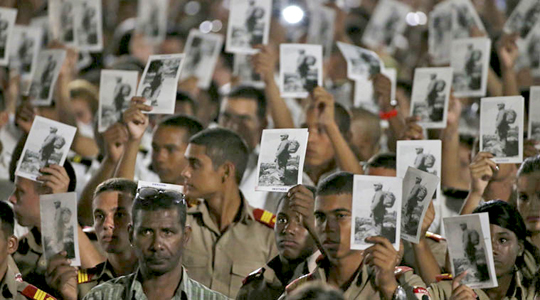
Chants of “Viva Fidel!” resounded as tens of thousands massed in Havana's Revolution Square on Tuesday evening to pay homage to Castro. “United, the people will never be defeated!” rang another.

Raul Castro embraced ideological ally, visiting Venezuelan President Nicolas Maduro, as the ceremony got underway.

“To weigh the success or failure of Cuba's economic model without factoring in the more than 50-year-long criminal (U.S.) embargo, is pure hypocrisy,” Ecuadorean President Rafael Correa said in a tribute to Fidel Castro.

The White House announced on Tuesday Obama would not send a presidential delegation. Instead, the United States will be represented by Jeffrey DeLaurentis, chief diplomat at the U.S. embassy in Havana, and Ben Rhodes, an Obama aide who represented the United States in 18 months of secret talks that led to detente.

That rapprochement is now threatened by U.S. President-elect Donald Trump, who takes office on Jan. 20 and who has spoken of resuming Washington's hard line unless the government makes political changes, the kind of pressure the Castro brothers always fiercely resisted.

DeLaurentis was head of the U.S. interests section in Havana when it was upgraded to an embassy in July 2015 and has been nominated by Obama to be named ambassador. White House spokesman Josh Earnest called Rhodes “the principal interlocutor with the Cuban government from the White House” on normalization.

Many leaders of Latin America's left, including Maduro and Bolivian President Evo Morales, flew in to attend the ceremony in the same space where Castro once delivered rousing, marathon speeches.

African leaders included Zimbabwe's Robert Mugabe and South African President Jacob Zuma, who paid Castro a tribute of his own. The late Nelson Mandelarepeatedly thanked Castro for his efforts in helping overturn apartheid in South Africa.

Mugabe, 92, himself a former Marxist guerrilla who has led Zimbabwe as prime minister or president since 1980 despite financial and health crises, praised Fidel Castro's government for having trained thousands of Zimbabwean doctors and teachers.

“Fidel was not just your leader. He was our leader and the leader of all revolutionaries. We followed him, listened to him and tried to emulate him,” Mugabe told reporters as he arrived in Havana,

“Farewell, dear brother. Farewell, revolutionary,” he said.

Few leaders from the world's major powers are heading to the Caribbean island, with many sending second-tier officials instead.

China has sent Vice President Li Yuanchao, while Chinese President Xi Jinping visited the Cuban embassy in Beijing to pay his condolences, China's foreign ministry said

Russian President Vladimir Putin has skipped the ceremony but described Castro as a “true friend of Russia.” The Kremlin said he held a different view on his legacy to that of Trump, who has called the Cuban leader “a brutal dictator.”

The Cuban government, still essentially dedicated to Fidel Castro's political vision despite some economic reforms under Raul Castro, has declared nine days of mourning. That has included a two-day commemoration in Havana, where tens of thousands of Cubans have waited in long lines to pay their respects in Revolution Square.

Some in tears or wrapped in the Cuban flag, mourners have filed past Castro's favorite portrait of himself, dressed in military fatigues and carrying a rifle. Many state employees and school children came together in groups.

A caravan carrying Castro's ashes will depart Havana on Wednesday en route to the eastern city of Santiago de Cuba, his final resting place, in a reversal of the journey he took with the rebel army that overthrew Fulgencio Batista in 1959.

Comments

Add new comment

  • Coastaldigest.com reserves the right to delete or block any comments.
  • Coastaldigset.com is not responsible for its readers’ comments.
  • Comments that are abusive, incendiary or irrelevant are strictly prohibited.
  • Please use a genuine email ID and provide your name to avoid reject.
Agencies
July 2,2020

Ramallah, Jul 2: Several world countries renew a call for Israel to halt contentious plans to annex parts of the occupied Palestinian territory after the regime delayed the implementation of the land garb bid in the face of a series of stumbling blocks, including internal rifts, global criticisms and the US’s failure to give Tel Aviv the go-ahead for the move.

Israel's ruling coalition, led by Prime Minister Benjamin Netanyahu, had announced July 1 as the date to begin moving forward with the plan to impose Tel Aviv’s “sovereignty” over about a third of the West Bank, including settlements and the fertile Jordan Valley.

Without clarifications, the regime, however, failed to launch the scheme on the set date amid widening differences between Netanyahu and his coalition partner, minister of military affairs Benny Gantz.

Meanwhile, there are signs that the administration of US President Donald Trump, a staunch Israel supporter, has cooled its backing for the Israeli move amid what is believed to be troubles at home and fears that it might hurt the president’s chances of re-election besides international pressure.

On Wednesday, Netanyahu's office said in a statement that he would continue to discuss a possible West bank annexation with the US administration.

“In the coming days there will be additional discussions,” the statement said.

Labor, Social Affairs and Social Services Minister Ofir Akunis said the Israel would annex portions of the West Bank in July but only after the US president issued a declaration on the matter.

The annexation “will only happen after a declaration by Trump,” he told Israeli Army Radio.

Trump had already given Tel Aviv the green light for the land grab in his self-proclaimed “deal of the century,” which was unveiled in January with the aim of re-drawing the Middle East map.

However, the Trump administration has so far refrained from offering official support for the annexation sought by Netanyahu and his right-wing allies.

Unlike the US, several countries, including some of Israel’s allies, have expressed their opposition to Israel’s planned push to consolidate its occupation of Palestine.

Germany passes anti-annexation resolution

On Wednesday, the German parliament approved a resolution calling on the government to dissuade Israel from annexing the West Bank.

The motion, which was brought in the German legislature by the three parties in Chancellor Angela Merkel's coalition, was approved without opposing votes. 

Berlin should use its “special relations and contacts [with Tel Aviv] to express to the Israeli government our concerns and our urgent demand to refrain from an annexation of parts of the West Bank and from the continued expansion of settlements, both of which contradict international law,” read the resolution.

Speaking at the parliamentary debate before the vote, German Foreign Minister Heiko Maas said, “We reject unilateral changes of borders, and we won’t recognize them.”

He also stressed that peace “cannot be achieved through unilateral steps but only through serious negotiations.”

France warns of consequences

Similarly, French Foreign Minister, Jean-Yves Le Drian warned that any Israeli annexation would be a violation of international law and would bring about consequences.

“Annexation of Palestinian territories, whatever the perimeters, would seriously throw into question the parameters to resolve the conflict,” he told a parliamentary hearing. 

The top diplomat added, “An annexation decision could not be left without consequences and we are examining different options at a national level and also in coordination with our main European partners.”

Australia raises concerns

Additionally, Australian Foreign Minister Marise Payne voiced worries about the Israeli scheme, saying she had directly expressed this view to Israeli Foreign Minister Gabi Ashkenazi.

“We are following with concern possible moves towards the unilateral annexation or change in status of territory on the West Bank,” she said in a statement.

“The focus needs to be on a return to direct and genuine negotiations between Israel and the Palestinians for a durable and resilient peace arrangement, as soon as possible,” Payne added.

Vatican summons US, Israeli envoys

Meanwhile, the Vatican announced on Wednesday that it had summoned the American and Israeli ambassadors to protest Israel’s annexation bid.

In separate meetings, Vatican Secretary of State Cardinal Pietro Parolin told Israeli Ambassador Oren David and US Ambassador Callista Gingrich of concerns “regarding possible unilateral actions that may further jeopardize the search for peace between Israelis and Palestinians, as well as the delicate situation in the Middle East,”

“As already declared … the Holy See reiterates that ... Israel and the State of Palestine have the right to exist and to live in peace and security, within internationally recognized borders,” the Vatican said in a statement.

“It thus appeals to the parties to do everything possible to reopen the process of direct negotiation, on the basis of the relevant Resolutions of the United Nations,” it added.

Amnesty urges firm action

Amnesty International called on the international community to take firm action against Israel’s annexation plan and its “law of the jungle” mentality.

“Members of the international community must enforce international law and restate that annexation of any part of the occupied West Bank is null and void,” said Saleh Higazi, deputy regional director for Amnesty Middle East and North Africa.

“They must also work to immediately stop the construction or expansion of illegal Israeli settlements and related infrastructure in the Occupied Palestinian Territories as a first step towards removing Israeli civilians living in such settlements,” he added.

Palestinians mark ‘Day of Rage'

Also on Wednesday, Palestinians held “Day of Rage” rallies both in the West Bank and the Gaza Strip against the Israeli expansionism.

In Gaza city, several thousand protesters gathered, some brandishing Palestinian national flags and placards condemning Trump.

Some demonstrators carried signs in English reading, “We Can’t Breathe Since 1948” and “Palestinian Lives Matter,” in reference to the American Black Lives Matter movement.

“The occupation has killed us and killed our children and deprived us of a good life. May God grant the Resistance victory,” a protester told the al-Aqsa TV.

“The resistance must be revived,” Gaza protester Rafeeq Inaiah told media persons. “Israel is afraid of force.”

Similar demonstrations also took place in the West Bank cities of Ramallah and Jericho.

Comments

Add new comment

  • Coastaldigest.com reserves the right to delete or block any comments.
  • Coastaldigset.com is not responsible for its readers’ comments.
  • Comments that are abusive, incendiary or irrelevant are strictly prohibited.
  • Please use a genuine email ID and provide your name to avoid reject.
News Network
June 9,2020

Washington, Jun 9: When epidemiologists talked about "flattening the curve," they probably didn't mean it this way: the US hit its peak coronavirus caseload in April, but since that time the graph has been on a seemingly unending plateau.

That's unlike several other hard-hit countries which have successfully pushed down their numbers of new cases, including Spain and Italy, which now have bell-shaped curves.

Experts say the prolonged nature of the US epidemic is the result of the cumulative impact of regional outbreaks, as the virus that started out primarily on the coasts and in major cities moves inward.

Layered on top of that are the effects of lifting lockdowns in parts of the country that are experiencing rising cases, as well as a lapse in compliance with social distancing guidelines because of economic hardship, and in some cases a belief that the threat is overstated.

"The US is a large country both in geography and population, and the virus is at very different stages in different parts of the country," Tom Frieden, a former director of the Centers for Disease Control and Prevention told AFP.

The US saw more than 35,000 new cases for several days in April. While that figure has declined, it has still been exceeding 20,000 regularly in recent days.

By contrast, Italy was regularly hitting more than 5,000 cases per day in March but is currently experiencing figures in the low hundreds.

"We did not act quickly and robustly enough to stop the virus spreading initially, and data indicate that it travelled from initial hotspots along major transport routes into other urban and rural areas," added Frieden, now CEO of the non-profit Resolve to Save Lives.

To wit: the East Coast states of New York, New Jersey and Massachusetts accounted for about 50 percent of all cases until about a month or so ago -- but now the geographic footprint of the US epidemic has shifted to the Midwest and southeast, including Florida.

Another key problem, said Jennifer Nuzzo, an epidemiologist at Johns Hopkins, is that the United States is still not doing enough testing, contact tracing and isolation.

After coming late to the testing party -- for reasons ranging from technical issues to regulatory hurdles -- the US has now conducted more COVID-19 tests than any other country.

It even has one of the highest per capita rates per country of 62 per 1,000 people, according to the website ourworldindata.org -- better than Germany (52 per 1,000) and South Korea (20 per 1,000).

But according to Nuzzo, these numbers are misleading, because "the amount of testing that a country should do should be scaled to the size of its epidemic.

"The United States has the largest epidemic in the world so obviously we need to do a lot more testing than any other country."

For Johns Hopkins, the more important metric is the positivity rate -- that is, out of all tests conducted, how many came back positive for COVID-19.

As of June 7, the United States had an average daily positivity rate of 14 percent, well above the World Health Organization guideline of 5 percent over two weeks before social distancing guidelines should be relaxed.

By contrast, Germany, which has tested far fewer people in relation to its population, has a positivity rate of 5 percent.

Even if testing were scaled up, carrying out tests in of itself does very little good without the next steps -- finding out who was exposed and then asking them to isolate.

Here also, too many US states are lagging woefully behind.

Texas, which is experiencing a surge in cases after relaxing its lockdown, is a case in point. The state targeted hiring a modest 4,000 tracers by June, but according to local reports is still more than a thousand shy of even that goal.

Opt-in app based efforts have also been slow to get off the ground.

Then there is the fact that some people are growing tired of lockdowns, while others don't have the economic luxury of being able to stay home for prolonged periods.

The government sent some 160 million Americans a single stimulus check of up to $1,200 back in April but it's not clear whether more will be forthcoming.

Still others, particularly in so-called red states under Republican leadership, have chafed under restrictions and mask-wearing guidelines that they see as an affront to their personal freedom.

"The US is kind of on the extreme of the individual liberty side," Sten Vermund, dean of the Yale School of Public Health, told AFP.

Part of this has to do with mixed messaging from Republican leaders, including President Donald Trump, said Nuzzo.

"We have had at the highest political level an assertion that this is a situation that's been overblown, and that maybe certain protective behaviors are not necessary," she said.

More recently, tens of thousands of people across the country have taken to the streets to protest the killing on an unarmed black man by police, risking coronavirus infection to demonstrate against the public health threat of racialized state violence.

Comments

Add new comment

  • Coastaldigest.com reserves the right to delete or block any comments.
  • Coastaldigset.com is not responsible for its readers’ comments.
  • Comments that are abusive, incendiary or irrelevant are strictly prohibited.
  • Please use a genuine email ID and provide your name to avoid reject.
News Network
May 9,2020

Beijing, May 9: Mounting a strong defence of the ruling Communist Party of China, President Xi Jinping has said the COVID-19 fight has once again shown that the CPC leadership and the country's socialist political system can overcome any challenge.

Xi's comments came as China faced global criticism for its initial inaction to act against the novel coronavirus, which according to Chinese officials emerged in the central Chinese city of Wuhan in December last year.

Pressure is also mounting on Beijing to agree for an international probe on the origins of the vicious virus, including from the Wuhan Institute of Virology (WIV), as claimed by the US leadership.

China curbed the spread of the coronavirus in over a month and brought COVID-19 under control at its first epicentre in Wuhan in about three months, Xi, also the General Secretary of the CPC, said at a symposium held on Friday to get suggestions from non-ruling Communist Party of China (CPC) parties on COVID-19 prevention and control.

He termed the curbing of the COVID-19 pandemic as "hard-won achievements" for the world's most populous country and the second-biggest economy.

The COVID-19 fight has once again shown that the CPC leadership, China's socialist system and its governance system can overcome any challenge and make big contributions to the progress of human civilisation, he said.

Xi said China had basically curbed the spread of the virus in over one month, managed to bring the daily number of new domestically-transmitted cases down to single digits in about two months, and secured decisive achievements in protecting epicentres Wuhan and Hubei province in about three months.

"For a huge country with 1.4 billion people, these are hard-won achievements," he said

Besides the top CPC officials, the symposium was attended by members of the central committees of non-CPC parties in China, the All-China Federation of Industry and Commerce, and persons without party affiliation.

The speakers at the symposium praised the Chinese leadership in handling the crisis, saying it fully demonstrated the political advantage of China's socialist system and showed that China was a major responsible country.

Xi, who is also the head of the People's Liberation Army, praised China's one-party political system governed by the CPC.

His comments on the country's political system came as Beijing is also defending the role of the CPC as US President Donald Trump and Secretary of State Mike Pompeo have blamed the ruling party for not being transparent in the fight against the pandemic.

Both Trump and Pompeo have been pressing Beijing to allow American experts for a probe on whether the virus emerged from the WIV, China's premier research lab where viruses of different types are reportedly researched.

At the symposium attended by the top CPC officials, Xi's leadership came for praise for successfully handling the situation, the state-run Xinhua news agency reported.

"Attendees noted the major strategic achievements in the COVID-19 fight under the strong leadership of the CPC Central Committee with Comrade Xi Jinping at the core," the report said.

The meeting was held amid reports of murmurs of internal criticism within the CPC about Xi's handling of the coronavirus crisis.

While China's move of handling the coronavirus from January 23 by locking down Hubei province and its capital Wuhan to prevent the spread of the virus and curbing it by deploying 42000 medical personnel has been praised, Beijing is criticised for its slow reaction after it emerged in December last year.

China used less than a week to identify the full genome sequence of the novel coronavirus and isolate the virus strain, produced various testing kits and swiftly selected a number of effective drugs and treatments. Different types of vaccines have also entered clinical trials.

President Xi said during the COVID-19 fight, China upheld the centralised and unified leadership of the CPC and concentrated the nation's best doctors, the most advanced equipment and the most needed resources to treat patients, with all treatment expenses covered by the state.

It managed to maximise the testing and cure rates while minimising the infection and fatality rates.

As of Friday, the COVID-19 death toll in China remained at 4,633 with no new fatalities reported for several days while the total number of cases stood at 82,887. In contrast, Chinese officials point out the death toll in the US which has crossed 75,000 with over 1.2 million cases, besides the mounting global toll.

Almost all countries in the world have been under lockdown for weeks to control the spread of the virus.

Xi called for mobilising the whole society, leveraging the institutional strength of concentrating resources to get things done and tapping the composite national strength as well as closely relying on science and technology.

On international cooperation, Xi said China had helped countries and international organisations to the best of its ability, demonstrating the nation's sense of responsibility as a major and responsible country.

Xi also stressed fixing the shortcomings in the country's major epidemic prevention and control mechanism and for the national public health system to raise the ability to deal with major public health emergencies.

He emphasised on targeted and effective measures to guard against the importation of cases and prevent a resurgence of the epidemic.

Comments

Add new comment

  • Coastaldigest.com reserves the right to delete or block any comments.
  • Coastaldigset.com is not responsible for its readers’ comments.
  • Comments that are abusive, incendiary or irrelevant are strictly prohibited.
  • Please use a genuine email ID and provide your name to avoid reject.