



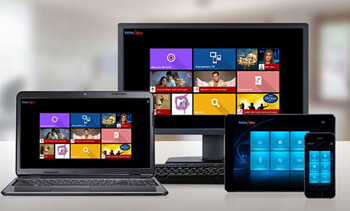
For FIFA World Cup, Tata Sky takes Everywhere TV app to PCs also

June 13, 2014

Tata Sky  FIFA World CupJun 13: Everywhere TV is an app that lets Tata Sky subscribers stream their television to Android and iOS devices, meaning FIFA World Cup fans must be overjoyed. But that"s not what it"ll be limited to from now on, even as its makers have made available a PC version of it, letting users watch their favorite programs on their desktops and laptops.

This release has come just in time for the FIFA World Cup 2014 in Brazil, and Tata Sky is advertising that all the matches from this sporting extravaganza will be available to be streamed through the app. That is of course, provided that you have the Sony Six channel added to your subscription.

All you need to do is download Everywhere TV app onto your devices and log in using your subscriber ID/RMN and password. This will let you experience more than sixty five live channels as well as Tata Sky"s Video on Demand titles on your PCs, smartphones or tablets. Once bought, the VoD titles will be available to be viewed on any of your devices as well as you set-top-box-connected TVs.

Another handy feature offered by Everywhere TV is the ability to catch up on unseen episodes in case you"ve missed them. Episodes from the last 5 days can be streamed through the application, provided you have subscribed to the channel they appear on. Airtel had recently released a similar app in the form of Pocket TV which is only available on Android and iOS at the moment.

Apps like Everywhere TV from Tata Sky and the one from Airtel are fast pushing the envelope on subscription-based television streaming services which are quite a rage right now in the US and the UK.

Comments

Add new comment

  • Coastaldigest.com reserves the right to delete or block any comments.
  • Coastaldigset.com is not responsible for its readers’ comments.
  • Comments that are abusive, incendiary or irrelevant are strictly prohibited.
  • Please use a genuine email ID and provide your name to avoid reject.
Agencies
January 10,2020

Indian enterprises were flooded with a whopping 14.6 crore malware threats in 2019 - a growth of 48 per cent (year-on-year) compared to 2018, a new report said on Friday.

Manufacturing, BFSI (banking, financial services and insurance), education, healthcare, IT/ITES, and the government were the most at-risk industries in the country, said the report from Seqrite, the enterprise arm of Pune-based IT security firm Quick Heal Technologies.

Interestingly, almost a quarter (23 per cent) of the threats were identified through 'Signatureless behaviour-based' detection by Seqrite, indicating how a growing number of cybercriminals were deploying new or previously unknown threat vectors to compromise enterprise security.

"With the latest Seqrite annual threat report, we want to empower CIOs, CISOs, business leaders and all key public stakeholders with the insights they need to combat the growing complexity of the threat landscape," said Sanjay Katkar, Joint Managing Director and CTO, Quick Heal Technologies.

The most prominent trend was the drastic increase in the volume, intensity, and sophistication of cyber-attack campaigns targeting Indian enterprises in 2019.

The rapid integration of IoT devices, BYOD (bring your own device), and third-party APIs into enterprise networks has created newer security vulnerabilities that might go unnoticed until a major breach occurs.

Threat researchers at Seqrite observed several large-scale advanced persistent threats (APT) attacks deployed against organisations in the government sector.

"The entry of nation-states and organised cybercrime cells into the fray is expected to add more complication to this situation and will require Indian government bodies and corporate enterprises to shore up their cyber defence strategies in 2020 and beyond," the report noted.

More alarming, however, was the continued lack of security awareness amongst enterprises and government organisations.

"Unsecured Remote Desktop Protocol (RDP) and Server Message Block (SMB) protocols continued to be targeted through brute-force attacks," said the report.

Spear phishing attack campaigns leveraging Office exploits and infected macros were also used extensively by cybercriminals to gain access to enterprise networks and steal critical data.

"India's digital journey depends on ensuring robust cybersecurity for all stakeholders within the enterprise ecosystem," said Katkar.

The sharp spike should be a cause of concern for CIOs and CISOs in the country, especially given the growing digital penetration within their enterprise networks.

"With network vulnerabilities and potential entry points increasing at a rapid pace, threat actors are expected to leverage artificial intelligence (AI) capabilities to power their malware campaigns in the future to capitalise on newer attack vectors," the report added.

Comments

Add new comment

  • Coastaldigest.com reserves the right to delete or block any comments.
  • Coastaldigset.com is not responsible for its readers’ comments.
  • Comments that are abusive, incendiary or irrelevant are strictly prohibited.
  • Please use a genuine email ID and provide your name to avoid reject.
News Network
July 24,2020

Melbourne, Jul 24: Home-made cloth face masks may need a minimum of two layers, and preferably three, to prevent the dispersal of viral droplets associated with Covid-19, according to a study.

Researchers, including those from the University of New South Wales in Australia, noted that viral droplets are generated by those infected with the novel coronavirus when they cough, sneeze, or speak.

As face masks have been proven to protect healthy people from inhaling infectious droplets as well as reducing the spread from those who are already infected, several types of material have been suggested for these, but based on little or no evidence of how well they work, the scientists said.

In the current study, published in the journal Thorax, the researchers compared the effectiveness of single and double-layer cloth face coverings with a surgical face mask (Bao Thach) at reducing droplet spread.

They said the single layer covering was made from a folded piece of cotton T shirt and hair ties, and the double layer covering was made using the sew method described by the US Centers for Disease Control and Prevention (CDC).

The scientists used a tailored LED lighting system and a high-speed camera to film the dispersal of airborne droplets produced by a healthy person with no respiratory infection, during speaking, coughing, and sneezing while wearing each type of mask.

Their analysis showed that the surgical face mask was the most effective at reducing airborne droplet dispersal, although even a single layer cloth face covering reduced the droplet spread from speaking.

But the study noted that a double layer covering was better than a single layer in reducing the droplet spread from coughing and sneezing.

According to the researchers, the effectiveness of cloth face masks is dependent on the number of layers of the covering, the type of material used, design, fit as well as the frequency of washing.

Based on their observations, they said a home made cloth mask with at least two layers is preferable to a single layer mask.

"Guidelines on home-made cloth masks should stipulate multiple layers," the scientists said, adding that there is a need for more research to inform safer cloth mask design.

Comments

Add new comment

  • Coastaldigest.com reserves the right to delete or block any comments.
  • Coastaldigset.com is not responsible for its readers’ comments.
  • Comments that are abusive, incendiary or irrelevant are strictly prohibited.
  • Please use a genuine email ID and provide your name to avoid reject.
Agencies
February 17,2020

Google on Monday announced it is gradually winding down its free public Wi-Fi Station programme currently available at over 400 railway stations in India, and will work with the Indian Railways and Railtel Corporation to help them with existing sites so they can remain useful resources for people.

Google launched its Station initiative in India in 2015 to bring fast, free public Wi-Fi to over 400 of the busiest railway stations in the country by mid-2020.

"We crossed that number by June 2018 and implemented Station in thousands of other locations around the country in partnership with telecommunications companies, ISPs and local authorities," Caesar Sengupta, Vice President, Payments and Next Billion Users, Google, said in a statement.

"Over time, partners in other countries asked for Station too and we responded accordingly. We're grateful for these partnerships, especially with the Indian Railways and the Government of India, that helped us serve millions of users over the last few years," he added.

According to Google, the decision to shut Station has been taken keeping the affordable mobile data plans and mobile connectivity in mind that is improving globally including in India.

"India, specifically now has among the cheapest mobile data per GB in the world, with mobile data prices having reduced by 95 per cent in the last 5 years, as per TRAI in 2019," said Sengupta.

The Indian users consume close to 10GB of data, each month, on average, according to reports.

"Our commitment to supporting the next billion users remains stronger than ever, from continuing our efforts to make the internet work for more people and building more relevant and helpful apps and services," Sengupta noted.

Global networking giant Cisco last year teamed up with Google to roll out free, high-speed public Wi-Fi access globally, starting with India.

The first pilot under the partnership was rolled out at 35 locations in Bengaluru.

Sengupta said that in addition to the changed context, the challenge of varying technical requirements and infrastructure among our partners across countries has also made it difficult for Station to scale and be sustainable, especially for our partners.

"And when we evaluate where we can truly make an impact in the future, we see greater need and bigger opportunities in building products and features tailored to work better for the next billion user markets," he said.

Comments

Add new comment

  • Coastaldigest.com reserves the right to delete or block any comments.
  • Coastaldigset.com is not responsible for its readers’ comments.
  • Comments that are abusive, incendiary or irrelevant are strictly prohibited.
  • Please use a genuine email ID and provide your name to avoid reject.