


Fiji opposition to boycott Modi's speech

November 18, 2014

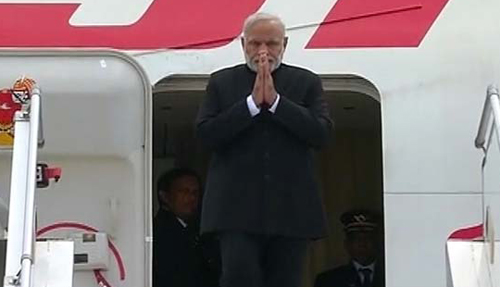
Suva, Nov 18: Fiji's opposition party has decided to boycott the special parliament meeting planned for Prime Minister Narendra Modi tomorrow after the government withdrew its decision to allow it to move the vote of thanks.

Modi, the first Indian Prime Minister to visit the pacific nation in 33 years, is due to address Fiji's parliament tomorrow. But the opposition SODEPLA leader, Ro Teimumu Kepa said that Government has withdrawn it's decision for the opposition to move the vote of thanks in Parliament tomorrow.
modifiji

In turn, the fifteen SODELPA members in Fiji's new Parliament said they will not attend the parliamentary sitting during which Modi will give his speech, Fijione reported.

"Government's decision ignores parliamentary best practice standards where the Prime Minister gives the welcome address and the opposition leader moves the vote of thanks," Kepa said.

The Opposition is also disappointed that the Chiefs have been excluded from the traditional welcome ceremony for Prime Minister Modi compared to what was accorded to Indira Gandhi during her visit in 1981.

Modi will be the first Indian Prime Minister to visit Fiji since Indira Gandhi travelled there in 1981.

On the other hand, Fijian Government has expressed "extreme disappointment" over SODELPA's decision to boycott the meeting planned for Modi.

"This visit is a national event, not a political one. It is an opportunity for our nation to engage the leader of the world's largest democracy and one of Fiji's most important international partners in discussions that are critical for Fiji's future," the government said in a statement.

The visit to Parliament is an opportunity for the elected representatives of all the Fijian people—not just government—to share in this visit, the statement said.

Obviously, the government has primary responsibility for the visit and the official discussions, but it has taken care to ensure that Modi experiences a visit with all the people of Fiji, it added.

"SODELPA's position is an insult to the people of Ba and all Fijians. The members of SODELPA have put their own political agenda ahead of the national interest. At this time, all Fijians should be united in putting our best foot forward," the statement said.

Government believes that visiting leaders should not be used to fight petty political battles. This is an important moment for Fiji, a time for Fijians to put their differences aside—even momentarily—in the interests of the nation, it added.

Unfortunately, SODELPA has passed up another opportunity to show that it can rise above petty politics and work for the national good. The burden is on SODELPA to show that it think beyond its own agenda, show true leadership, and focus on what is good for the nation, it said.

Comments

Add new comment

  • Coastaldigest.com reserves the right to delete or block any comments.
  • Coastaldigset.com is not responsible for its readers’ comments.
  • Comments that are abusive, incendiary or irrelevant are strictly prohibited.
  • Please use a genuine email ID and provide your name to avoid reject.
News Network
April 13,2020

Vienna, Apr 13: Top oil-producing countries agreed on "historic" output cuts to prop up prices hammered by the coronavirus crisis and a Russia-Saudi price war, sending crude prices soaring on Monday.

The US benchmark WTI climbed 7.7 percent to $24.52 a barrel in early Asian trade while Brent was up 5.0 percent at $33.08.

OPEC producers dominated by Saudi Arabia and allies led by Russia thrashed out a compromise deal via videoconference Sunday after Mexico had balked at an earlier agreement struck on Friday.

In the compromise reached Sunday they agreed to a cut of 9.7 million barrels per day from May, according to Mexican Energy Minister Rocio Nahle, down slightly from 10 million barrels a day envisioned earlier.

OPEC Secretary General Mohammad Barkindo called the cuts "historic".

"They are largest in volume and the longest in duration, as they are planned to last for two years," he said.

The agreement between the Vienna-based Organization of the Petroleum Exporting Countries and partners foresees deep output cuts in May and June followed by a gradual reduction in cuts until April 2022.

Barkindo added that the deal "paved the way for a global alliance with the participation of the G20".

Saudi Energy Minister Prince Abdulaziz bin Salman, who chaired the meeting together with his Russian and Algerian counterparts, also confirmed that the discussions "ended with consensus".

Comments

Add new comment

  • Coastaldigest.com reserves the right to delete or block any comments.
  • Coastaldigset.com is not responsible for its readers’ comments.
  • Comments that are abusive, incendiary or irrelevant are strictly prohibited.
  • Please use a genuine email ID and provide your name to avoid reject.
News Network
March 25,2020

Wellington, Mar 25: New Zealand has declared a state of emergency as it prepares to go into an unprecedented lockdown late Wednesday for about a month.

The declaration temporarily gives police and the military extra powers. And Prime Minister Jacinda Ardern says any New Zealanders returning home from overseas who show symptoms of COVID-19 will be put in isolation at an approved facility.

“I have one simple message for New Zealanders today as we head into the next four weeks: ‘stay at home,’” Ardern said. “It will break the chain of transmission and it will save lives.”

Ardern said exceptions include people working crucial jobs, those leaving to pick up essentials like groceries, and those engaging in solitary exercise.

The country has 205 reported cases of the virus, although Ardern said that number could rise into the thousands before it begins to recede even with the strict measures being taken.

Comments

Add new comment

  • Coastaldigest.com reserves the right to delete or block any comments.
  • Coastaldigset.com is not responsible for its readers’ comments.
  • Comments that are abusive, incendiary or irrelevant are strictly prohibited.
  • Please use a genuine email ID and provide your name to avoid reject.
News Network
April 15,2020

Wuhan, Apr 15: In the six days after top Chinese officials secretly determined they likely were facing a pandemic from a new coronavirus, the city of Wuhan at the epicenter of the disease hosted a mass banquet for tens of thousands of people; millions began traveling through for Lunar New Year celebrations.

President Xi Jinping warned the public on the seventh day, Janaury 20. But by that time, more than 3,000 people had been infected during almost a week of public silence, according to internal documents obtained by The Associated Press and expert estimates based on retrospective infection data.

That delay from Jan 14 to Jan. 20 was neither the first mistake made by Chinese officials at all levels in confronting the outbreak, nor the longest lag, as governments around the world have dragged their feet for weeks and even months in addressing the virus.

But the delay by the first country to face the new coronavirus came at a critical time — the beginning of the outbreak. China's attempt to walk a line between alerting the public and avoiding panic set the stage for a pandemic that has infected almost 2 million people and taken more than 126,000 lives.

A This is tremendous, a said Zuo-Feng Zhang, an epidemiologist at the University of California, Los Angeles. If they took action six days earlier, there would have been much fewer patients and medical facilities would have been sufficient. We might have avoided the collapse of Wuhan's medical system.

Other experts noted that the Chinese government may have waited on warning the public to stave off hysteria, and that it did act quickly in private during that time.

But the six-day delay by China's leaders in Beijing came on top of almost two weeks during which the national Center for Disease Control did not register any cases from local officials, internal bulletins obtained by the AP confirm. Yet during that time, from Jan 5 to Jan 17, hundreds of patients were appearing in hospitals not just in Wuhan but across the country.

It's uncertain whether it was local officials who failed to report cases or national officials who failed to record them. It's also not clear exactly what officials knew at the time in Wuhan, which only opened back up last week with restrictions after its quarantine.

But what is clear, experts say, is that China's rigid controls on information, bureaucratic hurdles and a reluctance to send bad news up the chain of command muffled early warnings. The punishment of eight doctors for rumor-mongering, broadcast on national television on Jan. 2, sent a chill through the city's hospitals.

Doctors in Wuhan were afraid, said Dali Yang, a professor of Chinese politics at the University of Chicago. It was truly intimidation of an entire profession. Without these internal reports, it took the first case outside China, in Thailand on Jan 13, to galvanize leaders in Beijing into recognising the possible pandemic before them. It was only then that they launched a nationwide plan to find cases distributing CDC-sanctioned test kits, easing the criteria for confirming cases and ordering health officials to screen patients, all without telling the public.

The Chinese government has repeatedly denied suppressing information in the early days, saying it immediately reported the outbreak to the World Health Organization.

Allegations of a cover-up or lack of transparency in China are groundless, said foreign ministry spokesman Zhao Lijian at a Thursday press conference.

The documents show that the head of China's National Health Commission, Ma Xiaowei, laid out a grim assessment of the situation on Jan. 14 in a confidential teleconference with provincial health officials.

A memo states that the teleconference was held to convey instructions on the coronavirus from President Xi Jinping, Premier Li Keqiang and Vice Premier Sun Chunlan, but does not specify what those instructions were.

The epidemic situation is still severe and complex, the most severe challenge since SARS in 2003, and is likely to develop into a major public health event, the memo cites Ma as saying.

The National Health Commission is the top medical agency in the country. In a faxed statement, the Commission said it had organised the teleconference because of the case reported in Thailand and the possibility of the virus spreading during New Year travel. It added that China had published information on the outbreak in an open, transparent, responsible and timely manner," in accordance with important instructions repeatedly issued by President Xi.

The documents come from an anonymous source in the medical field who did not want to be named for fear of retribution. The AP confirmed the contents with two other sources in public health familiar with the teleconference. Some of the memo's contents also appeared in a public notice about the teleconference, stripped of key details and published in February.

Under a section titled sober understanding of the situation, the memo said that clustered cases suggest that human-to-human transmission is possible. It singled out the case in Thailand, saying that the situation had changed significantly because of the possible spread of the virus abroad.

With the coming of the Spring Festival, many people will be traveling, and the risk of transmission and spread is high, the memo continued.

Comments

Add new comment

  • Coastaldigest.com reserves the right to delete or block any comments.
  • Coastaldigset.com is not responsible for its readers’ comments.
  • Comments that are abusive, incendiary or irrelevant are strictly prohibited.
  • Please use a genuine email ID and provide your name to avoid reject.