


Fiji opposition to boycott Modi's speech

November 18, 2014

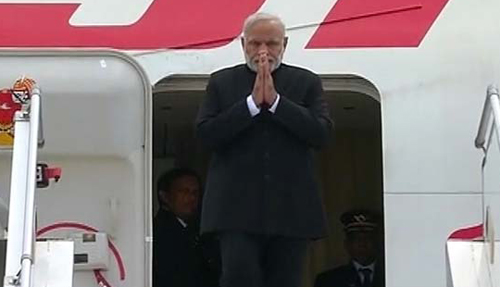
Suva, Nov 18: Fiji's opposition party has decided to boycott the special parliament meeting planned for Prime Minister Narendra Modi tomorrow after the government withdrew its decision to allow it to move the vote of thanks.

Modi, the first Indian Prime Minister to visit the pacific nation in 33 years, is due to address Fiji's parliament tomorrow. But the opposition SODEPLA leader, Ro Teimumu Kepa said that Government has withdrawn it's decision for the opposition to move the vote of thanks in Parliament tomorrow.
modifiji

In turn, the fifteen SODELPA members in Fiji's new Parliament said they will not attend the parliamentary sitting during which Modi will give his speech, Fijione reported.

"Government's decision ignores parliamentary best practice standards where the Prime Minister gives the welcome address and the opposition leader moves the vote of thanks," Kepa said.

The Opposition is also disappointed that the Chiefs have been excluded from the traditional welcome ceremony for Prime Minister Modi compared to what was accorded to Indira Gandhi during her visit in 1981.

Modi will be the first Indian Prime Minister to visit Fiji since Indira Gandhi travelled there in 1981.

On the other hand, Fijian Government has expressed "extreme disappointment" over SODELPA's decision to boycott the meeting planned for Modi.

"This visit is a national event, not a political one. It is an opportunity for our nation to engage the leader of the world's largest democracy and one of Fiji's most important international partners in discussions that are critical for Fiji's future," the government said in a statement.

The visit to Parliament is an opportunity for the elected representatives of all the Fijian people—not just government—to share in this visit, the statement said.

Obviously, the government has primary responsibility for the visit and the official discussions, but it has taken care to ensure that Modi experiences a visit with all the people of Fiji, it added.

"SODELPA's position is an insult to the people of Ba and all Fijians. The members of SODELPA have put their own political agenda ahead of the national interest. At this time, all Fijians should be united in putting our best foot forward," the statement said.

Government believes that visiting leaders should not be used to fight petty political battles. This is an important moment for Fiji, a time for Fijians to put their differences aside—even momentarily—in the interests of the nation, it added.

Unfortunately, SODELPA has passed up another opportunity to show that it can rise above petty politics and work for the national good. The burden is on SODELPA to show that it think beyond its own agenda, show true leadership, and focus on what is good for the nation, it said.

Comments

Add new comment

  • Coastaldigest.com reserves the right to delete or block any comments.
  • Coastaldigset.com is not responsible for its readers’ comments.
  • Comments that are abusive, incendiary or irrelevant are strictly prohibited.
  • Please use a genuine email ID and provide your name to avoid reject.
News Network
July 6,2020

Beijing, Jul 6: A city in northern China on Sunday sounded an alert after a suspected case of bubonic plague was reported, according to official media here.

Bayannur, Inner Mongolia Autonomous Region, announced a level III warning of plague prevention and control, state-run People’s Daily Online reported.

The suspected bubonic plague case was reported on Saturday by a hospital in Bayannur. The local health authority announced that the warning period will continue until the end of 2020.

"At present, there is a risk of a human plague epidemic spreading in this city. The public should improve its self-protection awareness and ability, and report abnormal health conditions promptly,” the local health authority said.

On July 1, state-run Xinhua news agency said that two suspected cases of bubonic plague reported in Khovd province in western Mongolia have been confirmed by lab test results.

The confirmed cases are a 27-year-old resident and his 17-year-old brother, who are being treated at two separate hospitals in their province, it quoted a health official as saying.

The brothers ate marmot meat, the health official said, warning people not to eat marmot meat.

A total of 146 people who had contact with them have been isolated and treated at local hospitals, according to Narangerel.

Bubonic plague is a bacterial disease that is spread by fleas living on wild rodents such as marmots. It can kill an adult in less than 24 hours if not treated in time, according to the World Health Organization (WHO).

A couple died of bubonic plague in the western Mongolian province of Bayan-Ulgii last year after eating raw marmot meat.

The news of bubonic plague came after Chinese researchers issued an early warning over another potential pandemic caused by an influenza virus in pigs.

Scientists from China Agricultural University, the Chinese Centre for Disease Control and Prevention and other institutes detected a pig influenza virus bearing genotype 4 (G4), which is contagious among pigs and has the possibility of jumping to humans, as the G4 virus is able to bind with human cells, state-run Global Times reported last week.

The researchers are concerned that it could mutate further so that it can spread easily from person to person, and trigger a global outbreak, BBC reported.

"Controlling the prevailing G4 EA H1N1 viruses in pigs and close monitoring in human populations, especially workers in the swine industry, should be urgently implemented," Chinese researchers warned in the paper.

The new diseases were reported even as China grappled with the second attack of Covid-19 in Beijing after controlling it in Wuhan where it was first reported in December last year.

On Saturday, Beijing reported a single-digit Covid-19, local authorities said Sunday.

The number of newly confirmed Covid-19 cases reached a peak in Beijing on June 13 and 14 and then started declining in general, Xinhua quoted local officials as saying.

From June 11 to July 4, the city reported 334 confirmed locally transmitted cases, 47 per cent of whom are workers of the Xinfadi wholesale food market, the official said.

Comments

Add new comment

  • Coastaldigest.com reserves the right to delete or block any comments.
  • Coastaldigset.com is not responsible for its readers’ comments.
  • Comments that are abusive, incendiary or irrelevant are strictly prohibited.
  • Please use a genuine email ID and provide your name to avoid reject.
Agencies
January 25,2020

Pentagon, Jan 25: Thirty-four US troops had been diagnosed with concussions and traumatic brain injury (TBI) as a result of the January 8 Iranian missile attack on two military bases in Iraq housing American soldiers, the Pentagon said.

"Eight service members who were previously transported to Germany have been brought to the US, they would continue to receive treatment in the US either at Walter Reed or their home bases," Pentagon spokesman Jonathan Hoffman told the media on Friday.

Hoffman said that nine service members were still undergoing treatment in Germany, and the rest of the 17 injured troops have already returned to duty in Iraq, reports Xinhua news agency.

Lat week, the US military had said that 11 service members were treated for concussion symptoms due to the missile attacks.

Hoffman noted that the symptoms "are late developing and manifested over a period of time".

In retaliation for the killing of Iranian Major General Qasem Soleimani in an American drone attack on January 3 in Baghdad, Tehran launched over 13 ballistic missiles on the two military bases in Anbar and near the city of Erbil.

US military initially said that no casualty was reported from the Iranian attack. President Donald Trump then downplayed the seriousness of those injures.

"I heard that they had headaches and a couple of other things, but I would say and I can report that it's not very serious," Trump told reporters on Wednesday at a press conference in Davos, Switzerland.

More than 5,000 US troops are deployed in Iraq to support the country's forces in the battle against Islamic State militants.

Comments

Add new comment

  • Coastaldigest.com reserves the right to delete or block any comments.
  • Coastaldigset.com is not responsible for its readers’ comments.
  • Comments that are abusive, incendiary or irrelevant are strictly prohibited.
  • Please use a genuine email ID and provide your name to avoid reject.
Agencies
July 1,2020

The ILO has warned that if another Covid-19 wave hits in the second half of 2020, there would be global working-hour loss of 11.9 percent - equivalent to the loss of 340 million full-time jobs.

According to the 5th edition of International Labour Organisation (ILO) Monitor: Covid-19 and the world of work, the recovery in the global labour market for the rest of the year will be uncertain and incomplete.

The report said that there was a 14 percent drop in global working hours during the second quarter of 2020, equivalent to the loss of 400 million full-time jobs.

The number of working hours lost across the world in the first half of 2020 was significantly worse than previously estimated. The highly uncertain recovery in the second half of the year will not be enough to go back to pre-pandemic levels even in the best scenario, the agency warned.

The baseline model – which assumes a rebound in economic activity in line with existing forecasts, the lifting of workplace restrictions and a recovery in consumption and investment – projects a decrease in working hours of 4.9 percent (equivalent to 140 million full-time jobs) compared to last quarter of 2019.

It says that in the pessimistic scenario, the situation in the second half of 2020 would remain almost as challenging as in the second quarter.

“Even if one assumes better-tailored policy responses – thanks to the lessons learned throughout the first half of the year – there would still be a global working-hour loss of 11.9 per cent at the end of 2020, or 340 million full-time jobs, relative to the fourth quarter of 2019,” it said.

The pessimistic scenario assumes a second pandemic wave and the return of restrictions that would significantly slow recovery. The optimistic scenario assumes that workers’ activities resume quickly, significantly boosting aggregate demand and job creation. With this exceptionally fast recovery, the global loss of working hours would fall to 1.2 per cent (34 million full-time jobs).

The agency said that under the three possible scenarios for recovery in the next six months, “none” sees the global job situation in better shape than it was before lockdown measures began.

“This is why we talk of an uncertain but incomplete recovery even in the best of scenarios for the second half of this year. So there is not going to be a simple or quick recovery,” ILO Director-General Guy Ryder said.

The new figures reflect the worsening situation in many regions over the past weeks, especially in developing economies. Regionally, working time losses for the second quarter were: Americas (18.3 percent), Europe and Central Asia (13.9 percent), Asia and the Pacific (13.5 percent), Arab States (13.2 percent), and Africa (12.1 percent).

The vast majority of the world’s workers (93 per cent) continue to live in countries with some sort of workplace closures, with the Americas experiencing the greatest restrictions.

During the first quarter of the year, an estimated 5.4 percent of global working hours (equivalent to 155 million full-time jobs) were lost relative to the fourth quarter of 2019. Working- hour losses for the second quarter of 2020 relative to the last quarter of 2019 are estimated to reach 14 per cent worldwide (equivalent to 400 million full-time jobs), with the largest reduction (18.3 per cent) occurring in the Americas.

The ILO Monitor also found that women workers have been disproportionately affected by the pandemic, creating a risk that some of the modest progress on gender equality made in recent decades will be lost, and that work-related gender inequality will be exacerbated.

The severe impact of Covid-19 on women workers relates to their over-representation in some of the economic sectors worst affected by the crisis, such as accommodation, food, sales and manufacturing.

Globally, almost 510 million or 40 percent of all employed women work in the four most affected sectors, compared to 36.6 percent of men, it said.

The report said that women also dominate in the domestic work and health and social care work sectors, where they are at greater risk of losing their income and of infection and transmission and are also less likely to have social protection.

The pre-pandemic unequal distribution of unpaid care work has also worsened during the crisis, exacerbated by the closure of schools and care services.

Even as countries have adopted policy measures with unprecedented speed and scope, the ILO Monitor highlights some key challenges ahead, including finding the right balance and sequencing of health, economic and social and policy interventions to produce optimal sustainable labour market outcomes; implementing and sustaining policy interventions at the necessary scale when resources are likely to be increasingly constrained and protecting and promoting the conditions of vulnerable, disadvantaged and hard-hit groups to make labour markets fairer and more equitable.

“The decisions we adopt now will echo in the years to come and beyond 2030. Although countries are at different stages of the pandemic and a lot has been done, we need to redouble our efforts if we want to come out of this crisis in a better shape than when it started,” Ryder said. 

Comments

Add new comment

  • Coastaldigest.com reserves the right to delete or block any comments.
  • Coastaldigset.com is not responsible for its readers’ comments.
  • Comments that are abusive, incendiary or irrelevant are strictly prohibited.
  • Please use a genuine email ID and provide your name to avoid reject.