



Fish eyes may hold key to blindness cure: study

March 11, 2017

Washington, Mar 11: Scientists, including one of Indian-origin, have identified a chemical signal in the zebrafish brain that helps it regenerate retina, a finding that may help cure blindness in humans.
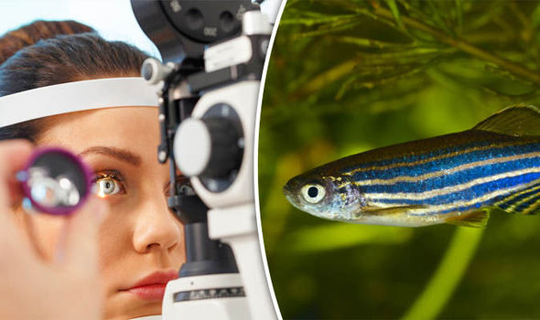
fisheye

The discovery raises the possibility that human retinas can be induced to regenerate, naturally repairing damage caused by degenerative retinal diseases and injury, including age-related macular degeneration and retinitis pigmentosa, researchers said.

"The prevailing belief has been that the regeneration process in fish retinas is triggered by secreted growth factors, but our results indicate that the neurotransmitter GABA might initiate the process instead," said James Patton, Professor at Vanderbilt University in the US.

"All the regeneration models assume that a retina must be seriously damaged before regeneration takes place, but our studies indicate that GABA can induce this process even in undamaged retinas," said Patton.

It turns out that the structure of the retinas of fish and mammals are basically the same.

Although the retina is very thin - less than 0.5 millimetres thick - it contains three layers of nerve cells: photoreceptors that detect the light, horizontal cells that integrate the signals from the photoreceptors and ganglion cells that receive the visual information and route it to the brain.

In addition, the retina contains a special type of adult stem cell, called Muller glia, that span all three layers and provide mechanical support and electrical insulation. In fish retinas, they also play a key role in regeneration.

When regeneration is triggered, the Muller glia dedifferentiate, begin proliferating, and then differentiate into replacements for the damaged nerve cells. Muller glia are also present in mammalian retinas, but do not regenerate.

Graduate student Mahesh Rao got the idea that GABA - normally a fast-acting neurotransmitter best known for its role of calming nervous activity by inhibiting nerve transmission in the brain - might be the trigger for retinal regeneration.

He was inspired by the results of a study in the mouse hippocampus which found that GABA was controlling stem cell activity.

Working with Patton and assistant professor Dominic Didiano, Rao designed a series of experiments with zebrafish which determined that high concentrations of GABA in the retina keep the Miller glia quiescent and that they begin dedifferentiating and proliferating when GABA concentrations drop.

They tested their hypothesis in two ways: By blinding zebrafish and injecting them with drugs that stimulate GABA production and by injecting normal zebrafish with an enzyme that lowers the GABA levels in their eyes.

Comments

Add new comment

  • Coastaldigest.com reserves the right to delete or block any comments.
  • Coastaldigset.com is not responsible for its readers’ comments.
  • Comments that are abusive, incendiary or irrelevant are strictly prohibited.
  • Please use a genuine email ID and provide your name to avoid reject.
Dr G K Sudhakar Reddy
August 4,2020

Being overweight or obese is now recognised as a serious cause of ill health and disability. There is a significant positive association between orthopaedic disorders and the level of obesity causing pain, deformity and difficulty in walking.

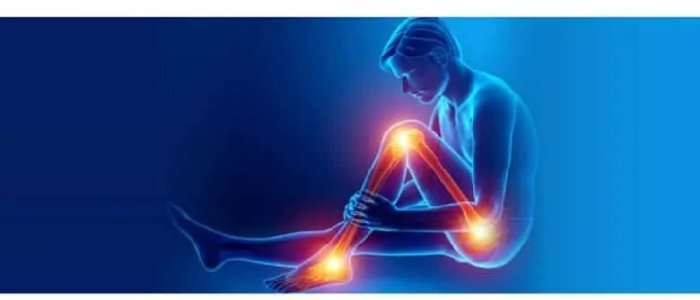
Excess body weight accumulation increases pressure on joints, particularly the hips, knees and ankles.

Here are a few type of  arthritis:

Osteoarthritis

It is a condition of damage/ wear and tear of the joint lining or cartilage. Obesity triggers this by loading excessive weight on the weight bearing joints like the knee and the hip. 

Knee Osteoarthritis

This is the most common arthritis especially in the Indian subcontinent.

While walking, an individual exerts 3 to 6 times pressure that of the body weight on the weight-bearing knee joint, which means in an obese with excess body weight, larger forces are exerted, which lead to higher risk of deterioration of cartilage.

In addition, there are excessive fat tissues that produce hormones and other factors that affect the joint cartilage metabolism and cause inflammation of the joints giving rise to joint pathology.  Leptin is one of the hormones causing knee osteoarthritis. 

Hip osteoarthritis

The force exerted across the hip is 3 times that of body weight. Hip osteoarthritis is caused by factors such as joint injury, increasing age and being overweight.    

Hand osteoarthritis

The observation that obese individual has a higher risk in having hand osteoarthritis has led to a hypothesis that the metabolic effect produced by fat tissue is the underlying factor. 

Osteoporosis

It is a progressive bone condition of decrease in bone mass and density (Bone Mineral Density or BMD) which can lead to an increased risk of fracture. Recent research suggests that obesity may accelerate bone loss. It is the amount of muscle mass which is seen in an active person, which accounts for bone strengthening effects and not due to the fat seen in a heavy person.

Low back pain

Low back pain from degenerative disc disease of the lumbar spine is one of the most disabling conditions in the community and overweight and obesity have the strongest association with seeking care for low back pain.

Managing Hip and Knee Osteoarthritis

Life style changes

If one is overweight, try to lose weight by doing more physical activity and eating a healthier diet. Regular exercise keeps you active and mobile and builds up muscle, thereby strengthening the joints and can improve symptoms. 

Pain Killers

Painkillers help with pain and stiffness for short term. They don’t affect the arthritis itself and won’t repair the damage to your joint. Creams and gels can be applied directly onto painful joints.

Nutritional Supplements

Glucosamine and chondroitin are nutritional supplements. Animal studies have found that glucosamine can both delay the breakdown of and repair damaged cartilage. However, there is insufficient evidence to support the use of glucosamine in humans and one can expect only a mild-to-moderate reduction in pain

Joint injections

If pain from osteoarthritis is severe joint steroid injections are injected into the joints that can reduces swelling and pain. The injections can start working within a day or so and may improve pain for several weeks or months. 

Hyaluronic acid injections, which help to lubricate your knee joint also give short term relief. In early stages. Stem cell treatment or cartilage regeneration procedures are being tried in young people with small defects, however it is still experimental and lacks long term evidence.

Surgery

May be recommended if you have severe pain or mobility problems.

Arthroscopy

If one has frequent painful locking/stiffening episodes especially in the knee joint, an operation to wash out loose fragments of bone and other tissue as joint can be performed by a minimally invasive key hole procedure called Arthroscopy.

Arthrodesis

If hip or knee replacement is not suitable, especially in young people who do heavy manual work, one can consider an operation known as an arthrodesis, which fuses your joint in a permanent position. This means that your joint will be stronger and much less painful, although you will no longer be able to move it.

Osteotomy

In young, active people in whom a knee joint replacement would fail due to excessive use one can consider an operation called an osteotomy. This involves adding or removing a small section of bone either above or below your knee joint.  This helps realign your knee so your weight is no longer focused on the damaged part of your knee. An osteotomy can relieve your symptoms of osteoarthritis, although you may still need knee replacement surgery eventually as you grow old

Joint replacement surgery

Joint replacement therapy is most commonly carried out to replace hip and knee joints. It involves replacing a damaged, worn or diseased joint with an artificial joint made of special plastics and metal.

For most people, a replacement hip or knee will last for at least 20 years, especially if it is cared for properly and not put under too much strain.

Dr G K Sudhakar Reddy is a Sr Consultant Orthopaedic Surgeon at Citizens Speciality Hospitals, Hyderabad

Comments

Add new comment

  • Coastaldigest.com reserves the right to delete or block any comments.
  • Coastaldigset.com is not responsible for its readers’ comments.
  • Comments that are abusive, incendiary or irrelevant are strictly prohibited.
  • Please use a genuine email ID and provide your name to avoid reject.
Agencies
June 11,2020

The World Health Organisation (WHO) Director-General Tedros Adhanom Ghebreyesus said that more research needs to be done to better understand the extent to which COVID-19 is being spread by people who don't show symptoms.

"Since early February, we have said that asymptomatic people can transmit COVID-19, but that we need more research to establish the extent of asymptomatic transmission," the WHO chief said at a virtual press conference from Geneva on Wednesday, Xinhua news agency reported.

"That research is ongoing, and we're seeing more and more research being done," he added.

Saying that the world has been achieving a lot in knowing the new virus, the WHO chief told reporters that "there's still a lot we don't

"WHO's advice will continue to evolve as new information becomes available," he said.

Tedros stressed that the most critical way to stop transmission is to find, isolate and test people with symptoms, and trace and quarantine their contacts.

"Many countries have succeeded in suppressing transmission and controlling the virus doing exactly this," Tedros said.

Meanwhile, Michael Ryan, executive director of WHO Health Emergencies Program, said Wednesday that the COVID-19 pandemic is still evolving.

"If we look at the numbers... this pandemic is still evolving. It is growing in many parts of the world," he said. "We have deep concerns that health systems of some countries are struggling, under a huge strain and require our support, our help and our solidarity."

He said "each and every country has a different combination of risks and opportunities, and it's really down to national authorities to carefully consider where they are in the pandemic."

In Europe, the risk issue now are about travels and the opening of the schools, around risk management, mass gathering, surveillance and contact tracing, said the WHO official.

In Southeast Asian countries, where to a great extent transmissions have been under control, governments are more concerned about the re-emergence of clusters, while in South America, the issue of PPE for health workers has not gone away, said Ryan.

As regards Africa, Ryan said the death rates have been very low in the past week, but the health system can be overwhelmed, as it would have to cope with other diseases such as malaria.

Comments

Add new comment

  • Coastaldigest.com reserves the right to delete or block any comments.
  • Coastaldigset.com is not responsible for its readers’ comments.
  • Comments that are abusive, incendiary or irrelevant are strictly prohibited.
  • Please use a genuine email ID and provide your name to avoid reject.